Early Ambulation Improves
Outcomes of Inpatients
Tamara Pooch, RN reviews a research study by J.
Nolan and S. Thomas
Elderly Inpatients Are At Risk of
Functional Decline
 Do hospitalized patients that are ambulated at
least three times per day have a decreased
recovery time with fewer complications than
patients who are not routinely ambulated?

 Would scheduled ambulation help achieve that
goal?
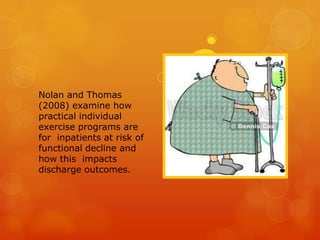
Nolan and Thomas
(2008) examine how
practical individual
exercise programs are
for inpatients at risk of
functional decline and
how this impacts
discharge outcomes.
Methods
Nolan & Thomas (2008) used a
quantitative non experimental
comparative study of 220 inpatients.
Patients were aged seventy and greater
and were at high risk of functional
decline, but able to commence exercise
within 48 hours.
Methods
A Functional Maintenance Program
(FMP) of individually tailored
exercise programs was created and
supervised for each patient.
Methods
Statistical analysis data was entered
into SPSS.
Methods
Benchmarking “Length of Stay” and
“Elderly Mobility Scale” were also
used to analyze data.
Results
Length of Stay was reduced
by 15.7 % with the
Functional Maintenance
Program
Results
Readmissions were fewer
than 8% with improved
functional mobility of the
same patients.
Discussion
Exercise programs for older
medical patients that
commence within 48 hours of
admission help to reduce length
of stay, decrease functional
decline, and improve outcomes.
Discussion
Could scheduling inpatient
ambulation or exercise
programs assure patients
receive daily assistance with
activity?
Acknowledgements
 Nolan, J., & Thomas, S. (2008, December
10). Targeted individual exercise
programmes for older medical patients are
feasible, and may change hospital and
patient outcomes: a service improvement
project. In BMC Health Services
Research. Retrieved September 12, 2013,
from
http://www.biomedcentral.com/14726963/8/250

Early Ambulation Improves Patients' Outcomes

  • 1.
    Early Ambulation Improves Outcomesof Inpatients Tamara Pooch, RN reviews a research study by J. Nolan and S. Thomas
  • 2.
    Elderly Inpatients AreAt Risk of Functional Decline  Do hospitalized patients that are ambulated at least three times per day have a decreased recovery time with fewer complications than patients who are not routinely ambulated?  Would scheduled ambulation help achieve that goal?
  • 3.
    Nolan and Thomas (2008)examine how practical individual exercise programs are for inpatients at risk of functional decline and how this impacts discharge outcomes.
  • 4.
    Methods Nolan & Thomas(2008) used a quantitative non experimental comparative study of 220 inpatients. Patients were aged seventy and greater and were at high risk of functional decline, but able to commence exercise within 48 hours.
  • 5.
    Methods A Functional MaintenanceProgram (FMP) of individually tailored exercise programs was created and supervised for each patient.
  • 6.
  • 7.
    Methods Benchmarking “Length ofStay” and “Elderly Mobility Scale” were also used to analyze data.
  • 8.
    Results Length of Staywas reduced by 15.7 % with the Functional Maintenance Program
  • 9.
    Results Readmissions were fewer than8% with improved functional mobility of the same patients.
  • 10.
    Discussion Exercise programs forolder medical patients that commence within 48 hours of admission help to reduce length of stay, decrease functional decline, and improve outcomes.
  • 12.
    Discussion Could scheduling inpatient ambulationor exercise programs assure patients receive daily assistance with activity?
  • 13.
    Acknowledgements  Nolan, J.,& Thomas, S. (2008, December 10). Targeted individual exercise programmes for older medical patients are feasible, and may change hospital and patient outcomes: a service improvement project. In BMC Health Services Research. Retrieved September 12, 2013, from http://www.biomedcentral.com/14726963/8/250