Sepsis – A
Physiotherapist
perspective
Michelle Paton
Critical Care and Surgical Services Physiotherapy Clinical Lead
Monash Health
Physiotherapy in ICU
Key part of the MDT
Respiratory management
• Ventilation and oxygen delivery optimisation
• Secretion clearance
• Lung recruitment
Improve function
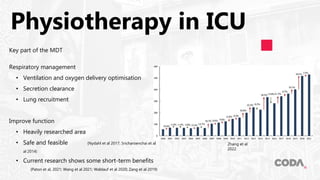
• Heavily researched area
• Safe and feasible (Nydahl et al 2017; Sricharoenchai et al
al 2014)
• Current research shows some short-term benefits
(Paton et al, 2021; Wang et al 2021; Waldauf et al 2020; Zang et al 2019)
Zhang et al
2022
Role of Physiotherapy
Decreasing mortality but increasing morbidity following ICU admission
• 41% of ICU patients MV >24 hours alive and without new disability at 6/12 (Higgins et al,
2021)
Bed rest leads to severe loss of muscle mass
• At least 2% per day (Wandrag et al,
2019)
• Increased wasting noted in septic patients
(Klaude et al, 2012)
• Permanent functional impairments and decreased QoL (Herridge et al,
2011)
Sepsis patients known to have higher mortality but similar disability incidence at 6/12
(Hodgson et al 2022)
Early physiotherapy for septic patients has been shown to be safe and preserve muscle mass
Treatment options
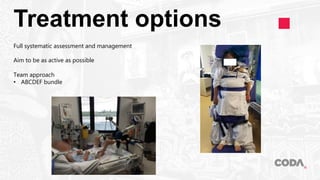
Full systematic assessment and management
Aim to be as active as possible
Team approach
• ABCDEF bundle
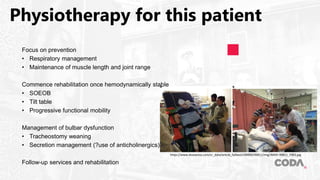
Physiotherapy for this patient
Focus on prevention
• Respiratory management
• Maintenance of muscle length and joint range
Commence rehabilitation once hemodynamically stable
• SOEOB
• Tilt table
• Progressive functional mobility
Management of bulbar dysfunction
• Tracheostomy weaning
• Secretion management (?use of anticholinergics)
Follow-up services and rehabilitation
https://www.dovepress.com/cr_data/article_fulltext/s99000/99811/img/JMDH-99811_F003.jpg
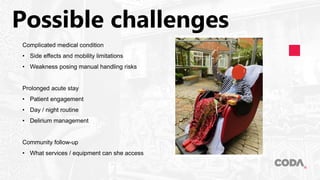
Possible challenges
Complicated medical condition
• Side effects and mobility limitations
• Weakness posing manual handling risks
Prolonged acute stay
• Patient engagement
• Day / night routine
• Delirium management
Community follow-up
• What services / equipment can she access
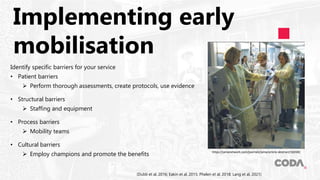
Implementing early
mobilisation
Identify specific barriers for your service
• Patient barriers
 Perform thorough assessments, create protocols, use evidence
• Structural barriers
 Staffing and equipment
• Process barriers
 Mobility teams
• Cultural barriers
 Employ champions and promote the benefits
(Dubb et al, 2016; Eakin et al, 2015; Phelen et al, 2018; Lang et al, 2021)
https://jamanetwork.com/journals/jama/article-abstract/182682
References
Dubb R, Nydahl P, Hermes C, Schwabbauer N, Toonstra A, Parker AM, Kaltwasser A, Needham DM. Barriers and Strategies for Early Mobilization of Patients in
Intensive Care Units. Ann Am Thorac Soc. 2016;13(5):724-30. doi: 10.1513/AnnalsATS.201509-586CME.
Eakin MN, Ugbah L, Arnautovic T, Parker AM, Needham DM. Implementing and sustaining an early rehabilitation program in a medical intensive care unit: A
qualitative analysis. J Crit Care. 2015;30(4):698-704. doi: 10.1016/j.jcrc.2015.03.019.
Hickmann CE, Castanares-Zapatero D, Deldicque L, Van den Bergh P, Caty G, Robert A, Roeseler J, Francaux M, Laterre PF. Impact of Very Early Physical
Therapy During Septic Shock on Skeletal Muscle: A Randomized Controlled Trial. Crit Care Med. 2018 Sep;46(9):1436-1443. doi:
10.1097/CCM.0000000000003263.
Higgins AM, Neto AS, Bailey M, et al. Predictors of death and new disability after critical illness: a multicentre prospective cohort study. Intensive Care Med.
2021;47(7):772-781. doi: 10.1007/s00134-021-06438-7.
Hodgson CL, Higgins AM, Bailey M, Barrett J, Bellomo R, Cooper DJ, Gabbe BJ, Iwashyna T, Linke N, Myles PS, Paton M, Philpot S, Shulman M, Young M, Serpa
Neto A; PREDICT Study Investigators. Comparison of 6-month outcomes of sepsis versus non-sepsis critically ill patients receiving mechanical ventilation. Crit Care.
2022;26(1):174. doi: 10.1186/s13054-022-04041-w.
Klaude M, Mori M, Tjäder I, Gustafsson T, Wernerman J, Rooyackers O. Protein metabolism and gene expression in skeletal muscle of critically ill patients with
sepsis. Clin Sci (Lond). 2012;122(3):133-42. doi: 10.1042/CS20110233.
Lang JK, Schaller SJ, Hodgson CL. Implementing Early Mobilisation in the Intensive Care Unit. In: Haines, K.J., McPeake, J., Sevin, C.M. (eds) Improving Critical
Care Survivorship. 2021. Springer, Cham. doi: 10.1007/978-3-030-68680-2_2.
Paton M, Lane R, Paul E, Cuthburtson GA, Hodgson CL. Mobilization During Critical Illness: A Higher Level of Mobilization Improves Health Status at 6 Months, a
Secondary Analysis of a Prospective Cohort Study. Crit Care Med. 2021;49(9):e860-e869. doi: 10.1097/CCM.0000000000005058.
Phelan S, Lin F, Mitchell M, Chaboyer W. Implementing early mobilisation in the intensive care unit: An integrative review. Int J Nurs Stud. 2018;77:91-105. doi:
10.1016/j.ijnurstu.2017.09.019.
Sricharoenchai T, Parker AM, Zanni JM, Nelliot A, Dinglas VD, Needham DM. Safety of physical therapy interventions in critically ill patients: a single-center
prospective evaluation of 1110 intensive care unit admissions. J Crit Care. 2014;29(3):395-400. doi: 10.1016/j.jcrc.2013.12.012
Wandrag L, Brett SJ, Frost GS, Bountziouka V, Hickson M. Exploration of muscle loss and metabolic state during prolonged critical illness: Implications for
intervention? PLoS One. 2019;14(11):e0224565. doi: 10.1371/journal.pone.0224565.
Zhang F, Xia Q, Zhang L, Wang H, Bai Y, Wu W. A bibliometric and visualized analysis of early mobilization in intensive care unit from 2000 to 2021. Front Neurol.
2022;13:848545. doi: 10.3389/fneur.2022.848545

Michelle_Paton.pptx

  • 1.
    Sepsis – A Physiotherapist perspective MichellePaton Critical Care and Surgical Services Physiotherapy Clinical Lead Monash Health
  • 2.
    Physiotherapy in ICU Keypart of the MDT Respiratory management • Ventilation and oxygen delivery optimisation • Secretion clearance • Lung recruitment Improve function • Heavily researched area • Safe and feasible (Nydahl et al 2017; Sricharoenchai et al al 2014) • Current research shows some short-term benefits (Paton et al, 2021; Wang et al 2021; Waldauf et al 2020; Zang et al 2019) Zhang et al 2022
  • 3.
    Role of Physiotherapy Decreasingmortality but increasing morbidity following ICU admission • 41% of ICU patients MV >24 hours alive and without new disability at 6/12 (Higgins et al, 2021) Bed rest leads to severe loss of muscle mass • At least 2% per day (Wandrag et al, 2019) • Increased wasting noted in septic patients (Klaude et al, 2012) • Permanent functional impairments and decreased QoL (Herridge et al, 2011) Sepsis patients known to have higher mortality but similar disability incidence at 6/12 (Hodgson et al 2022) Early physiotherapy for septic patients has been shown to be safe and preserve muscle mass
  • 4.
    Treatment options Full systematicassessment and management Aim to be as active as possible Team approach • ABCDEF bundle
  • 5.
    Physiotherapy for thispatient Focus on prevention • Respiratory management • Maintenance of muscle length and joint range Commence rehabilitation once hemodynamically stable • SOEOB • Tilt table • Progressive functional mobility Management of bulbar dysfunction • Tracheostomy weaning • Secretion management (?use of anticholinergics) Follow-up services and rehabilitation https://www.dovepress.com/cr_data/article_fulltext/s99000/99811/img/JMDH-99811_F003.jpg
  • 6.
    Possible challenges Complicated medicalcondition • Side effects and mobility limitations • Weakness posing manual handling risks Prolonged acute stay • Patient engagement • Day / night routine • Delirium management Community follow-up • What services / equipment can she access
  • 7.
    Implementing early mobilisation Identify specificbarriers for your service • Patient barriers  Perform thorough assessments, create protocols, use evidence • Structural barriers  Staffing and equipment • Process barriers  Mobility teams • Cultural barriers  Employ champions and promote the benefits (Dubb et al, 2016; Eakin et al, 2015; Phelen et al, 2018; Lang et al, 2021) https://jamanetwork.com/journals/jama/article-abstract/182682
  • 8.
    References Dubb R, NydahlP, Hermes C, Schwabbauer N, Toonstra A, Parker AM, Kaltwasser A, Needham DM. Barriers and Strategies for Early Mobilization of Patients in Intensive Care Units. Ann Am Thorac Soc. 2016;13(5):724-30. doi: 10.1513/AnnalsATS.201509-586CME. Eakin MN, Ugbah L, Arnautovic T, Parker AM, Needham DM. Implementing and sustaining an early rehabilitation program in a medical intensive care unit: A qualitative analysis. J Crit Care. 2015;30(4):698-704. doi: 10.1016/j.jcrc.2015.03.019. Hickmann CE, Castanares-Zapatero D, Deldicque L, Van den Bergh P, Caty G, Robert A, Roeseler J, Francaux M, Laterre PF. Impact of Very Early Physical Therapy During Septic Shock on Skeletal Muscle: A Randomized Controlled Trial. Crit Care Med. 2018 Sep;46(9):1436-1443. doi: 10.1097/CCM.0000000000003263. Higgins AM, Neto AS, Bailey M, et al. Predictors of death and new disability after critical illness: a multicentre prospective cohort study. Intensive Care Med. 2021;47(7):772-781. doi: 10.1007/s00134-021-06438-7. Hodgson CL, Higgins AM, Bailey M, Barrett J, Bellomo R, Cooper DJ, Gabbe BJ, Iwashyna T, Linke N, Myles PS, Paton M, Philpot S, Shulman M, Young M, Serpa Neto A; PREDICT Study Investigators. Comparison of 6-month outcomes of sepsis versus non-sepsis critically ill patients receiving mechanical ventilation. Crit Care. 2022;26(1):174. doi: 10.1186/s13054-022-04041-w. Klaude M, Mori M, Tjäder I, Gustafsson T, Wernerman J, Rooyackers O. Protein metabolism and gene expression in skeletal muscle of critically ill patients with sepsis. Clin Sci (Lond). 2012;122(3):133-42. doi: 10.1042/CS20110233. Lang JK, Schaller SJ, Hodgson CL. Implementing Early Mobilisation in the Intensive Care Unit. In: Haines, K.J., McPeake, J., Sevin, C.M. (eds) Improving Critical Care Survivorship. 2021. Springer, Cham. doi: 10.1007/978-3-030-68680-2_2. Paton M, Lane R, Paul E, Cuthburtson GA, Hodgson CL. Mobilization During Critical Illness: A Higher Level of Mobilization Improves Health Status at 6 Months, a Secondary Analysis of a Prospective Cohort Study. Crit Care Med. 2021;49(9):e860-e869. doi: 10.1097/CCM.0000000000005058. Phelan S, Lin F, Mitchell M, Chaboyer W. Implementing early mobilisation in the intensive care unit: An integrative review. Int J Nurs Stud. 2018;77:91-105. doi: 10.1016/j.ijnurstu.2017.09.019. Sricharoenchai T, Parker AM, Zanni JM, Nelliot A, Dinglas VD, Needham DM. Safety of physical therapy interventions in critically ill patients: a single-center prospective evaluation of 1110 intensive care unit admissions. J Crit Care. 2014;29(3):395-400. doi: 10.1016/j.jcrc.2013.12.012 Wandrag L, Brett SJ, Frost GS, Bountziouka V, Hickson M. Exploration of muscle loss and metabolic state during prolonged critical illness: Implications for intervention? PLoS One. 2019;14(11):e0224565. doi: 10.1371/journal.pone.0224565. Zhang F, Xia Q, Zhang L, Wang H, Bai Y, Wu W. A bibliometric and visualized analysis of early mobilization in intensive care unit from 2000 to 2021. Front Neurol. 2022;13:848545. doi: 10.3389/fneur.2022.848545