

Mobilization in icu
Manivel Arumugam MPT
Senior physiotherapist.Department of pulmonary medicine &rehabilitation
PSG hospitals
Mobilization in intensive care….
 Any activity that is done at the regular basis inside
intensive care whether passively or actively in the view of
improving hemodynamic parameter, reverse short term
shock or bed rest complications.
Linda Denhey, Kathe Stiller 2006
Mobilisation forms
 Active
 Passive
 Or
 Manual,
 Mechanical
Incommon
 Passive limb exercises
 Supported sitting
 Standing with or without support
 Continous rotational therapy
 Incase of contraindication for therapist mobilisation at least
flowtron pumps
Goal and benefits of mobilization:
 To reduce incidence of critical illness myoneuropathy (72 hrs)
 Reduce bed rest complication
 Reduce incidence of delirium
 Improves sleep wake cycle
 Improves and regulates hemodynamic parameters
 Improves patient confidence of coming out of “Hell’
Donna Frownfelter 2008 8th
edi
Physiological changes in ICU mobilisation
 Initial step for initiating ventilatory and cardiac functions in a
controlled manner in adequate support (MV or ionotropes)
 Increases tissue demand of aerobic, increases stroke, tidal
volumes, inspiratory capacities thereby regulates the
hemodynamic parameters in critically ill
 Improves neural, skeletal muscles circulation, vital organs
microgravity impact due to upright and activity
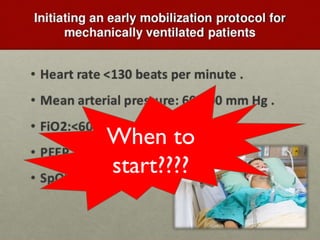
When to
start????
Evidence for ICU mobilisation
 Prolonged ICU stay is devastating and often results in
long term functional and cognitive impairment.
 Recent studies confirmed that early mobilization and
physical activity of mechanically ventilated patients is
feasible and safe and shortens the length of ICU stay.
Pires Neto et al 2015
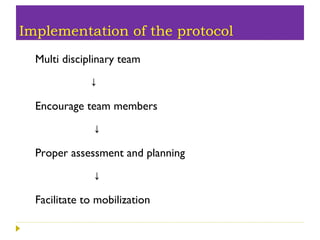
Implementation of the protocol
Multi disciplinary team
↓
Encourage team members
↓
Proper assessment and planning
↓
Facilitate to mobilization
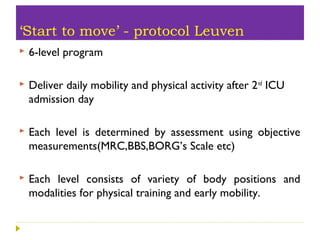
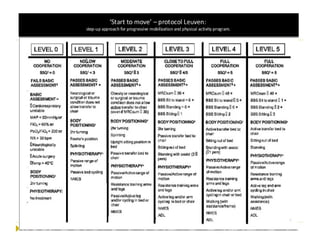
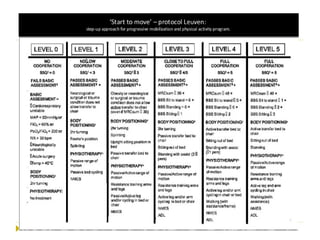
‘Start to move’ - protocol Leuven
 6-level program
 Deliver daily mobility and physical activity after 2nd
ICU
admission day
 Each level is determined by assessment using objective
measurements(MRC,BBS,BORG’s Scale etc)
 Each level consists of variety of body positions and
modalities for physical training and early mobility.
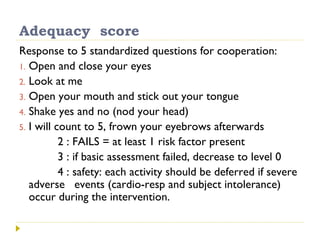
Adequacy score
Response to 5 standardized questions for cooperation:
1. Open and close your eyes
2. Look at me
3. Open your mouth and stick out your tongue
4. Shake yes and no (nod your head)
5. I will count to 5, frown your eyebrows afterwards
2 : FAILS = at least 1 risk factor present
3 : if basic assessment failed, decrease to level 0
4 : safety: each activity should be deferred if severe
adverse events (cardio-resp and subject intolerance)
occur during the intervention.
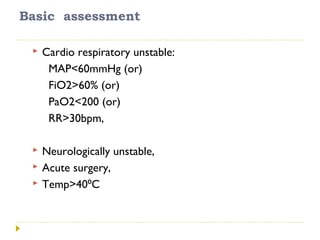
Basic assessment
 Cardio respiratory unstable:
MAP<60mmHg (or)
FiO2>60% (or)
PaO2<200 (or)
RR>30bpm,
 Neurologically unstable,
 Acute surgery,
 Temp>40 C⁰
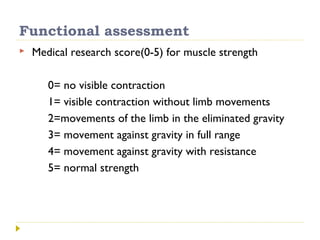
Functional assessment
 Medical research score(0-5) for muscle strength
0= no visible contraction
1= visible contraction without limb movements
2=movements of the limb in the eliminated gravity
3= movement against gravity in full range
4= movement against gravity with resistance
5= normal strength
 If the patient passed in S5Q then go for muscle strength
test.
Muscles to be
tested
Right side
MRC (0-5)
Left side
MRC (0-5)
Reasons
Shoulder abduction
Flexion of forearm
Extension of wrist
Flexion of leg
Extension of knee
Dorsi flexion of
ankle
TOTAL SCORE :
/
60
/30 /30
Score < 48/60: significant muscle weakness
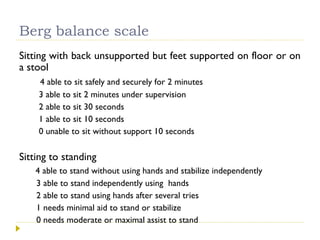
Berg balance scale
Sitting with back unsupported but feet supported on floor or on
a stool
4 able to sit safely and securely for 2 minutes
3 able to sit 2 minutes under supervision
2 able to sit 30 seconds
1 able to sit 10 seconds
0 unable to sit without support 10 seconds
Sitting to standing
4 able to stand without using hands and stabilize independently
3 able to stand independently using hands
2 able to stand using hands after several tries
1 needs minimal aid to stand or stabilize
0 needs moderate or maximal assist to stand
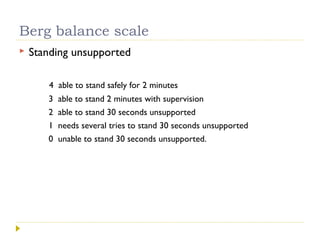
Berg balance scale
 Standing unsupported
4 able to stand safely for 2 minutes
3 able to stand 2 minutes with supervision
2 able to stand 30 seconds unsupported
1 needs several tries to stand 30 seconds unsupported
0 unable to stand 30 seconds unsupported.
PSG MICU
 Early mobilization is the prime and foremost goal of the MICU
therapeutic team
 Evidence claim the early mobilization shall
decrease mortality,
economic cost,
incidence of delirium,
length of stay in MICU,
reduction in impact of primary illness,
increase sense of wellbeing,
improves functional independence,
early return to social activities and quality of life.
Early mobilization includes
 2nd
hourly position: most of the time it is done by our
eminent MICU nursing staffs and also documented
properly in their chart.
 Long sitting within bed: this is done for almost all the
patients in MICU except comatose(semi reclined),
noradrenalin support. This is done to avoid aspiration
and proper ventilation.
Continue…
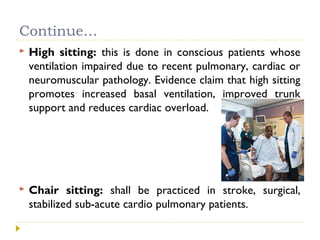
 High sitting: this is done in conscious patients whose
ventilation impaired due to recent pulmonary, cardiac or
neuromuscular pathology. Evidence claim that high sitting
promotes increased basal ventilation, improved trunk
support and reduces cardiac overload.
 Chair sitting: shall be practiced in stroke, surgical,
stabilized sub-acute cardio pulmonary patients.
Contd…
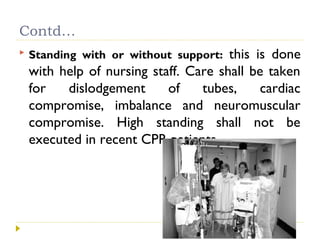
 Standing with or without support: this is done
with help of nursing staff. Care shall be taken
for dislodgement of tubes, cardiac
compromise, imbalance and neuromuscular
compromise. High standing shall not be
executed in recent CPR patients.
Contd…
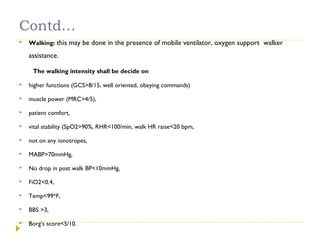
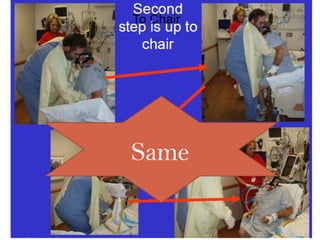
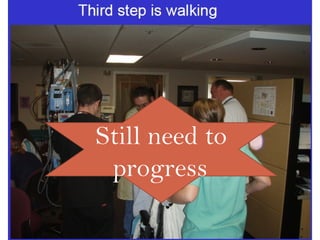
 Walking: this may be done in the presence of mobile ventilator, oxygen support walker
assistance.
The walking intensity shall be decide on
 higher functions (GCS>8/15, well oriented, obeying commands)
 muscle power (MRC>4/5),
 patient comfort,
 vital stability (SpO2>90%, RHR<100/min, walk HR raise<20 bpm,
 not on any ionotropes,
 MABP>70mmHg,
 No drop in post walk BP<10mmHg,
 FiO2<0.4,
 Temp<99*F,
 BBS >3,
 Borg’s score<5/10.
Contd…
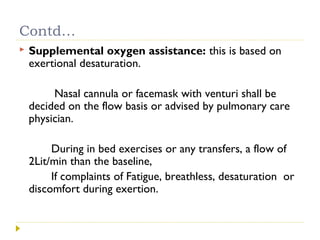
 Supplemental oxygen assistance: this is based on
exertional desaturation.
Nasal cannula or facemask with venturi shall be
decided on the flow basis or advised by pulmonary care
physician.
During in bed exercises or any transfers, a flow of
2Lit/min than the baseline,
If complaints of Fatigue, breathless, desaturation or
discomfort during exertion.
Criteria for terminating physical activity and
mobilization
 Heart Rate:
>70% APMHR
> 20% decrease in resting HR
< 40 beats/minute; > 130 beats/minute
New onset dysrhythmia
New anti-arrhythmia medication
New MI by ECG or cardiac enzymes
 Pulse Oximetry/SpO2:
> 4% decrease
< 88%- 90%
-
Cardiopulm Phys Ther J. 2012 Mar; 23(1): 5–13.
Continue….
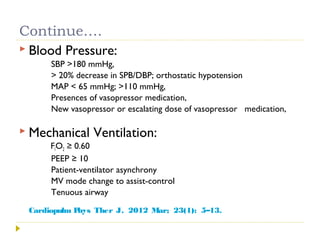
 Blood Pressure:
SBP >180 mmHg,
> 20% decrease in SPB/DBP; orthostatic hypotension
MAP < 65 mmHg; >110 mmHg,
Presences of vasopressor medication,
New vasopressor or escalating dose of vasopressor medication,
 Mechanical Ventilation:
FIO2 ≥ 0.60
PEEP ≥ 10
Patient-ventilator asynchrony
MV mode change to assist-control
Tenuous airway
Cardiopulm Phys Ther J. 2012 Mar; 23(1): 5–13.
Continue….
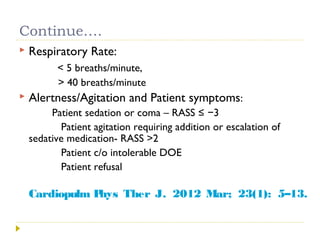
 Respiratory Rate:
< 5 breaths/minute,
> 40 breaths/minute
 Alertness/Agitation and Patient symptoms:
Patient sedation or coma – RASS ≤ 3−
Patient agitation requiring addition or escalation of
sedative medication- RASS >2
Patient c/o intolerable DOE
Patient refusal
Cardiopulm Phys Ther J. 2012 Mar; 23(1): 5–13.
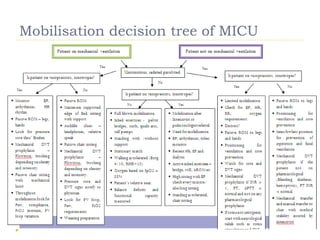
Mobilisation decision tree of MICU
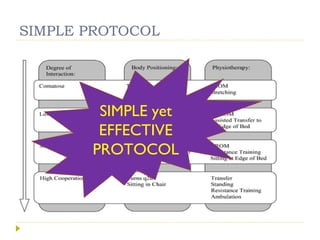
SIMPLE PROTOCOL
SIMPLE yet
EFFECTIVE
PROTOCOL
What we differ from Western
ICU mobilisation therapy ?
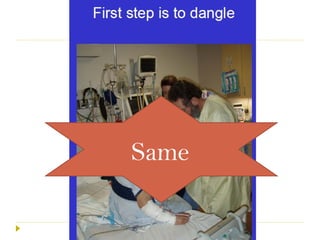
Same
Same
Still need to
progress
Team effort
for ambu??
Mobile oxygen
and max support
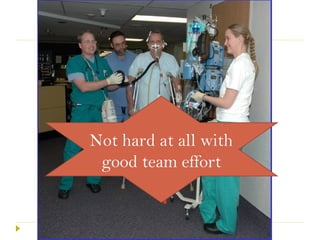
Not hard at all with
good team effort
Even with extracorporeal membrane O2
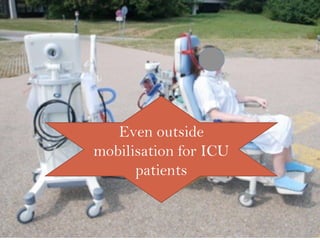
Even outside
mobilisation for ICU
patients
Technical advancements
Are we too far?
Let a change shall
begin…..

Mobilization in icu

  • 1.
    Mobilization in icu ManivelArumugam MPT Senior physiotherapist.Department of pulmonary medicine &rehabilitation PSG hospitals
  • 2.
    Mobilization in intensivecare….  Any activity that is done at the regular basis inside intensive care whether passively or actively in the view of improving hemodynamic parameter, reverse short term shock or bed rest complications. Linda Denhey, Kathe Stiller 2006
  • 3.
    Mobilisation forms  Active Passive  Or  Manual,  Mechanical Incommon  Passive limb exercises  Supported sitting  Standing with or without support  Continous rotational therapy  Incase of contraindication for therapist mobilisation at least flowtron pumps
  • 4.
    Goal and benefitsof mobilization:  To reduce incidence of critical illness myoneuropathy (72 hrs)  Reduce bed rest complication  Reduce incidence of delirium  Improves sleep wake cycle  Improves and regulates hemodynamic parameters  Improves patient confidence of coming out of “Hell’ Donna Frownfelter 2008 8th edi
  • 5.
    Physiological changes inICU mobilisation  Initial step for initiating ventilatory and cardiac functions in a controlled manner in adequate support (MV or ionotropes)  Increases tissue demand of aerobic, increases stroke, tidal volumes, inspiratory capacities thereby regulates the hemodynamic parameters in critically ill  Improves neural, skeletal muscles circulation, vital organs microgravity impact due to upright and activity
  • 6.
  • 7.
    Evidence for ICUmobilisation  Prolonged ICU stay is devastating and often results in long term functional and cognitive impairment.  Recent studies confirmed that early mobilization and physical activity of mechanically ventilated patients is feasible and safe and shortens the length of ICU stay. Pires Neto et al 2015
  • 8.
    Implementation of theprotocol Multi disciplinary team ↓ Encourage team members ↓ Proper assessment and planning ↓ Facilitate to mobilization
  • 9.
    ‘Start to move’- protocol Leuven  6-level program  Deliver daily mobility and physical activity after 2nd ICU admission day  Each level is determined by assessment using objective measurements(MRC,BBS,BORG’s Scale etc)  Each level consists of variety of body positions and modalities for physical training and early mobility.
  • 11.
    Adequacy score Response to5 standardized questions for cooperation: 1. Open and close your eyes 2. Look at me 3. Open your mouth and stick out your tongue 4. Shake yes and no (nod your head) 5. I will count to 5, frown your eyebrows afterwards 2 : FAILS = at least 1 risk factor present 3 : if basic assessment failed, decrease to level 0 4 : safety: each activity should be deferred if severe adverse events (cardio-resp and subject intolerance) occur during the intervention.
  • 12.
    Basic assessment  Cardiorespiratory unstable: MAP<60mmHg (or) FiO2>60% (or) PaO2<200 (or) RR>30bpm,  Neurologically unstable,  Acute surgery,  Temp>40 C⁰
  • 13.
    Functional assessment  Medicalresearch score(0-5) for muscle strength 0= no visible contraction 1= visible contraction without limb movements 2=movements of the limb in the eliminated gravity 3= movement against gravity in full range 4= movement against gravity with resistance 5= normal strength
  • 14.
     If thepatient passed in S5Q then go for muscle strength test. Muscles to be tested Right side MRC (0-5) Left side MRC (0-5) Reasons Shoulder abduction Flexion of forearm Extension of wrist Flexion of leg Extension of knee Dorsi flexion of ankle TOTAL SCORE : / 60 /30 /30 Score < 48/60: significant muscle weakness
  • 15.
    Berg balance scale Sittingwith back unsupported but feet supported on floor or on a stool 4 able to sit safely and securely for 2 minutes 3 able to sit 2 minutes under supervision 2 able to sit 30 seconds 1 able to sit 10 seconds 0 unable to sit without support 10 seconds Sitting to standing 4 able to stand without using hands and stabilize independently 3 able to stand independently using hands 2 able to stand using hands after several tries 1 needs minimal aid to stand or stabilize 0 needs moderate or maximal assist to stand
  • 16.
    Berg balance scale Standing unsupported 4 able to stand safely for 2 minutes 3 able to stand 2 minutes with supervision 2 able to stand 30 seconds unsupported 1 needs several tries to stand 30 seconds unsupported 0 unable to stand 30 seconds unsupported.
  • 18.
    PSG MICU  Earlymobilization is the prime and foremost goal of the MICU therapeutic team  Evidence claim the early mobilization shall decrease mortality, economic cost, incidence of delirium, length of stay in MICU, reduction in impact of primary illness, increase sense of wellbeing, improves functional independence, early return to social activities and quality of life.
  • 19.
    Early mobilization includes 2nd hourly position: most of the time it is done by our eminent MICU nursing staffs and also documented properly in their chart.  Long sitting within bed: this is done for almost all the patients in MICU except comatose(semi reclined), noradrenalin support. This is done to avoid aspiration and proper ventilation.
  • 20.
    Continue…  High sitting:this is done in conscious patients whose ventilation impaired due to recent pulmonary, cardiac or neuromuscular pathology. Evidence claim that high sitting promotes increased basal ventilation, improved trunk support and reduces cardiac overload.  Chair sitting: shall be practiced in stroke, surgical, stabilized sub-acute cardio pulmonary patients.
  • 21.
    Contd…  Standing withor without support: this is done with help of nursing staff. Care shall be taken for dislodgement of tubes, cardiac compromise, imbalance and neuromuscular compromise. High standing shall not be executed in recent CPR patients.
  • 22.
    Contd…  Walking: thismay be done in the presence of mobile ventilator, oxygen support walker assistance. The walking intensity shall be decide on  higher functions (GCS>8/15, well oriented, obeying commands)  muscle power (MRC>4/5),  patient comfort,  vital stability (SpO2>90%, RHR<100/min, walk HR raise<20 bpm,  not on any ionotropes,  MABP>70mmHg,  No drop in post walk BP<10mmHg,  FiO2<0.4,  Temp<99*F,  BBS >3,  Borg’s score<5/10.
  • 23.
    Contd…  Supplemental oxygenassistance: this is based on exertional desaturation. Nasal cannula or facemask with venturi shall be decided on the flow basis or advised by pulmonary care physician. During in bed exercises or any transfers, a flow of 2Lit/min than the baseline, If complaints of Fatigue, breathless, desaturation or discomfort during exertion.
  • 24.
    Criteria for terminatingphysical activity and mobilization  Heart Rate: >70% APMHR > 20% decrease in resting HR < 40 beats/minute; > 130 beats/minute New onset dysrhythmia New anti-arrhythmia medication New MI by ECG or cardiac enzymes  Pulse Oximetry/SpO2: > 4% decrease < 88%- 90% - Cardiopulm Phys Ther J. 2012 Mar; 23(1): 5–13.
  • 25.
    Continue….  Blood Pressure: SBP>180 mmHg, > 20% decrease in SPB/DBP; orthostatic hypotension MAP < 65 mmHg; >110 mmHg, Presences of vasopressor medication, New vasopressor or escalating dose of vasopressor medication,  Mechanical Ventilation: FIO2 ≥ 0.60 PEEP ≥ 10 Patient-ventilator asynchrony MV mode change to assist-control Tenuous airway Cardiopulm Phys Ther J. 2012 Mar; 23(1): 5–13.
  • 26.
    Continue….  Respiratory Rate: <5 breaths/minute, > 40 breaths/minute  Alertness/Agitation and Patient symptoms: Patient sedation or coma – RASS ≤ 3− Patient agitation requiring addition or escalation of sedative medication- RASS >2 Patient c/o intolerable DOE Patient refusal Cardiopulm Phys Ther J. 2012 Mar; 23(1): 5–13.
  • 27.
  • 28.
  • 29.
    What we differfrom Western ICU mobilisation therapy ?
  • 30.
  • 31.
  • 32.
  • 33.
  • 34.
  • 35.
    Not hard atall with good team effort
  • 36.
  • 37.
  • 38.
  • 39.
    Let a changeshall begin…..