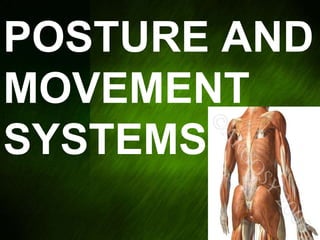
POSTURE AND
MOVEMENT
SYSTEMS
INTRODUCTION
• Functional activities are
controlled by two different
but complementary systems
• Postural system
• Movement system
POSTURAL SYSTEM
• Maintain alignment of body in any position
• Anticipate changes to allow goal directed
movements and make adjustments before,
during and after movement
• Tries to Maintains COM with in BOS
• Protects the integrity of joints
MOVEMENT SYSTEM
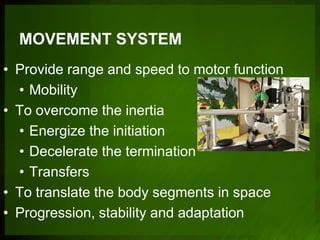
• Provide range and speed to motor function
• Mobility
• To overcome the inertia
• Energize the initiation
• Decelerate the termination
• Transfers
• To translate the body segments in space
• Progression, stability and adaptation
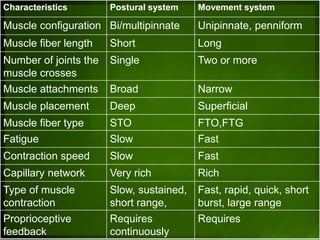
Characteristics Postural system Movement system
Muscle configuration Bi/multipinnate Unipinnate, penniform
Muscle fiber length Short Long
Number of joints the
muscle crosses
Single Two or more
Muscle attachments Broad Narrow
Muscle placement Deep Superficial
Muscle fiber type STO FTO,FTG
Fatigue Slow Fast
Contraction speed Slow Fast
Capillary network Very rich Rich
Type of muscle
contraction
Slow, sustained,
short range,
Fast, rapid, quick, short
burst, large range
Proprioceptive
feedback
Requires
continuously
Requires
Examples of postural and movement
muscles
• Postural
• Movement
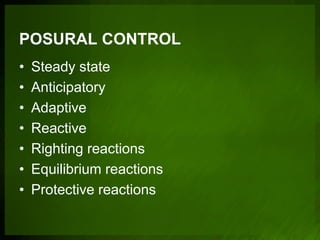
POSURAL CONTROL
• Steady state
• Anticipatory
• Adaptive
• Reactive
• Righting reactions
• Equilibrium reactions
• Protective reactions
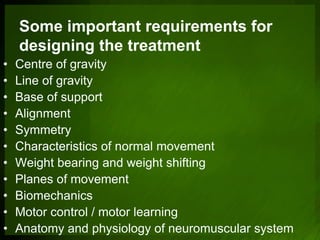
Some important requirements for
designing the treatment
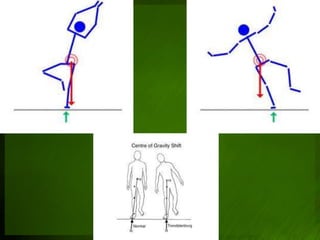
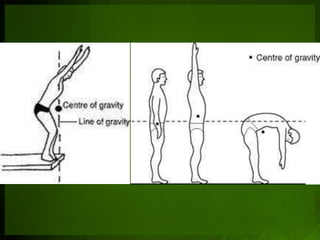
• Centre of gravity
• Line of gravity
• Base of support
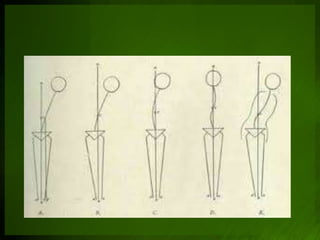
• Alignment
• Symmetry
• Characteristics of normal movement
• Weight bearing and weight shifting
• Planes of movement
• Biomechanics
• Motor control / motor learning
• Anatomy and physiology of neuromuscular system
POSTURAL CONTROL AND MOVEMENT SYSTEMS.pptx

POSTURAL CONTROL AND MOVEMENT SYSTEMS.pptx

  • 1.
  • 2.
    INTRODUCTION • Functional activitiesare controlled by two different but complementary systems • Postural system • Movement system
  • 3.
    POSTURAL SYSTEM • Maintainalignment of body in any position • Anticipate changes to allow goal directed movements and make adjustments before, during and after movement • Tries to Maintains COM with in BOS • Protects the integrity of joints
  • 4.
    MOVEMENT SYSTEM • Providerange and speed to motor function • Mobility • To overcome the inertia • Energize the initiation • Decelerate the termination • Transfers • To translate the body segments in space • Progression, stability and adaptation
  • 5.
    Characteristics Postural systemMovement system Muscle configuration Bi/multipinnate Unipinnate, penniform Muscle fiber length Short Long Number of joints the muscle crosses Single Two or more Muscle attachments Broad Narrow Muscle placement Deep Superficial Muscle fiber type STO FTO,FTG Fatigue Slow Fast Contraction speed Slow Fast Capillary network Very rich Rich Type of muscle contraction Slow, sustained, short range, Fast, rapid, quick, short burst, large range Proprioceptive feedback Requires continuously Requires
  • 6.
    Examples of posturaland movement muscles • Postural • Movement
  • 7.
    POSURAL CONTROL • Steadystate • Anticipatory • Adaptive • Reactive • Righting reactions • Equilibrium reactions • Protective reactions
  • 8.
    Some important requirementsfor designing the treatment • Centre of gravity • Line of gravity • Base of support • Alignment • Symmetry • Characteristics of normal movement • Weight bearing and weight shifting • Planes of movement • Biomechanics • Motor control / motor learning • Anatomy and physiology of neuromuscular system