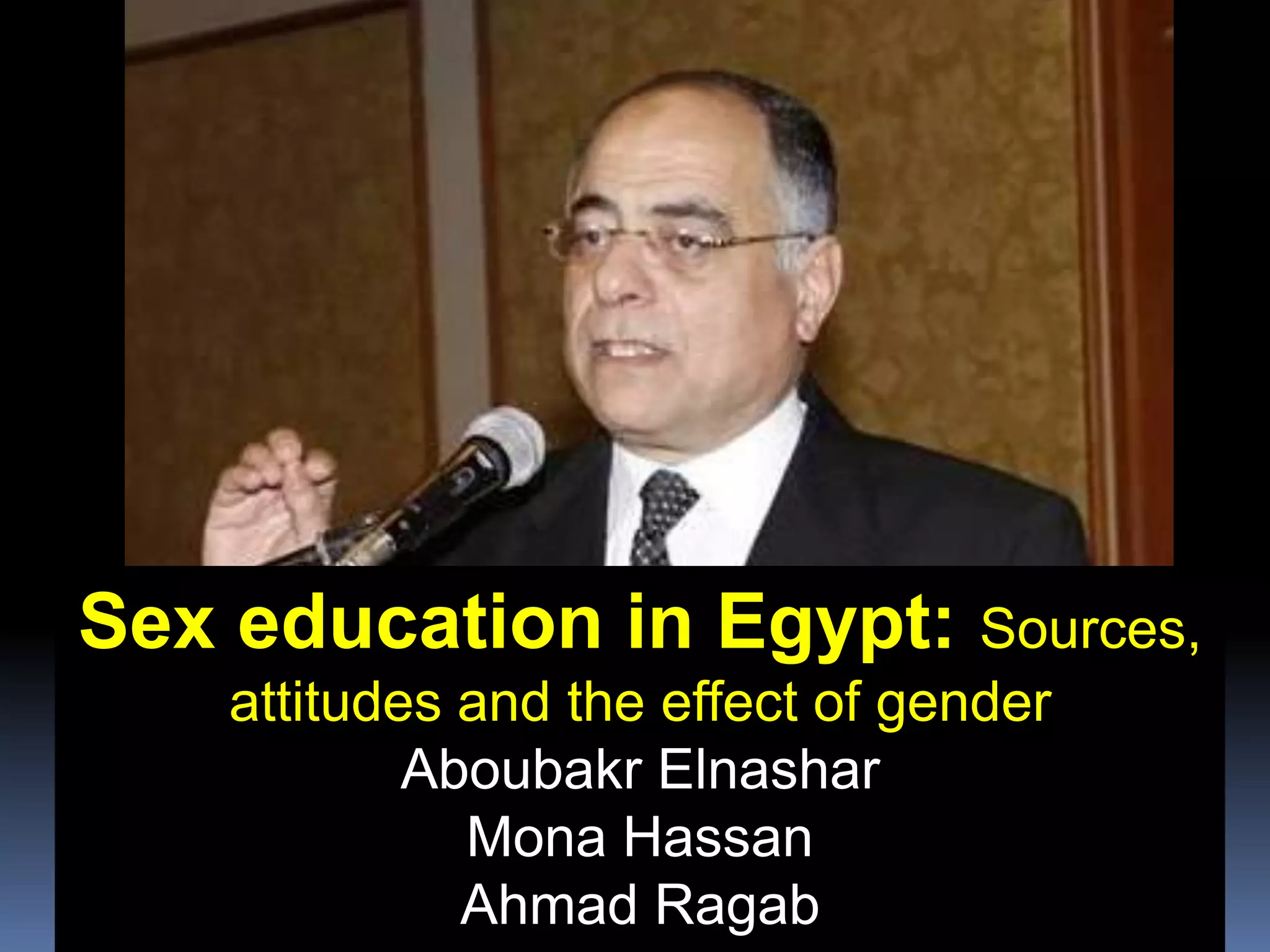
Sex education in Egypt: Sources,
attitudes and the effect of gender
Aboubakr Elnashar
Mona Hassan
Ahmad Ragab
Introduction
Sex education:
lifelong process that begins at birth.
provides life skills that can help people build
self-confidence& make informed choices.
The content needs to be:
Comprehensive: addressing the biological,
socio-cultural, psychological & spiritual
dimensions of sexuality
pay attention to gender bias& gender power
relations
ABOUBAKR ELNASHAR
At time of Prophet:
comprehensive package of sex education was
given side by side with other teachings of
Islam.
ABOUBAKR ELNASHAR
In Egypt:
Sexual health service for adolescents is very
limited:
Boys or girls reach puberty, they are given a little if
any information about sexual& reproductive health
No comprehensive sexuality education.
We do not have researches that can serve as the
ground for evidence- based public policy.
ABOUBAKR ELNASHAR
In schools:
Curriculum in the 9th grade
small chapter that focus mainly on the biological
aspects of sexuality.
 neglected by many teachers& students
when teachers open these topics, the student was
discouraged to discuss details or to take it in length.
Teachers are not prepared to address sexuality
ABOUBAKR ELNASHAR
Objectives
This work was done to assess:
1.Sources of sexual& reproductive health
information among participants& the perceived
credibility of these sources.
2.Attitude of participants toward sex education.
3.Difference in sexual attitudes linked to gender.
ABOUBAKR ELNASHAR
Methods
A cross sectional descriptive community based
survey
Study sample was selected from some
governmental schools.
Sample size was determined: 520 students were
asked to respond to the survey format.
An anonymously self administrated 11- items
questionnaire
ABOUBAKR ELNASHAR
Results
488 complied with the survey: 95.6% response rate.
The selected age of participants: 15-25 y
Middle preparatory & secondary schools: 272
(55.8%)
High schools: 217 (44.2%)
ABOUBAKR ELNASHAR
Respondent's Opinion Females Males Total P .049
N % n % n %
Strongly Agree 54 17.6 65 33.0 119 23.7 <0.001
Agree 167 54.6 79 40.1 246 48.9 0.002
Not sure 31 10.1 24 12.2 55 10.9 0.472
Disagree 32 10.5 16 8.1 48 9.5 0.384
Strongly Disagree 13 4.2 10 5.1 23 4.6 0.664
Should sexual health education be provided in
schools?
ABOUBAKR ELNASHAR
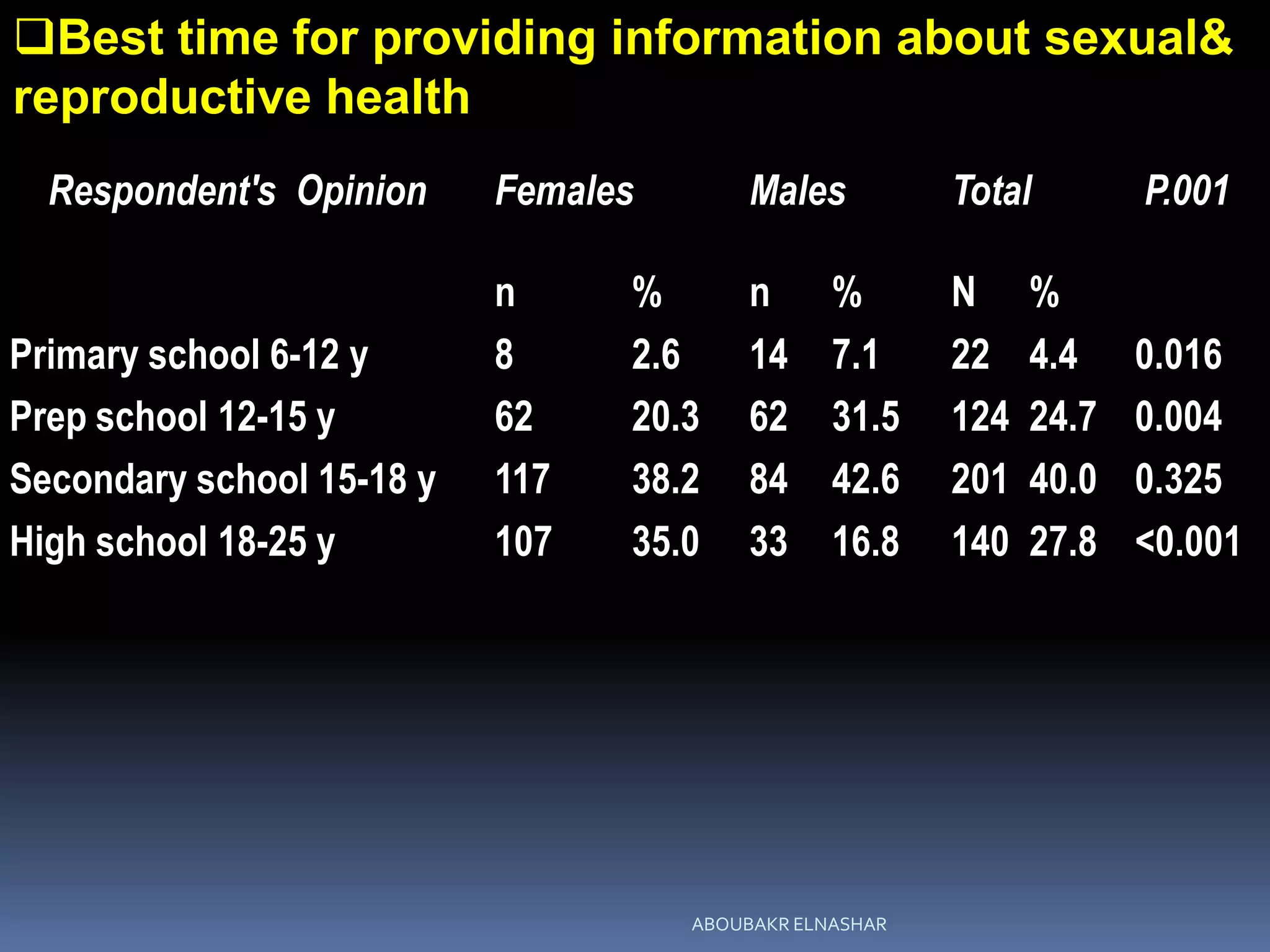
Respondent's Opinion Females Males Total P.001
n % n % N %
Primary school 6-12 y 8 2.6 14 7.1 22 4.4 0.016
Prep school 12-15 y 62 20.3 62 31.5 124 24.7 0.004
Secondary school 15-18 y 117 38.2 84 42.6 201 40.0 0.325
High school 18-25 y 107 35.0 33 16.8 140 27.8 <0.001
The best time for providing information about sexual and reproductive health
Best time for providing information about sexual&
reproductive health
ABOUBAKR ELNASHAR
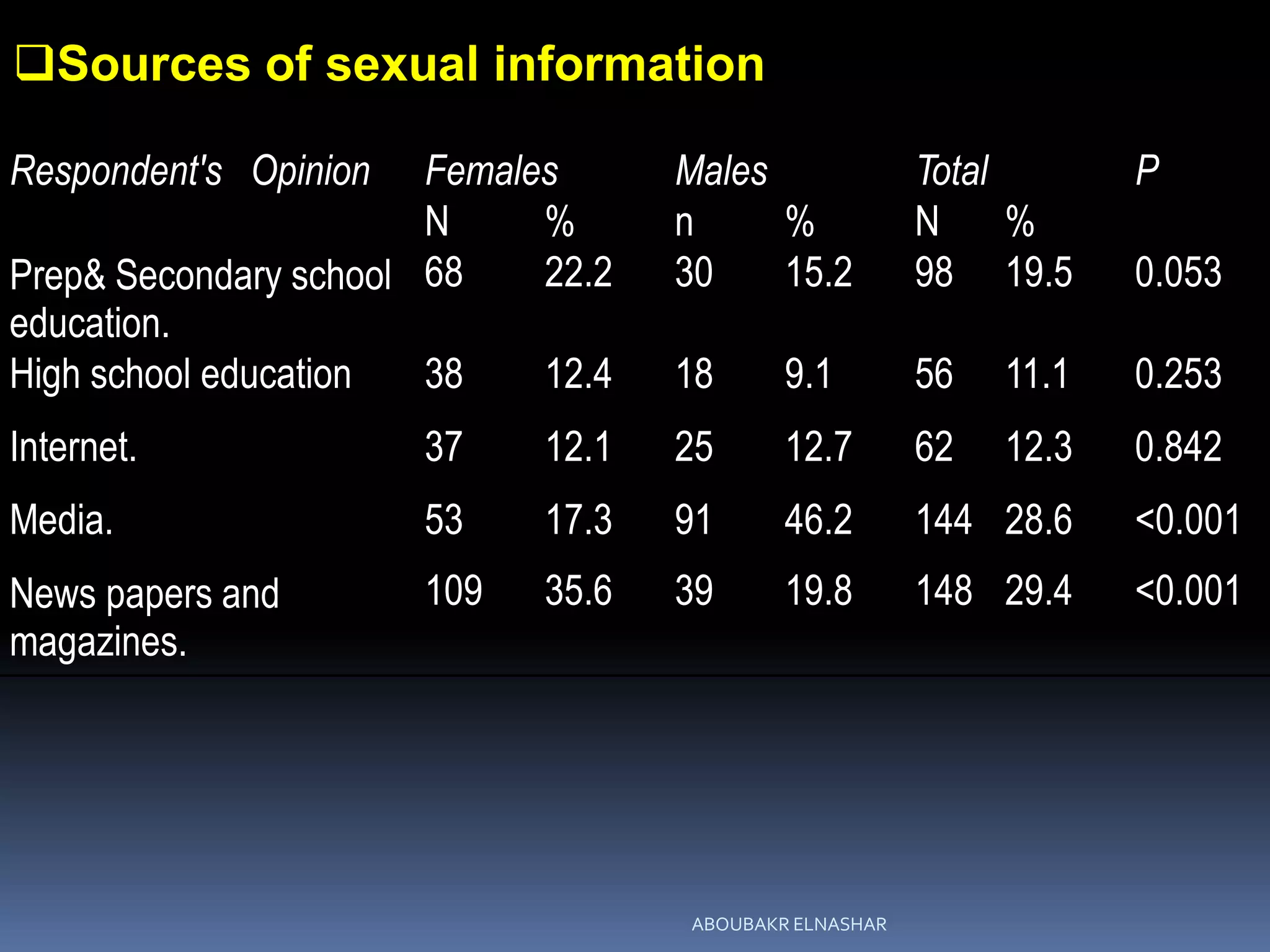
Sources of sexual information
Respondent's Opinion Females Males Total P
N % n % N %
Prep& Secondary school
education.
68 22.2 30 15.2 98 19.5 0.053
High school education 38 12.4 18 9.1 56 11.1 0.253
Internet. 37 12.1 25 12.7 62 12.3 0.842
Media. 53 17.3 91 46.2 144 28.6 <0.001
News papers and
magazines.
109 35.6 39 19.8 148 29.4 <0.001
ABOUBAKR ELNASHAR
Respondent's
Opinion
Females Males Total P .037
N % n % N %
Excellent 12 3.9 35 17.8 47 9.3 <0.001
Fair 104 34.0 57 28.9 161 32.0 0.236
Not sufficient 94 30.7 58 29.4 152 30.2 0.761
Unclear 76 24.8% 31 15.7 107 21.3 0.015
Wrong 5 1.6 7 3.6 12 2.4 0.169a
Quality of sexual health information
ABOUBAKR ELNASHAR
Respondent's
Opinion
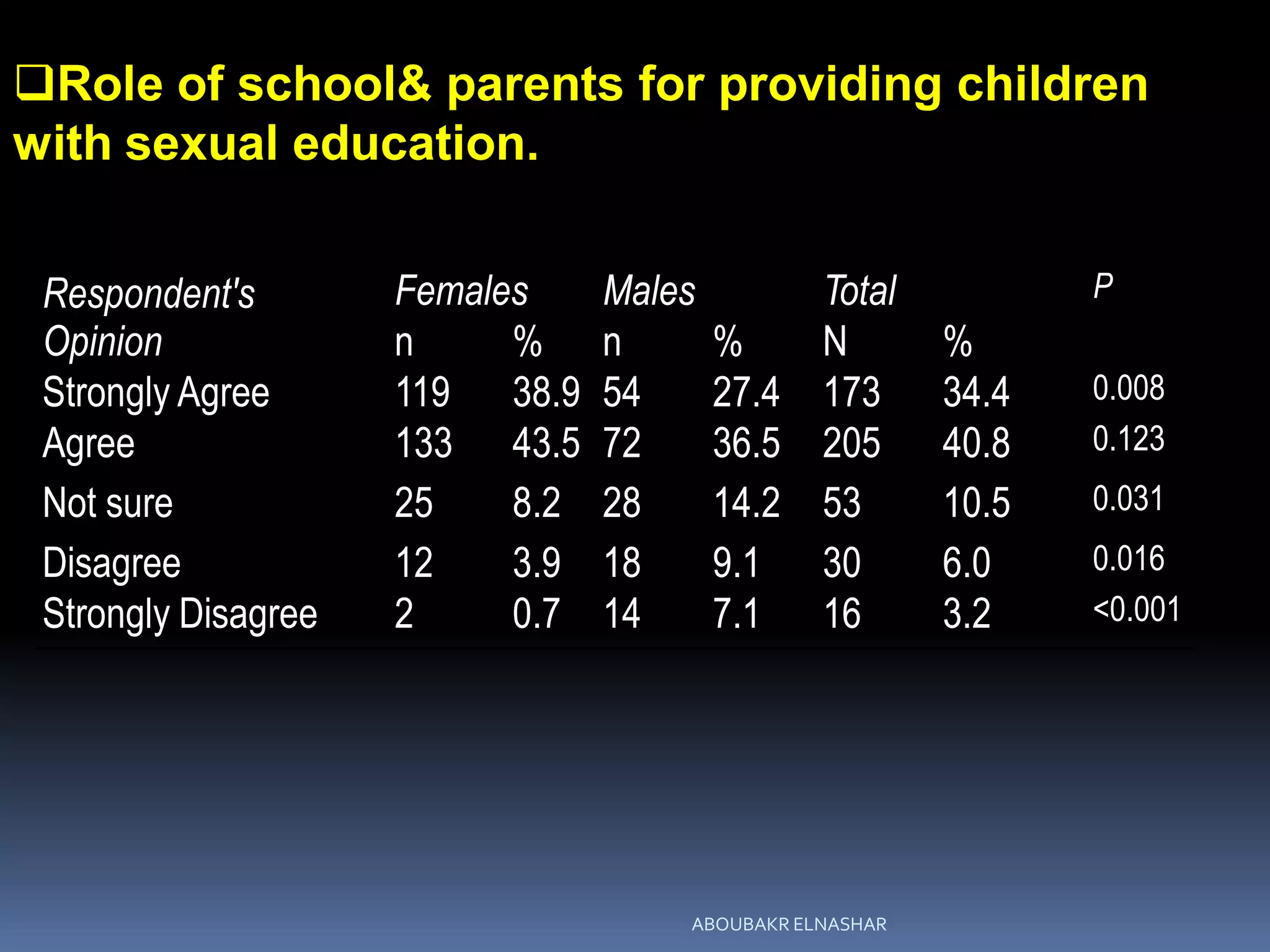
Females Males Total P
n % n % N %
Strongly Agree 119 38.9 54 27.4 173 34.4 0.008
Agree 133 43.5 72 36.5 205 40.8 0.123
Not sure 25 8.2 28 14.2 53 10.5 0.031
Disagree 12 3.9 18 9.1 30 6.0 0.016
Strongly Disagree 2 0.7 14 7.1 16 3.2 <0.001
Role of school& parents for providing children
with sexual education.
ABOUBAKR ELNASHAR
Respondent's Opinion Females Males Total P
N % N % N %
Changes of puberty. 210 68.6 127 64.5 337 67.0 0.333
Reproduction&how pregnancy occurs. 173 56.5 126 64.0 299 59.4 0.098
Birth control methods. 121 39.5 102 51.8 223 44.3 0.007
Safe sex practices& STD 149 48.7 101 51.3 250 49.7 0.573
How to prevent child sexual abuse. 77 25.2 56 28.4 133 26.4 0.418
S coercion& s assault among
women&how to prevent them.
86 28.1 62 31.5 148 29.4 0.419
The impact of good sex on
psychological health of men &women.
69 22.5 90 45.7 159 31.6 <0.001
The effects of healthy sexual relation
on marital relationship.
70 22.9 76 38.6 146 29.0 <0.001
Adverse effect of s coercion within
marriage upon couple
50 16.3 77 39.1 127 25.2 <0.001
Topics covered during receiving sexual health
education at school.
ABOUBAKR ELNASHAR
Respondent's Opinion Females Males Total P
N % n % N %
Well comfortable & clear 21 6.9 34 17.3 55 10.9 <0.001
Some what comfortable&
clear
98 32.0 92 46.7 190 37.8 0.001
Not comfortable 142 46.4 43 21.8 185 36.8 <0.001
Refuse discussion of the
topics at all
21 6.9 16 8.1 37 7.4 0.597
The level of comfort & clearness of the teacher
with the topics that were discussed during sexual
health education at school.
ABOUBAKR ELNASHAR
Respondent's
Opinion
Females Males Total P
n % n % N %
Very often 18 5.9 33 16.8 51 10.1 <0.001
Often 56 18.3 51 25.9 107 21.3 0.042
Few times 103 33.7 61 31.0 164 32.6 0.529
Not at all 105 34.3 40 20.3 145 28.8 0.001
Teacher's encouragement of students to ask
questions about sexual health.
ABOUBAKR ELNASHAR
Conclusions
1.Sex education at schools was not the main source of
sexual information; most respondents wanted sex
education at schools & wanted their parents' share in
sex education.
2.Only half of the respondents received sex education at
school, half of them rated this knowledge as
insufficient or unclear & most of them expressed their
need to have information on all the surveyed topics.
3.Most of the respondents felt their teachers
embarrassed& not encouraging as regard discussing
sexuality issue.
ABOUBAKR ELNASHAR
Recommendations
Researchers are required to determine:
What are the most effective ways to implement high
quality sex education programs?
How does health system integrate sexuality into
service delivery?
We need researches that address:
Role of proper religious believes on sexual attitude of
students and teachers alike
How to integrate positive religious view about sexuality
in our sex education programs for youth.
ABOUBAKR ELNASHAR
ABOUBAKR ELNASHAR

Sex education in Egypt: Sources, attitudes and the effect of gender

  • 1.
    Sex education inEgypt: Sources, attitudes and the effect of gender Aboubakr Elnashar Mona Hassan Ahmad Ragab
  • 2.
    Introduction Sex education: lifelong processthat begins at birth. provides life skills that can help people build self-confidence& make informed choices. The content needs to be: Comprehensive: addressing the biological, socio-cultural, psychological & spiritual dimensions of sexuality pay attention to gender bias& gender power relations ABOUBAKR ELNASHAR
  • 3.
    At time ofProphet: comprehensive package of sex education was given side by side with other teachings of Islam. ABOUBAKR ELNASHAR
  • 4.
    In Egypt: Sexual healthservice for adolescents is very limited: Boys or girls reach puberty, they are given a little if any information about sexual& reproductive health No comprehensive sexuality education. We do not have researches that can serve as the ground for evidence- based public policy. ABOUBAKR ELNASHAR
  • 5.
    In schools: Curriculum inthe 9th grade small chapter that focus mainly on the biological aspects of sexuality.  neglected by many teachers& students when teachers open these topics, the student was discouraged to discuss details or to take it in length. Teachers are not prepared to address sexuality ABOUBAKR ELNASHAR
  • 6.
    Objectives This work wasdone to assess: 1.Sources of sexual& reproductive health information among participants& the perceived credibility of these sources. 2.Attitude of participants toward sex education. 3.Difference in sexual attitudes linked to gender. ABOUBAKR ELNASHAR
  • 7.
    Methods A cross sectionaldescriptive community based survey Study sample was selected from some governmental schools. Sample size was determined: 520 students were asked to respond to the survey format. An anonymously self administrated 11- items questionnaire ABOUBAKR ELNASHAR
  • 8.
    Results 488 complied withthe survey: 95.6% response rate. The selected age of participants: 15-25 y Middle preparatory & secondary schools: 272 (55.8%) High schools: 217 (44.2%) ABOUBAKR ELNASHAR
  • 9.
    Respondent's Opinion FemalesMales Total P .049 N % n % n % Strongly Agree 54 17.6 65 33.0 119 23.7 <0.001 Agree 167 54.6 79 40.1 246 48.9 0.002 Not sure 31 10.1 24 12.2 55 10.9 0.472 Disagree 32 10.5 16 8.1 48 9.5 0.384 Strongly Disagree 13 4.2 10 5.1 23 4.6 0.664 Should sexual health education be provided in schools? ABOUBAKR ELNASHAR
  • 10.
    Respondent's Opinion FemalesMales Total P.001 n % n % N % Primary school 6-12 y 8 2.6 14 7.1 22 4.4 0.016 Prep school 12-15 y 62 20.3 62 31.5 124 24.7 0.004 Secondary school 15-18 y 117 38.2 84 42.6 201 40.0 0.325 High school 18-25 y 107 35.0 33 16.8 140 27.8 <0.001 The best time for providing information about sexual and reproductive health Best time for providing information about sexual& reproductive health ABOUBAKR ELNASHAR
  • 11.
    Sources of sexualinformation Respondent's Opinion Females Males Total P N % n % N % Prep& Secondary school education. 68 22.2 30 15.2 98 19.5 0.053 High school education 38 12.4 18 9.1 56 11.1 0.253 Internet. 37 12.1 25 12.7 62 12.3 0.842 Media. 53 17.3 91 46.2 144 28.6 <0.001 News papers and magazines. 109 35.6 39 19.8 148 29.4 <0.001 ABOUBAKR ELNASHAR
  • 12.
    Respondent's Opinion Females Males TotalP .037 N % n % N % Excellent 12 3.9 35 17.8 47 9.3 <0.001 Fair 104 34.0 57 28.9 161 32.0 0.236 Not sufficient 94 30.7 58 29.4 152 30.2 0.761 Unclear 76 24.8% 31 15.7 107 21.3 0.015 Wrong 5 1.6 7 3.6 12 2.4 0.169a Quality of sexual health information ABOUBAKR ELNASHAR
  • 13.
    Respondent's Opinion Females Males TotalP n % n % N % Strongly Agree 119 38.9 54 27.4 173 34.4 0.008 Agree 133 43.5 72 36.5 205 40.8 0.123 Not sure 25 8.2 28 14.2 53 10.5 0.031 Disagree 12 3.9 18 9.1 30 6.0 0.016 Strongly Disagree 2 0.7 14 7.1 16 3.2 <0.001 Role of school& parents for providing children with sexual education. ABOUBAKR ELNASHAR
  • 14.
    Respondent's Opinion FemalesMales Total P N % N % N % Changes of puberty. 210 68.6 127 64.5 337 67.0 0.333 Reproduction&how pregnancy occurs. 173 56.5 126 64.0 299 59.4 0.098 Birth control methods. 121 39.5 102 51.8 223 44.3 0.007 Safe sex practices& STD 149 48.7 101 51.3 250 49.7 0.573 How to prevent child sexual abuse. 77 25.2 56 28.4 133 26.4 0.418 S coercion& s assault among women&how to prevent them. 86 28.1 62 31.5 148 29.4 0.419 The impact of good sex on psychological health of men &women. 69 22.5 90 45.7 159 31.6 <0.001 The effects of healthy sexual relation on marital relationship. 70 22.9 76 38.6 146 29.0 <0.001 Adverse effect of s coercion within marriage upon couple 50 16.3 77 39.1 127 25.2 <0.001 Topics covered during receiving sexual health education at school. ABOUBAKR ELNASHAR
  • 15.
    Respondent's Opinion FemalesMales Total P N % n % N % Well comfortable & clear 21 6.9 34 17.3 55 10.9 <0.001 Some what comfortable& clear 98 32.0 92 46.7 190 37.8 0.001 Not comfortable 142 46.4 43 21.8 185 36.8 <0.001 Refuse discussion of the topics at all 21 6.9 16 8.1 37 7.4 0.597 The level of comfort & clearness of the teacher with the topics that were discussed during sexual health education at school. ABOUBAKR ELNASHAR
  • 16.
    Respondent's Opinion Females Males TotalP n % n % N % Very often 18 5.9 33 16.8 51 10.1 <0.001 Often 56 18.3 51 25.9 107 21.3 0.042 Few times 103 33.7 61 31.0 164 32.6 0.529 Not at all 105 34.3 40 20.3 145 28.8 0.001 Teacher's encouragement of students to ask questions about sexual health. ABOUBAKR ELNASHAR
  • 17.
    Conclusions 1.Sex education atschools was not the main source of sexual information; most respondents wanted sex education at schools & wanted their parents' share in sex education. 2.Only half of the respondents received sex education at school, half of them rated this knowledge as insufficient or unclear & most of them expressed their need to have information on all the surveyed topics. 3.Most of the respondents felt their teachers embarrassed& not encouraging as regard discussing sexuality issue. ABOUBAKR ELNASHAR
  • 18.
    Recommendations Researchers are requiredto determine: What are the most effective ways to implement high quality sex education programs? How does health system integrate sexuality into service delivery? We need researches that address: Role of proper religious believes on sexual attitude of students and teachers alike How to integrate positive religious view about sexuality in our sex education programs for youth. ABOUBAKR ELNASHAR
  • 19.