Anorexia Nervosa: Symptoms,
Side Effects
What is Eating Disorder
Eating disorders are characterised by an abnormal attitude towards food that
causes someone to change their eating habits and behaviour. A person with an
eating disorder focuses excessively on weight and shape, leading them to
make unhealthy choices about food with damaging results to their health.
Ellern Mede has been providing evidence-based specialised treatment for
children and young people with eating disorders since 2000. We support children and
young people aged 8 to 18 years, with a full care pathway to achieve exceptional rates
of recovery. In addition, Ellern Mede Barnet has a four bed ward for young adults up to
22 years transitioning from CAMHS to adult services, the community or back home.
Ellern Mede
Outpatient Services
Do I have an eating disorder? If that’s what you wonder, it’s worth
checking, because early intervention vastly improves your speed of
recovery. Your first step should be to see your GP and ask for a
Junior or Adult MARSIPAN check, blood tests and assessment with a
referral for a specialist Outpatient Eating Disorder Assessment, such
as we offer at Ellern Mede Group hospitals. Our affordable private
outpatient services are for children to age 18, young adults up to age
25, with specialist support for families and carers.
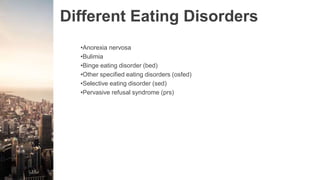
Different Eating Disorders
•Anorexia nervosa
•Bulimia
•Binge eating disorder (bed)
•Other specified eating disorders (osfed)
•Selective eating disorder (sed)
•Pervasive refusal syndrome (prs)
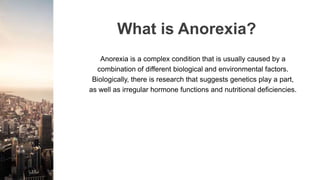
What is Anorexia?
Anorexia is a complex condition that is usually caused by a
combination of different biological and environmental factors.
Biologically, there is research that suggests genetics play a part,
as well as irregular hormone functions and nutritional deficiencies.
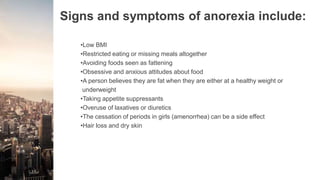
Signs and symptoms of anorexia include:
•Low BMI
•Restricted eating or missing meals altogether
•Avoiding foods seen as fattening
•Obsessive and anxious attitudes about food
•A person believes they are fat when they are either at a healthy weight or
underweight
•Taking appetite suppressants
•Overuse of laxatives or diuretics
•The cessation of periods in girls (amenorrhea) can be a side effect
•Hair loss and dry skin
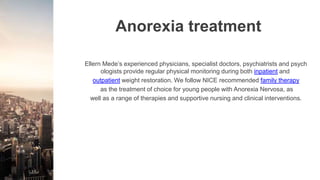
Anorexia treatment
Ellern Mede’s experienced physicians, specialist doctors, psychiatrists and psych
ologists provide regular physical monitoring during both inpatient and
outpatient weight restoration. We follow NICE recommended family therapy
as the treatment of choice for young people with Anorexia Nervosa, as
well as a range of therapies and supportive nursing and clinical interventions.
Contact Information
Head Office
Ellern Mede Ridgeway
Holcombe Hill
The Ridgeway
Mill Hill
London NW7 4HX
+44 (0)20 3209 7900
+44 (0)20 8906 1353
info@ellernmede.org

Anorexia Nervosa: Symptoms, Side Effects

  • 1.
  • 2.
    What is EatingDisorder Eating disorders are characterised by an abnormal attitude towards food that causes someone to change their eating habits and behaviour. A person with an eating disorder focuses excessively on weight and shape, leading them to make unhealthy choices about food with damaging results to their health.
  • 3.
    Ellern Mede hasbeen providing evidence-based specialised treatment for children and young people with eating disorders since 2000. We support children and young people aged 8 to 18 years, with a full care pathway to achieve exceptional rates of recovery. In addition, Ellern Mede Barnet has a four bed ward for young adults up to 22 years transitioning from CAMHS to adult services, the community or back home. Ellern Mede
  • 4.
    Outpatient Services Do Ihave an eating disorder? If that’s what you wonder, it’s worth checking, because early intervention vastly improves your speed of recovery. Your first step should be to see your GP and ask for a Junior or Adult MARSIPAN check, blood tests and assessment with a referral for a specialist Outpatient Eating Disorder Assessment, such as we offer at Ellern Mede Group hospitals. Our affordable private outpatient services are for children to age 18, young adults up to age 25, with specialist support for families and carers.
  • 5.
    Different Eating Disorders •Anorexianervosa •Bulimia •Binge eating disorder (bed) •Other specified eating disorders (osfed) •Selective eating disorder (sed) •Pervasive refusal syndrome (prs)
  • 6.
    What is Anorexia? Anorexiais a complex condition that is usually caused by a combination of different biological and environmental factors. Biologically, there is research that suggests genetics play a part, as well as irregular hormone functions and nutritional deficiencies.
  • 7.
    Signs and symptomsof anorexia include: •Low BMI •Restricted eating or missing meals altogether •Avoiding foods seen as fattening •Obsessive and anxious attitudes about food •A person believes they are fat when they are either at a healthy weight or underweight •Taking appetite suppressants •Overuse of laxatives or diuretics •The cessation of periods in girls (amenorrhea) can be a side effect •Hair loss and dry skin
  • 8.
    Anorexia treatment Ellern Mede’sexperienced physicians, specialist doctors, psychiatrists and psych ologists provide regular physical monitoring during both inpatient and outpatient weight restoration. We follow NICE recommended family therapy as the treatment of choice for young people with Anorexia Nervosa, as well as a range of therapies and supportive nursing and clinical interventions.
  • 9.
    Contact Information Head Office EllernMede Ridgeway Holcombe Hill The Ridgeway Mill Hill London NW7 4HX +44 (0)20 3209 7900 +44 (0)20 8906 1353 info@ellernmede.org