• Lifetime rates of significant anxiety - approximately 20% of children under 16
(Costello et al, 2003). DoH (2004) 1 in 10 children aged 5-16 clinically
diagnosable mental health condition
• Emotional and behavioural difficulties in childhood increase vulnerabilty
across multiple areas in adulthood
• NSPCC 2015- 20% of referrals to CAMHS are rejected.
• As childhood anxiety persists and increases risks of other disorders -depression,
illicit drug use and links with educational underachievement.
• Huge impact on learning and behaviour
• Evidence base for psychological interventions improving emotional resilience is
growing – FRIENDS
Prevalence of anxiety in children
• Future in Mind 2015 recommended focus on ‘resilience building’
urging health organisations to work with schools to promote well-
being and reduce stigma.
• Start psycho-education and building resilience early
• The normalising approach of the intervention is out of keeping with our
experience
• Mental health and emotional vulnerability aren’t spoken about at
school
• A lot of stigma still surrounds mental health issues amongst our peer
groups
• All highlights the need for a universal approach to delivery.
• Whole class approach can become a whole school approach
Why ?
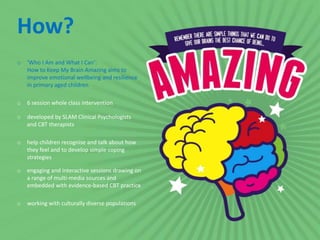
o ‘Who I Am and What I Can’:
How to Keep My Brain Amazing aims to
improve emotional wellbeing and resilience
in primary aged children
o 6 session whole class intervention
o developed by SLAM Clinical Psychologists
and CBT therapists
o help children recognise and talk about how
they feel and to develop simple coping
strategies
o engaging and interactive sessions drawing on
a range of multi-media sources and
embedded with evidence-based CBT practice
o working with culturally diverse populations
How?
Making evidence-
based practice
UNIVERSAL
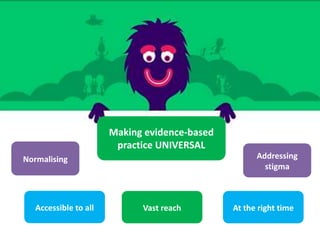
Making evidence-based
practice UNIVERSAL
Normalising
At the right time
Addressing
stigma
Vast reachAccessible to all
What are aims?
1. Decrease stigma
2. Normalising unusual experiences in this age-range.
3. Improve Knowledge
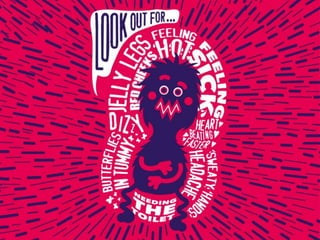
Children will know how to spot clues or signs that things are not right
(body language, facial expression, behavior and body signs).
Children will be better able to link thoughts, feelings and behaviours.
Children will be better able to differentiate what is a thought, feeling
and behavior
4. Increase awareness of different coping strategies
5. Improve ability to identify types of thoughts
6. Improve emotional well-being in those who need it most
7. Improve behavior in those whose behavior is problematic to start with
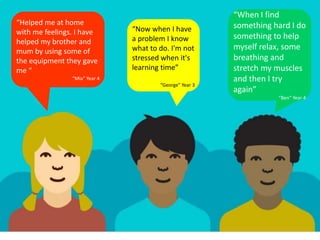
“Now when I have
a problem I know
what to do. I'm not
stressed when it's
learning time”
“George” Year 3
“Helped me at home
with me feelings. I have
helped my brother and
mum by using some of
the equipment they gave
me “
“Mia” Year 4
“When I find
something hard I do
something to help
myself relax, some
breathing and
stretch my muscles
and then I try
again”
“Ben” Year 4
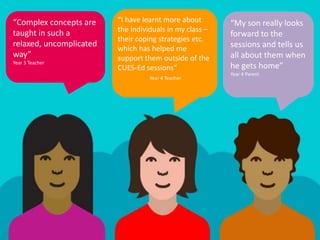
“I have learnt more about
the individuals in my class –
their coping strategies etc.
which has helped me
support them outside of the
CUES-Ed sessions”
Year 4 Teacher
“Complex concepts are
taught in such a
relaxed, uncomplicated
way”
Year 3 Teacher
“My son really looks
forward to the
sessions and tells us
all about them when
he gets home”
Year 4 Parent
Does it work?
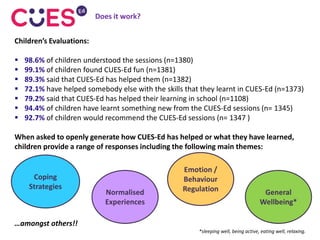
Children’s Evaluations:
 98.6% of children understood the sessions (n=1380)
 99.1% of children found CUES-Ed fun (n=1381)
 89.3% said that CUES-Ed has helped them (n=1382)
 72.1% have helped somebody else with the skills that they learnt in CUES-Ed (n=1373)
 79.2% said that CUES-Ed has helped their learning in school (n=1108)
 94.4% of children have learnt something new from the CUES-Ed sessions (n= 1345)
 92.7% of children would recommend the CUES-Ed sessions (n= 1347 )
When asked to openly generate how CUES-Ed has helped or what they have learned,
children provide a range of responses including the following main themes:
…amongst others!!
*sleeping well, being active, eating well, relaxing.
Coping
Strategies
Normalised
Experiences
Emotion /
Behaviour
Regulation General
Wellbeing*
Does it work?
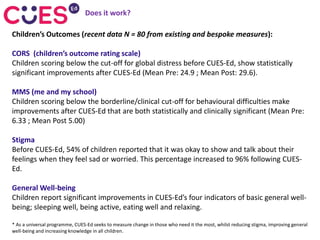
Children’s Outcomes (recent data N = 80 from existing and bespoke measures):
CORS (children’s outcome rating scale)
Children scoring below the cut-off for global distress before CUES-Ed, show statistically
significant improvements after CUES-Ed (Mean Pre: 24.9 ; Mean Post: 29.6).
MMS (me and my school)
Children scoring below the borderline/clinical cut-off for behavioural difficulties make
improvements after CUES-Ed that are both statistically and clinically significant (Mean Pre:
6.33 ; Mean Post 5.00)
Stigma
Before CUES-Ed, 54% of children reported that it was okay to show and talk about their
feelings when they feel sad or worried. This percentage increased to 96% following CUES-
Ed.
General Well-being
Children report significant improvements in CUES-Ed’s four indicators of basic general well-
being; sleeping well, being active, eating well and relaxing.
* As a universal programme, CUES-Ed seeks to measure change in those who need it the most, whilst reducing stigma, improving general
well-being and increasing knowledge in all children.
CUES ED. Children and Young People's National Conference 2017

CUES ED. Children and Young People's National Conference 2017

  • 3.
    • Lifetime ratesof significant anxiety - approximately 20% of children under 16 (Costello et al, 2003). DoH (2004) 1 in 10 children aged 5-16 clinically diagnosable mental health condition • Emotional and behavioural difficulties in childhood increase vulnerabilty across multiple areas in adulthood • NSPCC 2015- 20% of referrals to CAMHS are rejected. • As childhood anxiety persists and increases risks of other disorders -depression, illicit drug use and links with educational underachievement. • Huge impact on learning and behaviour • Evidence base for psychological interventions improving emotional resilience is growing – FRIENDS Prevalence of anxiety in children
  • 4.
    • Future inMind 2015 recommended focus on ‘resilience building’ urging health organisations to work with schools to promote well- being and reduce stigma. • Start psycho-education and building resilience early • The normalising approach of the intervention is out of keeping with our experience • Mental health and emotional vulnerability aren’t spoken about at school • A lot of stigma still surrounds mental health issues amongst our peer groups • All highlights the need for a universal approach to delivery. • Whole class approach can become a whole school approach Why ?
  • 5.
    o ‘Who IAm and What I Can’: How to Keep My Brain Amazing aims to improve emotional wellbeing and resilience in primary aged children o 6 session whole class intervention o developed by SLAM Clinical Psychologists and CBT therapists o help children recognise and talk about how they feel and to develop simple coping strategies o engaging and interactive sessions drawing on a range of multi-media sources and embedded with evidence-based CBT practice o working with culturally diverse populations How?
  • 6.
    Making evidence- based practice UNIVERSAL Makingevidence-based practice UNIVERSAL Normalising At the right time Addressing stigma Vast reachAccessible to all
  • 7.
    What are aims? 1.Decrease stigma 2. Normalising unusual experiences in this age-range. 3. Improve Knowledge Children will know how to spot clues or signs that things are not right (body language, facial expression, behavior and body signs). Children will be better able to link thoughts, feelings and behaviours. Children will be better able to differentiate what is a thought, feeling and behavior 4. Increase awareness of different coping strategies 5. Improve ability to identify types of thoughts 6. Improve emotional well-being in those who need it most 7. Improve behavior in those whose behavior is problematic to start with
  • 11.
    “Now when Ihave a problem I know what to do. I'm not stressed when it's learning time” “George” Year 3 “Helped me at home with me feelings. I have helped my brother and mum by using some of the equipment they gave me “ “Mia” Year 4 “When I find something hard I do something to help myself relax, some breathing and stretch my muscles and then I try again” “Ben” Year 4
  • 12.
    “I have learntmore about the individuals in my class – their coping strategies etc. which has helped me support them outside of the CUES-Ed sessions” Year 4 Teacher “Complex concepts are taught in such a relaxed, uncomplicated way” Year 3 Teacher “My son really looks forward to the sessions and tells us all about them when he gets home” Year 4 Parent
  • 13.
    Does it work? Children’sEvaluations:  98.6% of children understood the sessions (n=1380)  99.1% of children found CUES-Ed fun (n=1381)  89.3% said that CUES-Ed has helped them (n=1382)  72.1% have helped somebody else with the skills that they learnt in CUES-Ed (n=1373)  79.2% said that CUES-Ed has helped their learning in school (n=1108)  94.4% of children have learnt something new from the CUES-Ed sessions (n= 1345)  92.7% of children would recommend the CUES-Ed sessions (n= 1347 ) When asked to openly generate how CUES-Ed has helped or what they have learned, children provide a range of responses including the following main themes: …amongst others!! *sleeping well, being active, eating well, relaxing. Coping Strategies Normalised Experiences Emotion / Behaviour Regulation General Wellbeing*
  • 14.
    Does it work? Children’sOutcomes (recent data N = 80 from existing and bespoke measures): CORS (children’s outcome rating scale) Children scoring below the cut-off for global distress before CUES-Ed, show statistically significant improvements after CUES-Ed (Mean Pre: 24.9 ; Mean Post: 29.6). MMS (me and my school) Children scoring below the borderline/clinical cut-off for behavioural difficulties make improvements after CUES-Ed that are both statistically and clinically significant (Mean Pre: 6.33 ; Mean Post 5.00) Stigma Before CUES-Ed, 54% of children reported that it was okay to show and talk about their feelings when they feel sad or worried. This percentage increased to 96% following CUES- Ed. General Well-being Children report significant improvements in CUES-Ed’s four indicators of basic general well- being; sleeping well, being active, eating well and relaxing. * As a universal programme, CUES-Ed seeks to measure change in those who need it the most, whilst reducing stigma, improving general well-being and increasing knowledge in all children.