Harvard Medical School
Do Adolescents with Eating
Disorders Ever Get Well?
David B. Herzog, M.D.
Prevalence in Youth
 Anorexia nervosa and bulimia nervosa are rare in
children and adolescents (<4%)
 Eating disorder symptoms may be more common
 Typical eating disorders far more common in
females than males
 Criteria for diagnoses are same in youth, but
symptom profiles may differ
Symptom Presentation in Youth
 Denial of symptoms high
 Difficulty expressing/understanding motivation
for low weight/restriction/bingeing/purging
 Desire to be “healthy” often
 May begin as
 Diet
 Physical illness (e.g., flu)
 Fear of choking/stomach or GI pain
Sociocultural Factors
 Media images
 Celebrities (Selena Gomez, Taylor Swift, Miley Cyrus)
 TV (Pretty Little Liars, Gossip Girl, Disney channel)
 Cultural pressures to be slim
 Anti-obesity programs, messages
 Technology
 Pro-eating disorder websites
 Facebook, Twitter, Tumblr
 Teasing and harassment
Taylor Swift
Cast of Pretty Little Liars (CW)
Miley Cyrus
aka Hannah Montana
Assessment ToolsAssessment Tools
 Clinical InterviewsClinical Interviews
 Collateral contact with parents, treatmentCollateral contact with parents, treatment
team (including pediatrician)team (including pediatrician)
 Structured InterviewsStructured Interviews
 Eating Disorder Examination (child version)Eating Disorder Examination (child version)
 SCIDSCID
 Self-report QuestionnairesSelf-report Questionnaires
 EDE-QEDE-Q
 Beck Depression InventoryBeck Depression Inventory
 Anxiety questionnaires?Anxiety questionnaires?
Psychiatric ComorbidityPsychiatric Comorbidity
 DepressionDepression
 Anxiety disordersAnxiety disorders
 OCDOCD
 GADGAD
 Social PhobiaSocial Phobia
 Substance use disordersSubstance use disorders
 Dissociative disordersDissociative disorders
 KleptomaniaKleptomania
 Personality disordersPersonality disorders
TreatmentTreatment
 TeamTeam
 Multi-modalMulti-modal
 Continuum of ServicesContinuum of Services
 Safety ContractSafety Contract
Treatment ModalitiesTreatment Modalities
 PsychotherapyPsychotherapy
 IndividualIndividual
 GroupGroup
 Family TherapyFamily Therapy
 PharmacotherapyPharmacotherapy
 Nutritional CounselingNutritional Counseling
 Medical ManagementMedical Management
For whom, what?For whom, what?
 Assessment guides treatment decisionAssessment guides treatment decision
 Acute hospitalizationAcute hospitalization
 Residential treatmentResidential treatment
 Partial hospitalizationPartial hospitalization
 Intensive outpatientIntensive outpatient
 Outpatient treatmentOutpatient treatment
Clinical ToolsClinical Tools
 Be informed but allow patient to educate youBe informed but allow patient to educate you
 Allow the control to reside with patient as muchAllow the control to reside with patient as much
as possibleas possible
 Be active, respectful, courteous, puzzledBe active, respectful, courteous, puzzled
 Take some chancesTake some chances
Clinical ToolsClinical Tools
(continued)(continued)
 Anticipate:Anticipate:
 MistrustMistrust
 IntellectualizationIntellectualization
 DenialDenial
 LyingLying
 Be aware that many ED symptoms may beBe aware that many ED symptoms may be
benignbenign
 Be aware that some body imageBe aware that some body image
disturbance may persistdisturbance may persist
Addressing Denial andAddressing Denial and
Low MotivationLow Motivation
 Small statureSmall stature
 Confusion aboutConfusion about
why others perceivewhy others perceive
them as being toothem as being too
thinthin
 LonelinessLoneliness
 Family tensionFamily tension
 Boredom in routinesBoredom in routines
 Lack of pleasureLack of pleasure
 Domination of life byDomination of life by
thoughts about bodythoughts about body
 OsteoporosisOsteoporosis
 Brain MRIBrain MRI
Look for “windows in” to building alliance:Look for “windows in” to building alliance:
Family-Based Treatment (FBT)
 FBT for children and adolescent AN patients
with a short duration of illness is promising
 Most patients respond favorably after relatively
few outpatient treatment sessions
 FBT as effective in brief form as in longer form;
in conjoint form as in separated form
 The beneficial effects of FBT are sustained at 4-
5 year follow-up
Key Tenets of FBT
 Agnostic view AN etiology
 Parents not to blame, no guilt (not no anxiety!)
 Therapist does not pathologize or look for etiology
 Initial focus on symptoms (Pragmatic)
 Efforts on understanding devpt. of sxs and problem-solving on
how to change them
 Parents are responsible for weight restoration
(Empowerment)
 Family is a resource with skills and investment to help ill child
 Non-authoritarian therapeutic stance (Joining)
 Therapist is expert consultant
 Separation of child and illness (Respect for adolescent)
 Externalization of illness
Three Phases of Treatment
 Phase I (Sessions 1-10):
 Parents restore their child’s weight
 Phase II (Sessions 11-16):
 Transfer control back to adolescent
 Phase III (Sessions 17-20):
 Adolescent development issues
 Termination
Session Two (Family meal)
 Goals:
 Assess family structure as it may affect ability of
parents to refeed patient
 Provide opportunity for parents to successfully feed
patient
 Assess family process during eating
 Interventions:
 Family meal
 One more bite
 Coaching parents to work together
 Aligning patient with siblings for support
 Challenges:
 No meal!, parents not united
Comparing FBT with Systemic FT
for Adolescent AN
 Duration of Rx 9 months
 Remission rates for FBT 33% at end of Rx & 41% at 12-
month follow-up
 Corresponding rates for SyFT 25% & 39%
 Both Rx equally effective in terms of weight gain
 Family-based therapy led to faster weight
gain early in Rx, fewer days in hospital, & lower Rx
costs per patient at end of Rx
Agras, WS et al., JAMA Psychiatry, 2014
Cognitive Behavioral Therapy
 Psychoeducation and self-monitoring
 Building a personalized formulation
 Establishing regular eating
 Preventing relapse
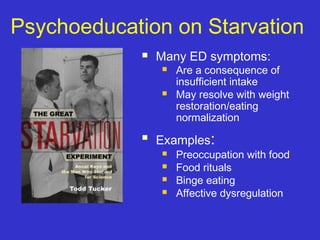
Psychoeducation on Starvation
 Many ED symptoms:
 Are a consequence of
insufficient intake
 May resolve with weight
restoration/eating
normalization
 Examples:
 Preoccupation with food
 Food rituals
 Binge eating
 Affective dysregulation
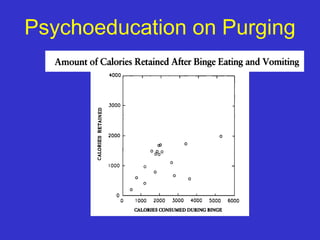
Psychoeducation on Purging
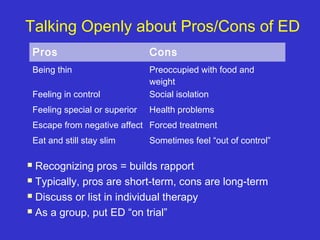
Talking Openly about Pros/Cons of ED
 Recognizing pros = builds rapport
 Typically, pros are short-term, cons are long-term
 Discuss or list in individual therapy
 As a group, put ED “on trial”
Pros Cons
Being thin Preoccupied with food and
weight
Feeling in control Social isolation
Feeling special or superior Health problems
Escape from negative affect Forced treatment
Eat and still stay slim Sometimes feel “out of control”
Form is More Important than Content
 Prescribe regular meal pattern
 3 meals + 2 snacks
 Let patient choose foods
 Even if they choose “diet” foods at first
 Form is more important than content early on
 Soothing post-meal activities are helpful
 To distract attention from post-prandial fullness (AN)
 To prevent post-meal purging (BN)
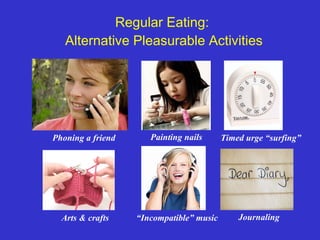
Regular Eating:
Alternative Pleasurable Activities
Phoning a friend Painting nails Timed urge “surfing”
Arts & crafts “Incompatible” music Journaling
Preventing Relapse
 Disabuse patients of model that one is always “in
recovery”
 This is not what the data show
 Full recovery is possible!
 Realistically anticipate that urges to engage in ED
behaviors may return during stressful life transitions
 Identify upcoming stressors
 Make plan for dealing with each
 Resume self-monitoring exercises
 Return to therapy
Pharmacotherapy for AN
No significant clinical effects with:
Amitriptyline (Biederman et al., 1985)
Risperidone (Hagman et al., 2011)
Olanzapine (Kafantaris et al., 2011)
Pharmacotherapy for BN
 SSRIs for adult bulimia nervosa:
 Fluoxetine most studied, safe and effective
 Sertraline effective
 Fluvoxamine effective
 No controlled studies with paroxetine
 For adolescent bulimia nervosa:
 Only one open trial with fluoxetine (Kotler et al 2003)
 ED symptoms improved after 8 wks of treatment
 Medication generally well-tolerated
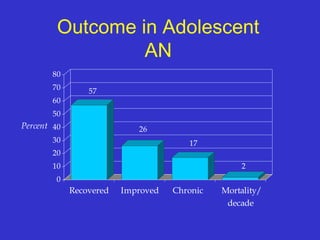
Outcome in Adolescent
AN
57
26
17
2
0
10
20
30
40
50
60
70
80
Percent
Recovered Improved Chronic Mortality/
decade
Course & OutcomeCourse & Outcome
“What am I going to
be like in 1, 2, 5, or 10 years,
whether I have treatment or I don’t?”
Longitudinal Study of Anorexia
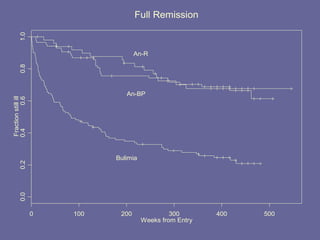
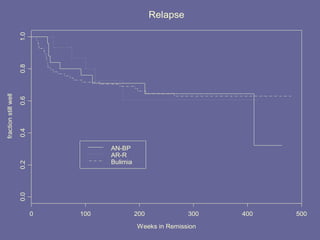
and Bulimia Nervosa
 Initiated in 1987
 Longitudinal project mapping the course and
outcome of eating disorders
 246 treatment-seeking adolescent & adult women
with AN or BN followed for 25 years and
interviewed semi–annually
 Prospective study with naturalistic design
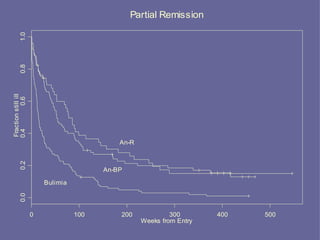
0 100 200 300 400 500
0.00.20.40.60.81.0
Partial RemissionFractionstillill
Weeks from Entry
Bulimia
An-BP
An-R
0 100 200 300 400 500
0.00.20.40.60.81.0
Partial RemissionFractionstillill
Weeks from Entry
Bulimia
An-BP
An-R
0 100 200 300 400 500
0.00.20.40.60.81.0
Full RemissionFractionstillill
Weeks from Entry
Bulimia
An-BP
An-R
Weeks in Remission
fractionstillwell
0 100 200 300 400 500
0.00.20.40.60.81.0
AN-BP
AR-R
Bulimia
Relapse
Mortality
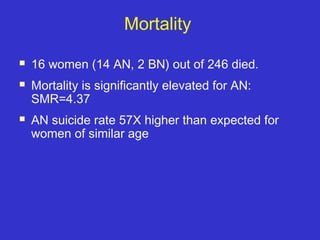
 16 women (14 AN, 2 BN) out of 246 died.
 Mortality is significantly elevated for AN:
SMR=4.37
 AN suicide rate 57X higher than expected for
women of similar age
“To say that I recovered during that time
applies primarily to the clinical side of
things. And to say that the more
complicated, internal struggles
vanished along with the preoccupation
– the daily battle with things like
closeness, vulnerability, and anger –
would be a lie.
Am I rigid and ritualistic about
food these days? No. But am I rigid
about other things? Exercise? Work?
My daily routines? Absolutely.
Anorexia is no longer what I am,
but it is – and I believe I can say this
with acceptance, rather than regret –
a part of who I am.”
- Knapp, C.
The Phoenix
1/24/92

Do Adolescents with Eating Disorders Ever Get Well?

  • 1.
    Harvard Medical School DoAdolescents with Eating Disorders Ever Get Well? David B. Herzog, M.D.
  • 3.
    Prevalence in Youth Anorexia nervosa and bulimia nervosa are rare in children and adolescents (<4%)  Eating disorder symptoms may be more common  Typical eating disorders far more common in females than males  Criteria for diagnoses are same in youth, but symptom profiles may differ
  • 4.
    Symptom Presentation inYouth  Denial of symptoms high  Difficulty expressing/understanding motivation for low weight/restriction/bingeing/purging  Desire to be “healthy” often  May begin as  Diet  Physical illness (e.g., flu)  Fear of choking/stomach or GI pain
  • 5.
    Sociocultural Factors  Mediaimages  Celebrities (Selena Gomez, Taylor Swift, Miley Cyrus)  TV (Pretty Little Liars, Gossip Girl, Disney channel)  Cultural pressures to be slim  Anti-obesity programs, messages  Technology  Pro-eating disorder websites  Facebook, Twitter, Tumblr  Teasing and harassment
  • 6.
    Taylor Swift Cast ofPretty Little Liars (CW) Miley Cyrus aka Hannah Montana
  • 7.
    Assessment ToolsAssessment Tools Clinical InterviewsClinical Interviews  Collateral contact with parents, treatmentCollateral contact with parents, treatment team (including pediatrician)team (including pediatrician)  Structured InterviewsStructured Interviews  Eating Disorder Examination (child version)Eating Disorder Examination (child version)  SCIDSCID  Self-report QuestionnairesSelf-report Questionnaires  EDE-QEDE-Q  Beck Depression InventoryBeck Depression Inventory  Anxiety questionnaires?Anxiety questionnaires?
  • 9.
    Psychiatric ComorbidityPsychiatric Comorbidity DepressionDepression  Anxiety disordersAnxiety disorders  OCDOCD  GADGAD  Social PhobiaSocial Phobia  Substance use disordersSubstance use disorders  Dissociative disordersDissociative disorders  KleptomaniaKleptomania  Personality disordersPersonality disorders
  • 10.
    TreatmentTreatment  TeamTeam  Multi-modalMulti-modal Continuum of ServicesContinuum of Services  Safety ContractSafety Contract
  • 11.
    Treatment ModalitiesTreatment Modalities PsychotherapyPsychotherapy  IndividualIndividual  GroupGroup  Family TherapyFamily Therapy  PharmacotherapyPharmacotherapy  Nutritional CounselingNutritional Counseling  Medical ManagementMedical Management
  • 12.
    For whom, what?Forwhom, what?  Assessment guides treatment decisionAssessment guides treatment decision  Acute hospitalizationAcute hospitalization  Residential treatmentResidential treatment  Partial hospitalizationPartial hospitalization  Intensive outpatientIntensive outpatient  Outpatient treatmentOutpatient treatment
  • 13.
    Clinical ToolsClinical Tools Be informed but allow patient to educate youBe informed but allow patient to educate you  Allow the control to reside with patient as muchAllow the control to reside with patient as much as possibleas possible  Be active, respectful, courteous, puzzledBe active, respectful, courteous, puzzled  Take some chancesTake some chances
  • 14.
    Clinical ToolsClinical Tools (continued)(continued) Anticipate:Anticipate:  MistrustMistrust  IntellectualizationIntellectualization  DenialDenial  LyingLying  Be aware that many ED symptoms may beBe aware that many ED symptoms may be benignbenign  Be aware that some body imageBe aware that some body image disturbance may persistdisturbance may persist
  • 15.
    Addressing Denial andAddressingDenial and Low MotivationLow Motivation  Small statureSmall stature  Confusion aboutConfusion about why others perceivewhy others perceive them as being toothem as being too thinthin  LonelinessLoneliness  Family tensionFamily tension  Boredom in routinesBoredom in routines  Lack of pleasureLack of pleasure  Domination of life byDomination of life by thoughts about bodythoughts about body  OsteoporosisOsteoporosis  Brain MRIBrain MRI Look for “windows in” to building alliance:Look for “windows in” to building alliance:
  • 16.
    Family-Based Treatment (FBT) FBT for children and adolescent AN patients with a short duration of illness is promising  Most patients respond favorably after relatively few outpatient treatment sessions  FBT as effective in brief form as in longer form; in conjoint form as in separated form  The beneficial effects of FBT are sustained at 4- 5 year follow-up
  • 17.
    Key Tenets ofFBT  Agnostic view AN etiology  Parents not to blame, no guilt (not no anxiety!)  Therapist does not pathologize or look for etiology  Initial focus on symptoms (Pragmatic)  Efforts on understanding devpt. of sxs and problem-solving on how to change them  Parents are responsible for weight restoration (Empowerment)  Family is a resource with skills and investment to help ill child  Non-authoritarian therapeutic stance (Joining)  Therapist is expert consultant  Separation of child and illness (Respect for adolescent)  Externalization of illness
  • 18.
    Three Phases ofTreatment  Phase I (Sessions 1-10):  Parents restore their child’s weight  Phase II (Sessions 11-16):  Transfer control back to adolescent  Phase III (Sessions 17-20):  Adolescent development issues  Termination
  • 19.
    Session Two (Familymeal)  Goals:  Assess family structure as it may affect ability of parents to refeed patient  Provide opportunity for parents to successfully feed patient  Assess family process during eating  Interventions:  Family meal  One more bite  Coaching parents to work together  Aligning patient with siblings for support  Challenges:  No meal!, parents not united
  • 20.
    Comparing FBT withSystemic FT for Adolescent AN  Duration of Rx 9 months  Remission rates for FBT 33% at end of Rx & 41% at 12- month follow-up  Corresponding rates for SyFT 25% & 39%  Both Rx equally effective in terms of weight gain  Family-based therapy led to faster weight gain early in Rx, fewer days in hospital, & lower Rx costs per patient at end of Rx Agras, WS et al., JAMA Psychiatry, 2014
  • 21.
    Cognitive Behavioral Therapy Psychoeducation and self-monitoring  Building a personalized formulation  Establishing regular eating  Preventing relapse
  • 22.
    Psychoeducation on Starvation Many ED symptoms:  Are a consequence of insufficient intake  May resolve with weight restoration/eating normalization  Examples:  Preoccupation with food  Food rituals  Binge eating  Affective dysregulation
  • 23.
  • 24.
    Talking Openly aboutPros/Cons of ED  Recognizing pros = builds rapport  Typically, pros are short-term, cons are long-term  Discuss or list in individual therapy  As a group, put ED “on trial” Pros Cons Being thin Preoccupied with food and weight Feeling in control Social isolation Feeling special or superior Health problems Escape from negative affect Forced treatment Eat and still stay slim Sometimes feel “out of control”
  • 25.
    Form is MoreImportant than Content  Prescribe regular meal pattern  3 meals + 2 snacks  Let patient choose foods  Even if they choose “diet” foods at first  Form is more important than content early on  Soothing post-meal activities are helpful  To distract attention from post-prandial fullness (AN)  To prevent post-meal purging (BN)
  • 26.
    Regular Eating: Alternative PleasurableActivities Phoning a friend Painting nails Timed urge “surfing” Arts & crafts “Incompatible” music Journaling
  • 27.
    Preventing Relapse  Disabusepatients of model that one is always “in recovery”  This is not what the data show  Full recovery is possible!  Realistically anticipate that urges to engage in ED behaviors may return during stressful life transitions  Identify upcoming stressors  Make plan for dealing with each  Resume self-monitoring exercises  Return to therapy
  • 28.
    Pharmacotherapy for AN Nosignificant clinical effects with: Amitriptyline (Biederman et al., 1985) Risperidone (Hagman et al., 2011) Olanzapine (Kafantaris et al., 2011)
  • 29.
    Pharmacotherapy for BN SSRIs for adult bulimia nervosa:  Fluoxetine most studied, safe and effective  Sertraline effective  Fluvoxamine effective  No controlled studies with paroxetine  For adolescent bulimia nervosa:  Only one open trial with fluoxetine (Kotler et al 2003)  ED symptoms improved after 8 wks of treatment  Medication generally well-tolerated
  • 30.
  • 31.
    Course & OutcomeCourse& Outcome “What am I going to be like in 1, 2, 5, or 10 years, whether I have treatment or I don’t?”
  • 32.
    Longitudinal Study ofAnorexia and Bulimia Nervosa  Initiated in 1987  Longitudinal project mapping the course and outcome of eating disorders  246 treatment-seeking adolescent & adult women with AN or BN followed for 25 years and interviewed semi–annually  Prospective study with naturalistic design
  • 33.
    0 100 200300 400 500 0.00.20.40.60.81.0 Partial RemissionFractionstillill Weeks from Entry Bulimia An-BP An-R 0 100 200 300 400 500 0.00.20.40.60.81.0 Partial RemissionFractionstillill Weeks from Entry Bulimia An-BP An-R
  • 34.
    0 100 200300 400 500 0.00.20.40.60.81.0 Full RemissionFractionstillill Weeks from Entry Bulimia An-BP An-R
  • 35.
    Weeks in Remission fractionstillwell 0100 200 300 400 500 0.00.20.40.60.81.0 AN-BP AR-R Bulimia Relapse
  • 36.
    Mortality  16 women(14 AN, 2 BN) out of 246 died.  Mortality is significantly elevated for AN: SMR=4.37  AN suicide rate 57X higher than expected for women of similar age
  • 37.
    “To say thatI recovered during that time applies primarily to the clinical side of things. And to say that the more complicated, internal struggles vanished along with the preoccupation – the daily battle with things like closeness, vulnerability, and anger – would be a lie. Am I rigid and ritualistic about food these days? No. But am I rigid about other things? Exercise? Work? My daily routines? Absolutely. Anorexia is no longer what I am, but it is – and I believe I can say this with acceptance, rather than regret – a part of who I am.” - Knapp, C. The Phoenix 1/24/92