SOCIETY
Compiled by:
Rana Zahid Zulfiqar
PhD Scholar Sociology
Government College University, Faisalabad.
Visiting Lecturer Sociology, Bahauddin
Zakariya University Multan, Pakistan
ranazahidzulfiqar@gmail.com
SOCIETY
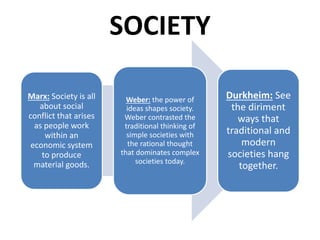
Marx: Society is all
about social
conflict that arises
as people work
within an
economic system
to produce
material goods.
Weber: the power of
ideas shapes society.
Weber contrasted the
traditional thinking of
simple societies with
the rational thought
that dominates complex
societies today.
Durkheim: See
the diriment
ways that
traditional and
modern
societies hang
together.
SOCIETY
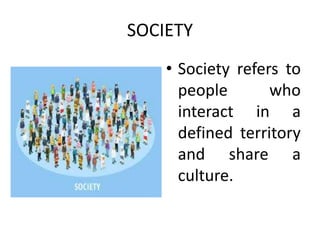
• Society refers to
people who
interact in a
defined territory
and share a
culture.
CHARACTERISTICS OF SOCIETY
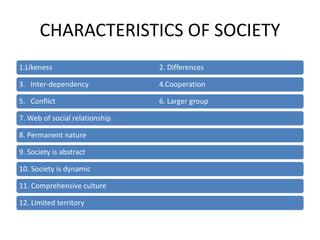
1.Likeness 2. Differences
3. Inter-dependency 4.Cooperation
5. Conflict 6. Larger group
7. Web of social relationship
8. Permanent nature
9. Society is abstract
10. Society is dynamic
11. Comprehensive culture
12. Limited territory
GERHARD LENSKI: SOCIETY AND
TECHNOLOGY
It describe how
technological
development has
shaped the history
of human
societies.
Lenshki uses the
term sociocultural
evolution to mean
changes that occur
as a society gains
new technology.
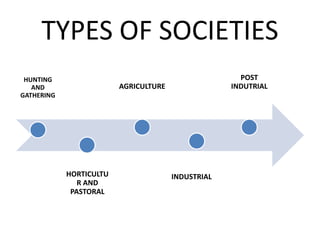
TYPES OF SOCIETIES
HUNTING
AND
GATHERING
HORTICULTU
R AND
PASTORAL
AGRICULTURE
INDUSTRIAL
POST
INDUTRIAL
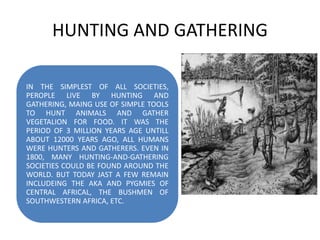
HUNTING AND GATHERING
IN THE SIMPLEST OF ALL SOCIETIES,
PEROPLE LIVE BY HUNTING AND
GATHERING, MAING USE OF SIMPLE TOOLS
TO HUNT ANIMALS AND GATHER
VEGETALION FOR FOOD. IT WAS THE
PERIOD OF 3 MILLION YEARS AGE UNTILL
ABOUT 12000 YEARS AGO, ALL HUMANS
WERE HUNTERS AND GATHERERS. EVEN IN
1800, MANY HUNTING-AND-GATHERING
SOCIETIES COULD BE FOUND AROUND THE
WORLD. BUT TODAY JAST A FEW REMAIN
INCLUDEING THE AKA AND PYGMIES OF
CENTRAL AFRICAL, THE BUSHMEN OF
SOUTHWESTERN AFRICA, ETC.
CHARACTERISTICS OF HUNTING AND
GATHERING SOCIETIES
Little ability to control their environment
Spend most of their time looking for game and collecting plants to eat.
Nomadic
Depend on the family to obtain and distribute food, to protect its
members and teach their children about life.
Spent most of the time in searching next meal.
CHARACTERISTICS OF HUNTING AND
GATHERING SOCIETIES
Majority of the work performed by young people,
whereas old and younger helped them.
Women gathered vegetation
They have a Shamans/ spiritual person who
enjoyed a high prestige but has to work to find
food like everyone else.
Used simple weapons (the spear, bow and arrow

and stone knife).
HORTICULTURE AND PASTORAL
SOCIETIES
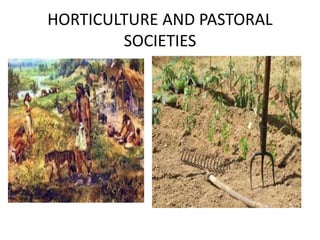
Some 10000 to 12000 years age, a new technology began
to change the lives of human beings. People developed to
change the lives of human beings. People developed
horticulture , the use of hand tools to raise crops. Using a
hoe t o work the soil and digging stick to punch holes in
the ground to plant seeds may not seem like something
that would change the world, but these inventions
allowed people to give up gathering in favor of growing
food for themselves.
They started to breed the animals properly as well.
HORTICULTURE AND PASTORAL
SOCIETIES
HORTICULTURE AND PASTORAL
SOCIETIES
Today, societies that mix horticulture and pastoralism can
be found throughout South America, Africa and Asia.
Horticulturalist more likely to believe on One God
The pastoral roots of Judaism, Christianity and
Muslims.
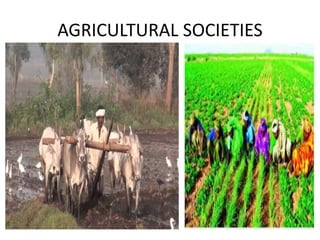
AGRICULTURAL SOCIETIES
About 5000 years age, another revolution in technology
was taking place in the Middle East, one that would end
up changing life of Earth. This was the emergence of
agriculture, large-scale cultivation using plows harnessed
to animals or more powerful energy sources. So,
important was the invention of the animals or more
powerful energy sources. So important was he invention
of the animal-drawn plow, along with other
breakthroughs of the period-including irrigation, the
wheel, writing, numbers and the use of various metals-
that this moment in history is often called the “dawn of
civilization”.
AGRICULTURAL SOCIETIES
INDUSTRIAL SOCIETIES
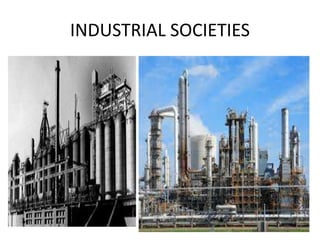
Dominated by machines and advanced technologies to produce
and distribute foods and services.
Industrial revolution processed began in Britain and then spread
through Europe and to the rest of the world, industrial societies
started to develop.
The growth of technologies led to advances in farming techniques,
so slavery lost its significance, economy developed quickly and
understanding of social charity and governments’ aid grew up.
INDUSTRIAL SOCIETIES
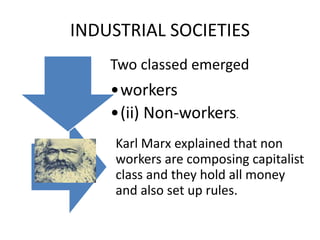
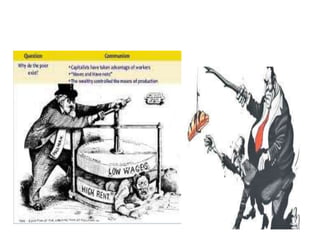
Two classed emerged
•workers
•(ii) Non-workers.
Karl Marx explained that non
workers are composing capitalist
class and they hold all money
and also set up rules.
POSTINDUSTRIAL SOCIETIES
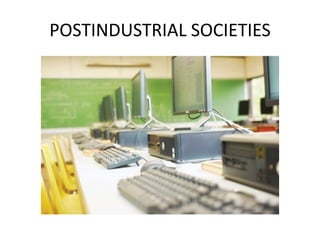
The countries that the industrial
revolution began, Britain, French,
USA and Japan- now became the
postindustrial countries. These
countries are users of advance
technologies like developed
computers, satellites, microchips.
POSTINDUSTRIAL SOCIETIES
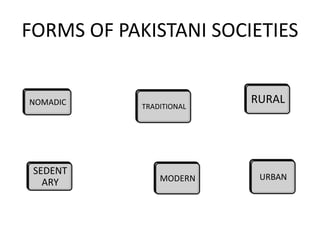
FORMS OF PAKISTANI SOCIETIES
NOMADIC
SEDENT
ARY
TRADITIONAL
MODERN
RURAL
URBAN
NOMADIC SOCIETY
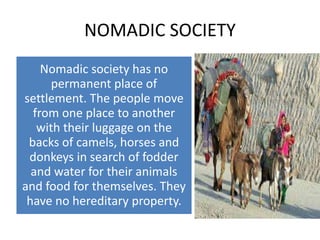
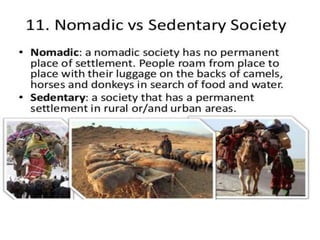
Nomadic society has no
permanent place of
settlement. The people move
from one place to another
with their luggage on the
backs of camels, horses and
donkeys in search of fodder
and water for their animals
and food for themselves. They
have no hereditary property.
CHARACTERISTICS OF NOMADIC
SOCIETY
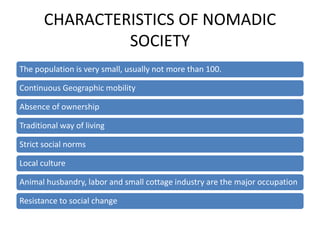
The population is very small, usually not more than 100.
Continuous Geographic mobility
Absence of ownership
Traditional way of living
Strict social norms
Local culture
Animal husbandry, labor and small cottage industry are the major occupation
Resistance to social change
CHARACTERISTICS OF SEDENTARY
SOCIETY
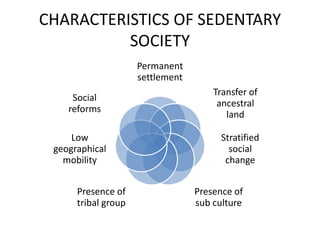
Permanent
settlement
Transfer of
ancestral
land
Stratified
social
change
Presence of
sub culture
Presence of
tribal group
Low
geographical
mobility
Social
reforms
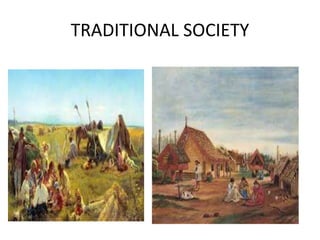
TRADITIONAL SOCIETY
Traditional is that society which has
informal and simple social institutions.
Traditional cultural values are prevailed
in this society. Means of
communication and transportation are
very slow and old. Social change are
gradual take place and almost invisible.
TRADITIONAL SOCIETY
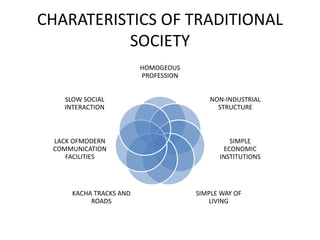
CHARATERISTICS OF TRADITIONAL
SOCIETY
HOMOGEOUS
PROFESSION
NON-INDUSTRIAL
STRUCTURE
SIMPLE
ECONOMIC
INSTITUTIONS
SIMPLE WAY OF
LIVING
KACHA TRACKS AND
ROADS
LACK OFMODERN
COMMUNICATION
FACILITIES
SLOW SOCIAL
INTERACTION
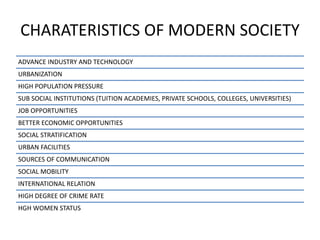
CHARATERISTICS OF MODERN SOCIETY
ADVANCE INDUSTRY AND TECHNOLOGY
URBANIZATION
HIGH POPULATION PRESSURE
SUB SOCIAL INSTITUTIONS (TUITION ACADEMIES, PRIVATE SCHOOLS, COLLEGES, UNIVERSITIES)
JOB OPPORTUNITIES
BETTER ECONOMIC OPPORTUNITIES
SOCIAL STRATIFICATION
URBAN FACILITIES
SOURCES OF COMMUNICATION
SOCIAL MOBILITY
INTERNATIONAL RELATION
HIGH DEGREE OF CRIME RATE
HGH WOMEN STATUS
MODERN SOCIETY
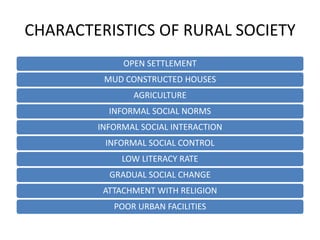
CHARACTERISTICS OF RURAL SOCIETY
OPEN SETTLEMENT
MUD CONSTRUCTED HOUSES
AGRICULTURE
INFORMAL SOCIAL NORMS
INFORMAL SOCIAL INTERACTION
INFORMAL SOCIAL CONTROL
LOW LITERACY RATE
GRADUAL SOCIAL CHANGE
ATTACHMENT WITH RELIGION
POOR URBAN FACILITIES
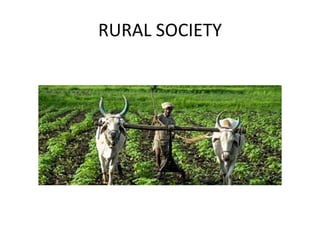
RURAL SOCIETY
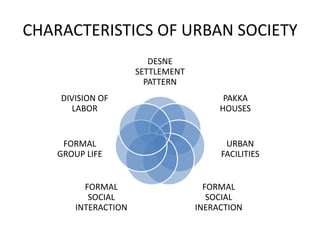
CHARACTERISTICS OF URBAN SOCIETY
DESNE
SETTLEMENT
PATTERN
PAKKA
HOUSES
URBAN
FACILITIES
FORMAL
SOCIAL
INERACTION
FORMAL
SOCIAL
INTERACTION
FORMAL
GROUP LIFE
DIVISION OF
LABOR
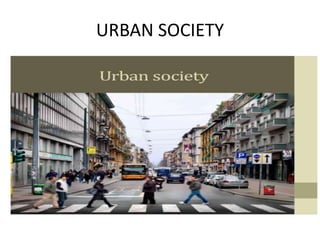
URBAN SOCIETY
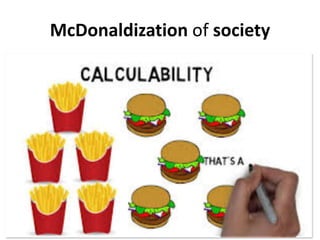
McDonaldization of society
• McDonaldization of society is a phenomenon
that occurs when society, its institutions, and
its organizations are adapted to have the same
characteristics that are found in fast-food
chains. These include efficiency, calculability,
predictability and standardization, and
control.
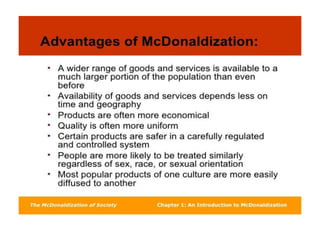
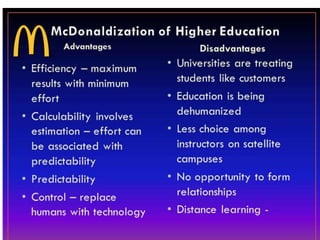
McDonaldization of society
THANK YOU

Lecture 6. society

  • 1.
    SOCIETY Compiled by: Rana ZahidZulfiqar PhD Scholar Sociology Government College University, Faisalabad. Visiting Lecturer Sociology, Bahauddin Zakariya University Multan, Pakistan ranazahidzulfiqar@gmail.com
  • 2.
    SOCIETY Marx: Society isall about social conflict that arises as people work within an economic system to produce material goods. Weber: the power of ideas shapes society. Weber contrasted the traditional thinking of simple societies with the rational thought that dominates complex societies today. Durkheim: See the diriment ways that traditional and modern societies hang together.
  • 3.
    SOCIETY • Society refersto people who interact in a defined territory and share a culture.
  • 4.
    CHARACTERISTICS OF SOCIETY 1.Likeness2. Differences 3. Inter-dependency 4.Cooperation 5. Conflict 6. Larger group 7. Web of social relationship 8. Permanent nature 9. Society is abstract 10. Society is dynamic 11. Comprehensive culture 12. Limited territory
  • 5.
    GERHARD LENSKI: SOCIETYAND TECHNOLOGY It describe how technological development has shaped the history of human societies. Lenshki uses the term sociocultural evolution to mean changes that occur as a society gains new technology.
  • 6.
    TYPES OF SOCIETIES HUNTING AND GATHERING HORTICULTU RAND PASTORAL AGRICULTURE INDUSTRIAL POST INDUTRIAL
  • 7.
    HUNTING AND GATHERING INTHE SIMPLEST OF ALL SOCIETIES, PEROPLE LIVE BY HUNTING AND GATHERING, MAING USE OF SIMPLE TOOLS TO HUNT ANIMALS AND GATHER VEGETALION FOR FOOD. IT WAS THE PERIOD OF 3 MILLION YEARS AGE UNTILL ABOUT 12000 YEARS AGO, ALL HUMANS WERE HUNTERS AND GATHERERS. EVEN IN 1800, MANY HUNTING-AND-GATHERING SOCIETIES COULD BE FOUND AROUND THE WORLD. BUT TODAY JAST A FEW REMAIN INCLUDEING THE AKA AND PYGMIES OF CENTRAL AFRICAL, THE BUSHMEN OF SOUTHWESTERN AFRICA, ETC.
  • 8.
    CHARACTERISTICS OF HUNTINGAND GATHERING SOCIETIES Little ability to control their environment Spend most of their time looking for game and collecting plants to eat. Nomadic Depend on the family to obtain and distribute food, to protect its members and teach their children about life. Spent most of the time in searching next meal.
  • 9.
    CHARACTERISTICS OF HUNTINGAND GATHERING SOCIETIES Majority of the work performed by young people, whereas old and younger helped them. Women gathered vegetation They have a Shamans/ spiritual person who enjoyed a high prestige but has to work to find food like everyone else. Used simple weapons (the spear, bow and arrow and stone knife).
  • 10.
    HORTICULTURE AND PASTORAL SOCIETIES Some10000 to 12000 years age, a new technology began to change the lives of human beings. People developed to change the lives of human beings. People developed horticulture , the use of hand tools to raise crops. Using a hoe t o work the soil and digging stick to punch holes in the ground to plant seeds may not seem like something that would change the world, but these inventions allowed people to give up gathering in favor of growing food for themselves. They started to breed the animals properly as well.
  • 11.
  • 12.
    HORTICULTURE AND PASTORAL SOCIETIES Today,societies that mix horticulture and pastoralism can be found throughout South America, Africa and Asia. Horticulturalist more likely to believe on One God The pastoral roots of Judaism, Christianity and Muslims.
  • 13.
    AGRICULTURAL SOCIETIES About 5000years age, another revolution in technology was taking place in the Middle East, one that would end up changing life of Earth. This was the emergence of agriculture, large-scale cultivation using plows harnessed to animals or more powerful energy sources. So, important was the invention of the animals or more powerful energy sources. So important was he invention of the animal-drawn plow, along with other breakthroughs of the period-including irrigation, the wheel, writing, numbers and the use of various metals- that this moment in history is often called the “dawn of civilization”.
  • 14.
  • 15.
    INDUSTRIAL SOCIETIES Dominated bymachines and advanced technologies to produce and distribute foods and services. Industrial revolution processed began in Britain and then spread through Europe and to the rest of the world, industrial societies started to develop. The growth of technologies led to advances in farming techniques, so slavery lost its significance, economy developed quickly and understanding of social charity and governments’ aid grew up.
  • 16.
  • 17.
    INDUSTRIAL SOCIETIES Two classedemerged •workers •(ii) Non-workers. Karl Marx explained that non workers are composing capitalist class and they hold all money and also set up rules.
  • 19.
    POSTINDUSTRIAL SOCIETIES The countriesthat the industrial revolution began, Britain, French, USA and Japan- now became the postindustrial countries. These countries are users of advance technologies like developed computers, satellites, microchips.
  • 20.
  • 21.
    FORMS OF PAKISTANISOCIETIES NOMADIC SEDENT ARY TRADITIONAL MODERN RURAL URBAN
  • 22.
    NOMADIC SOCIETY Nomadic societyhas no permanent place of settlement. The people move from one place to another with their luggage on the backs of camels, horses and donkeys in search of fodder and water for their animals and food for themselves. They have no hereditary property.
  • 24.
    CHARACTERISTICS OF NOMADIC SOCIETY Thepopulation is very small, usually not more than 100. Continuous Geographic mobility Absence of ownership Traditional way of living Strict social norms Local culture Animal husbandry, labor and small cottage industry are the major occupation Resistance to social change
  • 25.
    CHARACTERISTICS OF SEDENTARY SOCIETY Permanent settlement Transferof ancestral land Stratified social change Presence of sub culture Presence of tribal group Low geographical mobility Social reforms
  • 26.
    TRADITIONAL SOCIETY Traditional isthat society which has informal and simple social institutions. Traditional cultural values are prevailed in this society. Means of communication and transportation are very slow and old. Social change are gradual take place and almost invisible.
  • 27.
  • 28.
    CHARATERISTICS OF TRADITIONAL SOCIETY HOMOGEOUS PROFESSION NON-INDUSTRIAL STRUCTURE SIMPLE ECONOMIC INSTITUTIONS SIMPLEWAY OF LIVING KACHA TRACKS AND ROADS LACK OFMODERN COMMUNICATION FACILITIES SLOW SOCIAL INTERACTION
  • 29.
    CHARATERISTICS OF MODERNSOCIETY ADVANCE INDUSTRY AND TECHNOLOGY URBANIZATION HIGH POPULATION PRESSURE SUB SOCIAL INSTITUTIONS (TUITION ACADEMIES, PRIVATE SCHOOLS, COLLEGES, UNIVERSITIES) JOB OPPORTUNITIES BETTER ECONOMIC OPPORTUNITIES SOCIAL STRATIFICATION URBAN FACILITIES SOURCES OF COMMUNICATION SOCIAL MOBILITY INTERNATIONAL RELATION HIGH DEGREE OF CRIME RATE HGH WOMEN STATUS
  • 30.
  • 31.
    CHARACTERISTICS OF RURALSOCIETY OPEN SETTLEMENT MUD CONSTRUCTED HOUSES AGRICULTURE INFORMAL SOCIAL NORMS INFORMAL SOCIAL INTERACTION INFORMAL SOCIAL CONTROL LOW LITERACY RATE GRADUAL SOCIAL CHANGE ATTACHMENT WITH RELIGION POOR URBAN FACILITIES
  • 32.
  • 33.
    CHARACTERISTICS OF URBANSOCIETY DESNE SETTLEMENT PATTERN PAKKA HOUSES URBAN FACILITIES FORMAL SOCIAL INERACTION FORMAL SOCIAL INTERACTION FORMAL GROUP LIFE DIVISION OF LABOR
  • 34.
  • 35.
    McDonaldization of society •McDonaldization of society is a phenomenon that occurs when society, its institutions, and its organizations are adapted to have the same characteristics that are found in fast-food chains. These include efficiency, calculability, predictability and standardization, and control.
  • 38.
  • 39.