Preparing Spain for the digital
transformation
Carlos López Blanco
Telefónica S.A.
14th March 2017
Setting the Scene: The Digital Economy and the
Next Production Revolution
OECD and Fundación Ramón Areces workshop
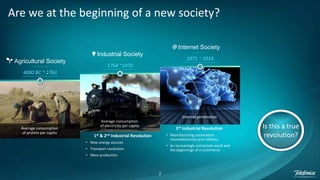
2
3rd Industrial Revolution
• Manufacturing automation:
microelectronics and robotics
• An increasingly connected world and
the beginnings of e-Commerce
1st & 2nd Industrial Revolution
• New energy sources
• Transport revolution
• Mass production
4000 BC ~ 1763
Agricultural Society
Average consumption
of protein per capita
1764 ~1970
Industrial Society
Average consumption
of electricity per capita
1971 ~ 2014
Internet Society
Internet penetration
Is this a true
revolution?
Are we at the beginning of a new society?
3
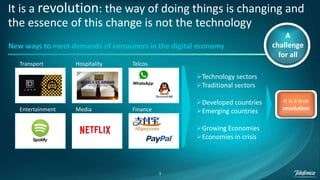
Technology sectors
Traditional sectors
Developed countries
Emerging countries
Growing Economies
Economies in crisis
New ways to meet demands of consumers in the digital economy
Transport Hospitality Telcos
Entertainment Media Finance
A
challenge
for all
It is a true
revolution
It is a revolution: the way of doing things is changing and
the essence of this change is not the technology
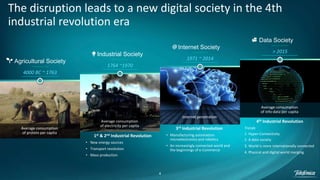
4
4th Industrial Revolution
Trends
1. Hyper-Connectivity
2. A data society
3. World is more internationally connected
4. Physical and digital world merging
3rd Industrial Revolution
• Manufacturing automation:
microelectronics and robotics
• An increasingly connected world and
the beginnings of e-Commerce
1st & 2nd Industrial Revolution
• New energy sources
• Transport revolution
• Mass production
4000 BC ~ 1763
Agricultural Society
Average consumption
of protein per capita
1764 ~1970
Industrial Society
Average consumption
of electricity per capita
1971 ~ 2014
Internet Society
Internet penetration
> 2015
Data Society
Average consumption
of info-data per capita
The disruption leads to a new digital society in the 4th
industrial revolution era
5
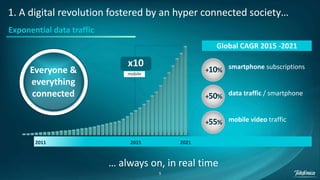
1. A digital revolution fostered by an hyper connected society…
Global CAGR 2015 -2021
+10% smartphone subscriptions
+50% data traffic / smartphone
+55% mobile video traffic
x10
mobile
2015 20212011
Exponential data traffic
Everyone &
everything
connected
… always on, in real time
6
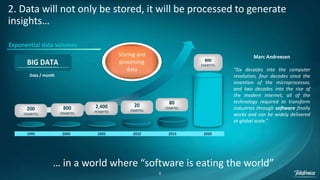
2. Data will not only be stored, it will be processed to generate
insights…
… in a world where “software is eating the world”
Marc Andreesen
“Six decades into the computer
revolution, four decades since the
invention of the microprocessor,
and two decades into the rise of
the modern Internet, all of the
technology required to transform
industries through software finally
works and can be widely delivered
at global scale.”
7
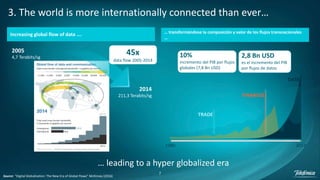
3. The world is more internationally connected than ever…
… leading to a hyper globalized era
2005
4,7 Terabits/sg
2014
211,3 Terabits/sg
Increasing global flow of data ….
1980 2014
TRADE
FINANCES
DATA
10%
incremento del PIB por flujos
globales (7,8 Bn USD)
2,8 Bn USD
es el incremento del PIB
por flujos de datos
Source: “Digital Globalization: The New Era of Global Flows” McKinsey (2016)
… transformándose la composición y valor de los flujos transnacionales
…
45x
data flow 2005-2014
8
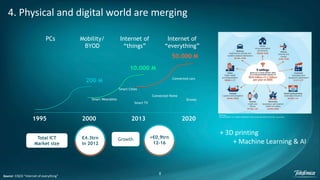
4. Physical and digital world are merging
Growth
200 M
10.000 M
50.000 M
1995 2000 2013 2020
PCs Mobility/
BYOD
Internet of
“things”
Internet of
“everything”
Smart TV
Smart Wearables
Connected cars
Smart Cities
Drones
Connected Home
€4.3trn
in 2012
Total ICT
Market size
+€0,9trn
12-16
Source: CISCO “Internet of everything”
+ 3D printing
+ Machine Learning & AI
McKinsey.
THE INTERNET OF THINGS: MAPPING THE VALUE BEYOND THE HYPE. Junio 2015
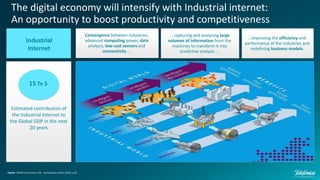
The digital economy will intensify with Industrial internet:
An opportunity to boost productivity and competitiveness
Fuente: Telefónica en base a GE - Annunziata y Evans (2012, p.9)
Convergence between industries,
advanced computing power, data
analysis, low-cost sensors and
connectivity ...
… capturing and analysing large
volumes of information from the
machines to transform it into
predictive analysis ...
…improving the efficiency and
performance of the industries and
redefining business models.
15 Tn $
Estimated contribution of
the Industrial Internet to
the Global GDP in the next
20 years
Industrial
Internet
10
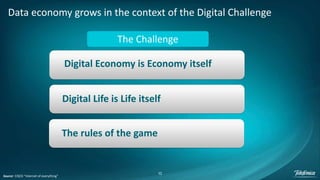
Data economy grows in the context of the Digital Challenge
Source: CISCO “Internet of everything”
The Challenge
The rules of the game
Digital Economy is Economy itself
Digital Life is Life itself
11
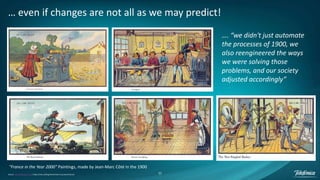
… even if changes are not all as we may predict!
Source: The Washington Post / https://ines.io/blog/wired-brain-ai-powered-future
…. “we didn't just automate
the processes of 1900, we
also reengineered the ways
we were solving those
problems, and our society
adjusted accordingly”
"France in the Year 2000“ Paintings, made by Jean-Marc Côté in the 1900
Challenges of the Digital
Transformation
13
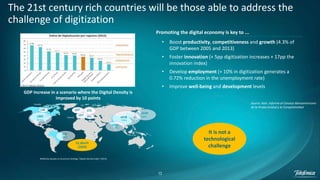
The 21st century rich countries will be those able to address the
challenge of digitization
$365
$75
$418
$114
$57
$57
$97
$41
$101
$38
$1,36mTr
(2020)
Japón
China
India
EE.UU.
Brasil
Canadá UK Alemania
Francia
Italia
Telefónica basado en Accenture Strategy “Digital Density Index” (2015).
GDP increase in a scenario where the Digital Density is
improved by 10 points
Promoting the digital economy is key to ...
• Boost productivity, competitiveness and growth (4.3% of
GDP between 2005 and 2013)
• Foster innovation (+ 5pp digitization increases + 17pp the
innovation index)
• Develop employment (+ 10% in digitization generates a
0.72% reduction in the unemployment rate)
• Improve well-being and development levels
Source. Katz. Informe al Consejo Iberoamericano
de la Productividad y la Competitividad
It is not a
technological
challenge
14
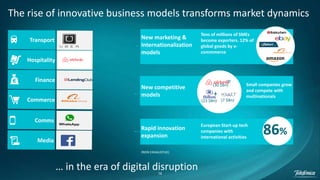
The rise of innovative business models transforms market dynamics
New marketing &
Internationalization
models
Rapid innovation
expansion
New competitive
models
Tens of millions of SMEs
become exporters. 12% of
global goods by e-
commmerce
=
+
Small companies grow
and compete with
multinationals
European Start-up tech
companies with
international activities
86%
(30 $Bn)
(23 $Bn) (7 $Bn)
… in the era of digital disruption
15
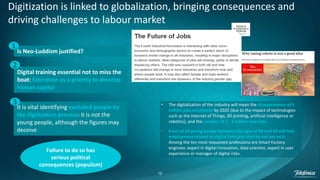
Digitization is linked to globalization, bringing consequences and
driving challenges to labour market
Is Neo-Luddism justified?
Digital training essential not to miss the
boat: Education as a priority to develop
human capital
It is vital identifying excluded people by
the digitization process: it is not the
young people, although the figures may
deceive
1
2
3
Failure to do so has
serious political
consequences (populism)
• The digitalization of the industry will mean the disappearance of 5
million jobs worldwide by 2020 (due to the impact of technologies
such as the Internet of Things, 3D printing, artificial intelligence or
robotics), and the creation of 2 , 1 million new jobs.
• 8 out of 10 young people between the ages of 20 and 30 will find
employment related to digital field jobs that do not yet exist.
Among the ten most requested professions are Smart Factory
engineer, expert in digital innovation, data scientist, expert in user
experience or manager of digital risks.
16
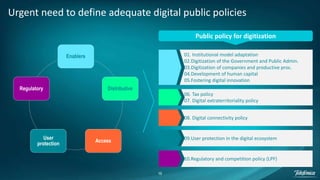
Urgent need to define adequate digital public policies
Enablers
Distributive
Access
User
protection
Regulatory
Public policy for digitization
06. Tax policy
07. Digital extraterritoriality policy
01. Institutional model adaptation
02.Digitization of the Government and Public Admin.
03.Digitization of companies and productive proc.
04.Development of human capital
05.Fostering digital innovation
08. Digital connectivity policy
09.User protection in the digital ecosystem
10.Regulatory and competition policy (LPF)
17
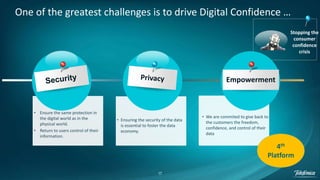
• Ensure the same protection in
the digital world as in the
physical world.
• Return to users control of their
information.
• Ensuring the security of the data
is essential to foster the data
economy.
• We are commited to give back to
the customers the freedom,
confidence, and control of their
data
One of the greatest challenges is to drive Digital Confidence …
Stopping the
consumer
confidence
crisis
4th
Platform
Empowerment
18
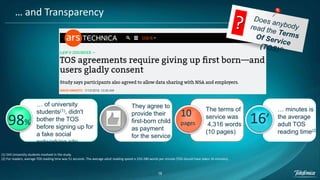
… and Transparency
98%
… of university
students(1), didn't
bother the TOS
before signing up for
a fake social
networking site
They agree to
provide their
first-born child
as payment
for the service
10
pages
The terms of
service was
4,316 words
(10 pages)
16’
… minutes is
the average
adult TOS
reading time(2)
(1) 543 University students involved in the study.
(2) For readers, average TOS reading time was 51 seconds. The average adult reading speed is 250-280 words per minute (TOS should have taken 16 minutes).
19
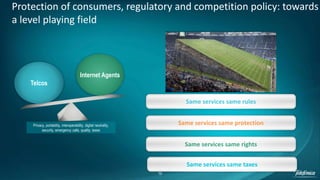
Protection of consumers, regulatory and competition policy: towards
a level playing field
Same services same rules
Same services same protection
Same services same rights
Internet Agents
Telcos
Privacy, portability, interoperability, digital neutrality,
security, emergency calls, quality, taxes
Same services same taxes
In this context, what is the state of
digitalisation in Spain?
1
4
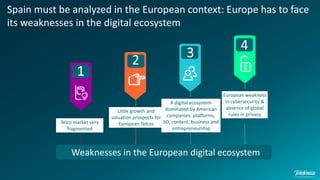
Spain must be analyzed in the European context: Europe has to face
its weaknesses in the digital ecosystem
2
Weaknesses in the European digital ecosystem
3
Telco market very
fragmented
Little growth and
valuation prospects for
European Telcos
A digital ecosystem
dominated by American
companies: platforms,
SO, content, business and
entrepreneurship
European weakness
in cybersecurity &
absence of global
rules in privacy
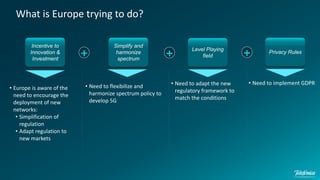
What is Europe trying to do?
Incentive to
Innovation &
Investment
Simplify and
harmonize
spectrum
Level Playing
field+ +
• Need to flexibilize and
harmonize spectrum policy to
develop 5G
• Need to adapt the new
regulatory framework to
match the conditions
• Europe is aware of the
need to encourage the
deployment of new
networks:
• Simplification of
regulation
• Adapt regulation to
new markets
Privacy Rules
+
• Need to implement GDPR
23
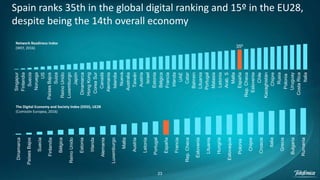
Spain ranks 35th in the global digital ranking and 15º in the EU28,
despite being the 14th overall economy
15º
Dinamarca
PaísesBajos
Suecia
Finlandia
Bélgica
ReinoUnido
Estonia
Irlanda
Alemania
Luxemburgo
Malta
Austria
Letonia
Portugal
España
Francia
Rep.Checa
Eslovenia
Lituania
Hungría
Eslovaquia
Polonia
Chipre
Croacia
Italia
Grecia
Bulgaria
Rumania
35º
Singapur
Finlandia
Suecia
Noruega
US
PaísesBajos
Suiza
ReinoUnido
Luxemburgo
Japón
Dinamarca
HongKong
CoreaSur
Canadá
Alemania
Islandia
Nueva…
Australia
Taiwán
Austria
Israel
Estonia
Bélgica
Francia
Irlanda
UAE
Catar
Bahrein
Lituania
Portugal
Malasia
Letonia
Arab.S
Malta
España
Rep.Checa
Eslovenia
Chile
Kazaghistán
Chipre
Rusia
Polonia
Uruguay
CostaRica
Italia
Network Readiness Index
(WEF, 2016)
The Digital Economy and Society Index (DESI), UE28
(Comisión Europea, 2016)
24
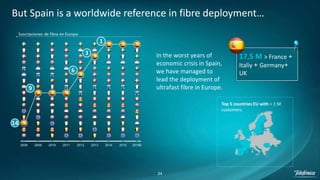
But Spain is a worldwide reference in fibre deployment…
17,5 M > France +
Italiy + Germany+
UK
In the worst years of
economic crisis in Spain,
we have managed to
lead the deployment of
ultrafast fibre in Europe.
Top 5 countries EU with > 1 M
customers
25
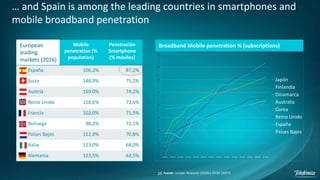
… and Spain is among the leading countries in smartphones and
mobile broadband penetration
0
20
40
60
80
100
120
140
160
2009-04 2010-Q2 2010-Q4 2011-Q2 2011-Q4 2012-Q2 2012-Q4 2013-Q2 2013-Q4 2014-Q2 2014-Q4 2015-Q2 2015-Q4 2016-Q2
Japón
Finlandia
Dinamarca
Australia
Corea
Reino Unido
España
Países Bajos
Mobile
penetration (%
population)
Penetración
Smartphone
(% móviles)
España 106,2% 87,2%
Suiza 148,9% 75,2%
Austria 159,0% 74,2%
Reino Unido 118,6% 73,6%
Francia 102,0% 71,5%
Noruega 98,2% 71,1%
Países Bajos 112,9% 70,8%
Italia 123,0% 68,0%
Alemania 123,5% 63,5%
Broadband Mobile penetration % (subscriptions)European
leading
markets (2016)
Fuente: Juniper Research (2016) y OCDE (2017)
26
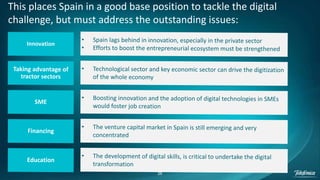
This places Spain in a good base position to tackle the digital
challenge, but must address the outstanding issues:
27
The digitization is a great
opportunity for Spain
Carlos López Blanco-La nueva revolución de la producción: la transformación digital

Carlos López Blanco-La nueva revolución de la producción: la transformación digital

  • 1.
    Preparing Spain forthe digital transformation Carlos López Blanco Telefónica S.A. 14th March 2017 Setting the Scene: The Digital Economy and the Next Production Revolution OECD and Fundación Ramón Areces workshop
  • 2.
    2 3rd Industrial Revolution •Manufacturing automation: microelectronics and robotics • An increasingly connected world and the beginnings of e-Commerce 1st & 2nd Industrial Revolution • New energy sources • Transport revolution • Mass production 4000 BC ~ 1763 Agricultural Society Average consumption of protein per capita 1764 ~1970 Industrial Society Average consumption of electricity per capita 1971 ~ 2014 Internet Society Internet penetration Is this a true revolution? Are we at the beginning of a new society?
  • 3.
    3 Technology sectors Traditional sectors Developedcountries Emerging countries Growing Economies Economies in crisis New ways to meet demands of consumers in the digital economy Transport Hospitality Telcos Entertainment Media Finance A challenge for all It is a true revolution It is a revolution: the way of doing things is changing and the essence of this change is not the technology
  • 4.
    4 4th Industrial Revolution Trends 1.Hyper-Connectivity 2. A data society 3. World is more internationally connected 4. Physical and digital world merging 3rd Industrial Revolution • Manufacturing automation: microelectronics and robotics • An increasingly connected world and the beginnings of e-Commerce 1st & 2nd Industrial Revolution • New energy sources • Transport revolution • Mass production 4000 BC ~ 1763 Agricultural Society Average consumption of protein per capita 1764 ~1970 Industrial Society Average consumption of electricity per capita 1971 ~ 2014 Internet Society Internet penetration > 2015 Data Society Average consumption of info-data per capita The disruption leads to a new digital society in the 4th industrial revolution era
  • 5.
    5 1. A digitalrevolution fostered by an hyper connected society… Global CAGR 2015 -2021 +10% smartphone subscriptions +50% data traffic / smartphone +55% mobile video traffic x10 mobile 2015 20212011 Exponential data traffic Everyone & everything connected … always on, in real time
  • 6.
    6 2. Data willnot only be stored, it will be processed to generate insights… … in a world where “software is eating the world” Marc Andreesen “Six decades into the computer revolution, four decades since the invention of the microprocessor, and two decades into the rise of the modern Internet, all of the technology required to transform industries through software finally works and can be widely delivered at global scale.”
  • 7.
    7 3. The worldis more internationally connected than ever… … leading to a hyper globalized era 2005 4,7 Terabits/sg 2014 211,3 Terabits/sg Increasing global flow of data …. 1980 2014 TRADE FINANCES DATA 10% incremento del PIB por flujos globales (7,8 Bn USD) 2,8 Bn USD es el incremento del PIB por flujos de datos Source: “Digital Globalization: The New Era of Global Flows” McKinsey (2016) … transformándose la composición y valor de los flujos transnacionales … 45x data flow 2005-2014
  • 8.
    8 4. Physical anddigital world are merging Growth 200 M 10.000 M 50.000 M 1995 2000 2013 2020 PCs Mobility/ BYOD Internet of “things” Internet of “everything” Smart TV Smart Wearables Connected cars Smart Cities Drones Connected Home €4.3trn in 2012 Total ICT Market size +€0,9trn 12-16 Source: CISCO “Internet of everything” + 3D printing + Machine Learning & AI McKinsey. THE INTERNET OF THINGS: MAPPING THE VALUE BEYOND THE HYPE. Junio 2015
  • 9.
    The digital economywill intensify with Industrial internet: An opportunity to boost productivity and competitiveness Fuente: Telefónica en base a GE - Annunziata y Evans (2012, p.9) Convergence between industries, advanced computing power, data analysis, low-cost sensors and connectivity ... … capturing and analysing large volumes of information from the machines to transform it into predictive analysis ... …improving the efficiency and performance of the industries and redefining business models. 15 Tn $ Estimated contribution of the Industrial Internet to the Global GDP in the next 20 years Industrial Internet
  • 10.
    10 Data economy growsin the context of the Digital Challenge Source: CISCO “Internet of everything” The Challenge The rules of the game Digital Economy is Economy itself Digital Life is Life itself
  • 11.
    11 … even ifchanges are not all as we may predict! Source: The Washington Post / https://ines.io/blog/wired-brain-ai-powered-future …. “we didn't just automate the processes of 1900, we also reengineered the ways we were solving those problems, and our society adjusted accordingly” "France in the Year 2000“ Paintings, made by Jean-Marc Côté in the 1900
  • 12.
    Challenges of theDigital Transformation
  • 13.
    13 The 21st centuryrich countries will be those able to address the challenge of digitization $365 $75 $418 $114 $57 $57 $97 $41 $101 $38 $1,36mTr (2020) Japón China India EE.UU. Brasil Canadá UK Alemania Francia Italia Telefónica basado en Accenture Strategy “Digital Density Index” (2015). GDP increase in a scenario where the Digital Density is improved by 10 points Promoting the digital economy is key to ... • Boost productivity, competitiveness and growth (4.3% of GDP between 2005 and 2013) • Foster innovation (+ 5pp digitization increases + 17pp the innovation index) • Develop employment (+ 10% in digitization generates a 0.72% reduction in the unemployment rate) • Improve well-being and development levels Source. Katz. Informe al Consejo Iberoamericano de la Productividad y la Competitividad It is not a technological challenge
  • 14.
    14 The rise ofinnovative business models transforms market dynamics New marketing & Internationalization models Rapid innovation expansion New competitive models Tens of millions of SMEs become exporters. 12% of global goods by e- commmerce = + Small companies grow and compete with multinationals European Start-up tech companies with international activities 86% (30 $Bn) (23 $Bn) (7 $Bn) … in the era of digital disruption
  • 15.
    15 Digitization is linkedto globalization, bringing consequences and driving challenges to labour market Is Neo-Luddism justified? Digital training essential not to miss the boat: Education as a priority to develop human capital It is vital identifying excluded people by the digitization process: it is not the young people, although the figures may deceive 1 2 3 Failure to do so has serious political consequences (populism) • The digitalization of the industry will mean the disappearance of 5 million jobs worldwide by 2020 (due to the impact of technologies such as the Internet of Things, 3D printing, artificial intelligence or robotics), and the creation of 2 , 1 million new jobs. • 8 out of 10 young people between the ages of 20 and 30 will find employment related to digital field jobs that do not yet exist. Among the ten most requested professions are Smart Factory engineer, expert in digital innovation, data scientist, expert in user experience or manager of digital risks.
  • 16.
    16 Urgent need todefine adequate digital public policies Enablers Distributive Access User protection Regulatory Public policy for digitization 06. Tax policy 07. Digital extraterritoriality policy 01. Institutional model adaptation 02.Digitization of the Government and Public Admin. 03.Digitization of companies and productive proc. 04.Development of human capital 05.Fostering digital innovation 08. Digital connectivity policy 09.User protection in the digital ecosystem 10.Regulatory and competition policy (LPF)
  • 17.
    17 • Ensure thesame protection in the digital world as in the physical world. • Return to users control of their information. • Ensuring the security of the data is essential to foster the data economy. • We are commited to give back to the customers the freedom, confidence, and control of their data One of the greatest challenges is to drive Digital Confidence … Stopping the consumer confidence crisis 4th Platform Empowerment
  • 18.
    18 … and Transparency 98% …of university students(1), didn't bother the TOS before signing up for a fake social networking site They agree to provide their first-born child as payment for the service 10 pages The terms of service was 4,316 words (10 pages) 16’ … minutes is the average adult TOS reading time(2) (1) 543 University students involved in the study. (2) For readers, average TOS reading time was 51 seconds. The average adult reading speed is 250-280 words per minute (TOS should have taken 16 minutes).
  • 19.
    19 Protection of consumers,regulatory and competition policy: towards a level playing field Same services same rules Same services same protection Same services same rights Internet Agents Telcos Privacy, portability, interoperability, digital neutrality, security, emergency calls, quality, taxes Same services same taxes
  • 20.
    In this context,what is the state of digitalisation in Spain?
  • 21.
    1 4 Spain must beanalyzed in the European context: Europe has to face its weaknesses in the digital ecosystem 2 Weaknesses in the European digital ecosystem 3 Telco market very fragmented Little growth and valuation prospects for European Telcos A digital ecosystem dominated by American companies: platforms, SO, content, business and entrepreneurship European weakness in cybersecurity & absence of global rules in privacy
  • 22.
    What is Europetrying to do? Incentive to Innovation & Investment Simplify and harmonize spectrum Level Playing field+ + • Need to flexibilize and harmonize spectrum policy to develop 5G • Need to adapt the new regulatory framework to match the conditions • Europe is aware of the need to encourage the deployment of new networks: • Simplification of regulation • Adapt regulation to new markets Privacy Rules + • Need to implement GDPR
  • 23.
    23 Spain ranks 35thin the global digital ranking and 15º in the EU28, despite being the 14th overall economy 15º Dinamarca PaísesBajos Suecia Finlandia Bélgica ReinoUnido Estonia Irlanda Alemania Luxemburgo Malta Austria Letonia Portugal España Francia Rep.Checa Eslovenia Lituania Hungría Eslovaquia Polonia Chipre Croacia Italia Grecia Bulgaria Rumania 35º Singapur Finlandia Suecia Noruega US PaísesBajos Suiza ReinoUnido Luxemburgo Japón Dinamarca HongKong CoreaSur Canadá Alemania Islandia Nueva… Australia Taiwán Austria Israel Estonia Bélgica Francia Irlanda UAE Catar Bahrein Lituania Portugal Malasia Letonia Arab.S Malta España Rep.Checa Eslovenia Chile Kazaghistán Chipre Rusia Polonia Uruguay CostaRica Italia Network Readiness Index (WEF, 2016) The Digital Economy and Society Index (DESI), UE28 (Comisión Europea, 2016)
  • 24.
    24 But Spain isa worldwide reference in fibre deployment… 17,5 M > France + Italiy + Germany+ UK In the worst years of economic crisis in Spain, we have managed to lead the deployment of ultrafast fibre in Europe. Top 5 countries EU with > 1 M customers
  • 25.
    25 … and Spainis among the leading countries in smartphones and mobile broadband penetration 0 20 40 60 80 100 120 140 160 2009-04 2010-Q2 2010-Q4 2011-Q2 2011-Q4 2012-Q2 2012-Q4 2013-Q2 2013-Q4 2014-Q2 2014-Q4 2015-Q2 2015-Q4 2016-Q2 Japón Finlandia Dinamarca Australia Corea Reino Unido España Países Bajos Mobile penetration (% population) Penetración Smartphone (% móviles) España 106,2% 87,2% Suiza 148,9% 75,2% Austria 159,0% 74,2% Reino Unido 118,6% 73,6% Francia 102,0% 71,5% Noruega 98,2% 71,1% Países Bajos 112,9% 70,8% Italia 123,0% 68,0% Alemania 123,5% 63,5% Broadband Mobile penetration % (subscriptions)European leading markets (2016) Fuente: Juniper Research (2016) y OCDE (2017)
  • 26.
    26 This places Spainin a good base position to tackle the digital challenge, but must address the outstanding issues:
  • 27.
    27 The digitization isa great opportunity for Spain

Editor's Notes

  • #10 The “Industrial Internet” goes beyond the concept of the “Everything connected”. It is an innovation wave transforming again the world as we know it today. It is a transformation wave that will impact at all levels, not being able today to imagine what kind of jobs or professions the market will be demanding in the future. To understand what Industrial Internet is and to explain in an easy way, Industrial Internet is “the marriage” between the previous other two revolutions: The industrial and the digital revolution. The rise of Intelligent machines, advanced Analytics, the era of Big Data. Traditional industries will transform into software companies, in order to capture and analyze the amounts of information coming from the intelligent machines to turn it into insights to enable predictive analysis and improve machines efficiency/performance. Digital and entrepreneurial skills are more relevant than ever. We are at the beginning of the digitalization process. WHAT DOES IT MEAN?