Technology, Society and  The Next Transformation Jonathan Murray WW Technology Officer, Public Sector Microsoft
 
 
Magna to lose production of  BMW SUV CBC News, May 16 th  2007 “ Magna International Inc. confirmed Wednesday that it will lose production of the BMW X3 mid-size sport utility vehicle in three years.” [BMW] CEO Norbert Reithofer said the shift in production to the United States was part of a strategy to reduce the risks associated with a falling U.S. dollar against the euro.


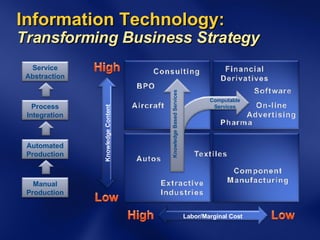
Information Technology:  Transforming Business Strategy Manual Production Automated Production Process Integration Service Abstraction Knowledge Content Labor/Marginal Cost Computable Services Knowledge Based Services
Increasing  computational power  and  networked infrastructures  are enabling a dramatic  transformation  in business models … And we’re only at the beginning!
Challenges and Opportunities Sources and location of value creation: Manufacturing    Services Local    Regional    Global Changing business models and competitive landscapes Accelerating demand for high level skills Balancing positive and negative social impact and policy issues
The future of information Technology
Prediction Horizons 3-5 Years :  Highly predictable Products already in development 5-10 Years :  Relatively Predictable Basic technologies identified 10-15 Years :  Non-predictable New basic technologies will disrupt Trends are the only guide
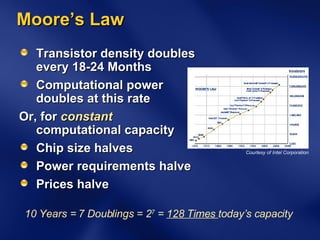
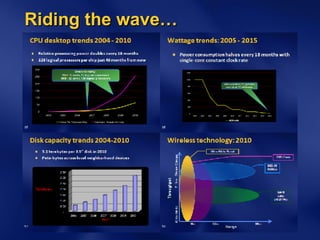
Moore’s Law Transistor density doubles every 18-24 Months Computational power doubles at this rate Or, for  constant  computational capacity Chip size halves Power requirements halve Prices halve 10 Years = 7 Doublings = 2 7  =  128 Times  today’s capacity Courtesy of Intel Corporation
Riding the wave…
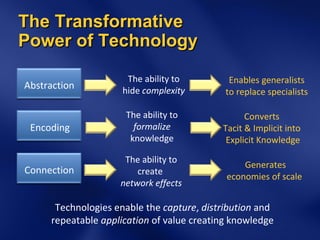
The Transformative Power of Technology Technologies enable the  capture ,  distribution  and repeatable  application  of value creating knowledge Connection Generates economies of scale  The ability to create  network effects Abstraction Enables generalists to replace specialists The ability to hide  complexity Encoding Converts  Tacit & Implicit into  Explicit Knowledge The ability to  formalize  knowledge
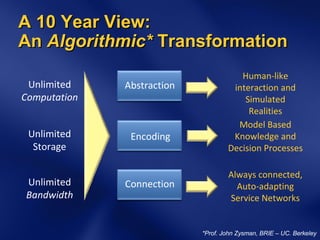
A 10 Year View: An  Algorithmic*  Transformation *Prof. John Zysman, BRIE – UC. Berkeley Encoding Abstraction Connection Always connected,  Auto-adapting Service Networks Human-like interaction and Simulated Realities Model Based Knowledge and Decision Processes Unlimited Computation Unlimited Storage Unlimited Bandwidth
“ Any sufficiently advanced technology is indistinguishable from magic. ” Arthur C. Clark "Profiles of The Future", 1961 (Clarke's third law)
The Politics of  Magic Will  social acceptance  issues limit our ability to tap technology’s  full potential  ? How will concepts of  liability  and personal  responsibility  evolve? What about  privacy ,  security  ,  identity : Will consumers continue to trade  privacy  for a  free lunch  ? What  skills  will be required to be fully economically  productive  ? Can the  developing world  catch up or does technology merely  amplify  the developed world’s existing  advantages ? Can  policy   makers  and  regulators  keep up?
Implications:  Business Strategy If it can be automated, it will be automated Labor cost may no longer drive manufacturing location Access to talent will increasingly be the primary driver of value creation Talent will demand new organizational structures and governance models
“ The illiterate of the 21 st  century will not be those who cannot read and write, but those who cannot learn, unlearn, and relearn ” Alvin Toffler
Implications:  Skills Much of today’s knowledge work will be automated  Knowledge workers will need to up-skill to remain economically relevant Countries/Regions will need to transform to attract the mobile, global talent Education systems will need to transform in order to produce economically viable talent
Implications:  Education Need to focus on developing higher level abstract thinking skills Learning as a personal responsibility:  Learning how to learn Abstract thinking:  Higher level math, music, second languages Information Discrimination:  Good from Bad, Truth from Fiction Teamwork :  Working in ad-hoc groups Communications:  Presentations skills, performance arts Deep implications for the classroom Teachers:  Evolving from gatekeepers of knowledge to learning coaches Students:  Using tools as an enabler of learning
National Innovation Strategy:  Quality of life matters  The  algorithmic  transformation will place increasing dependence on access to  talent This talent is  globally mobile  and will place a premium on  quality of life  issues Focus on creating an “ Intellectual Playground ” Opportunities for cross-disciplinary interaction Opportunities to “birth” ideas Participative decision making World class arts programs International schools …
Summary Massive increases in networked computational power will enable an “ Algorithmic ” transformation These new computational tools will have  major implications  for society, business models and skills Access to creative, conceptual, abstract thinking talent will drive national  economic advantage  and  global competitiveness National economic development strategies need to focus on  developing ,  retaining ,  attracting  and  enabling  this  globally mobile  talent

PresentacióN Murray IngléS

  • 1.
    Technology, Society and The Next Transformation Jonathan Murray WW Technology Officer, Public Sector Microsoft
  • 2.
  • 3.
  • 4.
    Magna to loseproduction of BMW SUV CBC News, May 16 th 2007 “ Magna International Inc. confirmed Wednesday that it will lose production of the BMW X3 mid-size sport utility vehicle in three years.” [BMW] CEO Norbert Reithofer said the shift in production to the United States was part of a strategy to reduce the risks associated with a falling U.S. dollar against the euro.
  • 5.
  • 6.
  • 7.
  • 8.
    Information Technology: Transforming Business Strategy Manual Production Automated Production Process Integration Service Abstraction Knowledge Content Labor/Marginal Cost Computable Services Knowledge Based Services
  • 9.
    Increasing computationalpower and networked infrastructures are enabling a dramatic transformation in business models … And we’re only at the beginning!
  • 10.
    Challenges and OpportunitiesSources and location of value creation: Manufacturing  Services Local  Regional  Global Changing business models and competitive landscapes Accelerating demand for high level skills Balancing positive and negative social impact and policy issues
  • 11.
    The future ofinformation Technology
  • 12.
    Prediction Horizons 3-5Years : Highly predictable Products already in development 5-10 Years : Relatively Predictable Basic technologies identified 10-15 Years : Non-predictable New basic technologies will disrupt Trends are the only guide
  • 13.
    Moore’s Law Transistordensity doubles every 18-24 Months Computational power doubles at this rate Or, for constant computational capacity Chip size halves Power requirements halve Prices halve 10 Years = 7 Doublings = 2 7 = 128 Times today’s capacity Courtesy of Intel Corporation
  • 14.
  • 15.
    The Transformative Powerof Technology Technologies enable the capture , distribution and repeatable application of value creating knowledge Connection Generates economies of scale The ability to create network effects Abstraction Enables generalists to replace specialists The ability to hide complexity Encoding Converts Tacit & Implicit into Explicit Knowledge The ability to formalize knowledge
  • 16.
    A 10 YearView: An Algorithmic* Transformation *Prof. John Zysman, BRIE – UC. Berkeley Encoding Abstraction Connection Always connected, Auto-adapting Service Networks Human-like interaction and Simulated Realities Model Based Knowledge and Decision Processes Unlimited Computation Unlimited Storage Unlimited Bandwidth
  • 17.
    “ Any sufficientlyadvanced technology is indistinguishable from magic. ” Arthur C. Clark "Profiles of The Future", 1961 (Clarke's third law)
  • 18.
    The Politics of Magic Will social acceptance issues limit our ability to tap technology’s full potential ? How will concepts of liability and personal responsibility evolve? What about privacy , security , identity : Will consumers continue to trade privacy for a free lunch ? What skills will be required to be fully economically productive ? Can the developing world catch up or does technology merely amplify the developed world’s existing advantages ? Can policy makers and regulators keep up?
  • 19.
    Implications: BusinessStrategy If it can be automated, it will be automated Labor cost may no longer drive manufacturing location Access to talent will increasingly be the primary driver of value creation Talent will demand new organizational structures and governance models
  • 20.
    “ The illiterateof the 21 st century will not be those who cannot read and write, but those who cannot learn, unlearn, and relearn ” Alvin Toffler
  • 21.
    Implications: SkillsMuch of today’s knowledge work will be automated Knowledge workers will need to up-skill to remain economically relevant Countries/Regions will need to transform to attract the mobile, global talent Education systems will need to transform in order to produce economically viable talent
  • 22.
    Implications: EducationNeed to focus on developing higher level abstract thinking skills Learning as a personal responsibility: Learning how to learn Abstract thinking: Higher level math, music, second languages Information Discrimination: Good from Bad, Truth from Fiction Teamwork : Working in ad-hoc groups Communications: Presentations skills, performance arts Deep implications for the classroom Teachers: Evolving from gatekeepers of knowledge to learning coaches Students: Using tools as an enabler of learning
  • 23.
    National Innovation Strategy: Quality of life matters The algorithmic transformation will place increasing dependence on access to talent This talent is globally mobile and will place a premium on quality of life issues Focus on creating an “ Intellectual Playground ” Opportunities for cross-disciplinary interaction Opportunities to “birth” ideas Participative decision making World class arts programs International schools …
  • 24.
    Summary Massive increasesin networked computational power will enable an “ Algorithmic ” transformation These new computational tools will have major implications for society, business models and skills Access to creative, conceptual, abstract thinking talent will drive national economic advantage and global competitiveness National economic development strategies need to focus on developing , retaining , attracting and enabling this globally mobile talent

Editor's Notes