BONGAIGAON POLYTECHNIC, BONGAIGAON,(ASSAM)
DEPARTMENT OF MECHANICAL (AUTOMOBILE) ENGINEERING,
REPORT ON CNG VERSUS LPG AS A FUEL
(PROFESSIONAL PRACTICE –IV)
SUBMITTED BY:
SAURAV BASAK (BOP/17/AU/023)
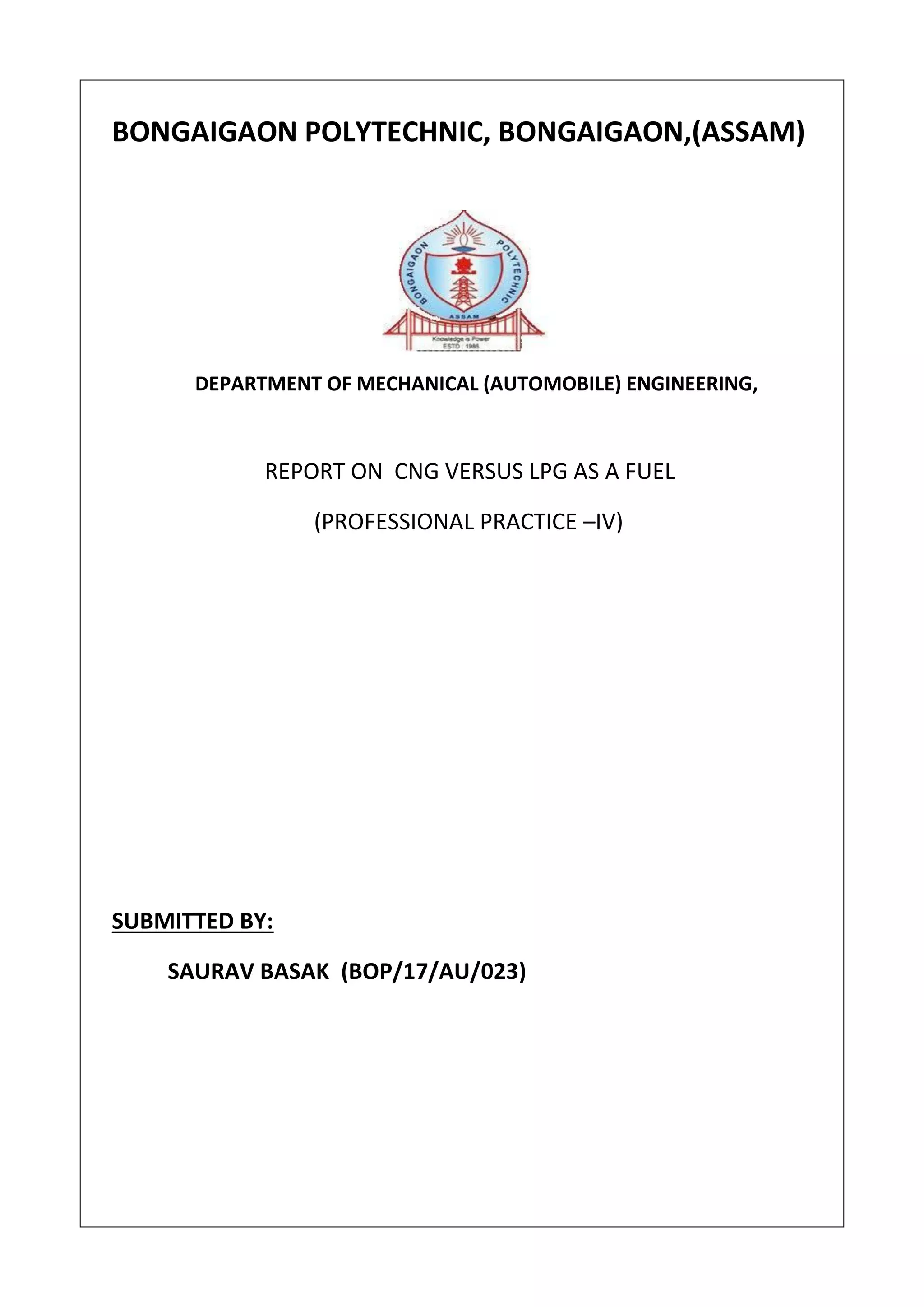
CONTENTS
Page no
1. Introduction
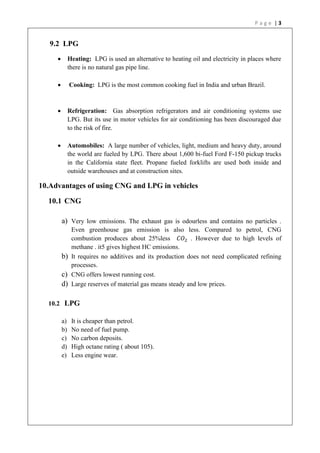
1.1 CNG .............................................................................................1
1.2 LPG........................................................ ........................................1
2. Production.................................................................................................1
3. Cost...........................................................................................................1
4. Availability....................................................................... .......................1
5. Energy Produced......................................................................................2
6. Safety and Environmental Impact............................................................2
7. Substituting LPG for CNG.......................................................................2
8. Odorant.....................................................................................................2
9. Uses
9.1 CNG..............................................................................................2
9.2 LPG...............................................................................................3
10.Advantages of using CNG and LPG in vehicle
10.1. CNG................................................................................................3
10.2. LPG.................................................................................................3
11. Disadvantages of using CNG and LPG in vehicles
11.1 CNG……………………………………………………………….4
11.2 LPG………………………………………………..………………4
12. Comparison chart………………………………………………………...4
13. Conclusion……………………………………………...………………...5
P a g e | 1
1. Introduction
1.1 CNG (Compressed Natural Gas)
Natural gas, like petroleum comes from underground reserves. It consist of, mainly
(about 95% of methane (𝐶𝐻4). The remaining 5% comprises butane, propane, ethane
with small amount of water vapour. Simple chemical structure of methane makes
possible its nearly complete combustion, releasing lesser emissions.
The examples of vehicles running on CNG are ‘Honda civic CGX’ and ‘Ford Crown
Victoria’.
1.2 LPG (Liquefied Petroleum Gas)
The liquefied petroleum gas is a by- product of the fractional distillation of petrol,
consisting mainly of butane and propane is also used as engine fuel. However, LPG is
formed naturally, interspersed with deposits of petroleum and natural gas, Natural gas
contains LPG, water vapour and other impurities which have to be removed before
transporting in pipelines. LPG is also produced by refining of crude oil.
It is stored in liquid form in special cylinders at a pressure of about 100 psi (700kPa)
and the engine is provided with a special fuel system.
2. Production
Natural gas is created over hundreds of years deep within the earth. It has to be
extracted (pumped to the surface) and cleaned to remove impurities including water to be
marketable. The by products of natural gas processing are ethane, propane, butane,
pentane and higher molecular weight hydrocarbons. LPG is manufactured during the
refining of petroleum (crude oil), or extracted from petroleum or natural gas streams as
they emerge from the ground.
3. Cost
CNG is generally cheaper than LPG. However, propane produces over twice the
amount of energy than natural gas. So LPG could be more cost effective than natural gas
depending upon local prices .
4. Availability
There is an extensive distribution network for both CNG and LPG. But the retail
availability of LPG is more compared to that of CNG. CNG distribution is mainly via
pipeline networks that run from natural gas production wells to various distribution
centers and finally into residential neighbourhoods and commercial areas.
P a g e | 2
5. Energy Produced
LPG, vaporized and at atmospheric pressure, has a higher calorific value (94 MJ/m3
or 26.1kWh/m3) than natural gas (38 MJ/m3 or 10.6 kWh/m3). This LPG produces more
energy than the equivalent amount of natural gas.
6. Safety and Environmental Impact
Although CNG does produce greenhouse gases upon combustion, it is a more
environmentally clean alternative to other fossil fuels like gasoline or LPG. CNG is also
safer than other fuels in the event of a spill because natural gas, being lighter than air,
disperses quickly when released.
7. Substituting LPG for CNG
Because LPG produces more energy than CNG, it cannot simply be substituted for
natural gas. Only gases that have the same Wobbe index are interchangeable. For LPG to
have the same Wobbe index as CNG, it has to be mixed with air. A 60:40 ratio for
LPG:air mixing is common but it depends upon the composition of LPG because LPG
itself is a mixture of propane and butane. This mixture of LPG and air to substitute
natural gas is called synthetic natural gas (SNG). Use of SNG is common before the CNG
distribution network is fully operational.
8. Odorant
Ethanethiol or ethyl mercaptan is commonly added to both LPG and CNG. Mercaptan
has a foul, rotten-egg smell that makes it easy to detect gas leaks.
9. Uses
9.1 CNG
• Automobiles: Any vehicle running on gasoline can be converted to a bi-fuel
vehicle (gasoline/CNG). It involves installing a CNG cylinder in the trunk,
installing the plumbing system, installing CNG injunction system and the
electronics. In the US, CNG vehicles have been introduced in a wide variety of
commercial vehicles, from light duty trucks and sedans like taxi cabs to medium
duty trucks like UPS delivery vans and postal vehicles to heavy duty vehicles like
transit buses, street sweepers and school buses. In California, transit agency buses
run on CNG. Coco Cola Enterprises delivered its beverages to London Olympics
Games 2012 in bio methane fueled lorries.
• Locomotives: Napa Wine Valley Train has been converted to be run with CNG.
FerroCarril Central Andino in Peru has been running a freight line on CNG run
locomotive since 2005. Iran, Pakistan, Argentina, Brazil and India have the
highest number of CNG vehicles run.
P a g e | 3
9.2 LPG
• Heating: LPG is used an alternative to heating oil and electricity in places where
there is no natural gas pipe line.
• Cooking: LPG is the most common cooking fuel in India and urban Brazil.
• Refrigeration: Gas absorption refrigerators and air conditioning systems use
LPG. But its use in motor vehicles for air conditioning has been discouraged due
to the risk of fire.
• Automobiles: A large number of vehicles, light, medium and heavy duty, around
the world are fueled by LPG. There about 1,600 bi-fuel Ford F-150 pickup trucks
in the California state fleet. Propane fueled forklifts are used both inside and
outside warehouses and at construction sites.
10.Advantages of using CNG and LPG in vehicles
10.1 CNG
a) Very low emissions. The exhaust gas is odourless and contains no particles .
Even greenhouse gas emission is also less. Compared to petrol, CNG
combustion produces about 25%less 𝐶𝑂2 . However due to high levels of
methane . it5 gives highest HC emissions.
b) It requires no additives and its production does not need complicated refining
processes.
c) CNG offers lowest running cost.
d) Large reserves of material gas means steady and low prices.
10.2 LPG
a) It is cheaper than petrol.
b) No need of fuel pump.
c) No carbon deposits.
d) High octane rating ( about 105).
e) Less engine wear.
P a g e | 4
11.Disadvantages of using CNG and LPG in vehicles
11.1 CNG
a) There being no lubrication, engine wear and tear is more.
b) Volumetric efficiency is less than comparable engines using liquid fuels.
11.2 LPG
a) Special fuel system has to be provided.
b) Heavy pressure cylinders increase the vehicle weight unnecessarily.
c) Distribution network not as widespread as that for petrol and diesel.
d) High octane rating of LPG goes waste while using in petrol engine which have
low compression rations.
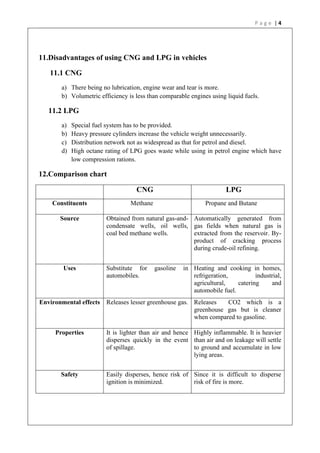
12.Comparison chart
CNG LPG
Constituents Methane Propane and Butane
Source Obtained from natural gas-and-
condensate wells, oil wells,
coal bed methane wells.
Automatically generated from
gas fields when natural gas is
extracted from the reservoir. By-
product of cracking process
during crude-oil refining.
Uses Substitute for gasoline in
automobiles.
Heating and cooking in homes,
refrigeration, industrial,
agricultural, catering and
automobile fuel.
Environmental effects Releases lesser greenhouse gas. Releases CO2 which is a
greenhouse gas but is cleaner
when compared to gasoline.
Properties It is lighter than air and hence
disperses quickly in the event
of spillage.
Highly inflammable. It is heavier
than air and on leakage will settle
to ground and accumulate in low
lying areas.
Safety Easily disperses, hence risk of
ignition is minimized.
Since it is difficult to disperse
risk of fire is more.
P a g e | 5
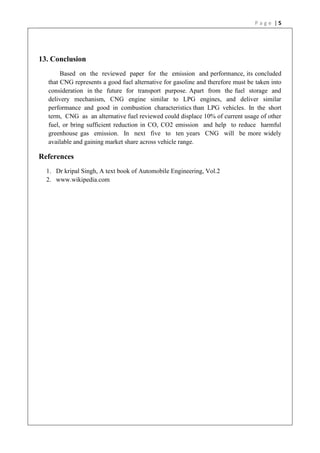
13. Conclusion
Based on the reviewed paper for the emission and performance, its concluded
that CNG represents a good fuel alternative for gasoline and therefore must be taken into
consideration in the future for transport purpose. Apart from the fuel storage and
delivery mechanism, CNG engine similar to LPG engines, and deliver similar
performance and good in combustion characteristics than LPG vehicles. In the short
term, CNG as an alternative fuel reviewed could displace 10% of current usage of other
fuel, or bring sufficient reduction in CO, CO2 emission and help to reduce harmful
greenhouse gas emission. In next five to ten years CNG will be more widely
available and gaining market share across vehicle range.
References
1. Dr kripal Singh, A text book of Automobile Engineering, Vol.2
2. www.wikipedia.com

CNG versus LPG as a fuel Report

  • 1.
    BONGAIGAON POLYTECHNIC, BONGAIGAON,(ASSAM) DEPARTMENTOF MECHANICAL (AUTOMOBILE) ENGINEERING, REPORT ON CNG VERSUS LPG AS A FUEL (PROFESSIONAL PRACTICE –IV) SUBMITTED BY: SAURAV BASAK (BOP/17/AU/023)
  • 2.
    CONTENTS Page no 1. Introduction 1.1CNG .............................................................................................1 1.2 LPG........................................................ ........................................1 2. Production.................................................................................................1 3. Cost...........................................................................................................1 4. Availability....................................................................... .......................1 5. Energy Produced......................................................................................2 6. Safety and Environmental Impact............................................................2 7. Substituting LPG for CNG.......................................................................2 8. Odorant.....................................................................................................2 9. Uses 9.1 CNG..............................................................................................2 9.2 LPG...............................................................................................3 10.Advantages of using CNG and LPG in vehicle 10.1. CNG................................................................................................3 10.2. LPG.................................................................................................3 11. Disadvantages of using CNG and LPG in vehicles 11.1 CNG……………………………………………………………….4 11.2 LPG………………………………………………..………………4 12. Comparison chart………………………………………………………...4 13. Conclusion……………………………………………...………………...5
  • 3.
    P a ge | 1 1. Introduction 1.1 CNG (Compressed Natural Gas) Natural gas, like petroleum comes from underground reserves. It consist of, mainly (about 95% of methane (𝐶𝐻4). The remaining 5% comprises butane, propane, ethane with small amount of water vapour. Simple chemical structure of methane makes possible its nearly complete combustion, releasing lesser emissions. The examples of vehicles running on CNG are ‘Honda civic CGX’ and ‘Ford Crown Victoria’. 1.2 LPG (Liquefied Petroleum Gas) The liquefied petroleum gas is a by- product of the fractional distillation of petrol, consisting mainly of butane and propane is also used as engine fuel. However, LPG is formed naturally, interspersed with deposits of petroleum and natural gas, Natural gas contains LPG, water vapour and other impurities which have to be removed before transporting in pipelines. LPG is also produced by refining of crude oil. It is stored in liquid form in special cylinders at a pressure of about 100 psi (700kPa) and the engine is provided with a special fuel system. 2. Production Natural gas is created over hundreds of years deep within the earth. It has to be extracted (pumped to the surface) and cleaned to remove impurities including water to be marketable. The by products of natural gas processing are ethane, propane, butane, pentane and higher molecular weight hydrocarbons. LPG is manufactured during the refining of petroleum (crude oil), or extracted from petroleum or natural gas streams as they emerge from the ground. 3. Cost CNG is generally cheaper than LPG. However, propane produces over twice the amount of energy than natural gas. So LPG could be more cost effective than natural gas depending upon local prices . 4. Availability There is an extensive distribution network for both CNG and LPG. But the retail availability of LPG is more compared to that of CNG. CNG distribution is mainly via pipeline networks that run from natural gas production wells to various distribution centers and finally into residential neighbourhoods and commercial areas.
  • 4.
    P a ge | 2 5. Energy Produced LPG, vaporized and at atmospheric pressure, has a higher calorific value (94 MJ/m3 or 26.1kWh/m3) than natural gas (38 MJ/m3 or 10.6 kWh/m3). This LPG produces more energy than the equivalent amount of natural gas. 6. Safety and Environmental Impact Although CNG does produce greenhouse gases upon combustion, it is a more environmentally clean alternative to other fossil fuels like gasoline or LPG. CNG is also safer than other fuels in the event of a spill because natural gas, being lighter than air, disperses quickly when released. 7. Substituting LPG for CNG Because LPG produces more energy than CNG, it cannot simply be substituted for natural gas. Only gases that have the same Wobbe index are interchangeable. For LPG to have the same Wobbe index as CNG, it has to be mixed with air. A 60:40 ratio for LPG:air mixing is common but it depends upon the composition of LPG because LPG itself is a mixture of propane and butane. This mixture of LPG and air to substitute natural gas is called synthetic natural gas (SNG). Use of SNG is common before the CNG distribution network is fully operational. 8. Odorant Ethanethiol or ethyl mercaptan is commonly added to both LPG and CNG. Mercaptan has a foul, rotten-egg smell that makes it easy to detect gas leaks. 9. Uses 9.1 CNG • Automobiles: Any vehicle running on gasoline can be converted to a bi-fuel vehicle (gasoline/CNG). It involves installing a CNG cylinder in the trunk, installing the plumbing system, installing CNG injunction system and the electronics. In the US, CNG vehicles have been introduced in a wide variety of commercial vehicles, from light duty trucks and sedans like taxi cabs to medium duty trucks like UPS delivery vans and postal vehicles to heavy duty vehicles like transit buses, street sweepers and school buses. In California, transit agency buses run on CNG. Coco Cola Enterprises delivered its beverages to London Olympics Games 2012 in bio methane fueled lorries. • Locomotives: Napa Wine Valley Train has been converted to be run with CNG. FerroCarril Central Andino in Peru has been running a freight line on CNG run locomotive since 2005. Iran, Pakistan, Argentina, Brazil and India have the highest number of CNG vehicles run.
  • 5.
    P a ge | 3 9.2 LPG • Heating: LPG is used an alternative to heating oil and electricity in places where there is no natural gas pipe line. • Cooking: LPG is the most common cooking fuel in India and urban Brazil. • Refrigeration: Gas absorption refrigerators and air conditioning systems use LPG. But its use in motor vehicles for air conditioning has been discouraged due to the risk of fire. • Automobiles: A large number of vehicles, light, medium and heavy duty, around the world are fueled by LPG. There about 1,600 bi-fuel Ford F-150 pickup trucks in the California state fleet. Propane fueled forklifts are used both inside and outside warehouses and at construction sites. 10.Advantages of using CNG and LPG in vehicles 10.1 CNG a) Very low emissions. The exhaust gas is odourless and contains no particles . Even greenhouse gas emission is also less. Compared to petrol, CNG combustion produces about 25%less 𝐶𝑂2 . However due to high levels of methane . it5 gives highest HC emissions. b) It requires no additives and its production does not need complicated refining processes. c) CNG offers lowest running cost. d) Large reserves of material gas means steady and low prices. 10.2 LPG a) It is cheaper than petrol. b) No need of fuel pump. c) No carbon deposits. d) High octane rating ( about 105). e) Less engine wear.
  • 6.
    P a ge | 4 11.Disadvantages of using CNG and LPG in vehicles 11.1 CNG a) There being no lubrication, engine wear and tear is more. b) Volumetric efficiency is less than comparable engines using liquid fuels. 11.2 LPG a) Special fuel system has to be provided. b) Heavy pressure cylinders increase the vehicle weight unnecessarily. c) Distribution network not as widespread as that for petrol and diesel. d) High octane rating of LPG goes waste while using in petrol engine which have low compression rations. 12.Comparison chart CNG LPG Constituents Methane Propane and Butane Source Obtained from natural gas-and- condensate wells, oil wells, coal bed methane wells. Automatically generated from gas fields when natural gas is extracted from the reservoir. By- product of cracking process during crude-oil refining. Uses Substitute for gasoline in automobiles. Heating and cooking in homes, refrigeration, industrial, agricultural, catering and automobile fuel. Environmental effects Releases lesser greenhouse gas. Releases CO2 which is a greenhouse gas but is cleaner when compared to gasoline. Properties It is lighter than air and hence disperses quickly in the event of spillage. Highly inflammable. It is heavier than air and on leakage will settle to ground and accumulate in low lying areas. Safety Easily disperses, hence risk of ignition is minimized. Since it is difficult to disperse risk of fire is more.
  • 7.
    P a ge | 5 13. Conclusion Based on the reviewed paper for the emission and performance, its concluded that CNG represents a good fuel alternative for gasoline and therefore must be taken into consideration in the future for transport purpose. Apart from the fuel storage and delivery mechanism, CNG engine similar to LPG engines, and deliver similar performance and good in combustion characteristics than LPG vehicles. In the short term, CNG as an alternative fuel reviewed could displace 10% of current usage of other fuel, or bring sufficient reduction in CO, CO2 emission and help to reduce harmful greenhouse gas emission. In next five to ten years CNG will be more widely available and gaining market share across vehicle range. References 1. Dr kripal Singh, A text book of Automobile Engineering, Vol.2 2. www.wikipedia.com