Download to read offline
![IOSR Journal of Electrical and Electronics Engineering (IOSR-JEEE)
e-ISSN: 2278-1676,p-ISSN: 2320-3331, Volume 10, Issue 2 Ver. III (Mar – Apr. 2015), PP 27-32
www.iosrjournals.org
DOI: 10.9790/1676-10232732 www.iosrjournals.org 27 | Page
A Traditional Approach to Solve Economic Load Dispatch
Problem Considering the Generator Constraints
Susheel Kumar Dewangan1
, Achala Jain2
, Dr. A.P. Huddar3
1
P.G. Scholar (Power System Engineering), 2
Senior Assistant Professor, 3
Professor
1, 2
(Department of Electrical and Electronics Engineering, SSTC, Bhilai, Chhattisgarh, India)
3
(Department of Electrical Engineering, Bhilai Institute of Technology, Durg, Chhattisgarh, India)
Abstract: Economic load dispatch (ELD) problem is very important part of the power system. The purpose of
economic dispatch is to determine the generation of different units in a plant such that the total fuel cost is
minimum and at the same time the total demand and losses at any instant must be equal to the total generation.
Many traditional methods such as lambda iteration, gradient method, Newton’s method etc. are applied to
determine the optimal combination of power output of all generating units so as to meet the desired demand
without violation of generator constraint. This paper presents lambda iteration method to solve the ELD
problem using MATLAB for three and six generating units with and without transmission losses.
Keywords: Economic Load Dispatch (ELD), Fuel Cost, Lambda Iteration Method, Matrix Laboratory
(MATLAB), Transmission Loss.
I. Introduction
The sizes of electric power system are increasing rapidly to meet the total demand but the rate of
increase of generation is less than the rate of increase of power demand hence it is necessary to operate power
system in economic manner. This can be done by ELD techniques. The most common task in power system is to
determine and provide an economic condition for generating units without violation of any system constraints,
which is known as Economic Load Dispatch (ELD). The parameters must be taken into account for any ELD
problem are load demand, transmission power losses and generation cost coefficients. The total operating cost of
a power plant depends upon the fuel cost, cost of labour, supplies and maintenance. Generally the costs such as
cost of labour, supplies and maintenance being difficult to determine and approximate, are assumed to change as
a fixed percentage of the fuel cost. Thus cost function of power plant which is mainly dependent on fuel cost is
given as a function of generation. Traditionally the cost function in ELD problem has been approximated as a
quadratic function [1]. The generation cost depends upon the system constraint for a particular load demand it
means that the generation cost is not fixed for a particular load demand but depends upon the operating constraint
of the sources [1], [2].
There are many traditional optimization methods to solve ELD problem. These traditional methods are
lambda iteration, gradient method, base point, participation factor method, Newton’s method, Linear
programming, and quadratic programming [5], [6]. ELD is major topic and many research works have been done
in this field. In [7], [11], [12] ELD problem has been solved by using GA. In [13] PSO technique has been used to
solve ELD problem.
The economic operation of a thermal unit, input-output modeling characteristic is significant. For this
function considers a single unit consisting of a boiler, a turbine, and a generator. Figure 1 shows the simple model
of a thermal generation system [3], [8], [9].
Fig.1 Simple model of thermal generation system](https://image.slidesharecdn.com/e010232732-160705061757/85/E010232732-1-320.jpg)
![IOSR Journal of Electrical and Electronics Engineering (IOSR-JEEE)
e-ISSN: 2278-1676,p-ISSN: 2320-3331, Volume 10, Issue 2 Ver. III (Mar – Apr. 2015), PP 27-32
www.iosrjournals.org
DOI: 10.9790/1676-10232732 www.iosrjournals.org 27 | Page
A Traditional Approach to Solve Economic Load Dispatch
Problem Considering the Generator Constraints
Susheel Kumar Dewangan1
, Achala Jain2
, Dr. A.P. Huddar3
1
P.G. Scholar (Power System Engineering), 2
Senior Assistant Professor, 3
Professor
1, 2
(Department of Electrical and Electronics Engineering, SSTC, Bhilai, Chhattisgarh, India)
3
(Department of Electrical Engineering, Bhilai Institute of Technology, Durg, Chhattisgarh, India)
Abstract: Economic load dispatch (ELD) problem is very important part of the power system. The purpose of
economic dispatch is to determine the generation of different units in a plant such that the total fuel cost is
minimum and at the same time the total demand and losses at any instant must be equal to the total generation.
Many traditional methods such as lambda iteration, gradient method, Newton’s method etc. are applied to
determine the optimal combination of power output of all generating units so as to meet the desired demand
without violation of generator constraint. This paper presents lambda iteration method to solve the ELD
problem using MATLAB for three and six generating units with and without transmission losses.
Keywords: Economic Load Dispatch (ELD), Fuel Cost, Lambda Iteration Method, Matrix Laboratory
(MATLAB), Transmission Loss.
I. Introduction
The sizes of electric power system are increasing rapidly to meet the total demand but the rate of
increase of generation is less than the rate of increase of power demand hence it is necessary to operate power
system in economic manner. This can be done by ELD techniques. The most common task in power system is to
determine and provide an economic condition for generating units without violation of any system constraints,
which is known as Economic Load Dispatch (ELD). The parameters must be taken into account for any ELD
problem are load demand, transmission power losses and generation cost coefficients. The total operating cost of
a power plant depends upon the fuel cost, cost of labour, supplies and maintenance. Generally the costs such as
cost of labour, supplies and maintenance being difficult to determine and approximate, are assumed to change as
a fixed percentage of the fuel cost. Thus cost function of power plant which is mainly dependent on fuel cost is
given as a function of generation. Traditionally the cost function in ELD problem has been approximated as a
quadratic function [1]. The generation cost depends upon the system constraint for a particular load demand it
means that the generation cost is not fixed for a particular load demand but depends upon the operating constraint
of the sources [1], [2].
There are many traditional optimization methods to solve ELD problem. These traditional methods are
lambda iteration, gradient method, base point, participation factor method, Newton’s method, Linear
programming, and quadratic programming [5], [6]. ELD is major topic and many research works have been done
in this field. In [7], [11], [12] ELD problem has been solved by using GA. In [13] PSO technique has been used to
solve ELD problem.
The economic operation of a thermal unit, input-output modeling characteristic is significant. For this
function considers a single unit consisting of a boiler, a turbine, and a generator. Figure 1 shows the simple model
of a thermal generation system [3], [8], [9].
Fig.1 Simple model of thermal generation system](https://image.slidesharecdn.com/e010232732-160705061757/75/E010232732-1-2048.jpg)
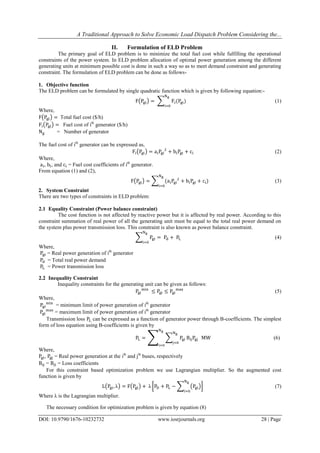
![A Traditional Approach to Solve Economic Load Dispatch Problem Considering the...
DOI: 10.9790/1676-10232732 www.iosrjournals.org 29 | Page
, (i=1, 2… ) (8)
(9)
Equation (9) can be written as
, (i=1, 2… ) (10)
Where,
= Incremental cost of the ith
generator ($/MWh)
= Incremental transmission loss (ITL) of ith
generator.
The above equation is called as coordination equation.
Furthermore,
(11)
By differentiating equation (6) with respect to ,
(12)
The incremental cost of ith
generator can be obtained by differentiating equation (3) with respect to ,
(13)
With the help of equation (12) & (13), equation (10) can be written as
(14)
By arranging equation (14)
(15)
The value of can be formulated as
, (i=1, 2… ) (16)
If is known then generator real power can be obtained by equation (16).
III. Lambda Iteration Method
One of the most popular traditional technique to solve ELD problem for minimizing the cost of
generating unit is lambda iteration method. Although in lambda iteration technique computational procedure is
complex but it converges very fast for this type of optimization problem [4], [13].
The detailed algorithm of lambda iteration method for ELD problem is given below:
1. Read given data, for example cost coefficients ( , B-coefficients, power limits and power demand.
2. Assume the starting value of and
3. Calculate generated power from each unit.
4. Check generation limit for each unit.
If , set
If , set
5. Calculate total generated power.
6. Calculate mismatch in power which is given by following equation
7. If , then stop calculation and calculate the generation cost. Otherwise go next step.
8. If , then .
If , then .
9. Repeat the procedure from step 3.
The above steps can be summarized in the flowchart of figure 2.](https://image.slidesharecdn.com/e010232732-160705061757/85/E010232732-3-320.jpg)
![A Traditional Approach to Solve Economic Load Dispatch Problem Considering the...
DOI: 10.9790/1676-10232732 www.iosrjournals.org 30 | Page
Fig. 2 Flow chart of lambda iteration method for ELD
IV. Result And Discussions
The Lambda iteration method is implemented in three and six generating units. The results are compared
for two different cases with and without losses. In first case generator constraints are considered along with the
lossless system and in second case generator constraints are considered with the losses. All the programming has
been done in MATLAB environment.
Case Study-1: 3-units system
In this case, three unit thermal power plant is considered which is solved for two different cases with and
without losses. The cost coefficients and generator power limits are shown by table 1 [13].
Table 1: Generating Unit Capacity and Cost-Coefficients for Three Unit System
Unit
1 10 85 0.008 7 200
2 10 80 0.009 6.3 180
3 10 70 0.007 6.8 140
The loss coefficient matrix is given by](https://image.slidesharecdn.com/e010232732-160705061757/85/E010232732-4-320.jpg)
![A Traditional Approach to Solve Economic Load Dispatch Problem Considering the...
DOI: 10.9790/1676-10232732 www.iosrjournals.org 31 | Page
Table 2 and Table 3 presents the results of ELD problem for 3-unit system using lambda iteration method.
Table 2 shows the result of 3-unit system for different loading condition without considering transmission
losses. Table 3 shows the fuel cost, active power output of generating units and transmission losses for different
loading condition.
Table 2: Results of Three Unit System (Without Loss)
S.No.
Load
Demand
(MW) (MW) (MW) (MW)
Fuel Cost
($/hr)
1. 120 22.0625 58.5 39.5 1357.2
2. 150 31.9375 67.2778 50.7857 1579.71
3. 170 38.5625 73.1667 58.3571 1731.63
Table 3: Results of Three Unit System (With Loss)
S.No.
Load
Demand
(MW) (MW) (MW) (MW) (MW)
Fuel
Cost
($/hr)
1. 120 22.9577 55.7822 42.8176 1.52698 1368.35
2. 150 32.8204 64.6008 54.9443 2.34274 1597.66
3. 170 39.4269 70.5116 63.0889 2.99255 1754.26
Case Study-2: 6-units system
In this case, six unit thermal power plant is considered which is solved for two different cases with and
without losses. The cost coefficients and generator power limits are shown by table 4 [13].
Table 4: Generating Unit Capacity and Cost-Coefficients for Six Unit System
Unit
1 100 500 240 7.00 0.0070
2 50 200 200 10.0 0.0095
3 80 300 220 8.50 0.0090
4 50 150 200 11.0 0.0090
5 50 200 220 10.5 0.0080
6 50 120 190 12.0 0.0075
The B-coefficient for six unit system is given as
Table 5 and Table 6 presents the results of ELD problem for 6-unit system using lambda iteration method.
Table 5 shows the result of 6-unit system for different loading condition without considering transmission
losses. Table 6 shows the fuel cost, active power output of generating unit and transmission losses for different
loading condition.
Table 5: Results of Six Unit System (Without Loss)
S. No.
Load
Demand
(MW)
(MW) (MW) (MW) (MW) (MW) (MW)
Fuel Cost
($/hr)
1. 600 271.879 50 128.128 50 50 50 7187.41
2. 800 342.221 94.2684 182.839 50 80.6937 50 9458.09
3. 1000 391.664 130.7 221.294 82.4056 123.956 50 11887.3
4. 1263 446.707 171.258 264.106 125.217 172.119 83.5933 15275.9
5. 1450 485.664 199.963 294.406 150 200 119.953 17802.6](https://image.slidesharecdn.com/e010232732-160705061757/85/E010232732-5-320.jpg)
![A Traditional Approach to Solve Economic Load Dispatch Problem Considering the...
DOI: 10.9790/1676-10232732 www.iosrjournals.org 32 | Page
Table 6: Results of Six Unit System (With Loss)
S.No.
Load
Demand
(MW) (MW) (MW) (MW) (MW) (MW) (MW) (MW)
Fuel Cost
($/hr)
1. 600 273.492 50 129.595 50 50 50 2.98958 7220.73
2. 800 341.757 95.2846 182.325 53.5857 82.5827 50 5.43591 9523.64
3. 1000 391.011 131.737 220.404 93.3534 121.621 50 8.0945 11989.60
4. 1263 447.122 173.22 263.962 139.093 165.617 86.6583 12.4204 15446.1
5. 1450 496.776 200 300 150 200 120 16.7313 18035.4
V. Conclusion
In this paper, the economic load dispatch problem is solved by most popular traditional technique
lambda iteration method. Two test units three unit system and six unit system are solved lambda iteration
method for two different cases. In first case ELD problem has been solved by considering generator constraints
without transmission loss and in second case ELD problem has been solved by considering generator constraints
with transmission loss. After comparison of the above cases we have concluded that first case (ELD without
transmission loss and with generator constraint) give the better result in comparison to other case. The above
comparison shows that transmission loss plays very important role in ELD problem. Thus lambda iteration
method is simple and gives the better result for ELD problem.
References
[1] Asbfaq Husain, “Electrical power system,” CBS publishers and Distributers, Fifth Edition, 2007.
[2] C.L. Wadhwa, “Electrical power system,” New Age Publication, Fifth Edition, 2009.
[3] D.P. Kothari, J.S. Dhillon, “Power system optimization,” PHI, Second Edition, 2010.
[4] J. Wood and B.F. Wollenberg, “Power generation operation and control,” New York: John Wiley and Sons, 1984.
[5] Hadi Saadat, “Power system Analysis,” Tata McGraw Hill Publishing Company, New Delhi, 2002.
[6] Samir Sayah, Khaled Zehar, “Using evolutionary computation to solve the economic load dispatch problem,” Leonardo Journal of
Sciences, Issue 12, January-June 2008, 67-78.
[7] M. Sailaja Kumari, M. Sydulu, “A fast computational genetic algorithm for economic load dispatch,” International Journal of
Recent Trends in Engineering, vol. 1, No. 1, May 2009, 349-356.
[8] Ashish Dhamanda, Arunesh Dutt, Surya Prakash, A.K. Bhardwaj, “A traditional approach to solve economic load dispatch problem
of thermal generating unit using MATLAB programming,” IJERT vol.2 Issue 9, September 2013, 3147-3152 .
[9] Arunesh Dutt, Ashish Dhamanda, “Classical approach to solve economic load dispatch problem of thermal generating unit using
MATLAB programming,” IJERT vol.2, Issue 10, October 2013, 1384-1389.
[10] Rahul Dogra, Nikita Gupta, Harsha Saroa, “Economic load dispatch problem and MATLAB programming of different methods,”
International Conference of Advanced Research and Innovation (ICARI-2014).
[11] Satyendra Pratap Singh, Rachna Tyagi, Anubhav Goel, “Genetic algorithm for solving the economic load dispatch,” International
Journal of Electronic and Electrical Engineering, vol. 7, Number 2014, 523-528.
[12] Chiragkumar K. Patel, Mihir B. Chaudhari, “Economic load dispatch problem using genetic algorithm,” Indian Journal of Applied
Research, vol.4, Issue 11, November 2014, 173-175.
[13] Revathy K, Nithiyanandham, “Economic dispatch using particle swarm optimization,” International Journal of Advanced Research
in Electrical, Electronics and Instrumentation Engineering, vol. 3, Special Issue 4, May 2014, 59-66.](https://image.slidesharecdn.com/e010232732-160705061757/85/E010232732-6-320.jpg)

This document presents a traditional approach called the lambda iteration method to solve the economic load dispatch (ELD) problem considering generator constraints. The ELD problem aims to minimize the total fuel cost while meeting demand and generator constraints. The lambda iteration method is implemented on a three-unit and six-unit system, with and without transmission losses, in MATLAB. The results show that considering transmission losses provides a more accurate solution to the ELD problem compared to ignoring losses. The lambda iteration method provides an effective traditional technique for solving the ELD problem.


![[IJET-V1I4P9] Author :Su Hlaing Win](https://cdn.slidesharecdn.com/ss_thumbnails/ijet-v1i4p9-150824171458-lva1-app6891-thumbnail.jpg?width=640&height=640&fit=bounds)


