Downloaded 19 times
![IJRET: International Journal of Research in Engineering and Technology eISSN: 2319-1163 | pISSN: 2321-7308
__________________________________________________________________________________________
Volume: 03 Special Issue: 03 | May-2014 | NCRIET-2014, Available @ http://www.ijret.org 237
ANALYSIS OF ECONOMIC LOAD DISPATCH USING FUZZIFIED PSO
Bhagyashree Hosamani1
, C R Sharada Prasad2
1
M.Tech Student, EEE, UBDT College of Engineering, Davanagere, Karnataka, India
2
Associate Professor, EEE, UBDT College of Engineering, Davanagere, Karnataka, India
Abstract
With large interconnection of the electric networks, the energy crisis in the world and continuous rise in prices, it is very essential to
reduce the running charges of the electric energy i.e., reduce the fuel consumption for meeting a particular load demand. The main
aim in the economic dispatch is to minimize the total cost of generating real power at various stations while satisfying the loads and
the losses in transmission links. A novel method is introduced in the planning and operation of power systems to provide reliable and
quality power to consumers at economical cost. The primary objective of this paper is to develop efficient and fast Fuzzified Particle
Swarm Optimization (FPSO) algorithm that can be applied to obtain the optimal solutions of multi-constrained dynamic ED, OPF. In
this paper, I considered Fuzzified particle swam optimization to solve multi-constrained dynamic economic dispatch problem. The
FPSO Method is inferred to have superior features than conventional methods and gives faster and stable convergence
characteristics. PSO is popular due to its significant property of dealing with optimization problem and ease of computation. But the
critical drawback of PSO is more number of iterations required and hence the computation time is required to obtain the optimal
solution is more and also the premature convergence Hence to overcome the premature convergence and to speed up the process, a
classical PSO technique is incorporated with fuzzy logic to get a faster convergence This improved technique is termed as Fuzzified
Particle Swarm Optimization (FPSO). The proposed method can provide an accurate solution with fast convergence and has the
potential to be applied to other power system optimization problems.
Keywords: Economic Dispatch(ED), Optimal Power Flow (OPF), Particle Swarm Optimization (PSO).
-----------------------------------------------------------------------***-----------------------------------------------------------------------
1. INTRODUCTION
In electrical power system operation we can minimize the total
generation cost by solving the economic dispatch problem by
satisfying some constraints. Economic load dispatch is taken
as optimization problem, to minimize the generation cost.
There are many algorithms to find the rate of optimum product
for every power generation division. Usual algorithms that are
used to solve the economic load dispatch problems are,
Lambda iteration method.
Gradient method.
Newton method.
Demand on energy is increasing day by day, whereas energy
resources are decreasing on the other side. Thus optimization
is necessary for power system operation and planning.
Economic Dispatch provides the best optimization scheme for
selecting the best generation schedule for supplying a preset
load, with minimum cost and satisfying the constraints [1].
The computation of optimum generation schedules for the
predicted loads over a period of time, with due considerations
of generator ramping rate limits, non-smooth fuel cost
function due to valve-point effect, spinning reserve
contribution constraints and prohibitive operating zones leads
to an advanced economic dispatch with multiple objectives
and several adequate constraints, effectively termed as multi-
constrained dynamic economic dispatch [2]. Thermal power
stations are a major cause of atmospheric pollution, due to the
high concentration of pollutants emitted. Currently, with the
increasing awareness of environmental pollution caused by
burning fossil fuels, controlling the amount of pollutant
emission is also a major criterion in the economic dispatch
problem. The purpose of Emission Constrained Economic
Dispatch (ECED) is to obtain the optimal generation schedule
by minimizing the fuel cost and the emission level
simultaneously while satisfying load demand and other
operational constraints [3].
From the exhaustive literature review on OPF it is inferred
that numerous deterministic and stochastic optimization
techniques have been applied for solving the OPF problems.
Moreover the conventional deterministic mathematical
optimization techniques are complex and leads to high
computational burden for large scale systems, and for
stochastic algorithms the large number of iterations leads to a
very large computation time. Partial Swarm Optimization
(PSO) technique is superior over all other stochastic
techniques cited in the literature review. But certain critical
Limitations are observed in the general PSO technique. The
literature review reveals that there exists a need for developing
simple, effective and accurate algorithm for solving ED and
OPF problems without and with security constraints. Hence, in
this research, an amendment has been made to PSO algorithm
to overcome drawbacks [2][3][5].](https://image.slidesharecdn.com/analysisofeconomicloaddispatchusingfuzzifiedpso-140821054455-phpapp01/85/Analysis-of-economic-load-dispatch-using-fuzzified-pso-1-320.jpg)
![IJRET: International Journal of Research in Engineering and Technology eISSN: 2319-1163 | pISSN: 2321-7308
__________________________________________________________________________________________
Volume: 03 Special Issue: 03 | May-2014 | NCRIET-2014, Available @ http://www.ijret.org 237
ANALYSIS OF ECONOMIC LOAD DISPATCH USING FUZZIFIED PSO
Bhagyashree Hosamani1
, C R Sharada Prasad2
1
M.Tech Student, EEE, UBDT College of Engineering, Davanagere, Karnataka, India
2
Associate Professor, EEE, UBDT College of Engineering, Davanagere, Karnataka, India
Abstract
With large interconnection of the electric networks, the energy crisis in the world and continuous rise in prices, it is very essential to
reduce the running charges of the electric energy i.e., reduce the fuel consumption for meeting a particular load demand. The main
aim in the economic dispatch is to minimize the total cost of generating real power at various stations while satisfying the loads and
the losses in transmission links. A novel method is introduced in the planning and operation of power systems to provide reliable and
quality power to consumers at economical cost. The primary objective of this paper is to develop efficient and fast Fuzzified Particle
Swarm Optimization (FPSO) algorithm that can be applied to obtain the optimal solutions of multi-constrained dynamic ED, OPF. In
this paper, I considered Fuzzified particle swam optimization to solve multi-constrained dynamic economic dispatch problem. The
FPSO Method is inferred to have superior features than conventional methods and gives faster and stable convergence
characteristics. PSO is popular due to its significant property of dealing with optimization problem and ease of computation. But the
critical drawback of PSO is more number of iterations required and hence the computation time is required to obtain the optimal
solution is more and also the premature convergence Hence to overcome the premature convergence and to speed up the process, a
classical PSO technique is incorporated with fuzzy logic to get a faster convergence This improved technique is termed as Fuzzified
Particle Swarm Optimization (FPSO). The proposed method can provide an accurate solution with fast convergence and has the
potential to be applied to other power system optimization problems.
Keywords: Economic Dispatch(ED), Optimal Power Flow (OPF), Particle Swarm Optimization (PSO).
-----------------------------------------------------------------------***-----------------------------------------------------------------------
1. INTRODUCTION
In electrical power system operation we can minimize the total
generation cost by solving the economic dispatch problem by
satisfying some constraints. Economic load dispatch is taken
as optimization problem, to minimize the generation cost.
There are many algorithms to find the rate of optimum product
for every power generation division. Usual algorithms that are
used to solve the economic load dispatch problems are,
Lambda iteration method.
Gradient method.
Newton method.
Demand on energy is increasing day by day, whereas energy
resources are decreasing on the other side. Thus optimization
is necessary for power system operation and planning.
Economic Dispatch provides the best optimization scheme for
selecting the best generation schedule for supplying a preset
load, with minimum cost and satisfying the constraints [1].
The computation of optimum generation schedules for the
predicted loads over a period of time, with due considerations
of generator ramping rate limits, non-smooth fuel cost
function due to valve-point effect, spinning reserve
contribution constraints and prohibitive operating zones leads
to an advanced economic dispatch with multiple objectives
and several adequate constraints, effectively termed as multi-
constrained dynamic economic dispatch [2]. Thermal power
stations are a major cause of atmospheric pollution, due to the
high concentration of pollutants emitted. Currently, with the
increasing awareness of environmental pollution caused by
burning fossil fuels, controlling the amount of pollutant
emission is also a major criterion in the economic dispatch
problem. The purpose of Emission Constrained Economic
Dispatch (ECED) is to obtain the optimal generation schedule
by minimizing the fuel cost and the emission level
simultaneously while satisfying load demand and other
operational constraints [3].
From the exhaustive literature review on OPF it is inferred
that numerous deterministic and stochastic optimization
techniques have been applied for solving the OPF problems.
Moreover the conventional deterministic mathematical
optimization techniques are complex and leads to high
computational burden for large scale systems, and for
stochastic algorithms the large number of iterations leads to a
very large computation time. Partial Swarm Optimization
(PSO) technique is superior over all other stochastic
techniques cited in the literature review. But certain critical
Limitations are observed in the general PSO technique. The
literature review reveals that there exists a need for developing
simple, effective and accurate algorithm for solving ED and
OPF problems without and with security constraints. Hence, in
this research, an amendment has been made to PSO algorithm
to overcome drawbacks [2][3][5].](https://image.slidesharecdn.com/analysisofeconomicloaddispatchusingfuzzifiedpso-140821054455-phpapp01/75/Analysis-of-economic-load-dispatch-using-fuzzified-pso-1-2048.jpg)
![IJRET: International Journal of Research in Engineering and Technology eISSN: 2319-1163 | pISSN: 2321-7308
__________________________________________________________________________________________
Volume: 03 Special Issue: 03 | May-2014 | NCRIET-2014, Available @ http://www.ijret.org 238
In this paper a new method is introduced to solve economic
load dispatch problem so that the state of the present power
system can be optimized. the various objectives considered in
the optimization problem are minimization of total generation
cost, minimization of total network active power loss and
maximization of security level.
2. ECONOMIC LOAD DISPATCH
In electric power industry the importance is given to the
operation of electric power system optimally and efficiently.
Now a day, the utilities are trying to minimize the cost of
running power systems and also trying to satisfy the demand
of their customers and by doing so the profit can be achieved.
For committed units it is necessary to operate optimally to
supply the expected load demand of customers even with
limited number of generating units, increasing fuel cost and
also increasing demand for power in different time intervals.
The main objective in ELD is to schedule the outputs of
committed generating units by meeting the power demand
with reduced operating cost to the utilities and also satisfying
equality and inequality constraints. Previously many
researches have been carried out for load dispatch problem.
There are different problems involved in ELD, the two main
problems considered are, Unit Commitment or pre-dispatch
problem and On-line economic dispatch. In unit commitment
problem the optimal generating unit is selected among the
available generating units to meet the expected load demand.
In the on-line economic dispatch the load is distributed equally
among the generating units in order to minimize the total cost
of supplying power [10].
2.1 Conventional Methods for solving ELD Problem
1. The Lambda –Iteration Method
2. The Gradient Search Method
3. Newton’s Method
4. ED with Piecewise linear Cost Functions
5. Base Point & Participation factor.
6. Linear Programming.
7. Dynamic Programming.
Fuzzy Logic and Particle Swarm Optimization methods are
introduced recently for solving load dispatch problem.
3. ECONOMIC LOAD DISPATCH USING FUZZY
LOGIC
The fuzzy logic method is treated as robust method because it
deals with fuzzy or crisp values and does not require precise
inputs and it can be programmed even if a feedback sensor
quits or is destroyed. Even though there is a wide variation in
the inputs the output control is a smooth control function. The
fuzzy logic controller processes user-defined rules hence it can
be modified easily to improve or modify system performance.
By the generation of appropriate governing rules the system
can be incorporated with new sensors. Fuzzy logic is not
limited one or two control outputs, and it is not necessary to
compute rate-of-change of parameters in order for
implementation. The sensor data is sufficient because that
provides some indication of a system's actions and reactions.
Hence the sensors will be inexpensive and less complex [3].
3.1 Advantages & Disadvantages:
3.1.1 Advantages:
1. ANFIS (Adaptive Neuro-Fuzzy Inference System)
method is faster in operation and gets better results in
most cases compare to delta gradient and analytical
method.
2. ANFIS Method uses the MATLAB toolbox and it is
applied to solve the problem that involves large
number of power plants.
3. Fuzzy logic solutions are easy to verify and optimize.
3.1.2 Disadvantage:
The variation in the limits of the real power generated will be
within minimum and maximum. Hence in the real time
optimization ELD problem will become more non-linear.
4. ECONOMIC LOAD DISPATCH USING PSO
Particle swarm optimization (PSO) is a technique of solving
optimization problem which considers the population based
stochastic optimization technique. This method is developed
by Dr.Ebehart and Dr. Kennedy in 1995, the main inspiration
is by the social behavior of bird flocking or fish schooling.
PSO is a robust, stochastic computational technique based on
movement and intelligence of swarm. PSO has many
similarities with evolutionary computation techniques such as
Genetic Algorithms (GA). The initialization of the system is
done with a population of random solutions and by updating
generations it will search for optimum solution. In GA
approach there are evolution operators such as crossover and
mutation. But PSO has no such operators. In PSO, the
particles fly through the problem space by following the
current optimum particles. PSO is easy in implementation and
having less parameter to make adjustment as compared to GA.
This is one of the advantages of PSO. The many areas of
application of PSO are: function optimization, artificial neural
network training, fuzzy system control, and other areas where
GA can be applied [6].
4.1 Problem Formulation [9]:
=w* +C1*rand ()*( ) +C2*rand
()*( - ) ---------------------- (1)
= + ------------------- (2)](https://image.slidesharecdn.com/analysisofeconomicloaddispatchusingfuzzifiedpso-140821054455-phpapp01/85/Analysis-of-economic-load-dispatch-using-fuzzified-pso-2-320.jpg)
![IJRET: International Journal of Research in Engineering and Technology eISSN: 2319-1163 | pISSN: 2321-7308
__________________________________________________________________________________________
Volume: 03 Special Issue: 03 | May-2014 | NCRIET-2014, Available @ http://www.ijret.org 239
Where C1, C2 are constants
The inertia weight ‘W’ is set according to the following
equation,
W = x ITER ------------ (3)
4.2 Steps of Implementation:
1. Initialize the total cost function this is also called as
Fitness Function. The total cost function is derived
from the individual cost function of the various
generating stations.
2. Initialization of the Parameters of the PSO they are
Population size, C1, C2, , , error
gradient etc.
3. Giving the inputs such as the Fuel cost Functions,
MW limits of the generating stations along with the
B-coefficient matrix and the total power demand.
4. In the first step the random allocation of large
number of vectors (equal to the population size) of
active power are done by satisfying the MW limits.
5. The value of fitness function is calculated for each
vector of active power. The values obtained in the
iteration are compared to obtain Pbest. At each
iteration all values of the whole population are
compared to obtain the Gbest. These values are
updated at each step.
6. The error gradient is checked at each step and the
value of Gbest is plotted till it comes within the pre-
specified range.
7. The final value of Gbest is the minimum cost and the
active power vector represents the economic load
dispatch solution.
4.3 Disadvantages:
1. Since PSO based algorithms are random search
techniques, the convergence will be very slow and
inconsistent for a large scale interconnected power
system as there are enormous number of decision
variables.
2. The inertia weight (in velocity adaptation) in PSO is
fixed throughout the whole search process. However,
for practical applications a small fixed inertia weight
may result in a premature convergence. Hence there
is a need for an adaptive inertia weight.
4.4 Need for Fuzzified PSO
1. PSO algorithm has very large computation time due
to the large number of iterations required to obtain a
global optimum.
2. In classical PSO technique the value of inertia weight
computation is completely based on iteration count
which leads to slow and premature convergence.
Hence there is a need for an adaptive inertia weight.
5. FUZZIFIED PARTICLE SWARM
OPTIMIZATION BASED ECONOMIC LOAD
DISPATCH
This presents an overview of some superior stochastic
optimization techniques followed by the need and formulation
of Fuzzified Particle Swarm Optimization (FPSO) algorithm
for solving Multi-constrained Dynamic Economic Dispatch,
Emission Constrained Economic Dispatch (ECED) and Multi-
area ED problems. Subsequently the FPSO algorithm is
applied on standard test systems for solving the above
mentioned ED problems and the optimal results obtained are
compared and analyzed with other stochastic optimization
techniques[7][8].
5.1 Problem Formulation:
Step 1 (Initialization): An initial swarm of particles Ii of size
n is generated randomly within the feasible range and the
distributions of initial trial parents are uniform. The elements
of each initial particle are the controllable real power outputs
of committed ng generating units.
= [ ]; i=1, 2 …n;
t=1, 2 …NT --------------------------------------------- (1)
Step 2 (Velocity updating): Using the Pbest and Gbest
compute the ith particle velocity as,
= ᵡ {w x + x rand ( - ) +
x rand ( - )} ------------------- (2)
Step 3 (Position updating): Based on the updated velocities,
each particle changes its position as,
- + --------------------- (3)
If a particle violates its position limits in any dimension, set its
position at the violating limit.
Step 4 (Updating Pbest and Gbest): With the updated
position evaluate fitness of all particles in the swarm and
obtain the Pbest of each particle and thereby compute the
Gbest.
Step 5 (Stopping criteria): If the preselected maximum
iteration is reached then the Gbest is the global optimal
solution, otherwise increment the iteration count and repeat
steps 2 to 4 [2].](https://image.slidesharecdn.com/analysisofeconomicloaddispatchusingfuzzifiedpso-140821054455-phpapp01/85/Analysis-of-economic-load-dispatch-using-fuzzified-pso-3-320.jpg)
![IJRET: International Journal of Research in Engineering and Technology eISSN: 2319-1163 | pISSN: 2321-7308
__________________________________________________________________________________________
Volume: 03 Special Issue: 03 | May-2014 | NCRIET-2014, Available @ http://www.ijret.org 241
The proposed FPSO method is used for solving emission
constrained economic dispatch problem. It is a bi-objective
problem.
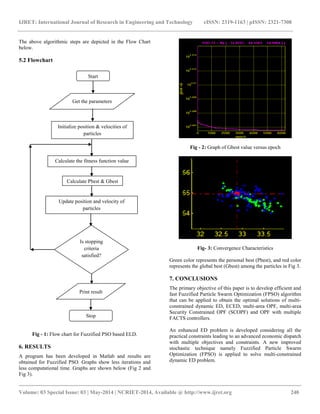
The FPSO method is inferred to have superior features than
the classical Particle Swarm Optimization (PSO) methods
such as faster and stable convergence characteristics.
The Fuzzified Particle Swarm Optimization algorithm
developed will be extremely useful for electric power utilities,
for enhancing the economy and security of operation in their
systems.
REFERENCES
[1]. Chowdhury, B.H. and Rahman, S. “A review of recent
advances in economic dispatch,” IEEE Transactions on Power
Systems, Vol. 5, No. 4, pp. 1248-1259,1990.
[2]. Mohd. Asif Iqbal. “Analysis and Comparison of Lambda
Iteration, Genetic Algorithm and Particle Swarm Optimization
to Solve Economic Load Dispatch Problem” IASIR-IJSWS
2012
[3]. A. Laoufi, A Hazzab and M. Rahli, “Power Dispatch
Using Fuzzy-Genetic Algorithm.”IJAER 2009
[4]. T. Ratniyomchai, A. Oonsivilai, P. Pao-La-Or, And T.
Kulworawanichpong, “Particle Swarm Optimization for
Solving Combined Economic and Emission Dispatch
Problems.”RAEE Thailand
[5]. M.A. Abido, “Multiobjective particle swarm optimization
for environmental/economic dispatch problem.” Electric
Power Systems Research 79 (2009) 1105–1113.
[6]. Rasoul Rahmani, Mohd Fauzi Othman “Solving
Economic Dispatch Problem Using Particle Swarm
Optimization By An Evolutionary Technique For Initializing
Particles”. JATIT, 2012
[7]. T. Ratniyomchai, A. oonsivilai, “Particle Swarm
Optimization for Solving Combined Economic and Emission
Dispatch Problems.” Recent Advances In Energy &
Environment. 2010.
[8]. Taher Niknam, Hasan Doagou Mojarrad and Majid
Nayeripour. “A New Hybrid Fuzzy Adaptive Particle Swarm
Optimization For Non-Convex Economic Dispatch.” IJICICI,
Volume 7, January 2011
[9]. N.M Jothi Swaroopan., P. Somasundaram, “Fuzzified
PSO Algorithm For DC-OPF of Interconnected Power
System” Journal of Theoretical and Applied Information
Technology. 2010.
[10]. Mahesh Prasad Mishra, “Solution to Economic Load
Dispatch Using PSO” National Institute of Technology,
Rourkela 2012.](https://image.slidesharecdn.com/analysisofeconomicloaddispatchusingfuzzifiedpso-140821054455-phpapp01/85/Analysis-of-economic-load-dispatch-using-fuzzified-pso-5-320.jpg)

The paper introduces a novel fuzzified particle swarm optimization (FPso) algorithm aimed at efficiently solving multi-constrained dynamic economic dispatch and emission constrained economic dispatch problems in power systems. The proposed FPso method enhances optimization by overcoming limitations of traditional particle swarm optimization, such as slow convergence and high computation time. The algorithm demonstrates superior performance with faster convergence characteristics and is deemed beneficial for enhancing the operational economy and security of electric power utilities.


