EPORTFOLIOS:	
  HALLMARKS	
  OF	
  EXCELLENCE	
  

In	
  the	
  Master	
  of	
  Education	
  program	
  we	
  require	
  students	
  to	
  develop	
  an	
  ePortfolio,	
  a	
  password-­‐
protected	
  online	
  collection	
  of	
  work	
  samples	
  and	
  written	
  reflections.	
  Here's	
  why:	
  

                                                            ePortfolio	
  Vision	
  Statement	
  
           By	
  pursuing	
  a	
  Master's	
  degree,	
  you	
  are	
  in	
  a	
  process	
  of	
  –	
  metaphorically	
  speaking	
  –	
  writing	
  
           the	
  next	
  chapter	
  in	
  the	
  story	
  of	
  your	
  life.	
  Your	
  courses	
  are	
  one	
  part	
  of	
  that	
  process.	
  You	
  
           construct	
   meaning	
   on	
   your	
   journey,	
   considering	
   how	
   your	
   program	
   informs	
   and	
   shapes	
  
           personal	
  and	
  professional	
  goals.	
  

           Your	
   ePortfolio	
   is	
   designed	
   to	
   help	
   you	
   document	
   this	
   narrative	
   of	
   growth	
   to	
   see	
   how	
  
           parts	
  relate	
  to	
  the	
  whole.	
  We	
  believe	
  it	
  will	
  help	
  you	
  improve	
  the	
  quality	
  of	
  your	
  learning	
  
           experience,	
  both	
  during	
  and	
  after	
  your	
  time	
  in	
  the	
  program.	


WHAT	
  MAKES	
  AN	
  EPORTFOLIO	
  “GOOD”?	
  

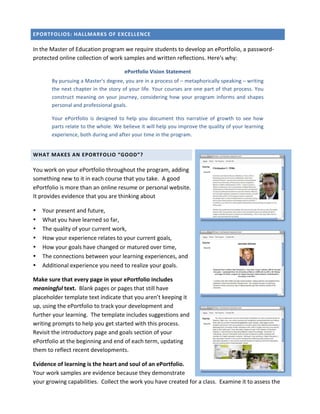
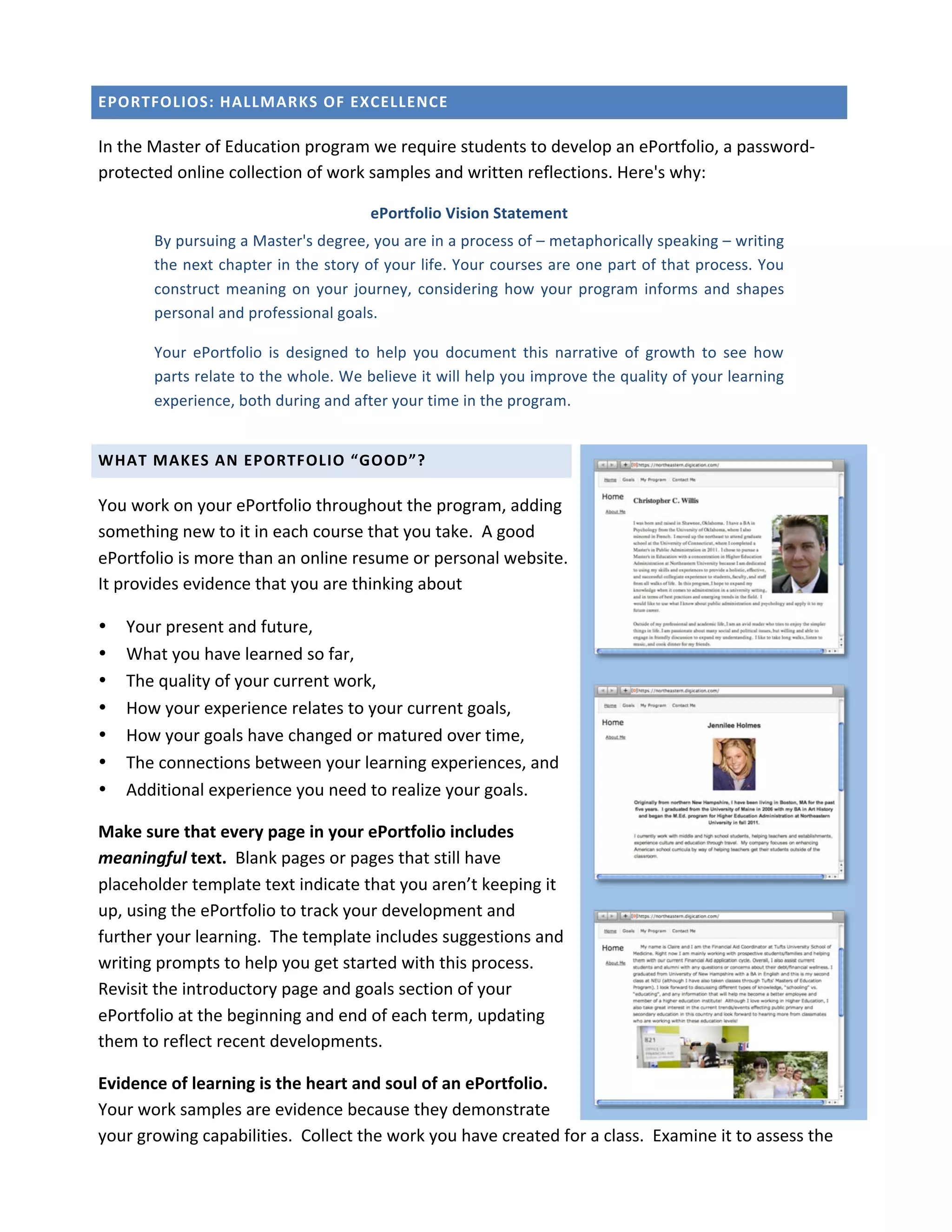
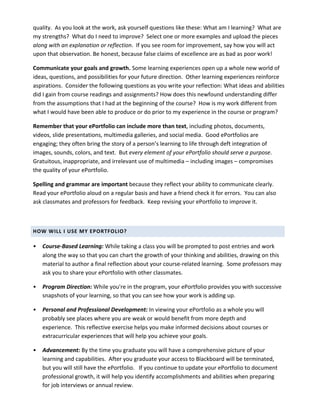
You	
  work	
  on	
  your	
  ePortfolio	
  throughout	
  the	
  program,	
  adding	
  
something	
  new	
  to	
  it	
  in	
  each	
  course	
  that	
  you	
  take.	
  	
  A	
  good	
  
ePortfolio	
  is	
  more	
  than	
  an	
  online	
  resume	
  or	
  personal	
  website.	
  	
  
It	
  provides	
  evidence	
  that	
  you	
  are	
  thinking	
  about	
  

     Your	
  present	
  and	
  future,	
  
     What	
  you	
  have	
  learned	
  so	
  far,	


     The	
  quality	
  of	
  your	
  current	
  work,	
  
     How	
  your	
  experience	
  relates	
  to	
  your	
  current	
  goals,	
  	
  
     How	
  your	
  goals	
  have	
  changed	
  or	
  matured	
  over	
  time,	
  	
  
     The	
  connections	
  between	
  your	
  learning	
  experiences,	
  and	
  
     Additional	
  experience	
  you	
  need	
  to	
  realize	
  your	
  goals.	
  

Make	
  sure	
  that	
  every	
  page	
  in	
  your	
  ePortfolio	
  includes	
  
meaningful	
  text.	
  	
  Blank	
  pages	
  or	
  pages	
  that	
  still	
  have	
  
placeholder	
  template	
  text	
  indicate	
  that	
  you	
  aren’t	
  keeping	
  it	


up,	
  using	
  the	
  ePortfolio	
  to	
  track	
  your	
  development	
  and	
  
further	
  your	
  learning.	
  	
  The	
  template	
  includes	
  suggestions	
  and	
  
writing	
  prompts	
  to	
  help	
  you	
  get	
  started	
  with	
  this	
  process.	
  
Revisit	
  the	
  introductory	
  page	
  and	
  goals	
  section	
  of	
  your	
  
ePortfolio	
  at	
  the	
  beginning	
  and	
  end	
  of	
  each	
  term,	
  updating	
  
them	
  to	
  reflect	
  recent	
  developments.	


Evidence	
  of	
  learning	
  is	
  the	
  heart	
  and	
  soul	
  of	
  an	
  ePortfolio.	
  	
  
Your	
  work	
  samples	
  are	
  evidence	
  because	
  they	
  demonstrate	
  
your	
  growing	
  capabilities.	
  	
  Collect	
  the	
  work	
  you	
  have	
  created	
  for	
  a	
  class.	
  	
  Examine	
  it	
  to	
  assess	
  the	
  
quality.	
  	
  As	
  you	
  look	
  at	
  the	
  work,	
  ask	
  yourself	
  questions	
  like	
  these:	
  What	
  am	
  I	
  learning?	
  	
  What	
  are	
  
my	
  strengths?	
  	
  What	
  do	
  I	
  need	
  to	
  improve?	
  	
  Select	
  one	
  or	
  more	
  examples	
  and	
  upload	
  the	
  pieces	
  
along	
  with	
  an	
  explanation	
  or	
  reflection.	
  	
  If	
  you	
  see	
  room	
  for	
  improvement,	
  say	
  how	
  you	
  will	
  act	
  
upon	
  that	
  observation.	
  Be	
  honest,	
  because	
  false	
  claims	
  of	
  excellence	
  are	
  as	
  bad	
  as	
  poor	
  work!	
  

Communicate	
  your	
  goals	
  and	
  growth.	
  Some	
  learning	
  experiences	
  open	
  up	
  a	
  whole	
  new	
  world	
  of	
  
ideas,	
  questions,	
  and	
  possibilities	
  for	
  your	
  future	
  direction.	
  	
  Other	
  learning	
  experiences	
  reinforce	
  
aspirations.	
  	
  Consider	
  the	
  following	
  questions	
  as	
  you	
  write	
  your	
  reflection:	
  What	
  ideas	
  and	
  abilities	
  
did	
  I	
  gain	
  from	
  course	
  readings	
  and	
  assignments?	
  How	
  does	
  this	
  newfound	
  understanding	
  differ	
  
from	
  the	
  assumptions	
  that	
  I	
  had	
  at	
  the	
  beginning	
  of	
  the	
  course?	
  	
  How	
  is	
  my	
  work	
  different	
  from	
  
what	
  I	
  would	
  have	
  been	
  able	
  to	
  produce	
  or	
  do	
  prior	
  to	
  my	
  experience	
  in	
  the	
  course	
  or	
  program?	
  

Remember	
  that	
  your	
  ePortfolio	
  can	
  include	
  more	
  than	
  text,	
  including	
  photos,	
  documents,	
  
videos,	
  slide	
  presentations,	
  multimedia	
  galleries,	
  and	
  social	
  media.	
  	
  Good	
  ePortfolios	
  are	
  
engaging;	
  they	
  often	
  bring	
  the	
  story	
  of	
  a	
  person’s	
  learning	
  to	
  life	
  through	
  deft	
  integration	
  of	
  
images,	
  sounds,	
  colors,	
  and	
  text.	
  	
  But	
  every	
  element	
  of	
  your	
  ePortfolio	
  should	
  serve	
  a	
  purpose.	
  	
  
Gratuitous,	
  inappropriate,	
  and	
  irrelevant	
  use	
  of	
  multimedia	
  –	
  including	
  images	
  –	
  compromises	
  
the	
  quality	
  of	
  your	
  ePortfolio.	
  

Spelling	
  and	
  grammar	
  are	
  important	
  because	
  they	
  reflect	
  your	
  ability	
  to	
  communicate	
  clearly.	
  	
  
Read	
  your	
  ePortfolio	
  aloud	
  on	
  a	
  regular	
  basis	
  and	
  have	
  a	
  friend	
  check	
  it	
  for	
  errors.	
  	
  You	
  can	
  also	
  
ask	
  classmates	
  and	
  professors	
  for	
  feedback.	
  	
  Keep	
  revising	
  your	
  ePortfolio	
  to	
  improve	
  it.	


HOW	
  WILL	
  I	
  USE	
  MY	
  EPORTFOLIO?	
  

•      Course-­‐Based	
  Learning:	
  While	
  taking	
  a	
  class	
  you	
  will	
  be	
  prompted	
  to	
  post	
  entries	
  and	
  work	
  
       along	
  the	
  way	
  so	
  that	
  you	
  can	
  chart	
  the	
  growth	
  of	
  your	
  thinking	
  and	
  abilities,	
  drawing	
  on	
  this	
  
       material	
  to	
  author	
  a	
  final	
  reflection	
  about	
  your	
  course-­‐related	
  learning.	
  	
  Some	
  professors	
  may	
  
       ask	
  you	
  to	
  share	
  your	
  ePortfolio	
  with	
  other	
  classmates.	
  

•      Program	
  Direction:	
  While	
  you're	
  in	
  the	
  program,	
  your	
  ePortfolio	
  provides	
  you	
  with	
  successive	
  
       snapshots	
  of	
  your	
  learning,	
  so	
  that	
  you	
  can	
  see	
  how	
  your	
  work	
  is	
  adding	
  up.	
  

•      Personal	
  and	
  Professional	
  Development:	
  In	
  viewing	
  your	
  ePortfolio	
  as	
  a	
  whole	
  you	
  will	
  
       probably	
  see	
  places	
  where	
  you	
  are	
  weak	
  or	
  would	
  benefit	
  from	
  more	
  depth	
  and	
  
       experience.	
  	
  This	
  reflective	
  exercise	
  helps	
  you	
  make	
  informed	
  decisions	
  about	
  courses	
  or	
  
       extracurricular	
  experiences	
  that	
  will	
  help	
  you	
  achieve	
  your	
  goals.	
  

•      Advancement:	
  By	
  the	
  time	
  you	
  graduate	
  you	
  will	
  have	
  a	
  comprehensive	
  picture	
  of	
  your	
  
       learning	
  and	
  capabilities.	
  	
  After	
  you	
  graduate	
  your	
  access	
  to	
  Blackboard	
  will	
  be	
  terminated,	
  
       but	
  you	
  will	
  still	
  have	
  the	
  ePortfolio.	
  	
  	
  If	
  you	
  continue	
  to	
  update	
  your	
  ePortfolio	
  to	
  document	
  
       professional	
  growth,	
  it	
  will	
  help	
  you	
  identify	
  accomplishments	
  and	
  abilities	
  when	
  preparing	
  
       for	
  job	
  interviews	
  or	
  annual	
  review.	
  

E portfolio hallmarks_of_excellence

  • 1.
    EPORTFOLIOS:  HALLMARKS  OF  EXCELLENCE   In  the  Master  of  Education  program  we  require  students  to  develop  an  ePortfolio,  a  password-­‐ protected  online  collection  of  work  samples  and  written  reflections.  Here's  why:   ePortfolio  Vision  Statement   By  pursuing  a  Master's  degree,  you  are  in  a  process  of  –  metaphorically  speaking  –  writing   the  next  chapter  in  the  story  of  your  life.  Your  courses  are  one  part  of  that  process.  You   construct   meaning   on   your   journey,   considering   how   your   program   informs   and   shapes   personal  and  professional  goals.   Your   ePortfolio   is   designed   to   help   you   document   this   narrative   of   growth   to   see   how   parts  relate  to  the  whole.  We  believe  it  will  help  you  improve  the  quality  of  your  learning   experience,  both  during  and  after  your  time  in  the  program.   WHAT  MAKES  AN  EPORTFOLIO  “GOOD”?   You  work  on  your  ePortfolio  throughout  the  program,  adding   something  new  to  it  in  each  course  that  you  take.    A  good   ePortfolio  is  more  than  an  online  resume  or  personal  website.     It  provides  evidence  that  you  are  thinking  about   Your  present  and  future,   What  you  have  learned  so  far,       The  quality  of  your  current  work,   How  your  experience  relates  to  your  current  goals,     How  your  goals  have  changed  or  matured  over  time,     The  connections  between  your  learning  experiences,  and   Additional  experience  you  need  to  realize  your  goals.   Make  sure  that  every  page  in  your  ePortfolio  includes   meaningful  text.    Blank  pages  or  pages  that  still  have   placeholder  template  text  indicate  that  you  aren’t  keeping  it     up,  using  the  ePortfolio  to  track  your  development  and   further  your  learning.    The  template  includes  suggestions  and   writing  prompts  to  help  you  get  started  with  this  process.   Revisit  the  introductory  page  and  goals  section  of  your   ePortfolio  at  the  beginning  and  end  of  each  term,  updating   them  to  reflect  recent  developments.     Evidence  of  learning  is  the  heart  and  soul  of  an  ePortfolio.     Your  work  samples  are  evidence  because  they  demonstrate   your  growing  capabilities.    Collect  the  work  you  have  created  for  a  class.    Examine  it  to  assess  the  
  • 2.
    quality.    As  you  look  at  the  work,  ask  yourself  questions  like  these:  What  am  I  learning?    What  are   my  strengths?    What  do  I  need  to  improve?    Select  one  or  more  examples  and  upload  the  pieces   along  with  an  explanation  or  reflection.    If  you  see  room  for  improvement,  say  how  you  will  act   upon  that  observation.  Be  honest,  because  false  claims  of  excellence  are  as  bad  as  poor  work!   Communicate  your  goals  and  growth.  Some  learning  experiences  open  up  a  whole  new  world  of   ideas,  questions,  and  possibilities  for  your  future  direction.    Other  learning  experiences  reinforce   aspirations.    Consider  the  following  questions  as  you  write  your  reflection:  What  ideas  and  abilities   did  I  gain  from  course  readings  and  assignments?  How  does  this  newfound  understanding  differ   from  the  assumptions  that  I  had  at  the  beginning  of  the  course?    How  is  my  work  different  from   what  I  would  have  been  able  to  produce  or  do  prior  to  my  experience  in  the  course  or  program?   Remember  that  your  ePortfolio  can  include  more  than  text,  including  photos,  documents,   videos,  slide  presentations,  multimedia  galleries,  and  social  media.    Good  ePortfolios  are   engaging;  they  often  bring  the  story  of  a  person’s  learning  to  life  through  deft  integration  of   images,  sounds,  colors,  and  text.    But  every  element  of  your  ePortfolio  should  serve  a  purpose.     Gratuitous,  inappropriate,  and  irrelevant  use  of  multimedia  –  including  images  –  compromises   the  quality  of  your  ePortfolio.   Spelling  and  grammar  are  important  because  they  reflect  your  ability  to  communicate  clearly.     Read  your  ePortfolio  aloud  on  a  regular  basis  and  have  a  friend  check  it  for  errors.    You  can  also   ask  classmates  and  professors  for  feedback.    Keep  revising  your  ePortfolio  to  improve  it.     HOW  WILL  I  USE  MY  EPORTFOLIO?   • Course-­‐Based  Learning:  While  taking  a  class  you  will  be  prompted  to  post  entries  and  work   along  the  way  so  that  you  can  chart  the  growth  of  your  thinking  and  abilities,  drawing  on  this   material  to  author  a  final  reflection  about  your  course-­‐related  learning.    Some  professors  may   ask  you  to  share  your  ePortfolio  with  other  classmates.   • Program  Direction:  While  you're  in  the  program,  your  ePortfolio  provides  you  with  successive   snapshots  of  your  learning,  so  that  you  can  see  how  your  work  is  adding  up.   • Personal  and  Professional  Development:  In  viewing  your  ePortfolio  as  a  whole  you  will   probably  see  places  where  you  are  weak  or  would  benefit  from  more  depth  and   experience.    This  reflective  exercise  helps  you  make  informed  decisions  about  courses  or   extracurricular  experiences  that  will  help  you  achieve  your  goals.   • Advancement:  By  the  time  you  graduate  you  will  have  a  comprehensive  picture  of  your   learning  and  capabilities.    After  you  graduate  your  access  to  Blackboard  will  be  terminated,   but  you  will  still  have  the  ePortfolio.      If  you  continue  to  update  your  ePortfolio  to  document   professional  growth,  it  will  help  you  identify  accomplishments  and  abilities  when  preparing   for  job  interviews  or  annual  review.