E-Marketing
Dr. Karim Kobeissi
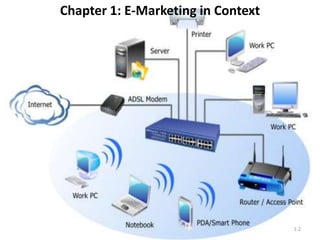
Chapter 1: E-Marketing in Context
1-2
Keyword: Internet
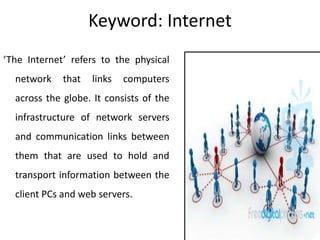
‘The Internet’ refers to the physical
network that links computers
across the globe. It consists of the
infrastructure of network servers
and communication links between
them that are used to hold and
transport information between the
client PCs and web servers.
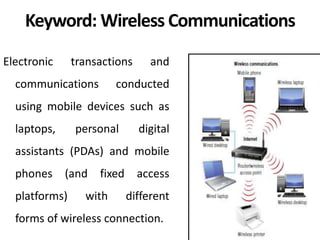
Keyword: Wireless Communications
Electronic transactions and
communications conducted
using mobile devices such as
laptops, personal digital
assistants (PDAs) and mobile
phones (and fixed access
platforms) with different
forms of wireless connection.
Keyword: Browser
A browser is a software application used to
locate, retrieve and display content on
the World Wide Web, including Web pages,
images, video and other files. Some
examples of web browsers are: Google
Chrome, Safari, internet Explorer ....
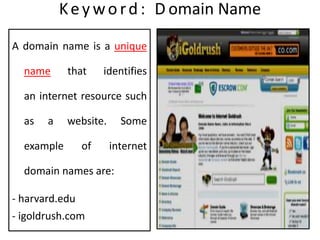
Key word: D omain Name
A domain name is a unique
name that identifies
an internet resource such
as a website. Some
example of internet
domain names are:
- harvard.edu
- igoldrush.com
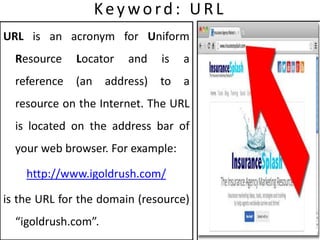
Key wo rd: URL
URL is an acronym for Uniform
Resource Locator and is a
reference (an address) to a
resource on the Internet. The URL
is located on the address bar of
your web browser. For example:
http://www.igoldrush.com/
is the URL for the domain (resource)
“igoldrush.com”.
Keyword: Web Server
Web servers are computers that deliver (serves up) Web pages.
Every Web server has an IP address and possibly a domain
name. For example, if you enter the URL
http://www.pcwebopedia.com/index.html in your browser, this
sends a request to the Web server whose domain name is
pcwebopedia.com. The server then go and get the page named
index.html and sends it to your browser.
• Any computer can be turned into a Web server by installing
server software and connecting the machine to the Internet.
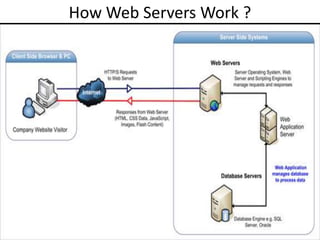
How Web Servers Work ?
K e y w o r d : C o o k i e
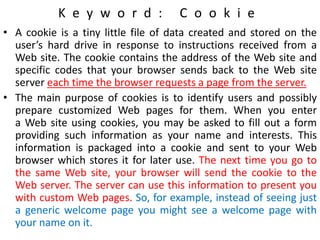
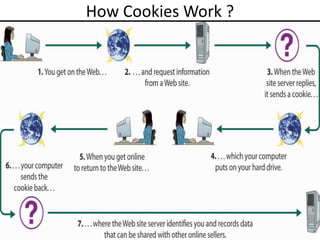
• A cookie is a tiny little file of data created and stored on the
user’s hard drive in response to instructions received from a
Web site. The cookie contains the address of the Web site and
specific codes that your browser sends back to the Web site
server each time the browser requests a page from the server.
• The main purpose of cookies is to identify users and possibly
prepare customized Web pages for them. When you enter
a Web site using cookies, you may be asked to fill out a form
providing such information as your name and interests. This
information is packaged into a cookie and sent to your Web
browser which stores it for later use. The next time you go to
the same Web site, your browser will send the cookie to the
Web server. The server can use this information to present you
with custom Web pages. So, for example, instead of seeing just
a generic welcome page you might see a welcome page with
your name on it.
How Cookies Work ?
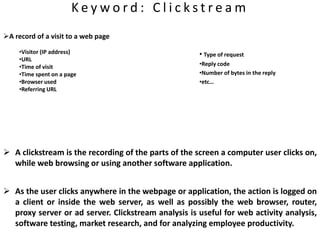
K e y w o r d : C l i c k s t r e a m
A record of a visit to a web page
•Visitor (IP address)
•URL
•Time of visit
•Time spent on a page
•Browser used
•Referring URL
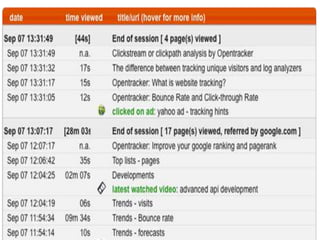
 A clickstream is the recording of the parts of the screen a computer user clicks on,
while web browsing or using another software application.
 As the user clicks anywhere in the webpage or application, the action is logged on
a client or inside the web server, as well as possibly the web browser, router,
proxy server or ad server. Clickstream analysis is useful for web activity analysis,
software testing, market research, and for analyzing employee productivity.
• Type of request
•Reply code
•Number of bytes in the reply
•etc…
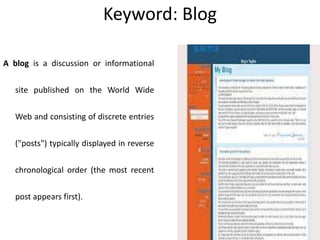
Keyword: Blog
A blog is a discussion or informational
site published on the World Wide
Web and consisting of discrete entries
("posts") typically displayed in reverse
chronological order (the most recent
post appears first).
Keywords: Value
1-15
• Value: The worth that a product has in the mind of the consumer.
• Value, a central marketing concept, is primarily a combination of quality,
service, and price (qsp), called the customer value triad. Value
perceptions increase with quality and service but decrease with price.
• The consumer's perceived value of a good or service affects the price
that he or she is willing to pay for it. For the most part, consumers are
unaware of the true cost of production for the products they buy. Instead,
they simply have an internal feeling for how much certain products are
worth to them. Thus, in order to obtain a higher price for their products,
producers may pursue marketing strategies to create a higher perceived
value for their products.
What is Marketing?
• An organizational function
• A process for exploring,
creating, and delivering
value to satisfy the needs of
a target market at a profit
(Kotler, 2006).
E-Marketing - Definition
1-17
Electronic Marketing refers to the conduct of
marketing activities – identifying the customer and
creating value to satisfy the customer - via
electronic communication technologies including
the internet* and mobile devices (Boateng, 2010).
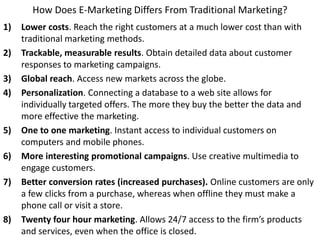
How Does E-Marketing Differs From Traditional Marketing?
1) Lower costs. Reach the right customers at a much lower cost than with
traditional marketing methods.
2) Trackable, measurable results. Obtain detailed data about customer
responses to marketing campaigns.
3) Global reach. Access new markets across the globe.
4) Personalization. Connecting a database to a web site allows for
individually targeted offers. The more they buy the better the data and
more effective the marketing.
5) One to one marketing. Instant access to individual customers on
computers and mobile phones.
6) More interesting promotional campaigns. Use creative multimedia to
engage customers.
7) Better conversion rates (increased purchases). Online customers are only
a few clicks from a purchase, whereas when offline they must make a
phone call or visit a store.
8) Twenty four hour marketing. Allows 24/7 access to the firm’s products
and services, even when the office is closed.
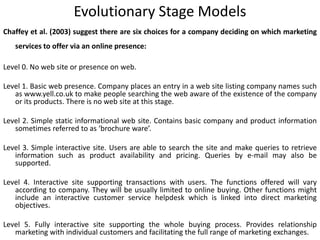
Evolutionary Stage Models
Chaffey et al. (2003) suggest there are six choices for a company deciding on which marketing
services to offer via an online presence:
Level 0. No web site or presence on web.
Level 1. Basic web presence. Company places an entry in a web site listing company names such
as www.yell.co.uk to make people searching the web aware of the existence of the company
or its products. There is no web site at this stage.
Level 2. Simple static informational web site. Contains basic company and product information
sometimes referred to as ‘brochure ware’.
Level 3. Simple interactive site. Users are able to search the site and make queries to retrieve
information such as product availability and pricing. Queries by e-mail may also be
supported.
Level 4. Interactive site supporting transactions with users. The functions offered will vary
according to company. They will be usually limited to online buying. Other functions might
include an interactive customer service helpdesk which is linked into direct marketing
objectives.
Level 5. Fully interactive site supporting the whole buying process. Provides relationship
marketing with individual customers and facilitating the full range of marketing exchanges.
E - c o m m e r c e
E-commerce is defined as all electronically mediated
information exchanges between an organization
and its EXTERNAL stakeholders (Chaffey, 2007).
This definitions shows that electronic commerce is
NOT SOLELY restricted to the actual buying and
selling of products, but also includes pre-sale and
post-sale activities across the supply chain.
E - b u s i n e s s
E-business is defined as all
electronically mediated information
exchanges, BOTH within an
organization and with external
stakeholders supporting the range of
business processes (Chaffey, 2007).
What Is The Relationship Between
E-Marketing, E-commerce, E-business
and Internet-marketing?
E-Marketing is Wider Than Internet Marketing
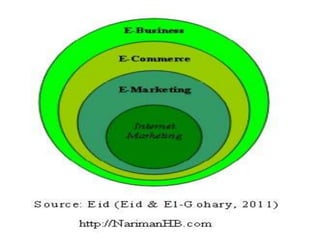
• Internet-marketing is a subset of E-marketing . It can be argued
that this is most realistic since e-marketing not only use the
internet but also other digital communication technologies such
as short message service (SMS), multimedia messaging service
(MMS), E-mails (without streaming), etc.
• E-marketing is a subset of E-commerce. It can be argued that
this is most realistic since e-commerce have a wider and
broader scope than e-Marketing.
• E-commerce is a subset of E-business. It can be argued that this
is most realistic since e-business is not only restricted to all
electronic information exchanges between an organization and
its EXTERNAL stakeholders , but it also covers INTERNAL
stakeholders .
E-Marketing Challenges and Opportunities
The Internet and other digital media have transformed marketing:
• For customers, they give a much wider choice of products and prices from
different suppliers and the means to select and purchase items more
readily. There is also a choice of technology platforms from desktops and
laptops to mobile and tablet devices for consumers to use.
• For organizations, digital media and new technology platforms give the
opportunity to expand into new markets, offer new services, apply new
online communication techniques and compete on a more equal footing
with larger businesses.
• For those working within these organizations it gives the opportunity to
learn and develop new skills and to use the Internet to improve the
competitiveness of the company through detailed customer and market
research.
E-Marketing Challenges and Opportunities
At the same time, the internet and related digital technology
platforms gives rise to many threats to organizations. For
example, online companies such as ASOS.com (clothing),
Amazon.com (books and retail) and Expedia (travel)have
captured a significant part of their market and struck fear
into the existing players. Many consumers now regularly
use social networks like Face book, Google +, LinkedIn and
Twitter as part of their daily lives. Engaging these
consumers is an ongoing challenge.

242031463 e-marketing-ch-1

  • 1.
  • 2.
    Chapter 1: E-Marketingin Context 1-2
  • 3.
    Keyword: Internet ‘The Internet’refers to the physical network that links computers across the globe. It consists of the infrastructure of network servers and communication links between them that are used to hold and transport information between the client PCs and web servers.
  • 4.
    Keyword: Wireless Communications Electronictransactions and communications conducted using mobile devices such as laptops, personal digital assistants (PDAs) and mobile phones (and fixed access platforms) with different forms of wireless connection.
  • 5.
    Keyword: Browser A browseris a software application used to locate, retrieve and display content on the World Wide Web, including Web pages, images, video and other files. Some examples of web browsers are: Google Chrome, Safari, internet Explorer ....
  • 6.
    Key word: Domain Name A domain name is a unique name that identifies an internet resource such as a website. Some example of internet domain names are: - harvard.edu - igoldrush.com
  • 7.
    Key wo rd:URL URL is an acronym for Uniform Resource Locator and is a reference (an address) to a resource on the Internet. The URL is located on the address bar of your web browser. For example: http://www.igoldrush.com/ is the URL for the domain (resource) “igoldrush.com”.
  • 8.
    Keyword: Web Server Webservers are computers that deliver (serves up) Web pages. Every Web server has an IP address and possibly a domain name. For example, if you enter the URL http://www.pcwebopedia.com/index.html in your browser, this sends a request to the Web server whose domain name is pcwebopedia.com. The server then go and get the page named index.html and sends it to your browser. • Any computer can be turned into a Web server by installing server software and connecting the machine to the Internet.
  • 9.
  • 10.
    K e yw o r d : C o o k i e • A cookie is a tiny little file of data created and stored on the user’s hard drive in response to instructions received from a Web site. The cookie contains the address of the Web site and specific codes that your browser sends back to the Web site server each time the browser requests a page from the server. • The main purpose of cookies is to identify users and possibly prepare customized Web pages for them. When you enter a Web site using cookies, you may be asked to fill out a form providing such information as your name and interests. This information is packaged into a cookie and sent to your Web browser which stores it for later use. The next time you go to the same Web site, your browser will send the cookie to the Web server. The server can use this information to present you with custom Web pages. So, for example, instead of seeing just a generic welcome page you might see a welcome page with your name on it.
  • 11.
  • 12.
    K e yw o r d : C l i c k s t r e a m A record of a visit to a web page •Visitor (IP address) •URL •Time of visit •Time spent on a page •Browser used •Referring URL  A clickstream is the recording of the parts of the screen a computer user clicks on, while web browsing or using another software application.  As the user clicks anywhere in the webpage or application, the action is logged on a client or inside the web server, as well as possibly the web browser, router, proxy server or ad server. Clickstream analysis is useful for web activity analysis, software testing, market research, and for analyzing employee productivity. • Type of request •Reply code •Number of bytes in the reply •etc…
  • 14.
    Keyword: Blog A blogis a discussion or informational site published on the World Wide Web and consisting of discrete entries ("posts") typically displayed in reverse chronological order (the most recent post appears first).
  • 15.
    Keywords: Value 1-15 • Value:The worth that a product has in the mind of the consumer. • Value, a central marketing concept, is primarily a combination of quality, service, and price (qsp), called the customer value triad. Value perceptions increase with quality and service but decrease with price. • The consumer's perceived value of a good or service affects the price that he or she is willing to pay for it. For the most part, consumers are unaware of the true cost of production for the products they buy. Instead, they simply have an internal feeling for how much certain products are worth to them. Thus, in order to obtain a higher price for their products, producers may pursue marketing strategies to create a higher perceived value for their products.
  • 16.
    What is Marketing? •An organizational function • A process for exploring, creating, and delivering value to satisfy the needs of a target market at a profit (Kotler, 2006).
  • 17.
    E-Marketing - Definition 1-17 ElectronicMarketing refers to the conduct of marketing activities – identifying the customer and creating value to satisfy the customer - via electronic communication technologies including the internet* and mobile devices (Boateng, 2010).
  • 18.
    How Does E-MarketingDiffers From Traditional Marketing? 1) Lower costs. Reach the right customers at a much lower cost than with traditional marketing methods. 2) Trackable, measurable results. Obtain detailed data about customer responses to marketing campaigns. 3) Global reach. Access new markets across the globe. 4) Personalization. Connecting a database to a web site allows for individually targeted offers. The more they buy the better the data and more effective the marketing. 5) One to one marketing. Instant access to individual customers on computers and mobile phones. 6) More interesting promotional campaigns. Use creative multimedia to engage customers. 7) Better conversion rates (increased purchases). Online customers are only a few clicks from a purchase, whereas when offline they must make a phone call or visit a store. 8) Twenty four hour marketing. Allows 24/7 access to the firm’s products and services, even when the office is closed.
  • 19.
    Evolutionary Stage Models Chaffeyet al. (2003) suggest there are six choices for a company deciding on which marketing services to offer via an online presence: Level 0. No web site or presence on web. Level 1. Basic web presence. Company places an entry in a web site listing company names such as www.yell.co.uk to make people searching the web aware of the existence of the company or its products. There is no web site at this stage. Level 2. Simple static informational web site. Contains basic company and product information sometimes referred to as ‘brochure ware’. Level 3. Simple interactive site. Users are able to search the site and make queries to retrieve information such as product availability and pricing. Queries by e-mail may also be supported. Level 4. Interactive site supporting transactions with users. The functions offered will vary according to company. They will be usually limited to online buying. Other functions might include an interactive customer service helpdesk which is linked into direct marketing objectives. Level 5. Fully interactive site supporting the whole buying process. Provides relationship marketing with individual customers and facilitating the full range of marketing exchanges.
  • 20.
    E - co m m e r c e E-commerce is defined as all electronically mediated information exchanges between an organization and its EXTERNAL stakeholders (Chaffey, 2007). This definitions shows that electronic commerce is NOT SOLELY restricted to the actual buying and selling of products, but also includes pre-sale and post-sale activities across the supply chain.
  • 21.
    E - bu s i n e s s E-business is defined as all electronically mediated information exchanges, BOTH within an organization and with external stakeholders supporting the range of business processes (Chaffey, 2007).
  • 22.
    What Is TheRelationship Between E-Marketing, E-commerce, E-business and Internet-marketing?
  • 23.
    E-Marketing is WiderThan Internet Marketing • Internet-marketing is a subset of E-marketing . It can be argued that this is most realistic since e-marketing not only use the internet but also other digital communication technologies such as short message service (SMS), multimedia messaging service (MMS), E-mails (without streaming), etc. • E-marketing is a subset of E-commerce. It can be argued that this is most realistic since e-commerce have a wider and broader scope than e-Marketing. • E-commerce is a subset of E-business. It can be argued that this is most realistic since e-business is not only restricted to all electronic information exchanges between an organization and its EXTERNAL stakeholders , but it also covers INTERNAL stakeholders .
  • 25.
    E-Marketing Challenges andOpportunities The Internet and other digital media have transformed marketing: • For customers, they give a much wider choice of products and prices from different suppliers and the means to select and purchase items more readily. There is also a choice of technology platforms from desktops and laptops to mobile and tablet devices for consumers to use. • For organizations, digital media and new technology platforms give the opportunity to expand into new markets, offer new services, apply new online communication techniques and compete on a more equal footing with larger businesses. • For those working within these organizations it gives the opportunity to learn and develop new skills and to use the Internet to improve the competitiveness of the company through detailed customer and market research.
  • 26.
    E-Marketing Challenges andOpportunities At the same time, the internet and related digital technology platforms gives rise to many threats to organizations. For example, online companies such as ASOS.com (clothing), Amazon.com (books and retail) and Expedia (travel)have captured a significant part of their market and struck fear into the existing players. Many consumers now regularly use social networks like Face book, Google +, LinkedIn and Twitter as part of their daily lives. Engaging these consumers is an ongoing challenge.