Note:
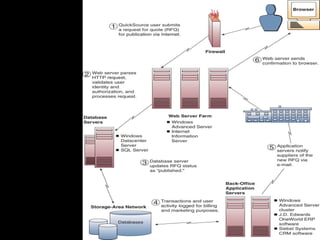
Project B is could be considered a
“baby” E-commerce system
Project A could be part of a larger e-
commerce system
Electronic Commerce Systems
(e-commerce)
What you need to know about
e-commerce
Major categories and trends of e-commerce
applications.
Essential processes of an e-commerce
Examples of how these process are
implemented in e-commerce applications.
What you need to know about
e-commerce
Web store requirements needed to succeed
in e-commerce.
Business value of several types of e-
commerce marketplaces.
Benefits and trade-offs of e-commerce
clicks and bricks alternatives.
What is Electronic Commerce?
Encompasses the entire online process of
developing, marketing, selling, delivering,
servicing, and paying for products and
services
Transacted on internetworked, global
marketplaces of customers, with the
support of a worldwide network of
business partners.
Case #1: Success in an Online
Marketplace
Evolution of eBay:
– Consumer auction market for small segment of
population to sell collectibles
– 30 million users listing 12 million items daily
with own laws, feedback system, enforcement,
payment processing unit
Case #1: Success in an Online
Marketplace
Reasons for Success:
– Voice of the Customer program
– Customer take initiative to expand eBay
economy
• Industrial products marketplace
• e-Bay motors
• Wholesale business
Case #1: Success in an Online
Marketplace
Why has eBay become such a successful
and diverse online marketplace?
Is E-bay’s move from C2C to B2C and
B2B a good long-term strategy?
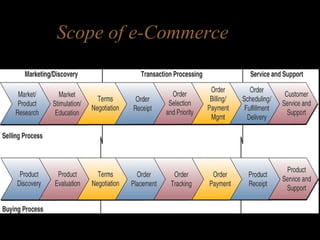
Scope of e-Commerce
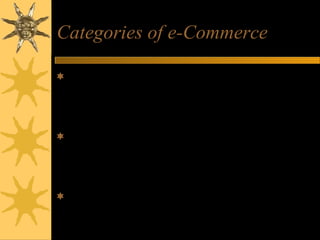
Categories of e-Commerce
Business-to-Consumer (B2C) – businesses
develop attractive electronic marketplaces to sell
products and services to consumers
Business-to-Business (B2B) – involves both
electronic business marketplaces and direct
market links between businesses
Consumer-to-Consumer (C2C) – includes auction
websites and electronic personal advertising
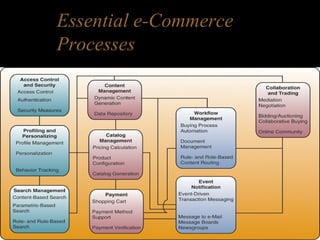
Essential e-Commerce
Processes
Access Control and Security
E-commerce processes must establish
mutual trust and secure access between the
parties in an e-commerce transaction
– by authenticating users,
– authorizing access, and
– enforcing security features
Profiling and Personalizing
Processes that gather data on you and your
website behavior and choices, and build
electronic profiles of your characteristics and
preferences.
These profiles are then used to recognize you as
an individual user and provide you with a
personalized view of the contents of the site, as
well as product recommendations and
personalized Web advertising
Search Management
Efficient and effective search processes
provide a top e-commerce website
capability that helps customers find the
specific product or service they want to
evaluate or buy
Content and Catalog
Management
Content Management – software that helps
e-commerce companies develop, generate,
deliver, update, and archive text data and
multimedia information at e-commerce
websites
Catalog Management – software that helps
generate and manage catalog content
Workflow Management
Software that helps employees
electronically collaborate to accomplish
structured work tasks within knowledge-
based business processes
Event Notification
Software that notifies customers, suppliers,
employees, and other stakeholders of their
status in a transaction based on events
initiated by one of the parties
Collaboration and Trading
Processes that support the vital
collaboration arrangements and trading
services needed by customers, suppliers,
and other stakeholders
Electronic Payment Processes
Web Payment – credit card payment processes
on the web
Electronic Funds Transfer (EFT) –money and
credit transfers between banks and businesses
and their customers
Secure Electronic Payments –
– encrypting data passing between customer and
merchant
– encrypting data passing between customer and
company authorizing the credit card transaction,
– taking sensitive information off-line
Case #2: Lean Manufacturing
Lean manufacturing is a methodology that
seeks to eliminate all waste from the
manufacturing process.
The goal is to create a production
environment driven by demand that holds
only a small amount of inventory and
products at any given time
Case #2: Lean Manufacturing
Modern Practices Employed:
Just-in-time processes ensure that goods arrive
when needed for production
Kaizen calls on everyone to look for ways to
improve quality, cycle times, safety and other
aspects of an operation
Kanban establishes a pull instead of a push
system of moving goods through the factory
Case #2: Lean Manufacturing
1. Does a company’s size have an effect on
the advantage gained from lean
manufacturing and integrations of the
various procurement systems?
2. What are some of the specific way that
E-commerce facilitates Lean
Manufacturing?
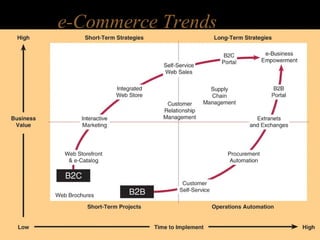
e-Commerce Trends
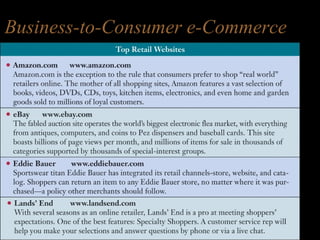
Business-to-Consumer e-Commerce
e-Commerce Success Factors
Selection and Value – attractive product
selections, competitive prices, satisfaction
guarantees, and customer support after the
sale
Performance and Service – fast, easy
navigation, shopping, and purchasing, and
prompt shipping and delivery
e-Commerce Success Factors
Look and Feel – attractive web storefront,
website shipping areas, multimedia product
catalog pages, and shopping features
Advertising and Incentives – targeted web
page advertising and e-mail promotions,
discounts and special offers, including
advertising at affiliate sites
e-Commerce Success Factors
Personal Attention – personal web pages,
personalized product recommendations, Web
advertising and e-mail notices, and interactive
support for all customers
Community Relationships – virtual communities
of customers, suppliers, company representatives,
and others via newsgroups, chat rooms, and links
to related sites
e-Commerce Success Factors
Security and Reliability – security of
customer information and website
transactions, trustworthy product
information, and reliable order fulfillment
Web Store Requirements
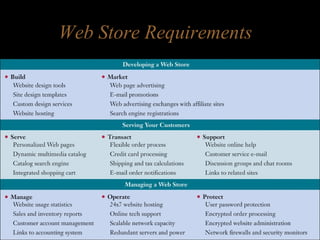
Developing a Web Store
Build website using simple website design
tools
Market website to attract visitors and
transform them into loyal Web customers
Serving Customers
Serve customers by creating user profiles,
customer files, and promotions that develop a
one-to-one relationship
Transact with customers by providing
dynamically changing catalog, fast catalog search
engine, and shopping cart system integrated with
promotions, payment, shipping, and account
information
Support customers with help menus, tutorials,
FAQs and e-mail correspondence with customer
service representatives
Managing a Web Store
Manage both the business and the website
Operate twenty-four hours a day, seven
days a week
Protect Web store transactions and
customer records, and repel hacker attacks
and other security threats
Business-to-Business e-
Commerce
B2B e-commerce is the wholesale and
supply side of the commercial process,
where businesses buy, sell, or trade with
other businesses.
All factors for building a successful retail
website also apply to wholesale websites
for B2B e-commerce.
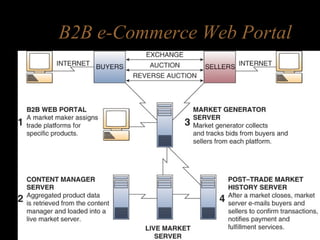
e-Commerce Portals
Definition:
Websites developed and hosted by third-
party market-maker companies who serve
as infomediaries that bring buyers and
sellers together in catalog, exchange, and
auction markets.
B2B e-Commerce Web Portal
Infomediaries
Definition:
Companies that serve as intermediaries in
e-business and e-commerce transactions
Provide e-commerce marketplace software
products and services to power business
Web portals for e-commerce transactions
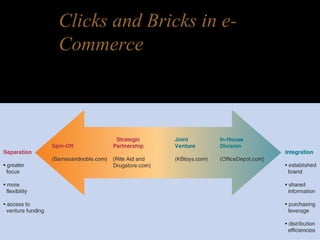
Clicks and Bricks in e-
Commerce
Summary
Electronic commerce encompasses the
entire online process of developing,
marketing, selling, delivering, servicing,
and paying for products and services.
The basic categories of e-commerce
include B2C, B2B and C2C.
Summary
Many e-business enterprises are moving
toward offering full service B2C and B2B
e-commerce portals supported by
– integrated customer-focused processes
and
– internetworked supply chains.
Summary
Businesses typically sell products and services to
consumers at e-commerce websites that provide
– attractive Web pages,
– multimedia catalogs,
– interactive order processing,
– secure electronic payment systems, and
– online customer support.

Summary
Business-to-business applications of e-
commerce involve
– electronic catalog, exchange, and
auction marketplaces that use Internet,
intranet, and extranet websites and
portals to unite buyers and sellers.

Ecommerce

  • 1.
    Note: Project B iscould be considered a “baby” E-commerce system Project A could be part of a larger e- commerce system Electronic Commerce Systems (e-commerce)
  • 2.
    What you needto know about e-commerce Major categories and trends of e-commerce applications. Essential processes of an e-commerce Examples of how these process are implemented in e-commerce applications.
  • 3.
    What you needto know about e-commerce Web store requirements needed to succeed in e-commerce. Business value of several types of e- commerce marketplaces. Benefits and trade-offs of e-commerce clicks and bricks alternatives.
  • 4.
    What is ElectronicCommerce? Encompasses the entire online process of developing, marketing, selling, delivering, servicing, and paying for products and services Transacted on internetworked, global marketplaces of customers, with the support of a worldwide network of business partners.
  • 5.
    Case #1: Successin an Online Marketplace Evolution of eBay: – Consumer auction market for small segment of population to sell collectibles – 30 million users listing 12 million items daily with own laws, feedback system, enforcement, payment processing unit
  • 6.
    Case #1: Successin an Online Marketplace Reasons for Success: – Voice of the Customer program – Customer take initiative to expand eBay economy • Industrial products marketplace • e-Bay motors • Wholesale business
  • 7.
    Case #1: Successin an Online Marketplace Why has eBay become such a successful and diverse online marketplace? Is E-bay’s move from C2C to B2C and B2B a good long-term strategy?
  • 8.
  • 10.
    Categories of e-Commerce Business-to-Consumer(B2C) – businesses develop attractive electronic marketplaces to sell products and services to consumers Business-to-Business (B2B) – involves both electronic business marketplaces and direct market links between businesses Consumer-to-Consumer (C2C) – includes auction websites and electronic personal advertising
  • 11.
  • 12.
    Access Control andSecurity E-commerce processes must establish mutual trust and secure access between the parties in an e-commerce transaction – by authenticating users, – authorizing access, and – enforcing security features
  • 13.
    Profiling and Personalizing Processesthat gather data on you and your website behavior and choices, and build electronic profiles of your characteristics and preferences. These profiles are then used to recognize you as an individual user and provide you with a personalized view of the contents of the site, as well as product recommendations and personalized Web advertising
  • 14.
    Search Management Efficient andeffective search processes provide a top e-commerce website capability that helps customers find the specific product or service they want to evaluate or buy
  • 15.
    Content and Catalog Management ContentManagement – software that helps e-commerce companies develop, generate, deliver, update, and archive text data and multimedia information at e-commerce websites Catalog Management – software that helps generate and manage catalog content
  • 16.
    Workflow Management Software thathelps employees electronically collaborate to accomplish structured work tasks within knowledge- based business processes
  • 17.
    Event Notification Software thatnotifies customers, suppliers, employees, and other stakeholders of their status in a transaction based on events initiated by one of the parties
  • 18.
    Collaboration and Trading Processesthat support the vital collaboration arrangements and trading services needed by customers, suppliers, and other stakeholders
  • 19.
    Electronic Payment Processes WebPayment – credit card payment processes on the web Electronic Funds Transfer (EFT) –money and credit transfers between banks and businesses and their customers Secure Electronic Payments – – encrypting data passing between customer and merchant – encrypting data passing between customer and company authorizing the credit card transaction, – taking sensitive information off-line
  • 20.
    Case #2: LeanManufacturing Lean manufacturing is a methodology that seeks to eliminate all waste from the manufacturing process. The goal is to create a production environment driven by demand that holds only a small amount of inventory and products at any given time
  • 21.
    Case #2: LeanManufacturing Modern Practices Employed: Just-in-time processes ensure that goods arrive when needed for production Kaizen calls on everyone to look for ways to improve quality, cycle times, safety and other aspects of an operation Kanban establishes a pull instead of a push system of moving goods through the factory
  • 22.
    Case #2: LeanManufacturing 1. Does a company’s size have an effect on the advantage gained from lean manufacturing and integrations of the various procurement systems? 2. What are some of the specific way that E-commerce facilitates Lean Manufacturing?
  • 23.
  • 24.
  • 25.
    e-Commerce Success Factors Selectionand Value – attractive product selections, competitive prices, satisfaction guarantees, and customer support after the sale Performance and Service – fast, easy navigation, shopping, and purchasing, and prompt shipping and delivery
  • 26.
    e-Commerce Success Factors Lookand Feel – attractive web storefront, website shipping areas, multimedia product catalog pages, and shopping features Advertising and Incentives – targeted web page advertising and e-mail promotions, discounts and special offers, including advertising at affiliate sites
  • 27.
    e-Commerce Success Factors PersonalAttention – personal web pages, personalized product recommendations, Web advertising and e-mail notices, and interactive support for all customers Community Relationships – virtual communities of customers, suppliers, company representatives, and others via newsgroups, chat rooms, and links to related sites
  • 28.
    e-Commerce Success Factors Securityand Reliability – security of customer information and website transactions, trustworthy product information, and reliable order fulfillment
  • 29.
  • 30.
    Developing a WebStore Build website using simple website design tools Market website to attract visitors and transform them into loyal Web customers
  • 31.
    Serving Customers Serve customersby creating user profiles, customer files, and promotions that develop a one-to-one relationship Transact with customers by providing dynamically changing catalog, fast catalog search engine, and shopping cart system integrated with promotions, payment, shipping, and account information Support customers with help menus, tutorials, FAQs and e-mail correspondence with customer service representatives
  • 32.
    Managing a WebStore Manage both the business and the website Operate twenty-four hours a day, seven days a week Protect Web store transactions and customer records, and repel hacker attacks and other security threats
  • 33.
    Business-to-Business e- Commerce B2B e-commerceis the wholesale and supply side of the commercial process, where businesses buy, sell, or trade with other businesses. All factors for building a successful retail website also apply to wholesale websites for B2B e-commerce.
  • 34.
    e-Commerce Portals Definition: Websites developedand hosted by third- party market-maker companies who serve as infomediaries that bring buyers and sellers together in catalog, exchange, and auction markets.
  • 35.
  • 36.
    Infomediaries Definition: Companies that serveas intermediaries in e-business and e-commerce transactions Provide e-commerce marketplace software products and services to power business Web portals for e-commerce transactions
  • 37.
    Clicks and Bricksin e- Commerce
  • 38.
    Summary Electronic commerce encompassesthe entire online process of developing, marketing, selling, delivering, servicing, and paying for products and services. The basic categories of e-commerce include B2C, B2B and C2C.
  • 39.
    Summary Many e-business enterprisesare moving toward offering full service B2C and B2B e-commerce portals supported by – integrated customer-focused processes and – internetworked supply chains.
  • 40.
    Summary Businesses typically sellproducts and services to consumers at e-commerce websites that provide – attractive Web pages, – multimedia catalogs, – interactive order processing, – secure electronic payment systems, and – online customer support.

  • 41.

    Summary Business-to-business applications ofe- commerce involve – electronic catalog, exchange, and auction marketplaces that use Internet, intranet, and extranet websites and portals to unite buyers and sellers.