FitForCommerce	
  Whitepaper	
  Series	
  
While	
  traditional	
  B2B	
  sales	
  channels	
  are	
  still	
  the	
  most	
  influential,	
  the	
  explosive	
  growth	
  of	
  B2B	
  ecommerce	
  is	
  
forcing	
  B2B	
  organizations	
  to	
  dedicate	
  resources	
  and	
  budget	
  to	
  the	
  online	
  sales	
  channel.	
  While	
  B2B	
  organizations	
  
can	
  learn	
  from	
  B2C	
  in	
  terms	
  of	
  user	
  experience,	
  B2B	
  selling	
  is	
  much	
  more	
  complex	
  and	
  requires	
  a	
  centralized	
  
commerce	
  platform	
  that	
  fully	
  supports	
  sophisticated	
  workflows,	
  pricing,	
  product	
  configurations,	
  approvals	
  and	
  
more.	
  In	
  this	
  paper,	
  we	
  explore	
  the	
  impact	
  of	
  the	
  online	
  channel	
  and	
  examine	
  five	
  key	
  components	
  required	
  to	
  
achieve	
  B2B	
  commerce	
  effectiveness.	


July	
  2014	
  
Kerry	
  Martin	
  and	
  Tim	
  Toews,	
  FitForCommerce	
   	
  
B2B	
  Commerce	
  Effectiveness:	
  5	
  Key	
  Components	
  of	
  Successful	
  
B2B	
  Commerce	


Traditional	
   business-­‐to-­‐business	
   (B2B)	
   channels	
   are	
   still	
   the	
   most	
   influential	
   in	
  
business	
  selling;	
  however,	
  buyer	
  expectations	
  and	
  technological	
  advances	
  have	
  
led	
   to	
   an	
   explosive	
   growth	
   of	
   B2B	
   ecommerce.	
   Most	
   business	
   buyers	
   have	
  
adopted	
   ecommerce	
   as	
   private	
   consumers	
   and	
   are,	
   therefore,	
   increasingly	
  
demanding	
  the	
  same	
  convenience	
  and	
  options	
  from	
  B2B.	
  	
  Most	
  B2B	
  organizations	
  
realize	
   that	
   the	
   online	
   channel	
   needs	
   to	
   be	
   included	
   in	
   their	
   sales	
   strategy,	
  
although	
  many	
  still	
  lag	
  far	
  behind	
  when	
  it	
  comes	
  to	
  B2B	
  commerce	
  capabilities.	
  	
  
While	
   B2B	
   organizations	
   can	
   learn	
   from	
   B2C	
   online	
   retailers	
   in	
   terms	
   of	
   user	
  
experience,	
  B2B	
  selling	
  typically	
  involves	
  much	
  more	
  complex	
  processes	
  such	
  as	
  
configurable	
   product	
   offerings,	
   advanced	
   pricing	
   and	
   promotions	
   based	
   on	
   the	
  
individual	
  business	
  buyer	
  and	
  sales	
  force	
  integration.	
  These	
  combined	
  factors	
  and	
  
the	
  execution	
  of	
  B2B	
  strategies	
  across	
  both	
  traditional	
  and	
  digital	
  channels	
  drives	
  
the	
  complexity	
  of	
  B2B	
  selling	
  and	
  accentuates	
  the	
  need	
  for	
  a	
  centralized	
  platform	
  
that	
  can	
  drive	
  all	
  product,	
  pricing	
  and	
  promotion	
  strategies.	
  Simply	
  providing	
  a	
  
B2C	
  experience	
  will	
  not	
  allow	
  organizations	
  to	
  gain	
  the	
  optimal	
  results	
  from	
  a	
  B2B	
  
multichannel	
  selling	
  approach.	


For	
  organizations	
  with	
  an	
  intricate	
  product/service	
  and	
  selling	
  structure,	
  a	
  B2B	
  
enterprise	
   commerce	
   solution	
   that	
   provides	
   the	
   flexibility	
   to	
   support	
   multiple	
  
business	
  models	
  is	
  a	
  necessity.	
  There	
  are	
  five	
  key	
  areas	
  that	
  the	
  solution	
  must	
  be	
  
able	
  to	
  support	
  in	
  order	
  to	
  achieve	
  B2B	
  ecommerce	
  effectiveness:	
  	
  
1. B2C	
   best	
   practices	
   to	
   meet	
   buyer	
   expectations	
   for	
   superior	
   online	
  
experience	
  
2. Advanced	
   configurability,	
   not	
   only	
   of	
   end-­‐user	
   capabilities	
   and	
   pricing	
  
options	
   but	
   also	
   of	
   complex	
   product	
   combinations	
   for	
   quoting	
   and	
  
ordering	
  
3. Analytics	
   and	
   segmentation	
   for	
   creating	
   separate	
   and	
   distinct	
   product	
  
offerings	
  and	
  pricing,	
  quotation	
  and	
  contracts	
  
4. Sophisticated	
   workflows	
   to	
   support	
   complex	
   buying	
   cycles	
   and	
   selling	
  
execution	
  across	
  multiple	
  channels	
  and	
  markets	
  
5. Single,	
  global	
  platform	
  that	
  can	
  adapt	
  to	
  local	
  market	
  execution	


In	
  this	
  paper,	
  we	
  will	
  explore	
  each	
  of	
  these	
  five	
  areas	
  in	
  more	
  detail	
  and	
  provide	
  best	
  
practices	
  and	
  examples	
  for	
  preparing	
  for	
  and	
  achieving	
  B2B	
  effectiveness.	


Introduction
	
  
  Copyright	
  2014	
  FitForCommerce,	
  All	
  Rights	
  Reserved	


The	
  B2B	
  commerce	
  factor	
  
While	
  traditional	
  selling	
  methods	
  still	
  dominate	
  B2B	
  sales	
  strategies,	
  digital	
  channels	
  are	
  
showing	
  the	
  fastest	
  growth	
  across	
  most	
  B2B	
  markets.	


1
	
  
Despite	
  the	
  huge	
  opportunity	
  that	
  B2B	
  ecommerce	
  represents,	
  many	
  B2B	
  organizations	
  
have	
  been	
  slow	
  to	
  adopt	
  the	
  online	
  channel,	
  and	
  those	
  that	
  do	
  often	
  fail	
  in	
  delivering	
  a	
  
compelling	
  customer	
  experience.	
  This	
  has	
  mainly	
  been	
  due	
  to	
  the	
  complex	
  nature	
  of	
  
B2B	
  selling	
  processes	
  and	
  the	
  lack	
  of	
  technology	
  platforms	
  capable	
  of	
  supporting	
  these	
  
complexities.	
  However,	
  driven	
  by	
  increasing	
  customer	
  demands	
  for	
  greater	
  convenience	
  
and	
   control	
   of	
   the	
   purchasing	
   process	
   and	
   the	
   entrance	
   of	
   more	
   sophisticated	
   B2B	
  
commerce	
  platforms,	
  B2B	
  organizations	
  are	
  increasingly	
  extending	
  and	
  improving	
  sales	
  
processes	
  online.	
  	
  
While	
  the	
  online	
  channel	
  in	
  B2B,	
  in	
  most	
  cases,	
  does	
  not	
  replace	
  personal	
  selling	
  and	
  
account	
   management,	
   it	
   offers	
   customers	
   the	
   control	
   and	
   flexibility	
   to	
   browse	
   and	
  
purchase	
   at	
   their	
   own	
   convenience,	
   and	
   enables	
   B2B	
   sellers	
   to	
   focus	
   on	
   building	
  
stronger	
  customer	
  relationship	
  and	
  new	
  customer	
  acquisition.	
  The	
  online	
  channel	
  also	
  
offers	
  the	
  ability	
  to	
  more	
  profitably	
  service	
  smaller	
  customers	
  whose	
  volume	
  does	
  not	
  
justify	
  the	
  expense	
  of	
  a	
  dedicated	
  sales	
  force.	


1
	
  IRCE	
  Focus	
  2014	
  –	
  Market	
  Trends	
  for	
  Brands,	
  Retail	
  and	
  B2B	
  
Why B2B Digital Commerce?
	
  
Approximately	
  
60	
  %	
  of	
  more	
  
than	
  200	
  
FitForCommerce	
  
retail	
  and	
  
manufacturers	
  
clients	
  are	
  
investing	
  in	
  B2B	
  
ecommerce	
  
initiatives.	


4	
  |	
  P a g e 	
  
	
   Copyright	
  2014	
  FitForCommerce,	
  All	
  Rights	
  Reserved	
  
The	
  benefits	
  of	
  B2B	
  ecommerce	
  
Business	
  buyers	
  increasingly	
  expect	
  the	
  same	
   options	
  when	
  purchasing	
  for	
  work	
  that	
  
they	
  have	
  become	
  accustomed	
  to	
  as	
  private	
  consumers,	
  including	
  the	
  ability	
  to	
  easily	
  
find	
   and	
   purchase	
   products	
   online.	
   Extending	
   B2B	
   traditional	
   selling	
   with	
   digital	
  
commerce	
   capabilities	
   provides	
   new	
   sales	
   tools	
   to	
   significantly	
   increase	
   revenue	
   and	
  
provides	
  opportunities	
  to	
  scale	
  more	
  easily	
  than	
  traditional	
  selling	
  strategies.	
  	
  
By	
   transforming	
   B2B	
   websites	
   into	
   a	
   commerce	
   resource,	
   B2B	
   organizations	
   can	
  
effectively	
   promote	
   products,	
   enable	
   online	
   order	
   transactions	
   and	
   gather	
   valuable	
  
customer	
   data.	
   B2B	
   commerce	
   can	
   replace	
   large,	
   outdated	
   print	
   catalogs,	
   offer	
   real-­‐
time	
  inventory	
  information	
  and	
  order	
  processing,	
  as	
  well	
  as	
  offer	
  post-­‐purchase	
  details	
  
such	
  as	
  order	
  tracking.	
  
Furthermore,	
   the	
   online	
   channel	
   allows	
   for	
   the	
   automation	
   of	
   a	
   large	
   portion	
   of	
  
customer	
  service	
  and	
  account	
  management	
  activities,	
  providing	
  greater	
  convenience	
  to	
  
customers	
  while	
  allowing	
  sales	
  representatives	
  to	
  allocate	
  more	
  time	
  to	
  new	
  customers.	
  	
  
The	
  online	
  channel	
  forces	
  organizations	
  to	
  fully	
  integrate	
  all	
  systems	
  in	
  the	
  ecosystem	
  
and	
   connect	
   and	
   centralize	
   disparate	
   systems	
   and	
   sales	
   channels.	
   As	
   a	
   result,	
   the	
  
organization	
  becomes	
  more	
  efficient	
  and	
  enables	
  real-­‐time	
  inventory	
  management.	
  It	
  
also	
   provides	
   access	
   to	
   data	
   that	
   is	
   challenging	
   to	
   capture	
   in	
   a	
   traditional	
   sales	
  
environment,	
  resulting	
  in	
  a	
  better	
  understanding	
  of	
  customer	
  behaviors.	
  	
  
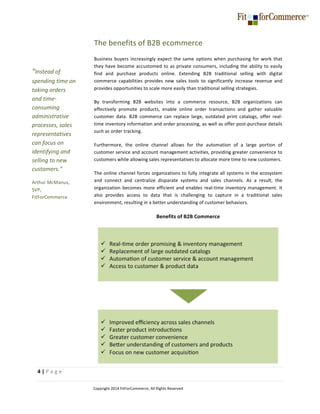
Benefits	
  of	
  B2B	
  Commerce	


“Instead	
  of	
  
spending	
  time	
  on	
  
taking	
  orders	
  
and	
  time-­‐
consuming	
  
administrative	
  
processes,	
  sales	
  
representatives	
  
can	
  focus	
  on	
  
identifying	
  and	
  
selling	
  to	
  new	
  
customers.”	
  
Arthur	
  McManus,	
  
SVP,	
  
FitForCommerce	
  
 
5	
  |	
  P a g e 	
  
	
   Copyright	
  2014	
  FitForCommerce,	
  All	
  Rights	
  Reserved	


The	
  main	
  differences	
  between	
  B2C	
  and	
  B2B	
  commerce	
  
Business-­‐to-­‐business	
  (B2B)	
  commerce	
  refers	
  to	
  transactions	
  between	
  two	
  businesses	
  -­‐	
  
often	
  manufacturer	
  to	
  wholesaler	
  or	
  wholesaler	
  to	
  retailer	
  –	
  but	
  B2B	
  is	
  often	
  a	
  hybrid	
  
model	
  such	
  as	
  B2B2B	
  or	
  B2B2C.	
  	
  
While	
   some	
   B2C	
   and	
   B2B	
   sites	
   may	
   look	
   similar,	
   placing	
   an	
   order	
   on	
   a	
   consumer	
  
ecommerce	
  site	
  is	
  much	
  simpler	
  compared	
  to	
  B2B	
  transactions.	
  While	
  B2C	
  companies	
  
can	
  focus	
  more	
  on	
  the	
  frontend	
  experience,	
  B2B	
  selling	
  typically	
  involves	
  more	
  complex	
  
processes,	
   such	
   as	
   pre-­‐negotiated	
   contracts,	
   specific	
   pricing	
   and	
   payment	
   terms,	
  
configurable	
   product	
   assortments	
   and	
   customized	
   price	
   lists,	
   as	
   well	
   as	
   sales	
   force	
  
integration.	
   On	
   top	
   of	
   intricate	
   business	
   models,	
   B2B	
   companies	
   may	
   also	
   operate	
  
multiple	
   currencies,	
   languages	
   and	
   typically	
   deal	
   with	
   regional	
   or	
   industry	
   regulatory	
  
rules.	
  	
  
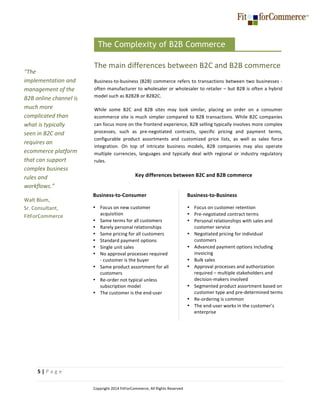
Key	
  differences	
  between	
  B2C	
  and	
  B2B	
  commerce	


The Complexity of B2B Commerce
	
  
“The	
  
implementation	
  and	
  
management	
  of	
  the	
  
B2B	
  online	
  channel	
  is	
  
much	
  more	
  
complicated	
  than	
  
what	
  is	
  typically	
  
seen	
  in	
  B2C	
  and	
  
requires	
  an	
  
ecommerce	
  platform	
  
that	
  can	
  support	
  
complex	
  business	
  
rules	
  and	
  
workflows.”	
  
Walt	
  Blum,	
  	
  
Sr.	
  Consultant,	
  
FitForCommerce	


Business-­‐to-­‐Business	
  	
  
• Focus	
  on	
  customer	
  retention	
  
• Pre-­‐negotiated	
  contract	
  terms	
  
• Personal	
  relationships	
  with	
  sales	
  and	
  
customer	
  service	
  
• Negotiated	
  pricing	
  for	
  individual	
  
customers	
  
• Advanced	
  payment	
  options	
  including	
  
invoicing	
  
• Bulk	
  sales	
  	
  
• Approval	
  processes	
  and	
  authorization	
  
required	
  –	
  multiple	
  stakeholders	
  and	
  
decision-­‐makers	
  involved	
  
• Segmented	
  product	
  assortment	
  based	
  on	
  
customer	
  type	
  and	
  pre-­‐determined	
  terms	
  
• Re-­‐ordering	
  is	
  common	
  	
  
• The	
  end-­‐user	
  works	
  in	
  the	
  customer’s	
  
enterprise	


Business-­‐to-­‐Consumer	
  
• Focus	
  on	
  new	
  customer	
  
acquisition	
  
• Same	
  terms	
  for	
  all	
  customers	
  
• Rarely	
  personal	
  relationships	
  
• Same	
  pricing	
  for	
  all	
  customers	
  
• Standard	
  payment	
  options	
  	
  
• Single	
  unit	
  sales	
   	
  
• No	
  approval	
  processes	
  required	
  
-­‐	
  customer	
  is	
  the	
  buyer	
  
• Same	
  product	
  assortment	
  for	
  all	
  
customers	
  
• Re-­‐order	
  not	
  typical	
  unless	
  
subscription	
  model	
  	
  
• The	
  customer	
  is	
  the	
  end-­‐user	


6	
  |	
  P a g e 	
  
	
   Copyright	
  2014	
  FitForCommerce,	
  All	
  Rights	
  Reserved	


Elements	
  for	
  effective	
  B2B	
  commerce	
  
Managing	
   the	
   intricacies	
   of	
   B2B	
   commerce	
   is	
   challenging	
   for	
   many	
   organizations.	
  
Historically,	
  the	
  lack	
  of	
  advanced	
  B2B	
  commerce	
  platforms	
  that	
  properly	
  support	
  the	
  
workflow	
   and	
   sophisticated	
   business	
   rules	
   required	
   of	
   B2B	
   sales	
   forced	
   some	
   B2B	
  
organizations	
  to	
  invest	
  heavily	
  in	
  homegrown	
  systems,	
  and	
  created	
  barriers	
  of	
  entry	
  for	
  
organizations	
  wanting	
  to	
  go	
  online.	
  This	
  resulted	
  in	
  complicated	
  infrastructure	
  models	
  
and	
   siloed	
   technology	
   systems	
   to	
   support	
   business	
   processes	
   across	
   the	
   entire	
  
enterprise.	
  In	
  addition,	
  presenting	
  backend	
  information	
  to	
  the	
  frontend	
  system	
  requires	
  
seamless	
   integration	
   and	
   customization	
   that	
   can	
   be	
   an	
   overwhelming	
   and	
   costly	
  
endeavor	
  without	
  the	
  right	
  systems	
  in	
  place.	
  	
  
With	
  the	
  emergence	
  of	
  new	
  technology	
  platforms	
  built	
  specifically	
  for	
  this	
  market,	
  the	
  
barrier	
   to	
   entry	
   is	
   removed.	
   Organizations,	
   however,	
   must	
   ensure	
   that	
   the	
   chosen	
  
platform	
  offers	
  capabilities	
  to	
  handle	
  the	
  complexities	
  of	
  their	
  business	
  while	
  delivering	
  
superior	
  customer	
  experiences.	
  
An	
  effective	
  and	
  successful	
  B2B	
  commerce	
  platform	
  should	
  offer	
  customers	
  the	
  same	
  
information	
   and	
   functionality	
   that	
   they	
   receive	
   when	
   interfacing	
   with	
   sales	
   and	
  
customer	
  service	
  departments.	
  At	
  the	
  same	
  time,	
  it	
  should	
  extend	
  proven	
  features	
  from	
  
B2C	
  to	
  meet	
  customer	
  demands	
  for	
  a	
  ‘retail-­‐like’	
  shopping	
  experience.	
  	
  
5	
  key	
  must-­‐have	
  components	
  of	
  the	
  B2B	
  enterprise	
  
commerce	
  platform	
  
Beyond	
   basic	
   commerce	
   capabilities	
   such	
   as	
   product	
   merchandising	
   and	
   order	
  
processing,	
  B2B	
  enterprise	
  commerce	
  platforms	
  should	
  include	
  five	
  key	
  areas	
  to	
  achieve	
  
B2B	
  commerce	
  effectiveness.	
  	
  
B2C	
   best	
   practices	
   to	
   meet	
   end-­‐user	
   expectations	
   for	
   superior	
   online	
  
experience	
  
Advances	
  in	
  B2C	
  shopping	
  experience	
  have	
  changed	
  the	
  expectations	
  of	
  the	
  business	
  
buyer.	
   Since	
   the	
   business	
   buyer	
   is	
   often	
   a	
   private	
   online	
   customer,	
   they	
   are	
   used	
   to	
  
highly	
   personalized	
   and	
   engaging	
   ecommerce	
   shopping	
   experiences.	
   These	
   B2C	
  
expectations	
   are	
   transferred	
   to	
   the	
   purchase	
   experience	
   during	
   work	
   hours.	
   B2B	
  
commerce	
   platforms	
   can	
   no	
   longer	
   simply	
   replicate	
   an	
   offline	
   catalog;	
   they	
   need	
   to	
  
include	
  more	
  and	
  better	
  product	
  content,	
  personalization,	
  dynamic	
  on-­‐site	
  searching,	
  
user	
  reviews,	
  social	
  integration,	
  video,	
  and	
  even	
  mobile	
  sites	
  and	
  apps.	
  	
  
B2B Commerce Effectiveness	
  
1	


7	
  |	
  P a g e 	
  
	
   Copyright	
  2014	
  FitForCommerce,	
  All	
  Rights	
  Reserved	
  
Adding	
  further	
  pressure	
  to	
  improve	
  the	
  online	
  experience,	
  B2C	
  powerhouses,	
  such	
  as	
  
Amazon,	
  are	
  leveraging	
  their	
  B2C	
  positions	
  to	
  expand	
  into	
  the	
  growing	
  B2B	
  market.	
  This	
  
poses	
   a	
   significant	
   threat	
   to	
   B2B	
   organizations	
   and	
   forces	
   them	
   to	
   tailor	
   B2B	
   online	
  
buying	
  experiences	
  that	
  mirror	
  B2C	
  shopping.	
  	
  
Effective	
   B2B	
   commerce	
   platforms	
   incorporate	
   best	
   practices	
   from	
   B2C	
   commerce,	
  
making	
   it	
   possible	
   to	
   create	
   experiences	
   that	
   align	
   with	
   buyer	
   expectations,	
   while	
  
supporting	
  the	
  complex	
  nature	
  of	
  B2B	
  commerce.	
  For	
  instance,	
  the	
  platform	
  must	
  offer	
  
account	
  configuration	
  and	
  customization	
  to	
  ensure	
  that	
  the	
  customer’s	
  business	
  rules	
  
are	
  reflected	
  in	
  the	
  end-­‐users	
  buying	
  experience.	
  
Furthermore,	
  the	
  platform	
  must	
  capture	
  proprietary	
  customer	
  purchasing	
  information	
  
such	
  as	
  Cost	
  Center,	
  Job	
  Code	
  or	
  Purchase	
  Order	
  Number,	
  and	
  include	
  reporting	
  tools	
  
that	
   allow	
   customers	
   to	
   review	
   past	
   purchases	
   in	
   detail	
   or	
   summary	
   for	
   a	
   variety	
   of	
  
selection	
  and	
  sorting	
  criteria.	


Offering	
  a	
  Rich,	
  Differentiated	
  	
  
Customer	
  Experience	
  
Dahl	
   Sweden	
   is	
   a	
   wholesaler	
   and	
   distributor	
   of	
   plumbing,	
   heating,	
   industrial	
   and	
  
construction	
  materials,	
  as	
  well	
  as	
  related	
  tools,	
  supplies	
  and	
  services.	
  To	
  establish	
  a	
  
more	
   competitive	
   ecommerce	
   channel	
   and	
   fully	
   capitalize	
   on	
   its	
   ecommerce	
  
potential,	
   Dahl	
   replaced	
   its	
   online	
   store	
   with	
   a	
   more	
   dynamic,	
   comprehensive,	
  
personalized	
  and	
  customer-­‐centric	
  platform.	
  	
  
With	
   easy-­‐to-­‐use	
   business	
   tools,	
   Dahl	
   was	
   able	
   to	
   improve	
   management	
   of	
  
marketing,	
   promotions,	
   catalogs,	
   product	
   assortments,	
   merchandising	
   and	
   the	
  
integration	
  of	
  external	
  systems	
  for	
  content	
  and	
  pricing.	
  	
  
The	
   Dahl	
   eShop	
   includes	
   advanced	
   search	
   capabilities,	
   a	
   favorites	
   list,	
   detailed	
  
product	
   views,	
   and	
   quick	
   ordering.	
   Customers	
   can	
   easily	
   find	
   and	
   purchase	
  
thousands	
   of	
   products,	
   and	
   Dahl	
   can	
   cost-­‐effectively	
   push	
   its	
   own	
   high-­‐margin	
  
brands.	


“More	
  and	
  more	
  B2B	
  
buyers	
  express	
  
interest	
  in	
  
purchasing	
  online,	
  
but	
  most	
  B2B	
  
ecommerce	
  sites	
  do	
  
not	
  meet	
  their	
  
expectations	
  of	
  
online	
  shopping.	
  
Instead,	
  they	
  are	
  
turning	
  to	
  sites	
  like	
  
Amazonsupply.com	
  
that	
  offer	
  the	
  same	
  
features	
  they	
  are	
  
used	
  to	
  when	
  
shopping	
  for	
  
themselves.”	
  
Kathy	
  Kimple,	
  VP	
  and	
  Sr.	
  
Consultant,	
  
FitForCommerce	
  
 
8	
  |	
  P a g e 	
  
	
   Copyright	
  2014	
  FitForCommerce,	
  All	
  Rights	
  Reserved	


Advanced	
  configurability,	
  not	
  only	
  of	
  end-­‐user	
  capabilities	
  and	
  pricing	
  
options,	
   but	
   also	
   of	
   complex	
   product	
   and	
   service	
   combinations	
   for	
  
quoting	
  and	
  ordering	
  
The	
  intricate	
  nature	
  of	
  B2B	
  selling	
  requires	
  an	
  advanced	
  level	
  of	
  sophistication	
  on	
  the	
  
backend,	
  both	
  in	
  terms	
  of	
  platform	
  functionality	
  and	
  integration.	
  	
  
The	
   complexities	
   of	
   B2B	
   selling	
   translate	
   into	
   customer	
   hierarchies,	
   differing	
   pricing	
  
models,	
   payment	
   options,	
   authorization	
   rules,	
   terms,	
   approval	
   workflows,	
   product	
  
portfolios,	
   configuration	
   and	
   marketing.	
   The	
   result	
   is	
   a	
   complicated	
   purchasing	
  
environment	
   that	
   requires	
   unique	
   processes	
   and	
   technology	
   capabilities.	
   In	
   addition,	
  
since	
  a	
  large	
  portion	
  of	
  the	
  sales	
  process	
  still	
  relies	
  on	
  personal	
  interactions	
  with	
  sales	
  
representatives,	
  the	
  commerce	
  platform	
  needs	
  to	
  have	
  strong	
  sales	
  force	
  integration.	
  	
  
B2B	
   buyers	
   typically	
   negotiate	
   contracts	
   that	
   provide	
   them	
   with	
   customized	
   pricing	
  
terms	
   and	
   discounts.	
   B2B	
   pricing	
   depends	
   on	
   the	
   type	
   of	
   products,	
   quantities,	
   direct	
  
sales	
   relationships,	
   shipping	
   and	
   logistics	
   needs	
   and	
   more.	
   Other	
   buyers	
   may	
   require	
  
functionality	
  that	
  allows	
  them	
  to	
  request	
  a	
  price	
  quote	
  and	
  circulate	
  the	
  quoted	
  price	
  
with	
  several	
  decision	
  makers	
  before	
  placing	
  an	
  order.	
  	
  
Since	
  there	
  are	
  usually	
  multiple	
  people	
  involved	
  in	
  the	
  purchasing	
  process	
  for	
  B2B,	
  many	
  
B2B	
  customers	
  require	
  different	
  purchasing	
  rules,	
  approval	
  flows	
  and	
  spending	
  limits	
  for	
  
different	
  users.	
  The	
  B2B	
  commerce	
  platform	
  should	
  include	
  permission-­‐based	
  rules	
  that	
  
allow	
  automation	
  of	
  these	
  processes.	
  	
  
Furthermore,	
   B2B	
   organizations	
   often	
   deal	
   with	
   various	
   networks	
   and	
   channels	
   of	
  
business	
  partners,	
  manufacturers,	
  resellers,	
  and	
  dealers	
  within	
  many	
  different	
  locations.	
  
This	
  often	
  means	
  that,	
  for	
  any	
  business	
  that	
  the	
  organization	
  interacts	
  with	
  during	
  the	
  
purchasing	
   process,	
   there	
   can	
   be	
   multiple	
   contacts	
   and	
   authorities	
   who	
   are	
   able	
   to	
  
Key	
  questions	
  to	
  consider	
  when	
  evaluating	
  the	
  B2B	
  commerce	
  experience	


1. Does	
  the	
  site	
  provide	
  the	
  right	
  information	
  to	
  the	
  right	
  customers	
  and	
  customer	
  
segments?	
  	
  
2. Is	
  the	
  site	
  easy	
  to	
  use?	
  Is	
  it	
  easy	
  to	
  find	
  and	
  search	
  for	
  products?	
  	
  
3. Does	
  the	
  site	
  include	
  rich	
  product	
  information	
  and	
  details?	
  
4. Does	
   it	
   provide	
   suggested	
   products	
   based	
   on	
   product	
   selection	
   for	
   cross	
   and	
  
upsell	
  opportunities?	
  
5. Is	
  it	
  easy	
  to	
  place	
  an	
  order?	


6. Is	
  the	
  site	
  personalized	
  to	
  individual	
  customers/customer	
  segments?	
  	
  
7. Does	
  the	
  site	
  take	
  advantage	
  of	
  the	
  expertise	
  you	
  have	
  on	
  your	
  products	
  and	
  
markets?	


8. Does	
  the	
  site	
  offer	
  relevant	
  promotions	
  based	
  on	
  order	
  history	


2	


“Giving	
  our	
  resellers	
  
the	
  ability	
  to	
  work	
  
with	
  us	
  via	
  a	
  robust	
  
ecommerce	
  system	
  
lets	
  us	
  provide	
  
cutting-­‐edge	
  service	
  
and,	
  for	
  them,	
  in	
  
turn,	
  to	
  provide	
  
cutting-­‐edge	
  service	
  
to	
  their	
  own	
  
customers.	
  It	
  allows	
  
both	
  Cranel	
  Imaging	
  
and	
  our	
  resellers	
  to	
  
operate	
  more	
  
effectively,	
  creating	
  
a	
  powerful	
  win-­‐win	
  
situation.”	
  
Scott	
  Slack,	
  	
  
Vice	
  President	
  of	
  
Marketing,	
  Cranel	
  
Imaging	
  
 
9	
  |	
  P a g e 	
  
	
   Copyright	
  2014	
  FitForCommerce,	
  All	
  Rights	
  Reserved	
  
purchase	
  for	
  an	
  entity	
  or	
  multiple	
  divisions	
  with	
  individual	
  contacts,	
  but	
  with	
  a	
  central	
  
corporate	
  purchasing	
  account.	
  	
  
Many	
   B2B	
   organizations	
   also	
   combine	
   product	
   and	
   service	
   offerings	
   such	
   as	
  
installations.	
  The	
  execution	
  of	
  combined	
  product/service	
  configurations	
  requires	
  real-­‐
time	
   integration	
   with	
   service	
   scheduling	
   systems	
   and	
   functionality	
   that	
   allows	
  
customers	
   to	
   order	
   products	
   and	
   schedule	
   services	
   in	
   a	
   consistent	
   and	
   seamless	
  
transaction	
  process.	


The	
  B2B	
  channel	
  requires	
  advanced	
  functionality	
  to	
  support	
  these	
  sophisticated	
  pricing	
  
and	
   product	
   configurations.	
   This	
   includes	
   business	
   rules	
   and	
   workflows	
   that	
   dictate	
  
specific	
   pricing	
   for	
   individual	
   customers,	
   approval	
   processes	
   and	
   governance	
   rules	
   in	
  
order	
   to	
   execute	
   the	
   sales	
   and	
   marketing	
   strategy	
   across	
   all	
   channels.	
   Furthermore,	
  
authorized	
  users	
  should	
  have	
  access	
  to	
  the	
  system	
  and	
  be	
  empowered	
  to	
  set	
  business	
  
rules,	
   by	
   segment	
   and	
   channels,	
   without	
   IT	
   involvement,	
   to	
   ensure	
   that	
   sales	
  
representatives	
  do	
  not	
  spend	
  unnecessary	
  time	
  on	
  internal	
  processes	
  and	
  instead	
  can	
  
focus	
  on	
  current	
  and	
  new	
  customer	
  sales.	


Driving	
  efficiency	
  and	
  new	
  sales	
  opportunities	
  through	
  mobility	


Smart	
  B2B	
  organizations	
  are	
  increasingly	
  providing	
  their	
  field	
  sales	
  reps	
  with	
  tablets,	
  
enabling	
  them	
  to	
  place	
  a	
  customer	
  order	
  online	
  when	
  they	
  are	
  with	
  their	
  customers	
  
in	
  the	
  field.	
  Where	
  they	
  used	
  to	
  fill	
  out	
  paper	
  order	
  forms	
  and	
  then	
  process	
  when	
  at	
  
office,	
   the	
   mobility	
   enables	
   them	
   to	
   enter	
   and	
   process	
   an	
   order	
   immediately	
  
allowing	
  them	
  to	
  spend	
  more	
  time	
  in	
  the	
  field	
  selling.	
  To	
  further	
  expedite	
  the	
  order	
  
process,	
   for	
   complicated	
   orders	
   that	
   require	
   configurations,	
   some	
   organizations	
  
equip	
  field	
  sales	
  reps	
  with	
  advanced	
  configuration	
  tools	
  that	
  walk	
  them	
  through	
  the	
  
process	
  of	
  configuring	
  the	
  item	
  based	
  on	
  rules	
  that	
  determine	
  what	
  components	
  are	
  
required.	


Installation,	
  repair	
  and	
  service	
  representatives	
  are	
  also	
  increasingly	
  being	
  equipped	
  
with	
   mobile	
   devices,	
   enabling	
   them	
   to	
   better	
   service	
   the	
   customer	
   on	
   site,	
   order	
  
spare	
  parts,	
  etc.,	
  speeding	
  up	
  the	
  process	
  and	
  allowing	
  them	
  to	
  upsell	
  to	
  customers	
  
while	
  on	
  site.	


These	
   advanced	
   mobility	
   tools	
   require	
   that	
   the	
   commerce	
   platform	
   is	
   fully	
  
integrated	
   with	
   other	
   systems	
   in	
   the	
   ecosystem,	
   such	
   as	
   order	
   management	
  
systems,	
  and	
  requires	
  that	
  the	
  people	
  in	
  the	
  field	
  have	
  access	
  to	
  the	
  main	
  commerce	
  
platform	
  and	
  permission	
  to	
  make	
  orders.	


10	
  |	
  P a g e 	
  
	
   Copyright	
  2014	
  FitForCommerce,	
  All	
  Rights	
  Reserved	


Analytics	
  and	
  segmentation	
  for	
  creating	
  separate	
  and	
  distinct	
  product	
  
offerings	
  and	
  pricing,	
  quotation	
  and	
  contracts	
  
Most	
   B2B	
   organizations	
   dedicate	
   resources	
   and	
   manpower	
   to	
   product,	
   customer	
   and	
  
sales	
  analytics.	
  Leveraging	
  this	
  data	
  enables	
  the	
  creation	
  of	
  segmented	
  strategies	
  with	
  
the	
   optimal	
   pricing	
   and	
   product	
   mix	
   for	
   each	
   customer	
   segment	
   and	
   allows	
   the	
  
organization	
  to	
  deliver	
  an	
  ideal	
  personalized	
  customer	
  experience.	
  
These	
  product,	
  pricing	
  and	
  promotion	
  strategies	
  must	
  be	
  executed	
  across	
  all	
  channels	
  
and	
   presented	
   in	
   the	
   context	
   to	
   the	
   buyer	
   based	
   upon	
   critical	
   factors,	
   including	
  
customer,	
  segment,	
  channel	
  and	
  other	
  variables.	
  Best	
  practices	
  and	
  tribal	
  knowledge	
  of	
  
top	
   sellers	
   must	
   be	
   embedded	
   into	
   the	
   frontend	
   systems	
   to	
   optimize	
   margins	
   and	
  
customer	
  satisfaction.	
  
Unfortunately,	
  many	
  B2B	
  organizations	
  find	
  that	
  their	
  frontend	
  commerce	
  platforms	
  are	
  
not	
  fully	
  capable	
  of	
  leveraging	
  this	
  data	
  in	
  real-­‐time.	
  If	
  product,	
  pricing	
  and	
  governance	
  
rules	
  are	
  not	
  included	
  into	
  the	
  offer,	
  then	
  the	
  analytics	
  and	
  segmentation	
  efforts	
  will	
  be	
  
wasted.	
   It	
   will	
   result	
   in	
   operational	
   inefficiencies,	
   where	
   sales	
   representatives	
   focus	
  
more	
   time	
   on	
   internal	
   processes	
   instead	
   of	
   on	
   their	
   customers	
   and	
   new	
   acquisition	
  
initiatives.	


With	
   complex	
   offers,	
   if	
   segment	
   analytics	
   are	
   not	
   available,	
   the	
   enterprise	
   often	
  
misquotes	
  pricing	
  and	
  discounts,	
  and	
  misses	
  out	
  on	
  opportunities	
  to	
  sell	
  value-­‐added	
  
products.	
  An	
  effective	
  B2B	
  enterprise	
  commerce	
  platform	
  must	
  include	
  tools	
  that	
  can	
  
execute	
  strategies	
  and	
  rules	
  based	
  on	
  advanced	
  analytics	
  and	
  segmentation	
  to	
  enable	
  
guided	
  selling	
  through	
  the	
  online	
  channel.	
  Analytics	
  should	
  be	
  used	
  to	
  dictate	
  the	
  best	
  
discounts	
   to	
   protect	
   margins	
   and	
   prevent	
   situations	
   where	
   sales	
   reps	
   offer	
   lower	
  
discounts	
  to	
  avoid	
  required	
  approval	
  processes.	
  For	
  instance,	
  a	
  sales	
  rep	
  may	
  be	
  inclined	
  
to	
   offer	
   a	
   19%	
   discount	
   instead	
   of	
   the	
   optimal	
   20%	
   discount	
   to	
   circumvent	
   approval	
  
requirements.	
   Segment	
   analytics	
   and	
   cross-­‐and	
   upsell	
   suggestions	
   based	
   on	
   data	
  
support	
   the	
   capability	
   to	
   align	
   the	
   solution	
   with	
   customer	
   needs	
   while	
   driving	
   the	
  
optimal	
  price	
  point	
  for	
  the	
  product/market	
  segment	
  and	
  thus	
  protecting	
  margins.	
  	
  
It	
  is	
  not	
  uncommon	
  for	
  product	
  managers	
  to	
  move	
  into	
  a	
  sales	
  role.	
  Through	
  their	
  
jobs,	
  they	
  need	
  to	
  be	
  up-­‐to-­‐date	
  on	
  all	
  the	
  important	
  analytics	
  and	
  segment	
  data.	
  
Therefore,	
  they	
  intimately	
  know	
  the	
  optimal	
  price	
  points	
  and	
  offer	
  details	
  that	
  will	
  
provide	
  the	
  best	
  value	
  for	
  both	
  customer	
  and	
  the	
  enterprise.	
  The	
  same	
  data	
  that	
  the	
  
product	
  manager	
  has	
  access	
  to	
  should	
  be	
  leveraged	
  across	
  all	
  channels	
  and	
  sellers.	


3	
  
“The	
  new	
  
ecommerce	
  solution	
  
gives	
  us	
  the	
  tools	
  
and	
  analytics	
  we	
  
need	
  to	
  meet	
  the	
  
changing	
  needs	
  of	
  
our	
  customers	
  and	
  
provide	
  a	
  more	
  
personalized	
  and	
  
productive	
  
experience,	
  resulting	
  
in	
  an	
  increase	
  in	
  
conversion	
  rate,	
  
average	
  order	
  size,	
  
customer	
  
satisfaction	
  and	
  
revenue.”	
  
Adrienne	
  Hartman,	
  
corporate	
  ecommerce	
  
manager,	
  J.	
  J.	
  Keller	
  
and	
  Associates,	
  Inc.	
  
 
11	
  |	
  P a g e 	
  
	
   Copyright	
  2014	
  FitForCommerce,	
  All	
  Rights	
  Reserved	


Sophisticated	
  workflows	
  to	
  support	
  complex	
  buying	
  cycles	
  and	
  selling	
  
execution	
  across	
  multiple	
  channels	
  and	
  markets	
  
Just	
  like	
  B2C	
  customers,	
  B2B	
  buyers	
  expect	
  an	
  omnichannel	
  experience.	
  Therefore,	
  the	
  
brand	
   and	
   product	
   offering	
   must	
   be	
   represented	
   consistently	
   across	
   every	
   point	
   of	
  
interaction.	
   B2B	
   enterprise	
   commerce	
   platforms	
   need	
   to	
   be	
   able	
   to	
   handle	
   the	
  
complexities	
   of	
   selling	
   through	
   both	
   direct	
   and	
   partner	
   sites,	
   which	
   require	
   tight	
  
integration	
  and	
  visibility	
  of	
  all	
  supply	
  chain	
  partners.	
  	
  
Because	
   of	
   the	
   slow	
   adoption	
   of	
   B2B	
   online	
   commerce,	
   we	
   at	
   FitForCommerce	
   see	
  
many	
  organizations	
  relying	
  on	
  legacy	
  systems	
  and	
  processes.	
  This	
  often	
  results	
  in	
  silos	
  
that	
  make	
  it	
  difficult	
  to	
  deliver	
  the	
  seamless	
  and	
  consistent	
  experience	
  that	
  customers	
  
expect,	
  leading	
  to	
  customer	
  frustration	
  because	
  they	
  are	
  spending	
  time	
  and	
  resources	
  
on	
  buying	
  and	
  tracking	
  orders	
  across	
  channels	
  and	
  business	
  units.	
  	
  
An	
   effective	
   B2B	
   enterprise	
   commerce	
   platform	
   must	
   have	
   capabilities	
   to	
   provide	
  
insights	
   into	
   all	
   aspects	
   of	
   the	
   order	
   across	
   channels.	
   This	
   includes	
   delivery	
   dates	
   for	
  
products	
   and	
   services,	
   monitoring	
   of	
   order	
   processes	
   and	
   automatic	
   customer	
  
notifications.	
   The	
   commerce	
   platform	
   should	
   be	
   the	
   single	
   source	
   of	
   truth	
   across	
  
business	
   units,	
   divisions	
   and	
   brands	
   and	
   provide	
   an	
   overall	
   consistent	
   experience	
  
regardless	
  of	
  whether	
  the	
  customer	
  is	
  interacting	
  with	
  a	
  field	
  sales	
  rep,	
  a	
  call	
  center	
  rep	
  
or	
  the	
  website.	


Additionally,	
   the	
   omnichannel	
   experience	
   includes	
   backend	
   processes	
   such,	
   as	
  
fulfillment,	
   across	
   the	
   entire	
   supply	
   chain.	
   The	
   system	
   should	
   be	
   able	
   to	
   intelligently	
  
source	
   orders	
   and	
   fulfill	
   from	
   the	
   best	
   distribution	
   option	
   that	
  will	
   result	
   in	
   products	
  
arriving	
  in	
  a	
  timely	
  matter	
  and	
  ensure	
  the	
  best	
  shipping	
  cost	
  for	
  the	
  organization.	
  	
  
The	
   omnichannel	
   experience	
   should	
   also	
   include	
   functionality	
   related	
   to	
   post-­‐sale	
  
actions	
  such	
  returns	
  and	
  reverse	
  logistics.	
  It	
  should	
  be	
  easy	
  for	
  the	
  customer	
  to	
  handle	
  
returns	
   and	
   exchanges	
   as	
   well	
   as	
   more	
   complex	
   processes	
   such	
   as	
   overships	
   and	
  
delivery	
   of	
   wrong	
   items.	
   To	
   further	
   streamline	
   processes,	
   this	
   also	
   includes	
   directed	
  
“With	
  our	
  B2B	
  commerce	
  approach,	
  we’re	
  delivering	
  new	
  programs	
  that	
  
address	
  quoting	
  capabilities.	
  In	
  one	
  case,	
  we	
  reduced	
  the	
  time	
  needed	
  to	
  
provide	
  a	
  60-­‐line	
  quote	
  from	
  several	
  hours	
  to	
  mere	
  minutes.	
  We	
  delivered	
  the	
  
quote	
  more	
  quickly	
  than	
  before	
  while	
  dramatically	
  improving	
  the	
  customer	
  
experience.	
  In	
  the	
  process,	
  we	
  also	
  saved	
  the	
  productivity	
  equivalent	
  of	
  12	
  to	
  
15	
  full-­‐time	
  employees,	
  freeing	
  our	
  sales	
  team	
  to	
  devote	
  even	
  more	
  time	
  to	
  
working	
  with	
  customers.”	
  	
  
Phil	
  Harrington,	
  EVP	
  of	
  Risk,	
  CA	


4	
  
 
12	
  |	
  P a g e 	
  
	
   Copyright	
  2014	
  FitForCommerce,	
  All	
  Rights	
  Reserved	
  
workflow	
  processes	
  such	
  as	
  return	
  to	
  stock,	
  return	
  to	
  supplier	
  and	
  so	
  on.	
  The	
  system	
  
should	
   also	
   be	
   able	
   to	
   manage	
   returned/refurbished	
   inventory	
   and	
   automated	
   re-­‐
classification	
  based	
  on	
  return	
  status.	
  	
  
No	
   matter	
   what	
   happens	
   on	
   the	
   backend	
   and	
   how	
   fulfillment	
   is	
   distributed,	
   the	
  
experience	
  on	
  the	
  frontend	
  experience	
  must	
  be	
  easy	
  and	
  seamless	
  for	
  the	
  customer.	


Single,	
  global	
  platform	
  that	
  can	
  adapt	
  to	
  local	
  market	
  execution	
  	
  
B2B	
   enterprises	
   that	
   target	
   multiple	
   markets	
   will	
   likely	
   have	
   sales	
   and	
   marketing	
  
strategies	
  that	
  are	
  tailored	
  to	
  local	
  market	
  conditions.	
  This	
  typically	
  includes	
  offers	
  and	
  
pricing	
  that	
  varies	
  by	
  geography	
  or	
  market	
  segments	
  and	
  governance	
  rules.	
  	
  
Deploying	
  and	
  managing	
  platforms	
  for	
  each	
  market	
  is	
  not	
  a	
  scalable	
  solution;	
  it	
  is	
  costly,	
  
time-­‐consuming,	
  and	
  will	
  eat	
  up	
  internal	
  resources.	
  At	
  FitForCommerce,	
  we	
  recommend	
  
that	
  organizations	
  instead	
  deploy	
  a	
  centralized	
  platform	
  that	
  allows	
  for	
  global	
  control,	
  
yet	
  offers	
  the	
  flexibility	
  to	
  adapt	
  for	
  specific	
  workflows	
  and	
  business	
  rules	
  that	
  align	
  with	
  
segment	
  needs	
  and	
  provides	
  a	
  differing	
  experience	
  based	
  on	
  market	
  segment.	
  	
  
A	
  centralized	
  platform	
  allows	
  the	
  B2B	
  organization	
  to	
  manage	
  the	
  entire	
  business	
  from	
  
one	
  platform	
  while	
  decentralizing	
  strategy	
  decisions	
  to	
  adapt	
  to	
  local	
  market	
  conditions.	
  
In	
  other	
  words,	
  the	
  platform	
  should	
  empower	
  business	
  users	
  to	
  be	
  able	
  to	
  set	
  strategies	
  
that	
  support	
  and	
  control	
  local	
  sales	
  execution.	
  This	
  means	
  that	
  the	
  platform	
  should	
  be	
  
capable	
  of	
  modeling	
  the	
  organization’s	
  structure	
  while	
  tailoring	
  sales	
  execution	
  to	
  local	
  
market	
   sectors	
   and	
   channels	
   including	
   custom	
   market	
   catalogs,	
   price	
   books,	
  
governance,	
  sourcing	
  rules	
  and	
  inventory.	
  Regional	
  managers	
  should	
  have	
  the	
  flexibility	
  
to	
   determine	
   promotions	
   and	
   pricing	
   within	
   the	
   region,	
   since	
   they	
   know	
   the	
   market	
  
best.	
   The	
   commerce	
   platform	
   should	
   allow	
   the	
   implementation	
   of	
   these	
   promotions	
  
and	
  pricing	
  strategies	
  without	
  having	
  to	
  rely	
  on	
  IT	
  and	
  processes	
  that	
  take	
  months	
  to	
  
implement.	


Executing	
  Competitive	
  Regional	
  Strategies	
  
A	
   leading	
   direct	
   broadcast	
   satellite	
   provider	
   empowers	
   regional	
   managers	
   to	
  
execute	
   competitive	
   strategies	
   by	
   regional	
   segments.	
   Their	
   B2B	
   enterprise	
  
commerce	
   platform	
   allows	
   them	
   to	
   align	
   strategy	
   and	
   execution	
   by	
   empowering	
  
authorized	
   users	
   to	
   set	
   product,	
   pricing,	
   promotion,	
   and	
   governance	
   rules	
   -­‐	
   by	
  
segment	
   and	
   channel	
   –	
   without	
   IT	
   involvement,	
   which	
   optimizes	
   margin	
   and	
  
revenue,	
  while	
  empowering	
  people	
  who	
  own	
  strategy	
  to	
  directly	
  set	
  it.	


As	
  a	
  result,	
  they	
  have	
  decreased	
  time	
  to	
  market	
  for	
  new	
  offers	
  and	
  promotions	
  from	
  
3-­‐4	
  months	
  to	
  just	
  6-­‐7	
  days.	


5	
  
 
13	
  |	
  P a g e 	
  
	
   Copyright	
  2014	
  FitForCommerce,	
  All	
  Rights	
  Reserved	


With	
   increasing	
   customer	
   demands	
   for	
   greater	
   convenience	
   and	
   control	
   over	
   the	
  
purchasing	
  process,	
  B2B	
  organizations	
  must	
  prioritize	
  the	
  online	
  channel	
  as	
  part	
  of	
  their	
  
overall	
   sales	
   strategy.	
   Although	
   most	
   B2B	
   organizations	
   realize	
   the	
   impact	
   of	
   B2B	
  
ecommerce,	
  many	
  have	
  been	
  slow	
  to	
  adapt	
  to	
  this	
  new	
  sales	
  reality.	
  In	
  our	
  experience,	
  
the	
  main	
  reason	
  for	
  the	
  slow	
  adoption	
  is	
  that,	
  until	
  recently,	
  there	
  has	
  been	
  a	
  lack	
  of	
  
robust	
   B2B	
   enterprise	
   commerce	
   platforms	
   available	
   capable	
   of	
   fully	
   supporting	
   the	
  
complexities	
  of	
  B2B	
  sales	
  strategies.	
  Addressing	
  the	
  growing	
  B2B	
  market,	
  today,	
  there	
  
are	
   platforms	
   available	
   built	
   specifically	
   for	
   B2B	
   commerce;	
   however,	
   organizations	
  
must	
  still	
  diligently	
  evaluate	
  platforms	
  to	
  ensure	
  that	
  they	
  offer	
  the	
  capabilities	
  required	
  
to	
  handle	
  B2B	
  complexities	
  while	
  delivering	
  superior	
  customer	
  experiences.	
  
B2B	
  typically	
  involves	
  much	
  more	
  complex	
  processes,	
  such	
  as	
  configurable	
  product	
  
offerings,	
  bulk	
  shipments	
  and	
  advanced	
  pricing	
  based	
  on	
  the	
  individual	
  business	
  buyer	
  
as	
  well	
  as	
  sales	
  force	
  integration	
  and	
  consistency	
  across	
  all	
  sales	
  channels.	
  Effective	
  
B2B	
   commerce	
   requires	
   a	
   centralized	
   commerce	
   platform	
   with	
   an	
   engine	
   that	
   can	
  
dictate	
  all	
  product,	
  pricing	
  and	
  promotion	
  strategies	
  across	
  the	
  entire	
  enterprise.	
  	
  
As	
  explored	
  in	
  this	
  paper,	
  the	
  key	
  components	
  of	
  B2B	
  effectiveness	
  include	
  frontend	
  
customer	
   experience,	
   advanced	
   configurability,	
   analytics	
   and	
   segmentation,	
  
sophisticated	
  workflows	
  and	
  local	
  market	
  execution.	
  When	
  evaluating	
  and	
  investing	
  in	
  
a	
  B2B	
  commerce	
  platform,	
  it	
  is	
  critical	
  to	
  ensure	
  that	
  the	
  solution	
  can	
  support	
  these	
  
components.	
   To	
   achieve	
   B2B	
   commerce	
   effectiveness,	
   B2B	
   organizations	
   should	
  
consider	
  whether	
  the	
  B2B	
  experience	
  matches	
  B2C	
  shopping	
  experiences,	
  the	
  product	
  
and	
   pricing	
   strategy	
   is	
   fully	
   executed	
   in	
   every	
   offer	
   across	
   every	
   channel,	
   every	
  
transaction	
   is	
   infused	
   with	
   analytics	
   to	
   minimize	
   the	
   risk	
   of	
   margin	
   and	
   revenue	
  
erosion	
  and	
  whether	
  the	
  right	
  business	
  users	
  are	
  empowered	
  to	
  set	
  strategies	
  that	
  
control	
  local	
  market	
  execution.	


Conclusion	
  
 
15	
  |	
  P a g e 	
  
	
   Copyright	
  2014	
  FitForCommerce,	
  All	
  Rights	
  Reserved	


Copyright	
  2014	
  All	
  rights	
  reserved.	
  FitForCommerce,	
  the	
  FitForCommerce	
  logo,	
  and	
  all	
  other	
  FitForCommerce	
  products	
  and	
  services	
  are	
  
trademarks	
  of	
  FitForCommerce.	
  All	
  other	
  trademarks	
  are	
  the	
  property	
  of	
  their	
  respective	
  owners.	


FitForCommerce	
  
40	
  Highland	
  Ave	
  
Short	
  Hills,	
  NJ	
  07078	
  
973.379.7399	
  phone	
  
973.404.8855	
  fax	
  
info@fitforcommerce.com	
  
www.fitforcommerce.com	


FitForCommerce	
  is	
  a	
  leading	
  consulting	
  firm,	
  helping	
  ecommerce	
  and	
  
multichannel	
  retailers	
  and	
  manufacturers	
  grow	
  their	
  online	
  retail	
  operations.	
  Our	
  
consultants	
  bring	
  decades	
  of	
  practical,	
  hands-­‐on	
  experience	
  to	
  guide	
  merchants	
  
in	
  defining	
  ecommerce	
  strategy,	
  selecting	
  the	
  right	
  technologies,	
  and	
  building	
  
online	
  marketing,	
  merchandising	
  and	
  best-­‐in-­‐class	
  website	
  experiences	
  —	
  all	
  
using	
  a	
  rigorous	
  ecommerce	
  Diligence	
  process	
  and	
  a	
  vast	
  knowledge	
  base	
  built	
  on	
  
our	
  work	
  with	
  hundreds	
  of	
  leading	
  retailers.	
  

Zzl03084 usen

  • 1.
                                  FitForCommerce  Whitepaper  Series   While  traditional  B2B  sales  channels  are  still  the  most  influential,  the  explosive  growth  of  B2B  ecommerce  is   forcing  B2B  organizations  to  dedicate  resources  and  budget  to  the  online  sales  channel.  While  B2B  organizations   can  learn  from  B2C  in  terms  of  user  experience,  B2B  selling  is  much  more  complex  and  requires  a  centralized   commerce  platform  that  fully  supports  sophisticated  workflows,  pricing,  product  configurations,  approvals  and   more.  In  this  paper,  we  explore  the  impact  of  the  online  channel  and  examine  five  key  components  required  to   achieve  B2B  commerce  effectiveness.       July  2014   Kerry  Martin  and  Tim  Toews,  FitForCommerce     B2B  Commerce  Effectiveness:  5  Key  Components  of  Successful   B2B  Commerce    
  • 2.
        Traditional  business-­‐to-­‐business   (B2B)   channels   are   still   the   most   influential   in   business  selling;  however,  buyer  expectations  and  technological  advances  have   led   to   an   explosive   growth   of   B2B   ecommerce.   Most   business   buyers   have   adopted   ecommerce   as   private   consumers   and   are,   therefore,   increasingly   demanding  the  same  convenience  and  options  from  B2B.    Most  B2B  organizations   realize   that   the   online   channel   needs   to   be   included   in   their   sales   strategy,   although  many  still  lag  far  behind  when  it  comes  to  B2B  commerce  capabilities.     While   B2B   organizations   can   learn   from   B2C   online   retailers   in   terms   of   user   experience,  B2B  selling  typically  involves  much  more  complex  processes  such  as   configurable   product   offerings,   advanced   pricing   and   promotions   based   on   the   individual  business  buyer  and  sales  force  integration.  These  combined  factors  and   the  execution  of  B2B  strategies  across  both  traditional  and  digital  channels  drives   the  complexity  of  B2B  selling  and  accentuates  the  need  for  a  centralized  platform   that  can  drive  all  product,  pricing  and  promotion  strategies.  Simply  providing  a   B2C  experience  will  not  allow  organizations  to  gain  the  optimal  results  from  a  B2B   multichannel  selling  approach.       For  organizations  with  an  intricate  product/service  and  selling  structure,  a  B2B   enterprise   commerce   solution   that   provides   the   flexibility   to   support   multiple   business  models  is  a  necessity.  There  are  five  key  areas  that  the  solution  must  be   able  to  support  in  order  to  achieve  B2B  ecommerce  effectiveness:     1. B2C   best   practices   to   meet   buyer   expectations   for   superior   online   experience   2. Advanced   configurability,   not   only   of   end-­‐user   capabilities   and   pricing   options   but   also   of   complex   product   combinations   for   quoting   and   ordering   3. Analytics   and   segmentation   for   creating   separate   and   distinct   product   offerings  and  pricing,  quotation  and  contracts   4. Sophisticated   workflows   to   support   complex   buying   cycles   and   selling   execution  across  multiple  channels  and  markets   5. Single,  global  platform  that  can  adapt  to  local  market  execution       In  this  paper,  we  will  explore  each  of  these  five  areas  in  more  detail  and  provide  best   practices  and  examples  for  preparing  for  and  achieving  B2B  effectiveness.         Introduction  
  • 3.
      Copyright  2014  FitForCommerce,  All  Rights  Reserved     The  B2B  commerce  factor   While  traditional  selling  methods  still  dominate  B2B  sales  strategies,  digital  channels  are   showing  the  fastest  growth  across  most  B2B  markets.       1   Despite  the  huge  opportunity  that  B2B  ecommerce  represents,  many  B2B  organizations   have  been  slow  to  adopt  the  online  channel,  and  those  that  do  often  fail  in  delivering  a   compelling  customer  experience.  This  has  mainly  been  due  to  the  complex  nature  of   B2B  selling  processes  and  the  lack  of  technology  platforms  capable  of  supporting  these   complexities.  However,  driven  by  increasing  customer  demands  for  greater  convenience   and   control   of   the   purchasing   process   and   the   entrance   of   more   sophisticated   B2B   commerce  platforms,  B2B  organizations  are  increasingly  extending  and  improving  sales   processes  online.     While  the  online  channel  in  B2B,  in  most  cases,  does  not  replace  personal  selling  and   account   management,   it   offers   customers   the   control   and   flexibility   to   browse   and   purchase   at   their   own   convenience,   and   enables   B2B   sellers   to   focus   on   building   stronger  customer  relationship  and  new  customer  acquisition.  The  online  channel  also   offers  the  ability  to  more  profitably  service  smaller  customers  whose  volume  does  not   justify  the  expense  of  a  dedicated  sales  force.                                                                                                                             1  IRCE  Focus  2014  –  Market  Trends  for  Brands,  Retail  and  B2B   Why B2B Digital Commerce?   Approximately   60  %  of  more   than  200   FitForCommerce   retail  and   manufacturers   clients  are   investing  in  B2B   ecommerce   initiatives.    
  • 4.
      4  |  Pa g e     Copyright  2014  FitForCommerce,  All  Rights  Reserved   The  benefits  of  B2B  ecommerce   Business  buyers  increasingly  expect  the  same   options  when  purchasing  for  work  that   they  have  become  accustomed  to  as  private  consumers,  including  the  ability  to  easily   find   and   purchase   products   online.   Extending   B2B   traditional   selling   with   digital   commerce   capabilities   provides   new   sales   tools   to   significantly   increase   revenue   and   provides  opportunities  to  scale  more  easily  than  traditional  selling  strategies.     By   transforming   B2B   websites   into   a   commerce   resource,   B2B   organizations   can   effectively   promote   products,   enable   online   order   transactions   and   gather   valuable   customer   data.   B2B   commerce   can   replace   large,   outdated   print   catalogs,   offer   real-­‐ time  inventory  information  and  order  processing,  as  well  as  offer  post-­‐purchase  details   such  as  order  tracking.   Furthermore,   the   online   channel   allows   for   the   automation   of   a   large   portion   of   customer  service  and  account  management  activities,  providing  greater  convenience  to   customers  while  allowing  sales  representatives  to  allocate  more  time  to  new  customers.     The  online  channel  forces  organizations  to  fully  integrate  all  systems  in  the  ecosystem   and   connect   and   centralize   disparate   systems   and   sales   channels.   As   a   result,   the   organization  becomes  more  efficient  and  enables  real-­‐time  inventory  management.  It   also   provides   access   to   data   that   is   challenging   to   capture   in   a   traditional   sales   environment,  resulting  in  a  better  understanding  of  customer  behaviors.     Benefits  of  B2B  Commerce     “Instead  of   spending  time  on   taking  orders   and  time-­‐ consuming   administrative   processes,  sales   representatives   can  focus  on   identifying  and   selling  to  new   customers.”   Arthur  McManus,   SVP,   FitForCommerce  
  • 5.
      5  |  Pa g e     Copyright  2014  FitForCommerce,  All  Rights  Reserved     The  main  differences  between  B2C  and  B2B  commerce   Business-­‐to-­‐business  (B2B)  commerce  refers  to  transactions  between  two  businesses  -­‐   often  manufacturer  to  wholesaler  or  wholesaler  to  retailer  –  but  B2B  is  often  a  hybrid   model  such  as  B2B2B  or  B2B2C.     While   some   B2C   and   B2B   sites   may   look   similar,   placing   an   order   on   a   consumer   ecommerce  site  is  much  simpler  compared  to  B2B  transactions.  While  B2C  companies   can  focus  more  on  the  frontend  experience,  B2B  selling  typically  involves  more  complex   processes,   such   as   pre-­‐negotiated   contracts,   specific   pricing   and   payment   terms,   configurable   product   assortments   and   customized   price   lists,   as   well   as   sales   force   integration.   On   top   of   intricate   business   models,   B2B   companies   may   also   operate   multiple   currencies,   languages   and   typically   deal   with   regional   or   industry   regulatory   rules.     Key  differences  between  B2C  and  B2B  commerce                     The Complexity of B2B Commerce   “The   implementation  and   management  of  the   B2B  online  channel  is   much  more   complicated  than   what  is  typically   seen  in  B2C  and   requires  an   ecommerce  platform   that  can  support   complex  business   rules  and   workflows.”   Walt  Blum,     Sr.  Consultant,   FitForCommerce     Business-­‐to-­‐Business     • Focus  on  customer  retention   • Pre-­‐negotiated  contract  terms   • Personal  relationships  with  sales  and   customer  service   • Negotiated  pricing  for  individual   customers   • Advanced  payment  options  including   invoicing   • Bulk  sales     • Approval  processes  and  authorization   required  –  multiple  stakeholders  and   decision-­‐makers  involved   • Segmented  product  assortment  based  on   customer  type  and  pre-­‐determined  terms   • Re-­‐ordering  is  common     • The  end-­‐user  works  in  the  customer’s   enterprise     Business-­‐to-­‐Consumer   • Focus  on  new  customer   acquisition   • Same  terms  for  all  customers   • Rarely  personal  relationships   • Same  pricing  for  all  customers   • Standard  payment  options     • Single  unit  sales     • No  approval  processes  required   -­‐  customer  is  the  buyer   • Same  product  assortment  for  all   customers   • Re-­‐order  not  typical  unless   subscription  model     • The  customer  is  the  end-­‐user    
  • 6.
      6  |  Pa g e     Copyright  2014  FitForCommerce,  All  Rights  Reserved     Elements  for  effective  B2B  commerce   Managing   the   intricacies   of   B2B   commerce   is   challenging   for   many   organizations.   Historically,  the  lack  of  advanced  B2B  commerce  platforms  that  properly  support  the   workflow   and   sophisticated   business   rules   required   of   B2B   sales   forced   some   B2B   organizations  to  invest  heavily  in  homegrown  systems,  and  created  barriers  of  entry  for   organizations  wanting  to  go  online.  This  resulted  in  complicated  infrastructure  models   and   siloed   technology   systems   to   support   business   processes   across   the   entire   enterprise.  In  addition,  presenting  backend  information  to  the  frontend  system  requires   seamless   integration   and   customization   that   can   be   an   overwhelming   and   costly   endeavor  without  the  right  systems  in  place.     With  the  emergence  of  new  technology  platforms  built  specifically  for  this  market,  the   barrier   to   entry   is   removed.   Organizations,   however,   must   ensure   that   the   chosen   platform  offers  capabilities  to  handle  the  complexities  of  their  business  while  delivering   superior  customer  experiences.   An  effective  and  successful  B2B  commerce  platform  should  offer  customers  the  same   information   and   functionality   that   they   receive   when   interfacing   with   sales   and   customer  service  departments.  At  the  same  time,  it  should  extend  proven  features  from   B2C  to  meet  customer  demands  for  a  ‘retail-­‐like’  shopping  experience.     5  key  must-­‐have  components  of  the  B2B  enterprise   commerce  platform   Beyond   basic   commerce   capabilities   such   as   product   merchandising   and   order   processing,  B2B  enterprise  commerce  platforms  should  include  five  key  areas  to  achieve   B2B  commerce  effectiveness.     B2C   best   practices   to   meet   end-­‐user   expectations   for   superior   online   experience   Advances  in  B2C  shopping  experience  have  changed  the  expectations  of  the  business   buyer.   Since   the   business   buyer   is   often   a   private   online   customer,   they   are   used   to   highly   personalized   and   engaging   ecommerce   shopping   experiences.   These   B2C   expectations   are   transferred   to   the   purchase   experience   during   work   hours.   B2B   commerce   platforms   can   no   longer   simply   replicate   an   offline   catalog;   they   need   to   include  more  and  better  product  content,  personalization,  dynamic  on-­‐site  searching,   user  reviews,  social  integration,  video,  and  even  mobile  sites  and  apps.     B2B Commerce Effectiveness   1    
  • 7.
      7  |  Pa g e     Copyright  2014  FitForCommerce,  All  Rights  Reserved   Adding  further  pressure  to  improve  the  online  experience,  B2C  powerhouses,  such  as   Amazon,  are  leveraging  their  B2C  positions  to  expand  into  the  growing  B2B  market.  This   poses   a   significant   threat   to   B2B   organizations   and   forces   them   to   tailor   B2B   online   buying  experiences  that  mirror  B2C  shopping.     Effective   B2B   commerce   platforms   incorporate   best   practices   from   B2C   commerce,   making   it   possible   to   create   experiences   that   align   with   buyer   expectations,   while   supporting  the  complex  nature  of  B2B  commerce.  For  instance,  the  platform  must  offer   account  configuration  and  customization  to  ensure  that  the  customer’s  business  rules   are  reflected  in  the  end-­‐users  buying  experience.   Furthermore,  the  platform  must  capture  proprietary  customer  purchasing  information   such  as  Cost  Center,  Job  Code  or  Purchase  Order  Number,  and  include  reporting  tools   that   allow   customers   to   review   past   purchases   in   detail   or   summary   for   a   variety   of   selection  and  sorting  criteria.       Offering  a  Rich,  Differentiated     Customer  Experience   Dahl   Sweden   is   a   wholesaler   and   distributor   of   plumbing,   heating,   industrial   and   construction  materials,  as  well  as  related  tools,  supplies  and  services.  To  establish  a   more   competitive   ecommerce   channel   and   fully   capitalize   on   its   ecommerce   potential,   Dahl   replaced   its   online   store   with   a   more   dynamic,   comprehensive,   personalized  and  customer-­‐centric  platform.     With   easy-­‐to-­‐use   business   tools,   Dahl   was   able   to   improve   management   of   marketing,   promotions,   catalogs,   product   assortments,   merchandising   and   the   integration  of  external  systems  for  content  and  pricing.     The   Dahl   eShop   includes   advanced   search   capabilities,   a   favorites   list,   detailed   product   views,   and   quick   ordering.   Customers   can   easily   find   and   purchase   thousands   of   products,   and   Dahl   can   cost-­‐effectively   push   its   own   high-­‐margin   brands.               “More  and  more  B2B   buyers  express   interest  in   purchasing  online,   but  most  B2B   ecommerce  sites  do   not  meet  their   expectations  of   online  shopping.   Instead,  they  are   turning  to  sites  like   Amazonsupply.com   that  offer  the  same   features  they  are   used  to  when   shopping  for   themselves.”   Kathy  Kimple,  VP  and  Sr.   Consultant,   FitForCommerce  
  • 8.
      8  |  Pa g e     Copyright  2014  FitForCommerce,  All  Rights  Reserved     Advanced  configurability,  not  only  of  end-­‐user  capabilities  and  pricing   options,   but   also   of   complex   product   and   service   combinations   for   quoting  and  ordering   The  intricate  nature  of  B2B  selling  requires  an  advanced  level  of  sophistication  on  the   backend,  both  in  terms  of  platform  functionality  and  integration.     The   complexities   of   B2B   selling   translate   into   customer   hierarchies,   differing   pricing   models,   payment   options,   authorization   rules,   terms,   approval   workflows,   product   portfolios,   configuration   and   marketing.   The   result   is   a   complicated   purchasing   environment   that   requires   unique   processes   and   technology   capabilities.   In   addition,   since  a  large  portion  of  the  sales  process  still  relies  on  personal  interactions  with  sales   representatives,  the  commerce  platform  needs  to  have  strong  sales  force  integration.     B2B   buyers   typically   negotiate   contracts   that   provide   them   with   customized   pricing   terms   and   discounts.   B2B   pricing   depends   on   the   type   of   products,   quantities,   direct   sales   relationships,   shipping   and   logistics   needs   and   more.   Other   buyers   may   require   functionality  that  allows  them  to  request  a  price  quote  and  circulate  the  quoted  price   with  several  decision  makers  before  placing  an  order.     Since  there  are  usually  multiple  people  involved  in  the  purchasing  process  for  B2B,  many   B2B  customers  require  different  purchasing  rules,  approval  flows  and  spending  limits  for   different  users.  The  B2B  commerce  platform  should  include  permission-­‐based  rules  that   allow  automation  of  these  processes.     Furthermore,   B2B   organizations   often   deal   with   various   networks   and   channels   of   business  partners,  manufacturers,  resellers,  and  dealers  within  many  different  locations.   This  often  means  that,  for  any  business  that  the  organization  interacts  with  during  the   purchasing   process,   there   can   be   multiple   contacts   and   authorities   who   are   able   to   Key  questions  to  consider  when  evaluating  the  B2B  commerce  experience     1. Does  the  site  provide  the  right  information  to  the  right  customers  and  customer   segments?     2. Is  the  site  easy  to  use?  Is  it  easy  to  find  and  search  for  products?     3. Does  the  site  include  rich  product  information  and  details?   4. Does   it   provide   suggested   products   based   on   product   selection   for   cross   and   upsell  opportunities?   5. Is  it  easy  to  place  an  order?       6. Is  the  site  personalized  to  individual  customers/customer  segments?     7. Does  the  site  take  advantage  of  the  expertise  you  have  on  your  products  and   markets?       8. Does  the  site  offer  relevant  promotions  based  on  order  history     2     “Giving  our  resellers   the  ability  to  work   with  us  via  a  robust   ecommerce  system   lets  us  provide   cutting-­‐edge  service   and,  for  them,  in   turn,  to  provide   cutting-­‐edge  service   to  their  own   customers.  It  allows   both  Cranel  Imaging   and  our  resellers  to   operate  more   effectively,  creating   a  powerful  win-­‐win   situation.”   Scott  Slack,     Vice  President  of   Marketing,  Cranel   Imaging  
  • 9.
      9  |  Pa g e     Copyright  2014  FitForCommerce,  All  Rights  Reserved   purchase  for  an  entity  or  multiple  divisions  with  individual  contacts,  but  with  a  central   corporate  purchasing  account.     Many   B2B   organizations   also   combine   product   and   service   offerings   such   as   installations.  The  execution  of  combined  product/service  configurations  requires  real-­‐ time   integration   with   service   scheduling   systems   and   functionality   that   allows   customers   to   order   products   and   schedule   services   in   a   consistent   and   seamless   transaction  process.       The  B2B  channel  requires  advanced  functionality  to  support  these  sophisticated  pricing   and   product   configurations.   This   includes   business   rules   and   workflows   that   dictate   specific   pricing   for   individual   customers,   approval   processes   and   governance   rules   in   order   to   execute   the   sales   and   marketing   strategy   across   all   channels.   Furthermore,   authorized  users  should  have  access  to  the  system  and  be  empowered  to  set  business   rules,   by   segment   and   channels,   without   IT   involvement,   to   ensure   that   sales   representatives  do  not  spend  unnecessary  time  on  internal  processes  and  instead  can   focus  on  current  and  new  customer  sales.           Driving  efficiency  and  new  sales  opportunities  through  mobility     Smart  B2B  organizations  are  increasingly  providing  their  field  sales  reps  with  tablets,   enabling  them  to  place  a  customer  order  online  when  they  are  with  their  customers   in  the  field.  Where  they  used  to  fill  out  paper  order  forms  and  then  process  when  at   office,   the   mobility   enables   them   to   enter   and   process   an   order   immediately   allowing  them  to  spend  more  time  in  the  field  selling.  To  further  expedite  the  order   process,   for   complicated   orders   that   require   configurations,   some   organizations   equip  field  sales  reps  with  advanced  configuration  tools  that  walk  them  through  the   process  of  configuring  the  item  based  on  rules  that  determine  what  components  are   required.       Installation,  repair  and  service  representatives  are  also  increasingly  being  equipped   with   mobile   devices,   enabling   them   to   better   service   the   customer   on   site,   order   spare  parts,  etc.,  speeding  up  the  process  and  allowing  them  to  upsell  to  customers   while  on  site.       These   advanced   mobility   tools   require   that   the   commerce   platform   is   fully   integrated   with   other   systems   in   the   ecosystem,   such   as   order   management   systems,  and  requires  that  the  people  in  the  field  have  access  to  the  main  commerce   platform  and  permission  to  make  orders.            
  • 10.
      10  |  Pa g e     Copyright  2014  FitForCommerce,  All  Rights  Reserved     Analytics  and  segmentation  for  creating  separate  and  distinct  product   offerings  and  pricing,  quotation  and  contracts   Most   B2B   organizations   dedicate   resources   and   manpower   to   product,   customer   and   sales  analytics.  Leveraging  this  data  enables  the  creation  of  segmented  strategies  with   the   optimal   pricing   and   product   mix   for   each   customer   segment   and   allows   the   organization  to  deliver  an  ideal  personalized  customer  experience.   These  product,  pricing  and  promotion  strategies  must  be  executed  across  all  channels   and   presented   in   the   context   to   the   buyer   based   upon   critical   factors,   including   customer,  segment,  channel  and  other  variables.  Best  practices  and  tribal  knowledge  of   top   sellers   must   be   embedded   into   the   frontend   systems   to   optimize   margins   and   customer  satisfaction.   Unfortunately,  many  B2B  organizations  find  that  their  frontend  commerce  platforms  are   not  fully  capable  of  leveraging  this  data  in  real-­‐time.  If  product,  pricing  and  governance   rules  are  not  included  into  the  offer,  then  the  analytics  and  segmentation  efforts  will  be   wasted.   It   will   result   in   operational   inefficiencies,   where   sales   representatives   focus   more   time   on   internal   processes   instead   of   on   their   customers   and   new   acquisition   initiatives.     With   complex   offers,   if   segment   analytics   are   not   available,   the   enterprise   often   misquotes  pricing  and  discounts,  and  misses  out  on  opportunities  to  sell  value-­‐added   products.  An  effective  B2B  enterprise  commerce  platform  must  include  tools  that  can   execute  strategies  and  rules  based  on  advanced  analytics  and  segmentation  to  enable   guided  selling  through  the  online  channel.  Analytics  should  be  used  to  dictate  the  best   discounts   to   protect   margins   and   prevent   situations   where   sales   reps   offer   lower   discounts  to  avoid  required  approval  processes.  For  instance,  a  sales  rep  may  be  inclined   to   offer   a   19%   discount   instead   of   the   optimal   20%   discount   to   circumvent   approval   requirements.   Segment   analytics   and   cross-­‐and   upsell   suggestions   based   on   data   support   the   capability   to   align   the   solution   with   customer   needs   while   driving   the   optimal  price  point  for  the  product/market  segment  and  thus  protecting  margins.     It  is  not  uncommon  for  product  managers  to  move  into  a  sales  role.  Through  their   jobs,  they  need  to  be  up-­‐to-­‐date  on  all  the  important  analytics  and  segment  data.   Therefore,  they  intimately  know  the  optimal  price  points  and  offer  details  that  will   provide  the  best  value  for  both  customer  and  the  enterprise.  The  same  data  that  the   product  manager  has  access  to  should  be  leveraged  across  all  channels  and  sellers.     3   “The  new   ecommerce  solution   gives  us  the  tools   and  analytics  we   need  to  meet  the   changing  needs  of   our  customers  and   provide  a  more   personalized  and   productive   experience,  resulting   in  an  increase  in   conversion  rate,   average  order  size,   customer   satisfaction  and   revenue.”   Adrienne  Hartman,   corporate  ecommerce   manager,  J.  J.  Keller   and  Associates,  Inc.  
  • 11.
      11  |  Pa g e     Copyright  2014  FitForCommerce,  All  Rights  Reserved       Sophisticated  workflows  to  support  complex  buying  cycles  and  selling   execution  across  multiple  channels  and  markets   Just  like  B2C  customers,  B2B  buyers  expect  an  omnichannel  experience.  Therefore,  the   brand   and   product   offering   must   be   represented   consistently   across   every   point   of   interaction.   B2B   enterprise   commerce   platforms   need   to   be   able   to   handle   the   complexities   of   selling   through   both   direct   and   partner   sites,   which   require   tight   integration  and  visibility  of  all  supply  chain  partners.     Because   of   the   slow   adoption   of   B2B   online   commerce,   we   at   FitForCommerce   see   many  organizations  relying  on  legacy  systems  and  processes.  This  often  results  in  silos   that  make  it  difficult  to  deliver  the  seamless  and  consistent  experience  that  customers   expect,  leading  to  customer  frustration  because  they  are  spending  time  and  resources   on  buying  and  tracking  orders  across  channels  and  business  units.     An   effective   B2B   enterprise   commerce   platform   must   have   capabilities   to   provide   insights   into   all   aspects   of   the   order   across   channels.   This   includes   delivery   dates   for   products   and   services,   monitoring   of   order   processes   and   automatic   customer   notifications.   The   commerce   platform   should   be   the   single   source   of   truth   across   business   units,   divisions   and   brands   and   provide   an   overall   consistent   experience   regardless  of  whether  the  customer  is  interacting  with  a  field  sales  rep,  a  call  center  rep   or  the  website.       Additionally,   the   omnichannel   experience   includes   backend   processes   such,   as   fulfillment,   across   the   entire   supply   chain.   The   system   should   be   able   to   intelligently   source   orders   and   fulfill   from   the   best   distribution   option   that  will   result   in   products   arriving  in  a  timely  matter  and  ensure  the  best  shipping  cost  for  the  organization.     The   omnichannel   experience   should   also   include   functionality   related   to   post-­‐sale   actions  such  returns  and  reverse  logistics.  It  should  be  easy  for  the  customer  to  handle   returns   and   exchanges   as   well   as   more   complex   processes   such   as   overships   and   delivery   of   wrong   items.   To   further   streamline   processes,   this   also   includes   directed   “With  our  B2B  commerce  approach,  we’re  delivering  new  programs  that   address  quoting  capabilities.  In  one  case,  we  reduced  the  time  needed  to   provide  a  60-­‐line  quote  from  several  hours  to  mere  minutes.  We  delivered  the   quote  more  quickly  than  before  while  dramatically  improving  the  customer   experience.  In  the  process,  we  also  saved  the  productivity  equivalent  of  12  to   15  full-­‐time  employees,  freeing  our  sales  team  to  devote  even  more  time  to   working  with  customers.”     Phil  Harrington,  EVP  of  Risk,  CA     4  
  • 12.
      12  |  Pa g e     Copyright  2014  FitForCommerce,  All  Rights  Reserved   workflow  processes  such  as  return  to  stock,  return  to  supplier  and  so  on.  The  system   should   also   be   able   to   manage   returned/refurbished   inventory   and   automated   re-­‐ classification  based  on  return  status.     No   matter   what   happens   on   the   backend   and   how   fulfillment   is   distributed,   the   experience  on  the  frontend  experience  must  be  easy  and  seamless  for  the  customer.       Single,  global  platform  that  can  adapt  to  local  market  execution     B2B   enterprises   that   target   multiple   markets   will   likely   have   sales   and   marketing   strategies  that  are  tailored  to  local  market  conditions.  This  typically  includes  offers  and   pricing  that  varies  by  geography  or  market  segments  and  governance  rules.     Deploying  and  managing  platforms  for  each  market  is  not  a  scalable  solution;  it  is  costly,   time-­‐consuming,  and  will  eat  up  internal  resources.  At  FitForCommerce,  we  recommend   that  organizations  instead  deploy  a  centralized  platform  that  allows  for  global  control,   yet  offers  the  flexibility  to  adapt  for  specific  workflows  and  business  rules  that  align  with   segment  needs  and  provides  a  differing  experience  based  on  market  segment.     A  centralized  platform  allows  the  B2B  organization  to  manage  the  entire  business  from   one  platform  while  decentralizing  strategy  decisions  to  adapt  to  local  market  conditions.   In  other  words,  the  platform  should  empower  business  users  to  be  able  to  set  strategies   that  support  and  control  local  sales  execution.  This  means  that  the  platform  should  be   capable  of  modeling  the  organization’s  structure  while  tailoring  sales  execution  to  local   market   sectors   and   channels   including   custom   market   catalogs,   price   books,   governance,  sourcing  rules  and  inventory.  Regional  managers  should  have  the  flexibility   to   determine   promotions   and   pricing   within   the   region,   since   they   know   the   market   best.   The   commerce   platform   should   allow   the   implementation   of   these   promotions   and  pricing  strategies  without  having  to  rely  on  IT  and  processes  that  take  months  to   implement.       Executing  Competitive  Regional  Strategies   A   leading   direct   broadcast   satellite   provider   empowers   regional   managers   to   execute   competitive   strategies   by   regional   segments.   Their   B2B   enterprise   commerce   platform   allows   them   to   align   strategy   and   execution   by   empowering   authorized   users   to   set   product,   pricing,   promotion,   and   governance   rules   -­‐   by   segment   and   channel   –   without   IT   involvement,   which   optimizes   margin   and   revenue,  while  empowering  people  who  own  strategy  to  directly  set  it.       As  a  result,  they  have  decreased  time  to  market  for  new  offers  and  promotions  from   3-­‐4  months  to  just  6-­‐7  days.     5  
  • 13.
      13  |  Pa g e     Copyright  2014  FitForCommerce,  All  Rights  Reserved     With   increasing   customer   demands   for   greater   convenience   and   control   over   the   purchasing  process,  B2B  organizations  must  prioritize  the  online  channel  as  part  of  their   overall   sales   strategy.   Although   most   B2B   organizations   realize   the   impact   of   B2B   ecommerce,  many  have  been  slow  to  adapt  to  this  new  sales  reality.  In  our  experience,   the  main  reason  for  the  slow  adoption  is  that,  until  recently,  there  has  been  a  lack  of   robust   B2B   enterprise   commerce   platforms   available   capable   of   fully   supporting   the   complexities  of  B2B  sales  strategies.  Addressing  the  growing  B2B  market,  today,  there   are   platforms   available   built   specifically   for   B2B   commerce;   however,   organizations   must  still  diligently  evaluate  platforms  to  ensure  that  they  offer  the  capabilities  required   to  handle  B2B  complexities  while  delivering  superior  customer  experiences.   B2B  typically  involves  much  more  complex  processes,  such  as  configurable  product   offerings,  bulk  shipments  and  advanced  pricing  based  on  the  individual  business  buyer   as  well  as  sales  force  integration  and  consistency  across  all  sales  channels.  Effective   B2B   commerce   requires   a   centralized   commerce   platform   with   an   engine   that   can   dictate  all  product,  pricing  and  promotion  strategies  across  the  entire  enterprise.     As  explored  in  this  paper,  the  key  components  of  B2B  effectiveness  include  frontend   customer   experience,   advanced   configurability,   analytics   and   segmentation,   sophisticated  workflows  and  local  market  execution.  When  evaluating  and  investing  in   a  B2B  commerce  platform,  it  is  critical  to  ensure  that  the  solution  can  support  these   components.   To   achieve   B2B   commerce   effectiveness,   B2B   organizations   should   consider  whether  the  B2B  experience  matches  B2C  shopping  experiences,  the  product   and   pricing   strategy   is   fully   executed   in   every   offer   across   every   channel,   every   transaction   is   infused   with   analytics   to   minimize   the   risk   of   margin   and   revenue   erosion  and  whether  the  right  business  users  are  empowered  to  set  strategies  that   control  local  market  execution.                   Conclusion  
  • 14.
      15  |  Pa g e     Copyright  2014  FitForCommerce,  All  Rights  Reserved                                           Copyright  2014  All  rights  reserved.  FitForCommerce,  the  FitForCommerce  logo,  and  all  other  FitForCommerce  products  and  services  are   trademarks  of  FitForCommerce.  All  other  trademarks  are  the  property  of  their  respective  owners.       FitForCommerce   40  Highland  Ave   Short  Hills,  NJ  07078   973.379.7399  phone   973.404.8855  fax   info@fitforcommerce.com   www.fitforcommerce.com       FitForCommerce  is  a  leading  consulting  firm,  helping  ecommerce  and   multichannel  retailers  and  manufacturers  grow  their  online  retail  operations.  Our   consultants  bring  decades  of  practical,  hands-­‐on  experience  to  guide  merchants   in  defining  ecommerce  strategy,  selecting  the  right  technologies,  and  building   online  marketing,  merchandising  and  best-­‐in-­‐class  website  experiences  —  all   using  a  rigorous  ecommerce  Diligence  process  and  a  vast  knowledge  base  built  on   our  work  with  hundreds  of  leading  retailers.