Promoting Quality eLearning in Higher Education What are the challenges and how to meet them Johan Jongstra 2007 Johan Jongstra License under  Creative Commons
The mission of promoting Acceptation of the University’s digital landscape and eLearning environment by the learning communities  as an important part of daily educational life
Challenge How do we close  the gap  in digital literacy between students and teachers How do we make the university, the teachers and the student use the same language How do we focus the promotion on this gap
Where is this gap about Teachers  Learned to live with computers and technology.  They have to be convinced about the computer as a tool for their work.   Students  They belong to the net-generation.  Computers, the internet and mobile technology is just another window to their lives.
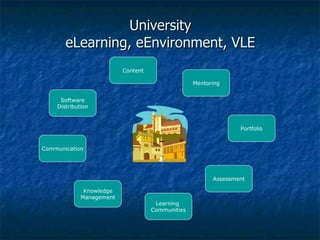
University eLearning, eEnvironment, VLE Software Distribution Content Mentoring Assessment Portfolio Communication Knowledge Management Learning  Communities
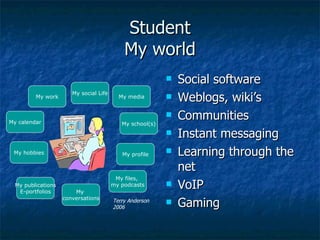
Student My world Social software Weblogs, wiki’s Communities Instant messaging Learning through the net VoIP Gaming My hobbies My calendar My social Life My school(s) My files,  my podcasts My publications E-portfolios My profile My  conversations My work My media Terry Anderson 2006
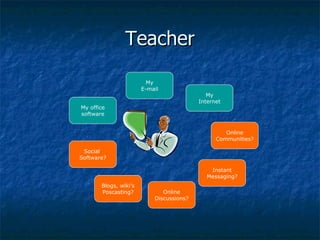
Teacher My E-mail My Internet My office software Social  Software? Online Communities? Blogs, wiki’s Poscasting? Online Discussions? Instant Messaging?
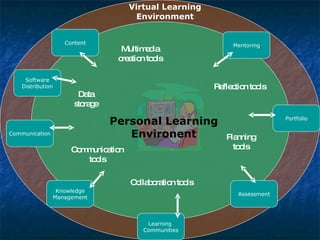
Software Distribution Content Mentoring Assessment Portfolio Communication Knowledge Management Learning  Communities Virtual Learning Environment Multimedia creation tools Communication tools Data storage Reflection tools Collaboration tools Planning tools Personal Learning Environent
How to meet this challenge …in general… Different approaches to students and teachers Use ‘ambassadors’ to promote the fundamentals of the eEnvironment Use ‘key-users’ who are important for disseminating the knowledge Focus on the tools of communication and collaboration, rather then the content tools Start using synchronous communicating tools Give users a face… my profile
How to meet this challenge …teacher approach… Point out the necessity: eLearning is part of the curriculum. Build commitment Workshops, conferences about the social software, web 2.0, etc. Develop digital literacy by specialised courses Training in using Instant Messaging as an efficient tool in communicating and coaching students Facilitate teachers in hardware as well as time to use these software Scan for teachers that could take the role of key-users and/or ambassador ;  facilitate them, train them Try to build small efficient learning communities between teachers and students
How to meet this challenge …student approach… Don’t put too much effort into courses in software… No ‘buttons courses’ Make them aware what the position is of eLearning in their curriculum Communicate clearly about the possibilities… Communicate clearly about what the school is expecting from the students and what they can expect from teachers/tutors Make the tools they use at home worthwhile in their ‘school’ hours Facilitate tools that students can use outside the campus Invest in mobile features
Promoting Overall principles Focus on the acceptation and well-being of students/teachers in using the eEnvironment Promoting is part of the implementation project Monitor the use of newly implemented environments, listen to the users and decide for JIT help projects, courses etc. Use best practices from ‘older’ environments Develop an eLearning knowledge centre
More Challenges Defining eLearning requirements as part of the chosen educational strategy plans The change management needed to bend ‘traditional’ education into the newer forms Communicating about the mission and strategy at the ‘work floor’  The tension between what people want, requirements and technical issues. The understanding that eLearning is about Communication, Collaboration and Cognition

Promoting Quality E Learning

  • 1.
    Promoting Quality eLearningin Higher Education What are the challenges and how to meet them Johan Jongstra 2007 Johan Jongstra License under Creative Commons
  • 2.
    The mission ofpromoting Acceptation of the University’s digital landscape and eLearning environment by the learning communities as an important part of daily educational life
  • 3.
    Challenge How dowe close the gap in digital literacy between students and teachers How do we make the university, the teachers and the student use the same language How do we focus the promotion on this gap
  • 4.
    Where is thisgap about Teachers Learned to live with computers and technology. They have to be convinced about the computer as a tool for their work. Students They belong to the net-generation. Computers, the internet and mobile technology is just another window to their lives.
  • 5.
    University eLearning, eEnvironment,VLE Software Distribution Content Mentoring Assessment Portfolio Communication Knowledge Management Learning Communities
  • 6.
    Student My worldSocial software Weblogs, wiki’s Communities Instant messaging Learning through the net VoIP Gaming My hobbies My calendar My social Life My school(s) My files, my podcasts My publications E-portfolios My profile My conversations My work My media Terry Anderson 2006
  • 7.
    Teacher My E-mailMy Internet My office software Social Software? Online Communities? Blogs, wiki’s Poscasting? Online Discussions? Instant Messaging?
  • 8.
    Software Distribution ContentMentoring Assessment Portfolio Communication Knowledge Management Learning Communities Virtual Learning Environment Multimedia creation tools Communication tools Data storage Reflection tools Collaboration tools Planning tools Personal Learning Environent
  • 9.
    How to meetthis challenge …in general… Different approaches to students and teachers Use ‘ambassadors’ to promote the fundamentals of the eEnvironment Use ‘key-users’ who are important for disseminating the knowledge Focus on the tools of communication and collaboration, rather then the content tools Start using synchronous communicating tools Give users a face… my profile
  • 10.
    How to meetthis challenge …teacher approach… Point out the necessity: eLearning is part of the curriculum. Build commitment Workshops, conferences about the social software, web 2.0, etc. Develop digital literacy by specialised courses Training in using Instant Messaging as an efficient tool in communicating and coaching students Facilitate teachers in hardware as well as time to use these software Scan for teachers that could take the role of key-users and/or ambassador ; facilitate them, train them Try to build small efficient learning communities between teachers and students
  • 11.
    How to meetthis challenge …student approach… Don’t put too much effort into courses in software… No ‘buttons courses’ Make them aware what the position is of eLearning in their curriculum Communicate clearly about the possibilities… Communicate clearly about what the school is expecting from the students and what they can expect from teachers/tutors Make the tools they use at home worthwhile in their ‘school’ hours Facilitate tools that students can use outside the campus Invest in mobile features
  • 12.
    Promoting Overall principlesFocus on the acceptation and well-being of students/teachers in using the eEnvironment Promoting is part of the implementation project Monitor the use of newly implemented environments, listen to the users and decide for JIT help projects, courses etc. Use best practices from ‘older’ environments Develop an eLearning knowledge centre
  • 13.
    More Challenges DefiningeLearning requirements as part of the chosen educational strategy plans The change management needed to bend ‘traditional’ education into the newer forms Communicating about the mission and strategy at the ‘work floor’ The tension between what people want, requirements and technical issues. The understanding that eLearning is about Communication, Collaboration and Cognition

Editor's Notes

  • #5 They use the digital highway for networking, expressing themselves, the search for knowledge, communicating and many more.