Text types in English
There twotypesofcategory oftexttypeswhich studentsmustbecompetent inusing-
Literary texttypesand factual texttypes.Every texttypehasstructural and language
features. Anoutline is providedbelow:
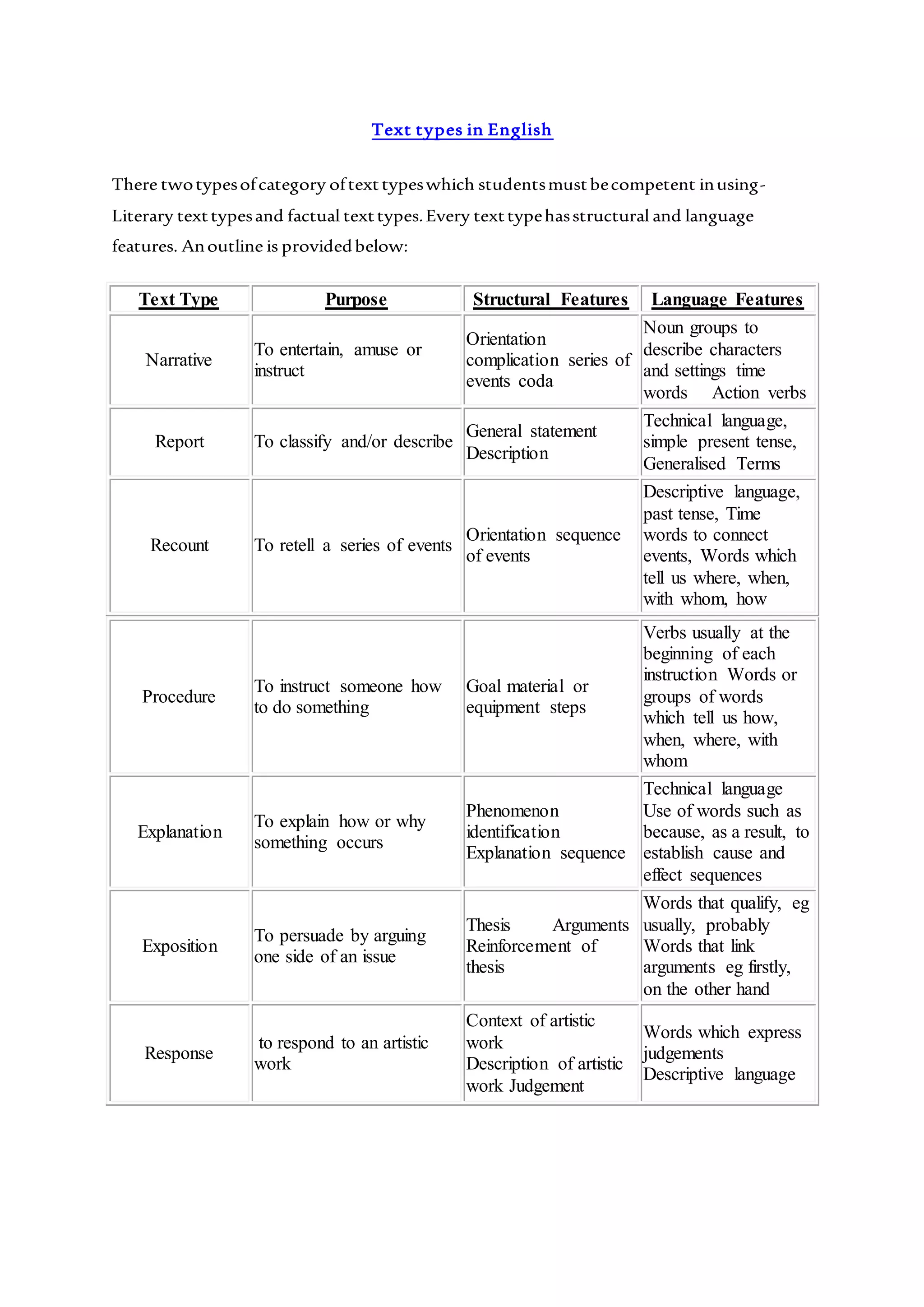
Text Type Purpose Structural Features Language Features
Narrative
To entertain, amuse or
instruct
Orientation
complication series of
events coda
Noun groups to
describe characters
and settings time
words Action verbs
Report To classify and/or describe
General statement
Description
Technical language,
simple present tense,
Generalised Terms
Recount To retell a series of events
Orientation sequence
of events
Descriptive language,
past tense, Time
words to connect
events, Words which
tell us where, when,
with whom, how
Procedure
To instruct someone how
to do something
Goal material or
equipment steps
Verbs usually at the
beginning of each
instruction Words or
groups of words
which tell us how,
when, where, with
whom
Explanation
To explain how or why
something occurs
Phenomenon
identification
Explanation sequence
Technical language
Use of words such as
because, as a result, to
establish cause and
effect sequences
Exposition
To persuade by arguing
one side of an issue
Thesis Arguments
Reinforcement of
thesis
Words that qualify, eg
usually, probably
Words that link
arguments eg firstly,
on the other hand
Response
to respond to an artistic
work
Context of artistic
work
Description of artistic
work Judgement
Words which express
judgements
Descriptive language

Table of text types

  • 1.
    Text types inEnglish There twotypesofcategory oftexttypeswhich studentsmustbecompetent inusing- Literary texttypesand factual texttypes.Every texttypehasstructural and language features. Anoutline is providedbelow: Text Type Purpose Structural Features Language Features Narrative To entertain, amuse or instruct Orientation complication series of events coda Noun groups to describe characters and settings time words Action verbs Report To classify and/or describe General statement Description Technical language, simple present tense, Generalised Terms Recount To retell a series of events Orientation sequence of events Descriptive language, past tense, Time words to connect events, Words which tell us where, when, with whom, how Procedure To instruct someone how to do something Goal material or equipment steps Verbs usually at the beginning of each instruction Words or groups of words which tell us how, when, where, with whom Explanation To explain how or why something occurs Phenomenon identification Explanation sequence Technical language Use of words such as because, as a result, to establish cause and effect sequences Exposition To persuade by arguing one side of an issue Thesis Arguments Reinforcement of thesis Words that qualify, eg usually, probably Words that link arguments eg firstly, on the other hand Response to respond to an artistic work Context of artistic work Description of artistic work Judgement Words which express judgements Descriptive language