MERA DIGITAL INDIA
http://www.whatisseo.in/
WHAT IS DIGITAL INDIA?
Digital India is a campaign launched by the Government
of India to ensure that Government services are made
available to citizens electronically by improved online
infrastructure and by increasing Internet connectivity or
by making the country digitally empowered in the field
of technology
The focus is on making technology central to enabling
change.
It is an Umbrella Programme – covering many
departments.
 It weaves together a large number of ideas and thoughts into a
single, comprehensive vision so that each of them is seen as
The Programme:
Pulls together many existing schemes.
These schemes will be restructured and re-focused.
They will be implemented in a synchronized manner.
Many elements are only process improvements with
minimal cost.
The common branding of programmes as Digital
India highlights their transformative impact.
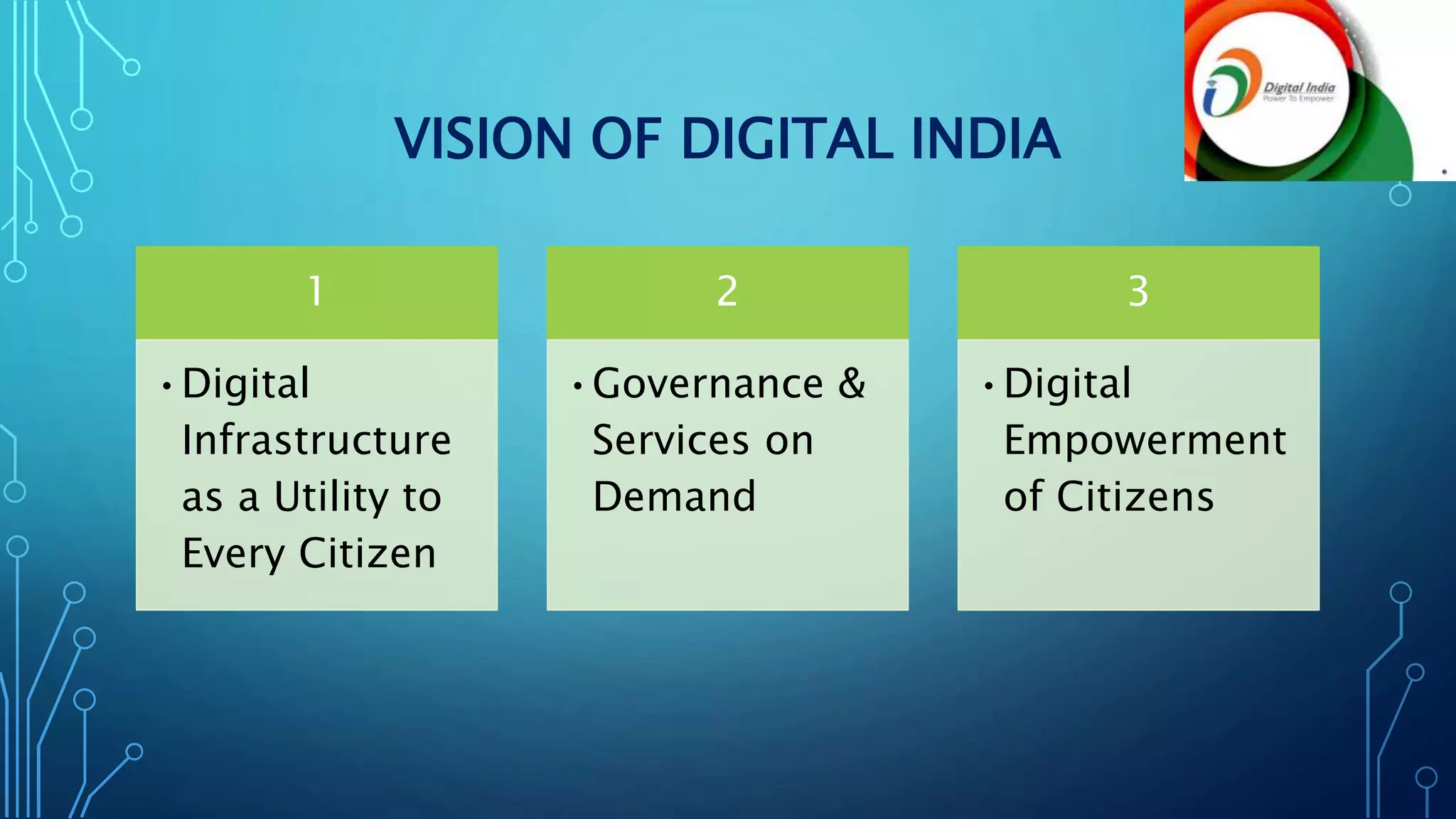
VISION OF DIGITAL INDIA
1
•Digital
Infrastructure
as a Utility to
Every Citizen
2
•Governance &
Services on
Demand
3
•Digital
Empowerment
of Citizens
VISION AREA 1: INFRASTRUCTURE AS A UTILITY TO EVERY
CITIZEN
• High speed internet as a core utility
• Cradle to grave digital identity -unique, lifelong, online,
authenticable
• Mobile phone & Bank account enabling participation in digital &
financial space
• Easy access to a Common Service Centre
• Shareable private space on a public cloud
• Safe and secure Cyber-space
VISION AREA 2: GOVERNANCE & SERVICES ON
DEMAND
• Seamlessly integrated across departments or jurisdictions
• Services available in real time from online &mobile platform
• All citizen entitlements to be available on the cloud
• Services digitally transformed for improving Ease of Doing
Business
• Making financial transactions electronic & cashless
• Leveraging GIS for decision support systems & development
VISION AREA 3: DIGITAL EMPOWERMENT OF
CITIZENS
• Universal Digital Literacy
• Universally accessible digital resources
• All documents/ certificates to be available on cloud
• Availability of digital resources / services in Indian languages
• Collaborative digital platforms for participative governance
• Portability of all entitlements through cloud
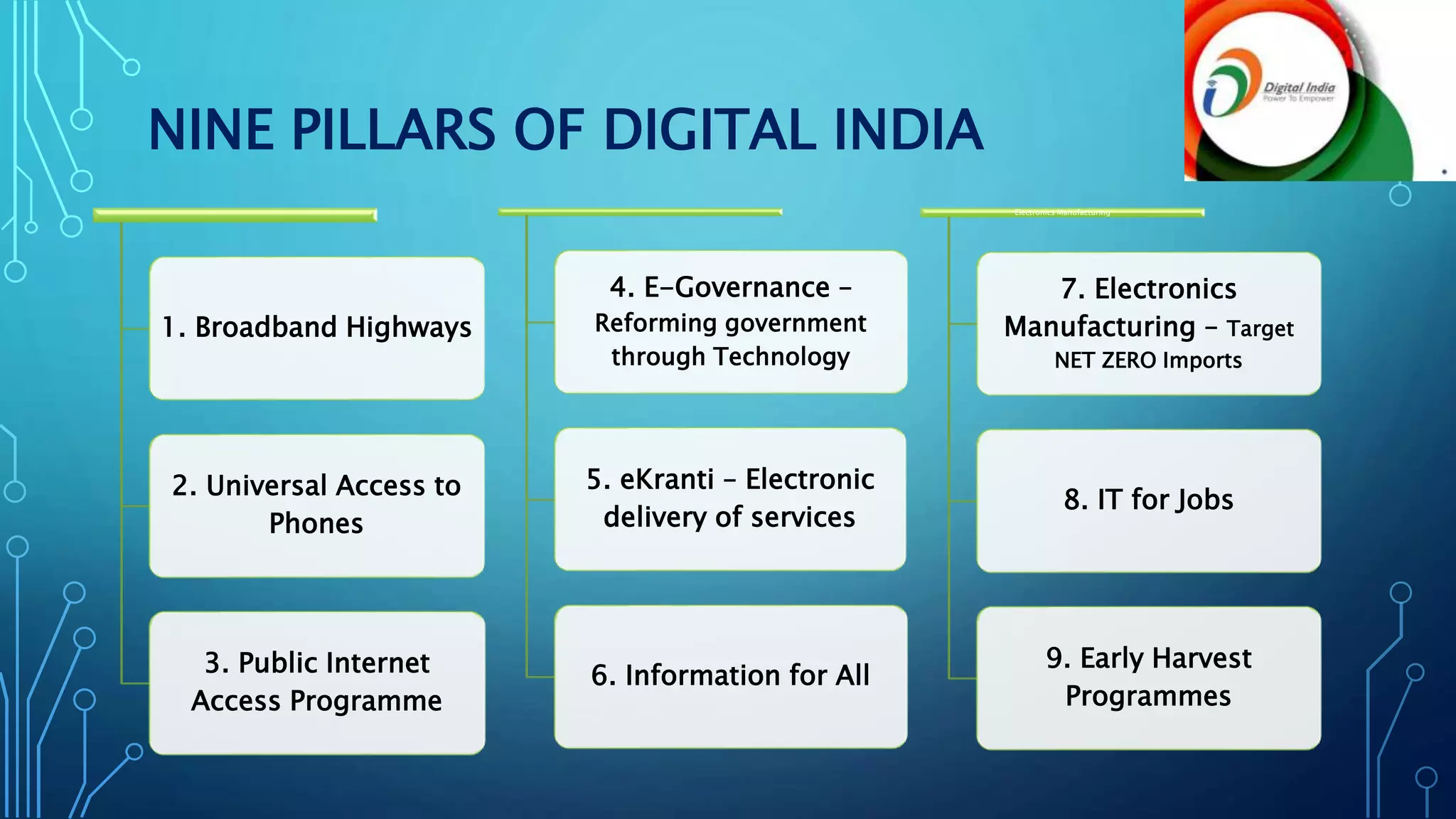
NINE PILLARS OF DIGITAL INDIA
1. Broadband Highways
2. Universal Access to
Phones
3. Public Internet
Access Programme
4. E-Governance –
Reforming government
through Technology
5. eKranti – Electronic
delivery of services
6. Information for All
Electronics Manufacturing
7. Electronics
Manufacturing – Target
NET ZERO Imports
8. IT for Jobs
9. Early Harvest
Programmes
PILLAR 1. BROADBAND HIGHWAYS
•Coverage: 250,000 GP
•Timeline: December 2016
•CAPEX: Rs 32,000 Cr
•Nodal Dept: DoT
Broadband
for all
Rural
•Virtual Network Operators
for service delivery.
•Mandate communication
infrastructure in new
urban development and
buildings.
Broadband
for all
Urban
•Coverage: Nationwide
•Timeline: March 2017
•Cost: Rs 15,686 Cr
•Nodal Dept: DeitY
National
Information
Infrastructur
e
1yr: 50,000 GP
2yr: 100,000
GP
3yr: 100,000
GP
Changes in
Rules to
facilitate.
Integration of
SWAN, NKN,
NOFN. To be
implemented in
2 years
PILLAR 2. UNIVERSAL ACCESS TO MOBILE
CONNECTIVITY
•Coverage: Remaining
uncovered villages (~
42,300 villages)
•Timeline: FY 2014-
18
•Cost: Rs 16,000 Cr
•Nodal Dept: DoT
Universal Access
to mobile
connectivity
Ongoing
Programme
Increased
network
penetration &
coverage of gaps
PILLAR 3. PUBLIC INTERNET ACCESS
PROGRAMME – NATIONAL RURAL
INTERNET MISSION
•Coverage: 2,50,000 villages (now 130,000)
•Timeline: 3 Years - March 2017
•Cost: Rs 4750 Cr
•Nodal Agency: DeitY
CSCs –
made viable,
multi-functional
end-points for
service delivery
•Coverage: 1,50,000 Post Offices
•Timeline: 2 Years
•Nodal Agency: D/o Posts
Post Offices
to become
Multi-Service
Centres
Ongoing
Programme
Reach of Govt.
services to all GPs
This should be long
term vision for POs
PILLAR 4. E-GOVERNANCE: REFORMING
GOVERNMENT THROUGH TECHNOLOGY
 Government Business Process Re-engineering using IT to improve
transactions
• Form Simplification, reduction
• Online applications and tracking, Interface between departments
• Integration of services and platforms – UIDAI, Payment Gateway, Mobile Platform, EDI
 Electronic Databases – all databases and information to be electronic, not manual
 Workflow automation inside government
 Public Grievance Redressal - using IT to automate, respond, analyse data to identify and
resolve persistent problems – largely process improvements
PILLAR 5. eKRANTI - ELECTRONIC
DELIVERY OF SERVICES
 Technology for Education – e-
Education
• All Schools connected with broadband
• Free wifi in all schools (250,000)
• Digital Literacy program
• MOOCs – develop pilot Massive Online
Open Courses
 Technology for Health – e-Healthcare
• Online medical consultation
• Online medical records
• Online medicine supply
• Pan-India exchange for patient
information
 Technology for Farmers
• Real time price information
• Online ordering of inputs
• Online cash, loan, relief payment with mobile banking
 Technology for Security
• Mobile Emergency Services
 Technology for Financial Inclusion
• Mobile Banking
• Micro-ATM program
• CSCs/ Post Offices
 Technology for Justice
• e-Courts, e-Police, e-Jails, e-Prosecution
 Technology for Security
 National Cyber Security Co-ordination Center
PILLAR 6. INFORMATION FOR ALL
 Online Hosting of Information & documents
 Citizens have open, easy access to information
 Open data platform
 Government pro-actively engages through social media and web based
platforms to inform citizens
 MyGov.in
 2-way communication between citizens and government
 Online messaging to citizens on special occasions/programs
 Largely utilize existing infrastructure – limited additional resources needed
Pillar 7. Electronics Manufacturing
TARGET NET ZERO IMPORTS BY 2020
 Target NET ZERO Imports is a striking demonstration of intent
 Ambitious goal which requires coordinated action on many fronts
 Taxation, Incentives
 Economies of Scale, Eliminate cost disadvantages
 Focused areas – Big Ticket Items
 FABS, Fab-less design, Set top boxes, VSATs, Mobiles, Consumer & Medical Electronics, Smart Energy
meters, Smart cards, micro-ATMs
 Incubators, clusters
 Skill development
 Government procurement
 There are many ongoing programs which will be fine-tuned.
 Existing Structures inadequate to handle this goal. Need strengthening.
PILLAR 8. IT FOR JOBS
•Coverage: 1 Crore students
•Timeline: 5 years
•Cost: Rs 200 Cr for weaker sections
•Nodal Agency: DeitY
Train people in smaller
towns & villages for IT
sector jobs
•Scope: Setting up of BPO per NE State
•Coverage: NE States
•Nodal Agency: DeitY
IT/ITES in NE
•Coverage: 3,00,000
•Timeline: 2 Years
•Nodal Agency: DeitY
Train Service Delivery
Agents to run viable
businesses delivering IT
services
•Coverage: 5,00,000
•Timeline: 5 Years
•Nodal Agency: DoT
Telecom service
providers to train rural
workforce to cater to
their own needs
New
Scheme
IT ready
workforce
ICT enabled
growth in NE
Ongoing
Skilled VLEs
and Viable
CSCs
Telecom
ready
workforce
PILLAR 9. EARLY HARVEST PROGRAMMES
•Coverage: Elected representatives, All Govt
employees
•1.36 Cr mobiles and 22 Lakh emails
• Mass Messaging Application developed
IT platform for
messages
• Basket of e-Greetings templates available
• Crowd sourcing of e-Greetings thru MyGov
• e-Greetings Portal ready by 14 August 2014
Government
Greetings to be e-
Greetings
•Coverage: All Central Govt. Offices in Delhi
•Operational in DeitY & Initiated in Urban Development
•On-boarding started in other depts
•Procurement of devices – tender issued
Biometric
attendance
Targeted
Mass
messaging
since July 14
1st e-
Greeting
from PM on
15th Aug
2014
To be
completed
by Oct 2014
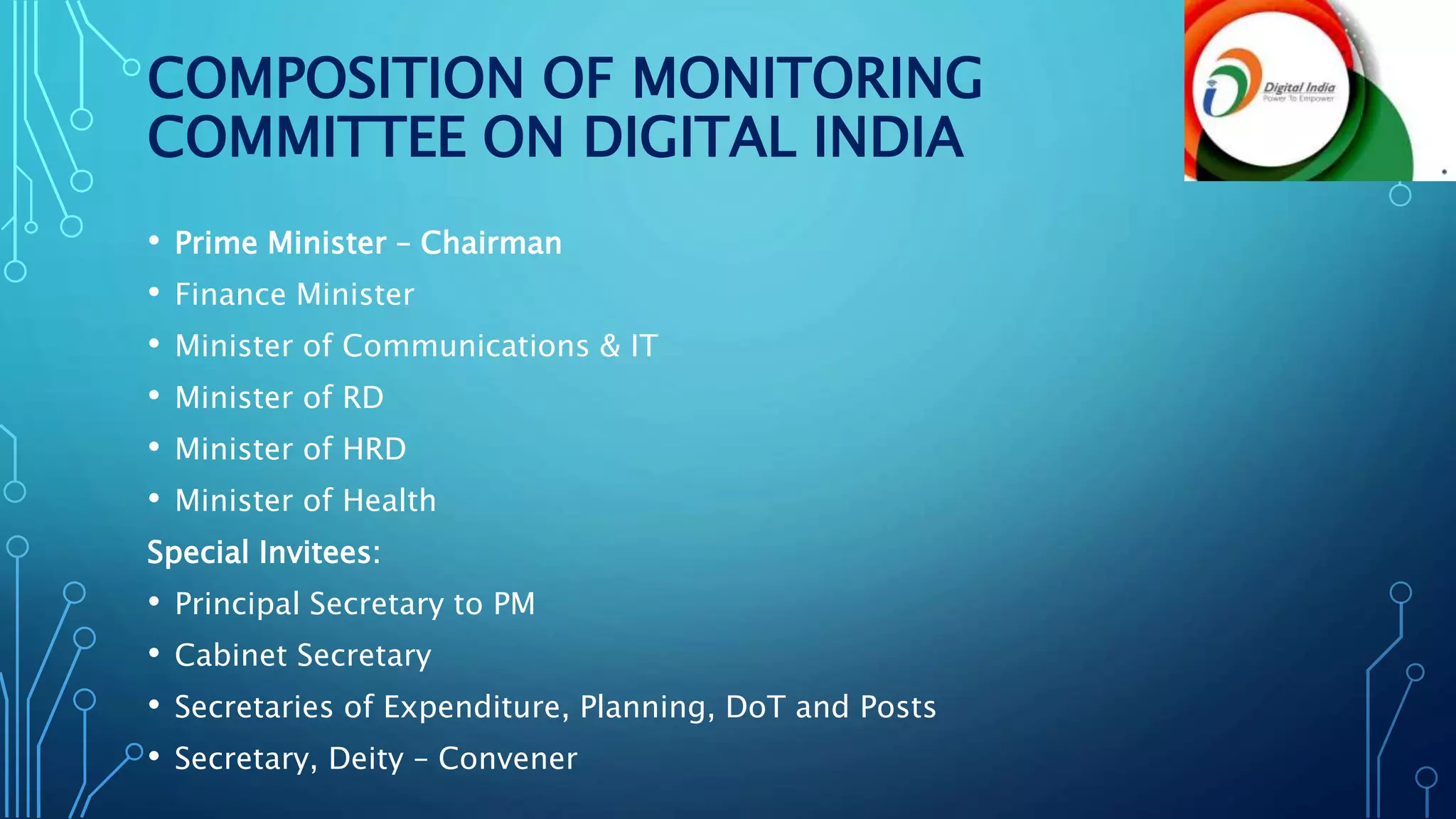
COMPOSITION OF MONITORING
COMMITTEE ON DIGITAL INDIA
• Prime Minister – Chairman
• Finance Minister
• Minister of Communications & IT
• Minister of RD
• Minister of HRD
• Minister of Health
Special Invitees:
• Principal Secretary to PM
• Cabinet Secretary
• Secretaries of Expenditure, Planning, DoT and Posts
• Secretary, Deity – Convener
MINISTER
(Communication
s & IT)
SECRETARY
(DeitY)
Addl. Secretary
(e-Gov)
Joint Secretary
(Electronics Hardware
Manufacturing)
Joint Secretary
(Personnel, Admn. &
Industry Promotion S/W)
Addl. Secretary
(Digital India)
Joint Secretary
(Infrastructure
Development)
Joint Secretary
(Capacity Building &
Digital Enablement
of Citizens)
Joint Secretary
(IT applications in un-
covered areas &
Process Re-engineering
Joint Secretary
(e-Gov)
Electronic
Manufacturing – Target
Net Zero Imports
Public Internet
Access Programme
E-Governance:
Reforming
Government through
Technology
Electronic Delivery of
Services - eKranti
Technology for
Jobs
Information for All
Reorganisation of
NIC
CIOs in important Ministries
ESTIMATED COSTS AND IMPACTS
 Overall Costs of Digital India
~ Rs 100,000 Cr in ongoing schemes (only DeitY, DOT & not incl. those in other line
Ministries)
~ Rs 13,000 Cr for new schemes & activities
 Impact of Digital India by 2019
• Broadband in 2.5 lakh villages, universal phone connectivity
• Net Zero Imports by 2020
• 400,000 Public Internet Access Points
• Wi-fi in 2.5 lakh schools, all universities; Public wi-fi hotspots for
citizens
• Digital Inclusion: 1.7 Cr trained for IT, Telecom and Electronics Jobs
• Job creation: Direct 1.7 Cr. and Indirect at least 8.5 Cr.
• e-Governance & eServices: Across government
• India to be leader in IT use in services – health, education, banking
• Digitally empowered citizens – public cloud, internet access
CHALLENGES & CHANGES NEEDED
 Program on this scale never conceived
 Each Pillar/program has own challenges
 Human Resource Issues
 NIC - not equipped for a fraction of this task (obsolesce) - needs revamping & restructuring
 DeitY – needs program managers – at least 4 more officers at senior levels
 Ministries – Need a Chief Information Officer / Chief Technology Officer (CIO/CTO)
 Could begin with CIOs 10 major Ministries
 Can be anyone – from within or outside government
 To be patterned as AS & FAs – dual reporting
 Financial Resource Issues
 Mostly structured around ongoing programs : Better focus, need some restructuring
 Some others are process improvements or better utilization of resources
 Coordination Issues
 Program covers many other departments
 Need commitment and effort
 Leadership and support critical for success
Thankyou

PPt With animation on Mera Digital India

  • 1.
  • 2.
    WHAT IS DIGITALINDIA? Digital India is a campaign launched by the Government of India to ensure that Government services are made available to citizens electronically by improved online infrastructure and by increasing Internet connectivity or by making the country digitally empowered in the field of technology The focus is on making technology central to enabling change. It is an Umbrella Programme – covering many departments.  It weaves together a large number of ideas and thoughts into a single, comprehensive vision so that each of them is seen as
  • 3.
    The Programme: Pulls togethermany existing schemes. These schemes will be restructured and re-focused. They will be implemented in a synchronized manner. Many elements are only process improvements with minimal cost. The common branding of programmes as Digital India highlights their transformative impact.
  • 4.
    VISION OF DIGITALINDIA 1 •Digital Infrastructure as a Utility to Every Citizen 2 •Governance & Services on Demand 3 •Digital Empowerment of Citizens
  • 5.
    VISION AREA 1:INFRASTRUCTURE AS A UTILITY TO EVERY CITIZEN • High speed internet as a core utility • Cradle to grave digital identity -unique, lifelong, online, authenticable • Mobile phone & Bank account enabling participation in digital & financial space • Easy access to a Common Service Centre • Shareable private space on a public cloud • Safe and secure Cyber-space
  • 6.
    VISION AREA 2:GOVERNANCE & SERVICES ON DEMAND • Seamlessly integrated across departments or jurisdictions • Services available in real time from online &mobile platform • All citizen entitlements to be available on the cloud • Services digitally transformed for improving Ease of Doing Business • Making financial transactions electronic & cashless • Leveraging GIS for decision support systems & development
  • 7.
    VISION AREA 3:DIGITAL EMPOWERMENT OF CITIZENS • Universal Digital Literacy • Universally accessible digital resources • All documents/ certificates to be available on cloud • Availability of digital resources / services in Indian languages • Collaborative digital platforms for participative governance • Portability of all entitlements through cloud
  • 8.
    NINE PILLARS OFDIGITAL INDIA 1. Broadband Highways 2. Universal Access to Phones 3. Public Internet Access Programme 4. E-Governance – Reforming government through Technology 5. eKranti – Electronic delivery of services 6. Information for All Electronics Manufacturing 7. Electronics Manufacturing – Target NET ZERO Imports 8. IT for Jobs 9. Early Harvest Programmes
  • 9.
    PILLAR 1. BROADBANDHIGHWAYS •Coverage: 250,000 GP •Timeline: December 2016 •CAPEX: Rs 32,000 Cr •Nodal Dept: DoT Broadband for all Rural •Virtual Network Operators for service delivery. •Mandate communication infrastructure in new urban development and buildings. Broadband for all Urban •Coverage: Nationwide •Timeline: March 2017 •Cost: Rs 15,686 Cr •Nodal Dept: DeitY National Information Infrastructur e 1yr: 50,000 GP 2yr: 100,000 GP 3yr: 100,000 GP Changes in Rules to facilitate. Integration of SWAN, NKN, NOFN. To be implemented in 2 years
  • 10.
    PILLAR 2. UNIVERSALACCESS TO MOBILE CONNECTIVITY •Coverage: Remaining uncovered villages (~ 42,300 villages) •Timeline: FY 2014- 18 •Cost: Rs 16,000 Cr •Nodal Dept: DoT Universal Access to mobile connectivity Ongoing Programme Increased network penetration & coverage of gaps
  • 11.
    PILLAR 3. PUBLICINTERNET ACCESS PROGRAMME – NATIONAL RURAL INTERNET MISSION •Coverage: 2,50,000 villages (now 130,000) •Timeline: 3 Years - March 2017 •Cost: Rs 4750 Cr •Nodal Agency: DeitY CSCs – made viable, multi-functional end-points for service delivery •Coverage: 1,50,000 Post Offices •Timeline: 2 Years •Nodal Agency: D/o Posts Post Offices to become Multi-Service Centres Ongoing Programme Reach of Govt. services to all GPs This should be long term vision for POs
  • 12.
    PILLAR 4. E-GOVERNANCE:REFORMING GOVERNMENT THROUGH TECHNOLOGY  Government Business Process Re-engineering using IT to improve transactions • Form Simplification, reduction • Online applications and tracking, Interface between departments • Integration of services and platforms – UIDAI, Payment Gateway, Mobile Platform, EDI  Electronic Databases – all databases and information to be electronic, not manual  Workflow automation inside government  Public Grievance Redressal - using IT to automate, respond, analyse data to identify and resolve persistent problems – largely process improvements
  • 13.
    PILLAR 5. eKRANTI- ELECTRONIC DELIVERY OF SERVICES  Technology for Education – e- Education • All Schools connected with broadband • Free wifi in all schools (250,000) • Digital Literacy program • MOOCs – develop pilot Massive Online Open Courses  Technology for Health – e-Healthcare • Online medical consultation • Online medical records • Online medicine supply • Pan-India exchange for patient information  Technology for Farmers • Real time price information • Online ordering of inputs • Online cash, loan, relief payment with mobile banking  Technology for Security • Mobile Emergency Services  Technology for Financial Inclusion • Mobile Banking • Micro-ATM program • CSCs/ Post Offices  Technology for Justice • e-Courts, e-Police, e-Jails, e-Prosecution  Technology for Security  National Cyber Security Co-ordination Center
  • 14.
    PILLAR 6. INFORMATIONFOR ALL  Online Hosting of Information & documents  Citizens have open, easy access to information  Open data platform  Government pro-actively engages through social media and web based platforms to inform citizens  MyGov.in  2-way communication between citizens and government  Online messaging to citizens on special occasions/programs  Largely utilize existing infrastructure – limited additional resources needed
  • 15.
    Pillar 7. ElectronicsManufacturing TARGET NET ZERO IMPORTS BY 2020  Target NET ZERO Imports is a striking demonstration of intent  Ambitious goal which requires coordinated action on many fronts  Taxation, Incentives  Economies of Scale, Eliminate cost disadvantages  Focused areas – Big Ticket Items  FABS, Fab-less design, Set top boxes, VSATs, Mobiles, Consumer & Medical Electronics, Smart Energy meters, Smart cards, micro-ATMs  Incubators, clusters  Skill development  Government procurement  There are many ongoing programs which will be fine-tuned.  Existing Structures inadequate to handle this goal. Need strengthening.
  • 16.
    PILLAR 8. ITFOR JOBS •Coverage: 1 Crore students •Timeline: 5 years •Cost: Rs 200 Cr for weaker sections •Nodal Agency: DeitY Train people in smaller towns & villages for IT sector jobs •Scope: Setting up of BPO per NE State •Coverage: NE States •Nodal Agency: DeitY IT/ITES in NE •Coverage: 3,00,000 •Timeline: 2 Years •Nodal Agency: DeitY Train Service Delivery Agents to run viable businesses delivering IT services •Coverage: 5,00,000 •Timeline: 5 Years •Nodal Agency: DoT Telecom service providers to train rural workforce to cater to their own needs New Scheme IT ready workforce ICT enabled growth in NE Ongoing Skilled VLEs and Viable CSCs Telecom ready workforce
  • 17.
    PILLAR 9. EARLYHARVEST PROGRAMMES •Coverage: Elected representatives, All Govt employees •1.36 Cr mobiles and 22 Lakh emails • Mass Messaging Application developed IT platform for messages • Basket of e-Greetings templates available • Crowd sourcing of e-Greetings thru MyGov • e-Greetings Portal ready by 14 August 2014 Government Greetings to be e- Greetings •Coverage: All Central Govt. Offices in Delhi •Operational in DeitY & Initiated in Urban Development •On-boarding started in other depts •Procurement of devices – tender issued Biometric attendance Targeted Mass messaging since July 14 1st e- Greeting from PM on 15th Aug 2014 To be completed by Oct 2014
  • 18.
    COMPOSITION OF MONITORING COMMITTEEON DIGITAL INDIA • Prime Minister – Chairman • Finance Minister • Minister of Communications & IT • Minister of RD • Minister of HRD • Minister of Health Special Invitees: • Principal Secretary to PM • Cabinet Secretary • Secretaries of Expenditure, Planning, DoT and Posts • Secretary, Deity – Convener
  • 19.
    MINISTER (Communication s & IT) SECRETARY (DeitY) Addl.Secretary (e-Gov) Joint Secretary (Electronics Hardware Manufacturing) Joint Secretary (Personnel, Admn. & Industry Promotion S/W) Addl. Secretary (Digital India) Joint Secretary (Infrastructure Development) Joint Secretary (Capacity Building & Digital Enablement of Citizens) Joint Secretary (IT applications in un- covered areas & Process Re-engineering Joint Secretary (e-Gov) Electronic Manufacturing – Target Net Zero Imports Public Internet Access Programme E-Governance: Reforming Government through Technology Electronic Delivery of Services - eKranti Technology for Jobs Information for All Reorganisation of NIC CIOs in important Ministries
  • 20.
    ESTIMATED COSTS ANDIMPACTS  Overall Costs of Digital India ~ Rs 100,000 Cr in ongoing schemes (only DeitY, DOT & not incl. those in other line Ministries) ~ Rs 13,000 Cr for new schemes & activities  Impact of Digital India by 2019 • Broadband in 2.5 lakh villages, universal phone connectivity • Net Zero Imports by 2020 • 400,000 Public Internet Access Points • Wi-fi in 2.5 lakh schools, all universities; Public wi-fi hotspots for citizens • Digital Inclusion: 1.7 Cr trained for IT, Telecom and Electronics Jobs • Job creation: Direct 1.7 Cr. and Indirect at least 8.5 Cr. • e-Governance & eServices: Across government • India to be leader in IT use in services – health, education, banking • Digitally empowered citizens – public cloud, internet access
  • 21.
    CHALLENGES & CHANGESNEEDED  Program on this scale never conceived  Each Pillar/program has own challenges  Human Resource Issues  NIC - not equipped for a fraction of this task (obsolesce) - needs revamping & restructuring  DeitY – needs program managers – at least 4 more officers at senior levels  Ministries – Need a Chief Information Officer / Chief Technology Officer (CIO/CTO)  Could begin with CIOs 10 major Ministries  Can be anyone – from within or outside government  To be patterned as AS & FAs – dual reporting  Financial Resource Issues  Mostly structured around ongoing programs : Better focus, need some restructuring  Some others are process improvements or better utilization of resources  Coordination Issues  Program covers many other departments  Need commitment and effort  Leadership and support critical for success
  • 22.