DIGITAL INDIA
Presented by Rahul Sah
Table of Content
Advantage & Disadvantage of Digital India
Pillars of Digital India
Components of Digital India
Current Status of Digital India
History of Digital India
Introduction
Key Features of Digital India
Introduction
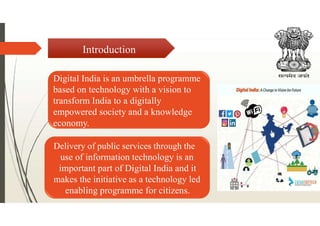
Digital India is an umbrella programme
based on technology with a vision to
transform India to a digitally
empowered society and a knowledge
economy.
Delivery of public services through the
use of information technology is an
important part of Digital India and it
makes the initiative as a technology led
enabling programme for citizens.
History of Digital India
E-governance initiatives in India took a
wider
broader
sectoraldimension in the mid 1990s for
applications with emphasis on citizen-centric services
Digital India was launched by the Prime Minister of India
Narendra Modi on 1 July 2015 with an objective of connecting
rural areas with high-speed Internet networks and improving
digital literacy.
It is centred on three key areas – digital infrastructure as a utility
to every citizen, governance and services on demand, and digital
empowerment of citizens
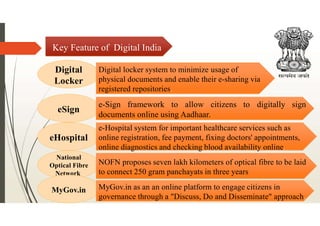
Key Feature of Digital India
eSign
Digital
Locker
eHospital
National
Optical Fibre
Network
MyGov.in
Digital locker system to minimize usage of
physical documents and enable their e-sharing via
registered repositories.
MyGov.in as an an online platform to engage citizens in
governance through a "Discuss, Do and Disseminate" approach.
signe-Sign framework to allow
documents online using Aadhaar.
citizens to digitally sign
online diagnostics and checking blood availability online
e-Hospital system for important healthcare services such as
online registration, fee payment, fixing doctors' appointments,
online diagnostics and checking blood availability online.
NOFN proposes seven lakh kilometers of optical fibre to be laid
to connect 250 gram panchayats in three years
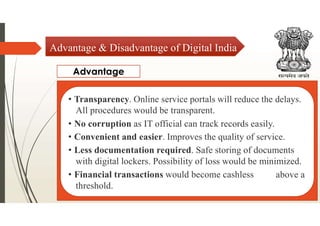
Advantage & Disadvantage of Digital India
Advantage
• Transparency. Online service portals will reduce the delays.
All procedures would be transparent.
• No corruption as IT official can track records easily.
• Convenient and easier. Improves the quality of service.
• Less documentation required. Safe storing of documents
with digital lockers. Possibility of loss would be minimized.
• Financial transactions would become cashless
threshold.
above a
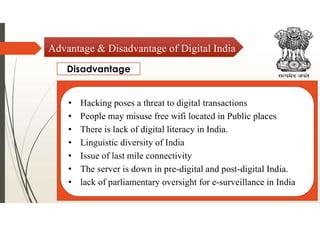
Disadvantage
Advantage & Disadvantage of Digital India
• Hacking poses a threat to digital transactions
• People may misuse free wifi located in Public places
• There is lack of digital literacy in India.
• Linguistic diversity of India
• Issue of last mile connectivity
• The server is down in pre-digital and post-digital India.
• lack of parliamentary oversight for e-surveillance in India
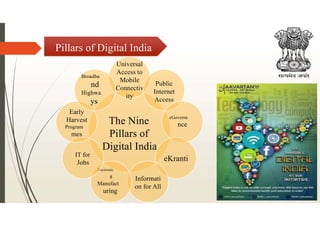
Pillars of Digital India
The Nine
Pillars of
Digital India
Universal
Access to
Mobile
Connectiv
ity
Public
Internet
Access
eGoverna
nce
eKranti
Informati
on for All
Electronic
s
Manufact
uring
IT for
Jobs
Early
Harvest
Program
mes
Broadba
nd
Highwa
ys
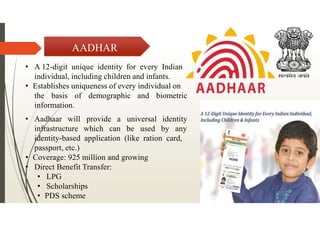
• A 12-digit unique identity for every Indian
individual, including children and infants.
• Establishes uniqueness of every individual on
the basis
information.
of demographic and biometric
• Aadhaar will
infrastructure
provide a
can
universal identity
which be used by any
identity-based application (like ration card,
passport, etc.)
• Coverage: 925 million and growing
• Direct Benefit Transfer:
•
•
LPG
Scholarships
• PDS scheme
AADHAR
Examples of Digital Enterprise
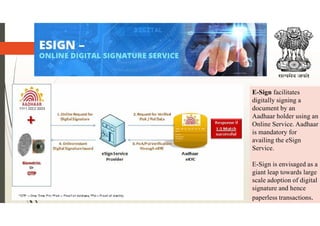
E-Sign facilitates
digitally signing a
document by an
Aadhaar holder using an
Online Service. Aadhaar
is mandatory for
availing the eSign
Service.
E-Sign is envisaged as a
giant leap towards large
scale adoption of digital
signature and hence
paperless transactions.
Digital Locker
DigiLocker is a service launched by
Government of India in February 2015
to provide a secure dedicated personal
electronic space for storing the
documents of resident Indian citizens.
The storage space (maximum 1GB) is
linked to the Aadhaar number of the
user.
Conclusion
India would become a very powerful
digitally connected world. This would
lead to a good architecture for
electronic delivery of service. The Digital
India project provides a huge
opportunity to use the latest technology
to redefine the paradigms of service
delivery.
Digital india

Digital india

  • 1.
  • 2.
    Table of Content Advantage& Disadvantage of Digital India Pillars of Digital India Components of Digital India Current Status of Digital India History of Digital India Introduction Key Features of Digital India
  • 3.
    Introduction Digital India isan umbrella programme based on technology with a vision to transform India to a digitally empowered society and a knowledge economy. Delivery of public services through the use of information technology is an important part of Digital India and it makes the initiative as a technology led enabling programme for citizens.
  • 4.
    History of DigitalIndia E-governance initiatives in India took a wider broader sectoraldimension in the mid 1990s for applications with emphasis on citizen-centric services Digital India was launched by the Prime Minister of India Narendra Modi on 1 July 2015 with an objective of connecting rural areas with high-speed Internet networks and improving digital literacy. It is centred on three key areas – digital infrastructure as a utility to every citizen, governance and services on demand, and digital empowerment of citizens
  • 5.
    Key Feature ofDigital India eSign Digital Locker eHospital National Optical Fibre Network MyGov.in Digital locker system to minimize usage of physical documents and enable their e-sharing via registered repositories. MyGov.in as an an online platform to engage citizens in governance through a "Discuss, Do and Disseminate" approach. signe-Sign framework to allow documents online using Aadhaar. citizens to digitally sign online diagnostics and checking blood availability online e-Hospital system for important healthcare services such as online registration, fee payment, fixing doctors' appointments, online diagnostics and checking blood availability online. NOFN proposes seven lakh kilometers of optical fibre to be laid to connect 250 gram panchayats in three years
  • 6.
    Advantage & Disadvantageof Digital India Advantage • Transparency. Online service portals will reduce the delays. All procedures would be transparent. • No corruption as IT official can track records easily. • Convenient and easier. Improves the quality of service. • Less documentation required. Safe storing of documents with digital lockers. Possibility of loss would be minimized. • Financial transactions would become cashless threshold. above a
  • 7.
    Disadvantage Advantage & Disadvantageof Digital India • Hacking poses a threat to digital transactions • People may misuse free wifi located in Public places • There is lack of digital literacy in India. • Linguistic diversity of India • Issue of last mile connectivity • The server is down in pre-digital and post-digital India. • lack of parliamentary oversight for e-surveillance in India
  • 8.
    Pillars of DigitalIndia The Nine Pillars of Digital India Universal Access to Mobile Connectiv ity Public Internet Access eGoverna nce eKranti Informati on for All Electronic s Manufact uring IT for Jobs Early Harvest Program mes Broadba nd Highwa ys
  • 9.
    • A 12-digitunique identity for every Indian individual, including children and infants. • Establishes uniqueness of every individual on the basis information. of demographic and biometric • Aadhaar will infrastructure provide a can universal identity which be used by any identity-based application (like ration card, passport, etc.) • Coverage: 925 million and growing • Direct Benefit Transfer: • • LPG Scholarships • PDS scheme AADHAR
  • 10.
  • 11.
    E-Sign facilitates digitally signinga document by an Aadhaar holder using an Online Service. Aadhaar is mandatory for availing the eSign Service. E-Sign is envisaged as a giant leap towards large scale adoption of digital signature and hence paperless transactions.
  • 12.
    Digital Locker DigiLocker isa service launched by Government of India in February 2015 to provide a secure dedicated personal electronic space for storing the documents of resident Indian citizens. The storage space (maximum 1GB) is linked to the Aadhaar number of the user.
  • 14.
    Conclusion India would becomea very powerful digitally connected world. This would lead to a good architecture for electronic delivery of service. The Digital India project provides a huge opportunity to use the latest technology to redefine the paradigms of service delivery.