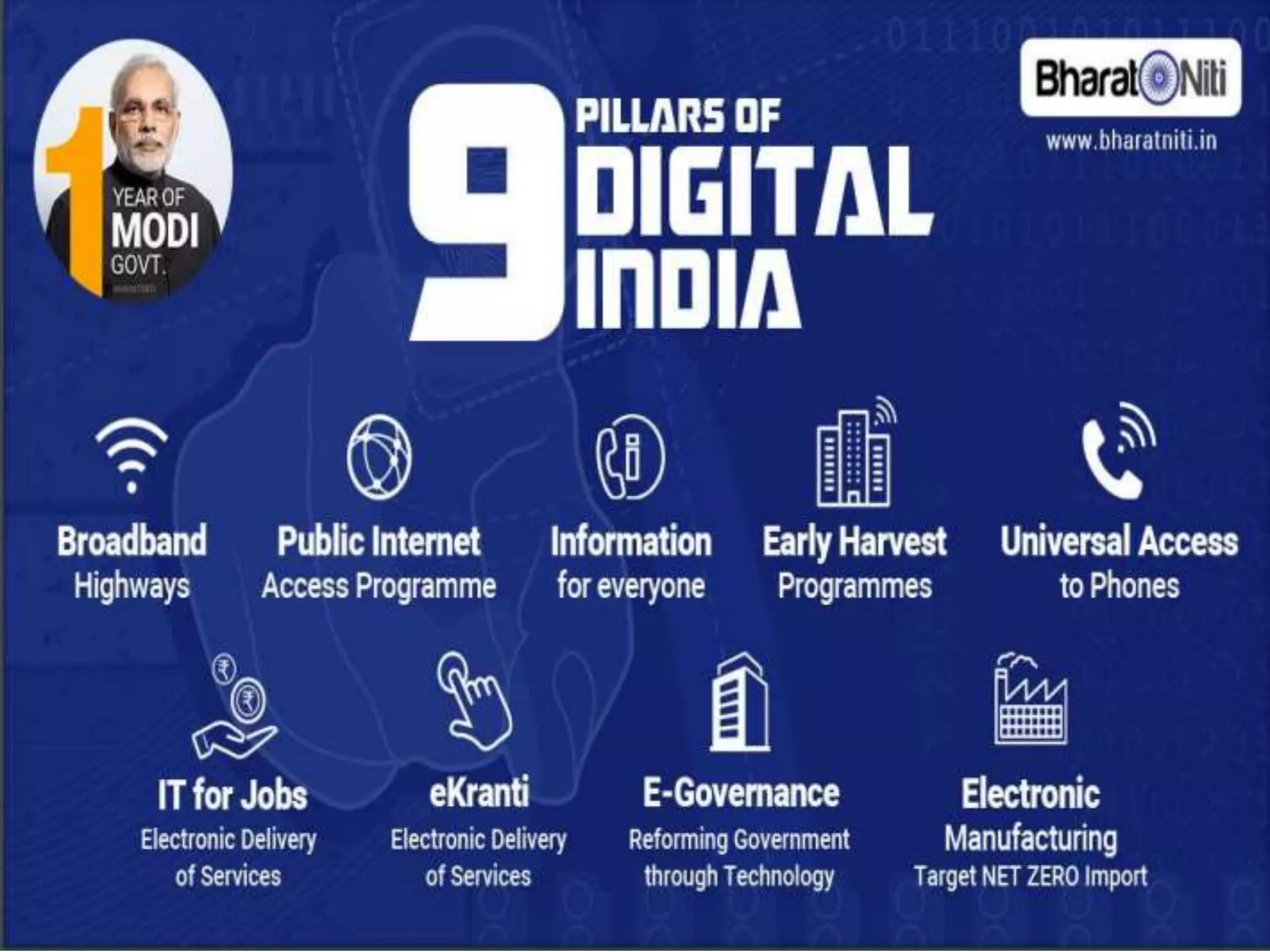
Nine Pillars
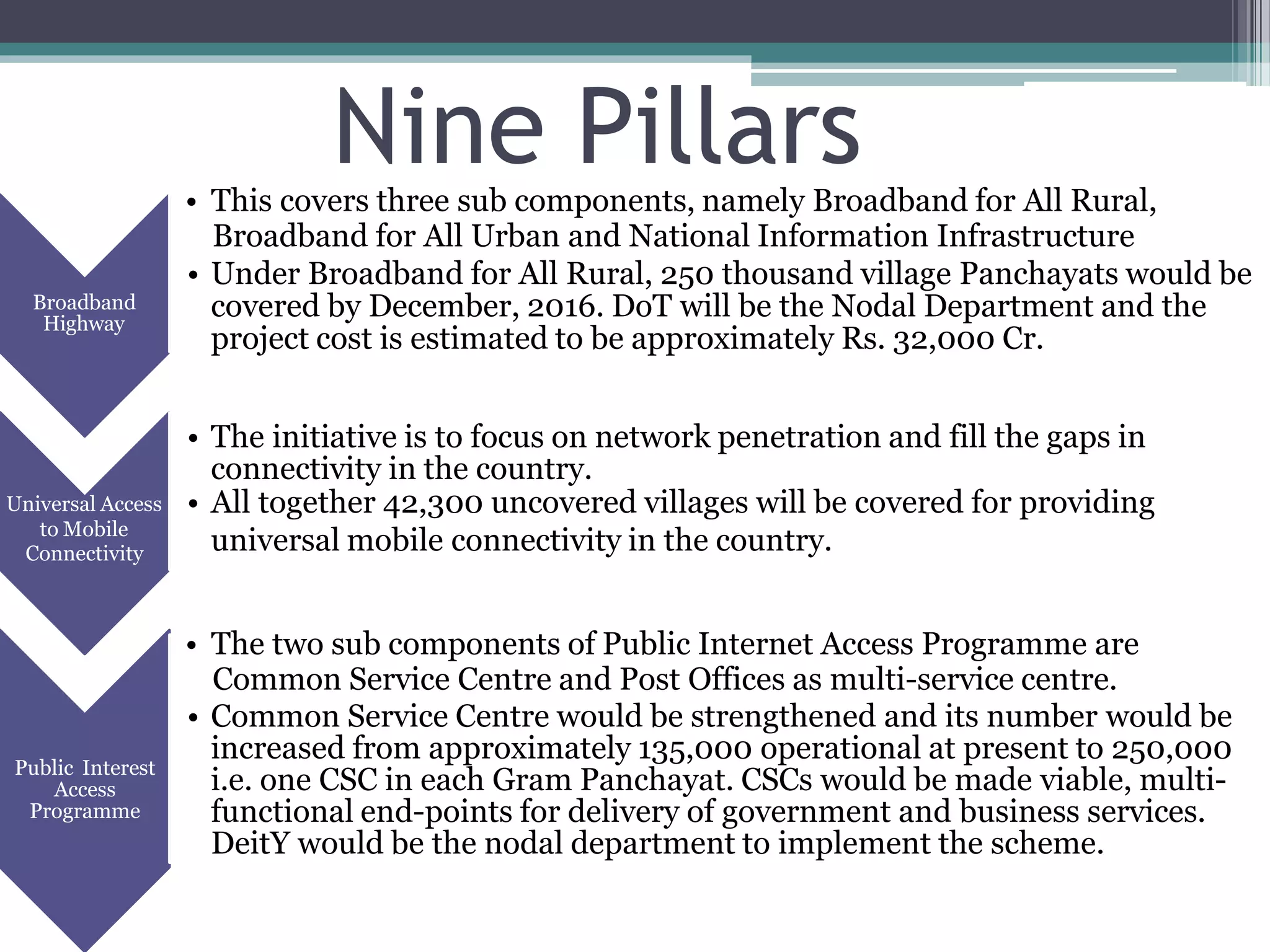
Broadband
Highway
• This covers three sub components, namely Broadband for All Rural,
Broadband for All Urban and National Information Infrastructure
• Under Broadband for All Rural, 250 thousand village Panchayats would be
covered by December, 2016. DoT will be the Nodal Department and the
project cost is estimated to be approximately Rs. 32,000 Cr.
Connectivity
• The initiative is to focus on network penetration and fill the gaps in
connectivity in the country.
Universal Access • All together 42,300 uncovered villages will be covered for providing
to Mobile
universal mobile connectivity in the country.
Public Interest
Access
Programme
• The two sub components of Public Internet Access Programme are
Common Service Centre and Post Offices as multi-service centre.
• Common Service Centre would be strengthened and its number would be
increased from approximately 135,000 operational at present to 250,000
i.e. one CSC in each Gram Panchayat. CSCs would be made viable, multi-
functional end-points for delivery of government and business services.
DeitY would be the nodal department to implement the scheme.
Nine Pillars (Contd..)
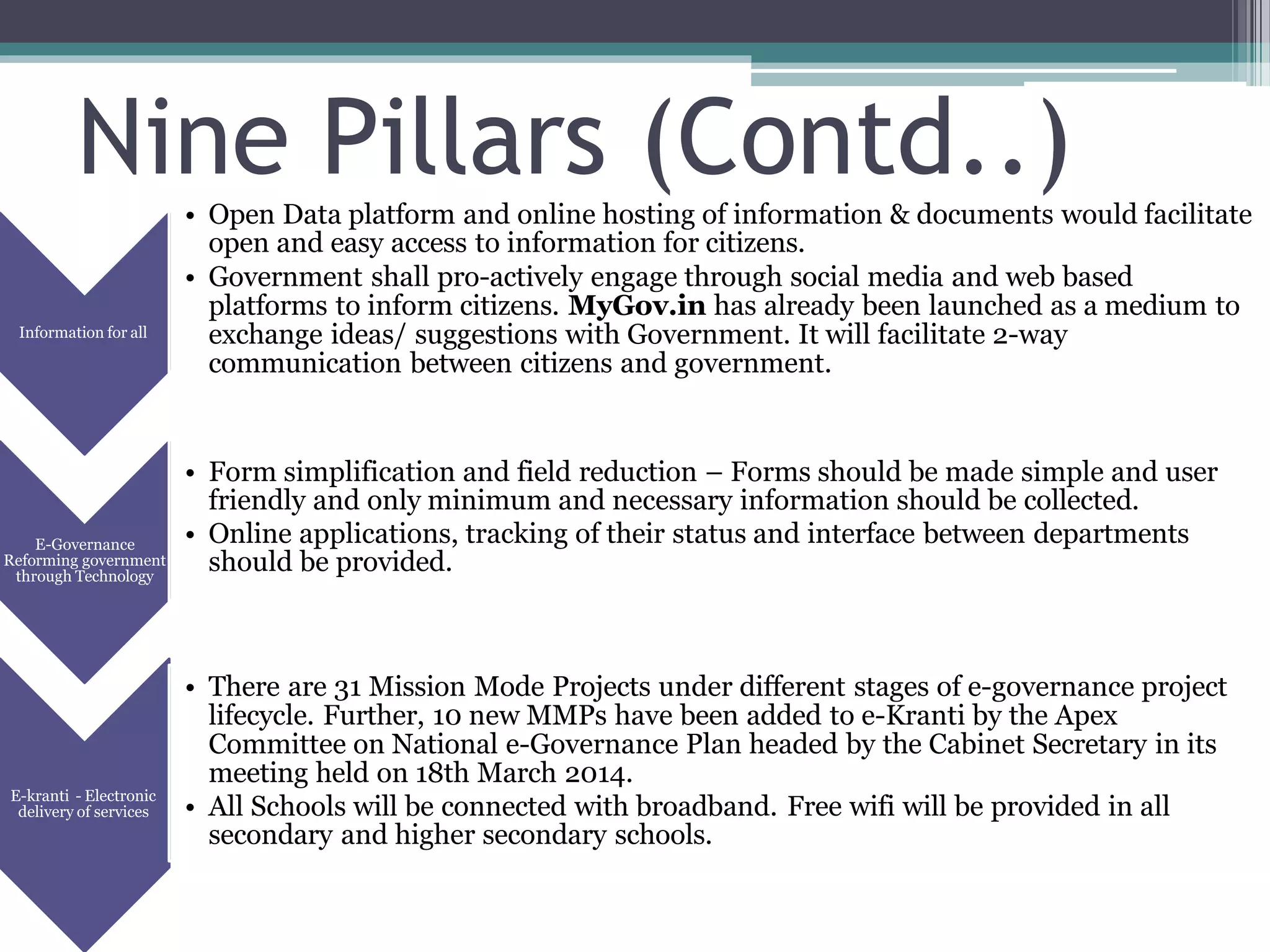
Information for all
• Open Data platform and online hosting of information & documents would facilitate
open and easy access to information for citizens.
• Government shall pro-actively engage through social media and web based
platforms to inform citizens. MyGov.in has already been launched as a medium to
exchange ideas/ suggestions with Government. It will facilitate 2-way
communication between citizens and government.
E-Governance
Reforming government
through Technology
• Form simplification and field reduction – Forms should be made simple and user
friendly and only minimum and necessary information should be collected.
• Online applications, tracking of their status and interface between departments
should be provided.
E-kranti - Electronic
delivery of services
• There are 31 Mission Mode Projects under different stages of e-governance project
lifecycle. Further, 10 new MMPs have been added to e-Kranti by the Apex
Committee on National e-Governance Plan headed by the Cabinet Secretary in its
meeting held on 18th March 2014.
• All Schools will be connected with broadband. Free wifi will be provided in all
secondary and higher secondary schools.
Nine Pillars (Contd..)
IT for Jobs
• The government is planning to teaching one crore learners from small towns
and village for IT industry. Plans are also to exercise 300,000 assistance
distribution providers in 2 years to run practical companies offering IT
services and telecoms companies to train 500,000 rural workers in 5 years.
Early Harvest
Programmes
• The govt is planning to set up Aadhaar Allowed Fingerprint Presence
Program in all central government workplaces situated at Delhi. A web based
application software system will allow online documenting of attendance and
its watching by the involved stakeholders.
Electronics
• Concentrate is on set tob containers, VSAT, mobile,consumer electronics,
technology, medical electronic devices, intelligent energy metres, Smart cards
and micro ATMs. For this the government is co-ordinating on many front be
it taxes, rewards, financial systems of range and offering cost benefits to local
Manufacturing producers.
Estimated Costs of Digital India
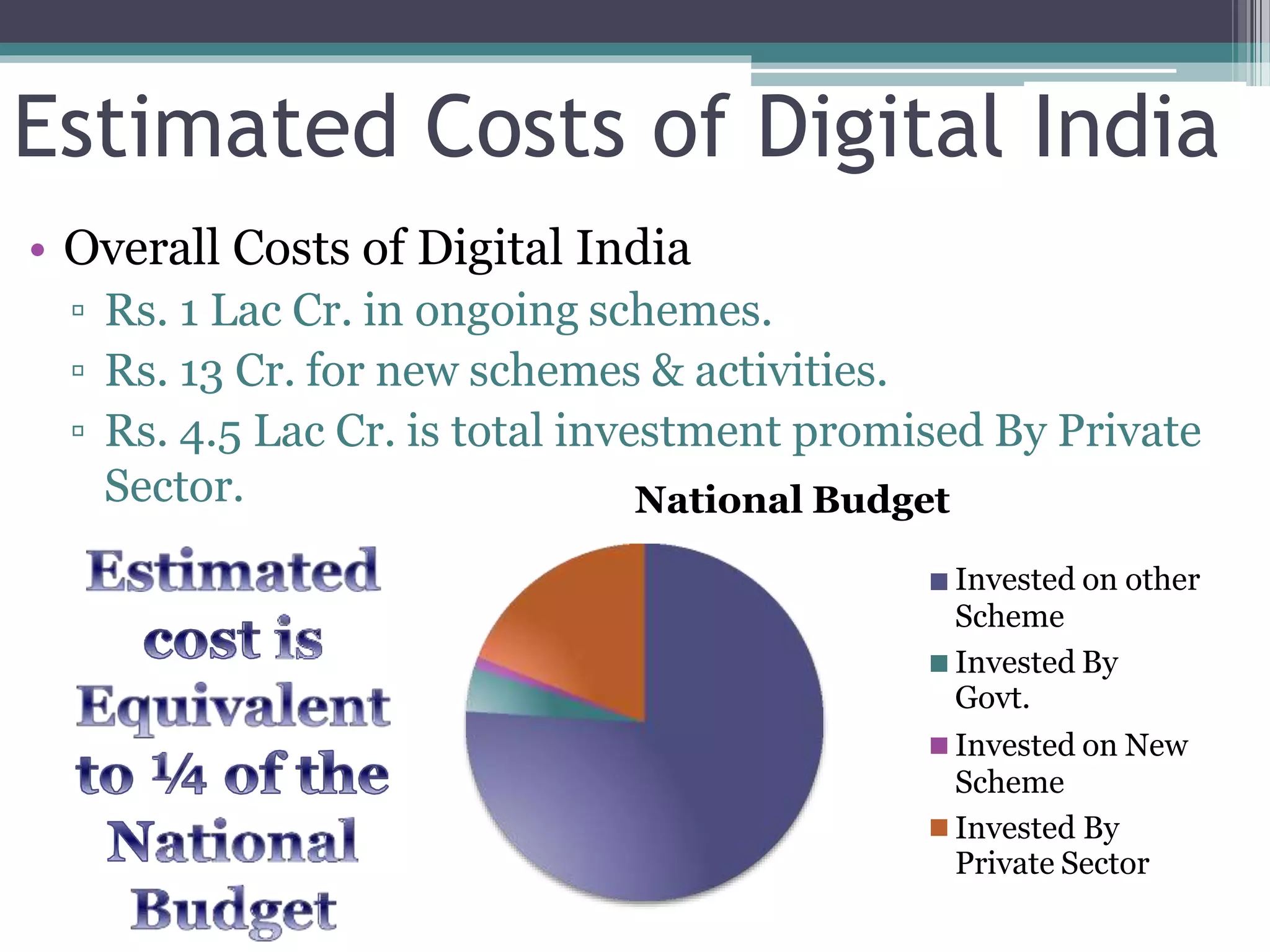
• Overall Costs of Digital India
▫ Rs. 1 Lac Cr. in ongoing schemes.
▫ Rs. 13 Cr. for new schemes & activities.
▫ Rs. 4.5 Lac Cr. is total investment promised By Private
Sector. National Budget
Invested on other
Scheme
Invested By
Govt.
Invested on New
Scheme
Invested By
Private Sector
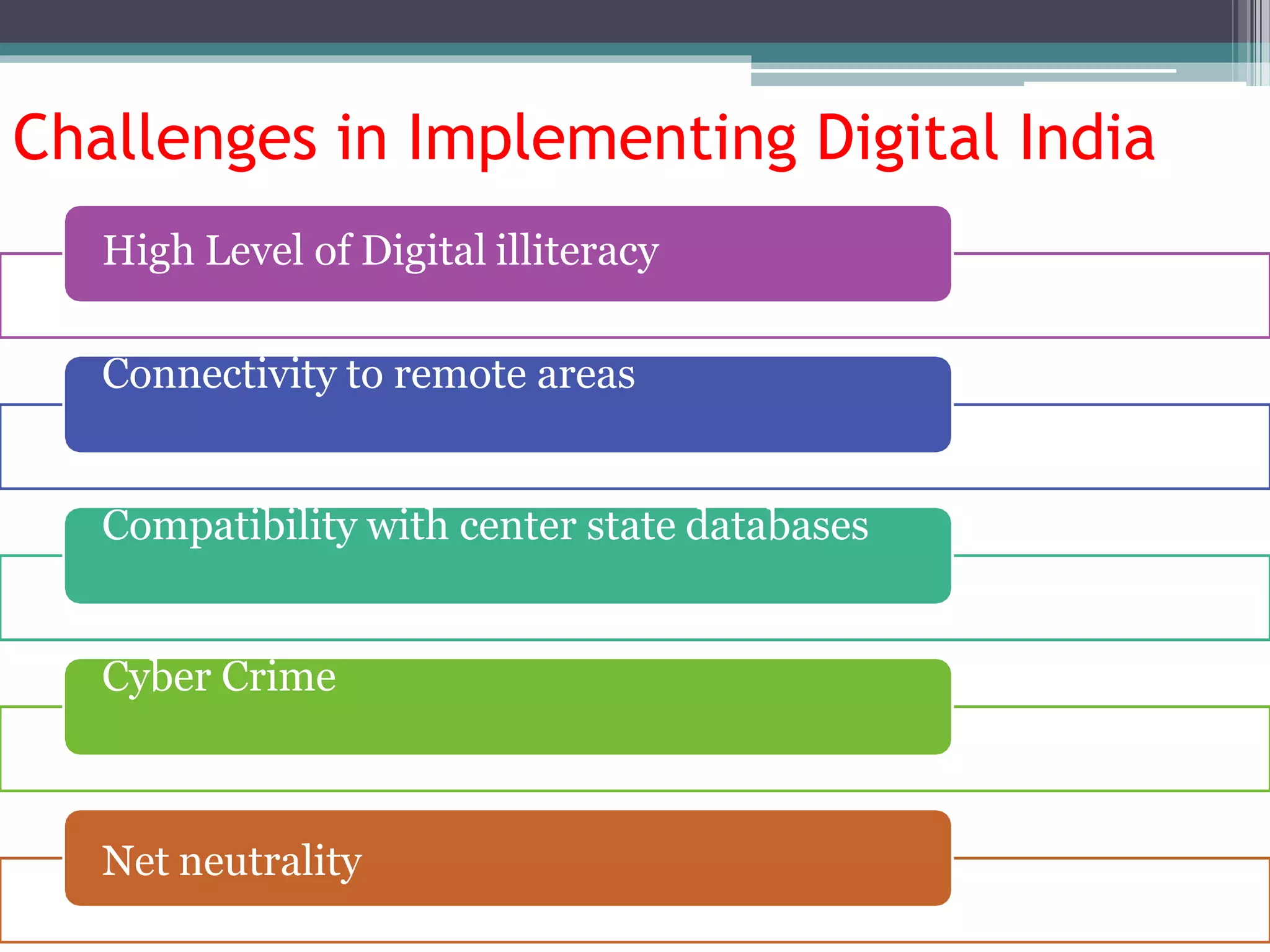
Challenges in Implementing Digital India
High Level of Digital illiteracy
Connectivity to remote areas
Compatibility with center state databases
Cyber Crime
Net neutrality
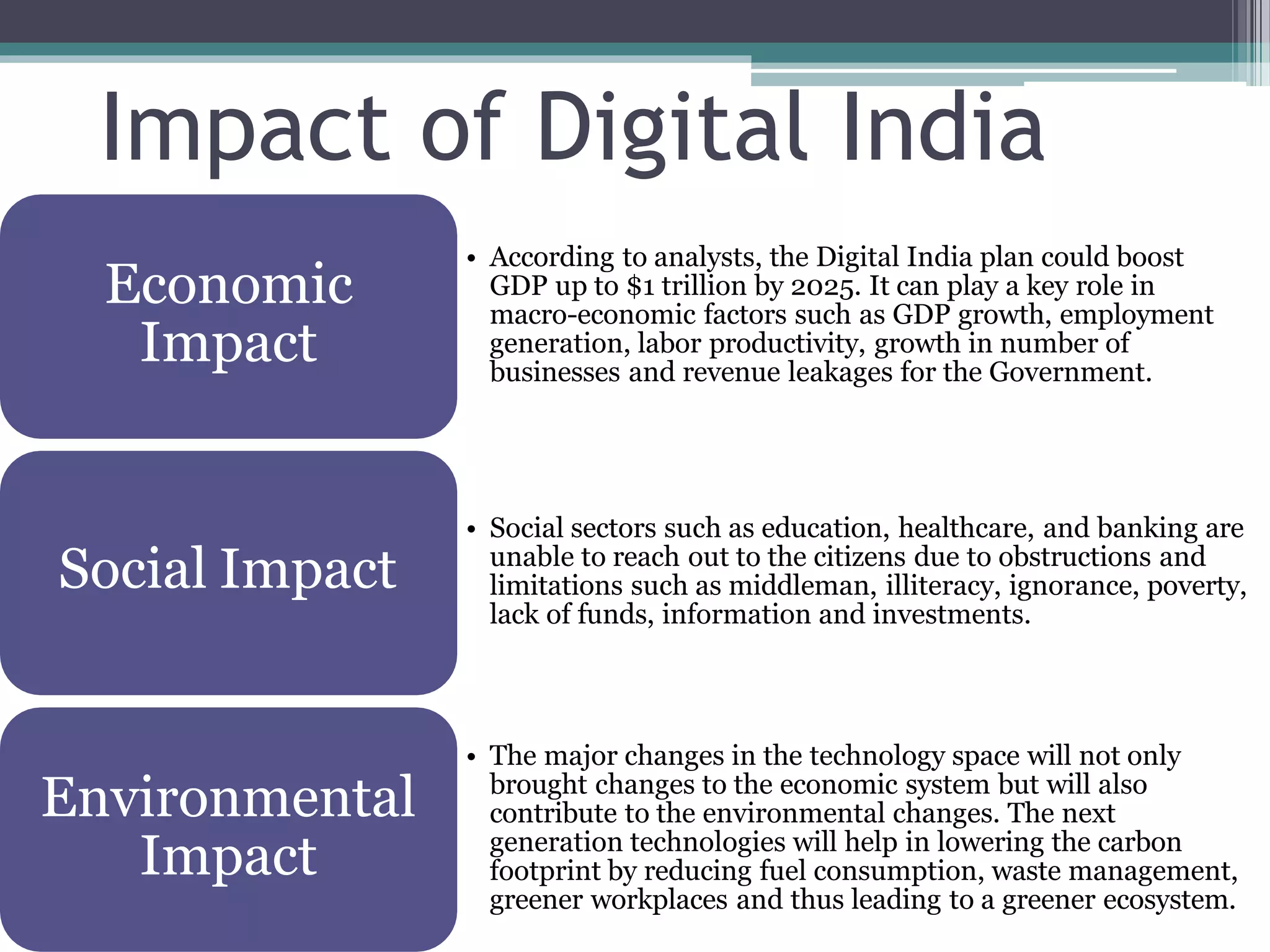
Impact of Digital India
• According to analysts, the Digital India plan could boost
GDP up to $1 trillion by 2025. It can play a key role in
macro-economic factors such as GDP growth, employment
generation, labor productivity, growth in number of
businesses and revenue leakages for the Government.
Economic
Impact
• Social sectors such as education, healthcare, and banking are
unable to reach out to the citizens due to obstructions and
limitations such as middleman, illiteracy, ignorance, poverty,
lack of funds, information and investments.
Social Impact
• The major changes in the technology space will not only
brought changes to the economic system but will also
contribute to the environmental changes. The next
generation technologies will help in lowering the carbon
footprint by reducing fuel consumption, waste management,
greener workplaces and thus leading to a greener ecosystem.
Environmental
Impact
Conclusion
The vision of digital india is grand. It is a huge step
towards building a truly empowered nation. If
successful, it transform citizen access to multimedia
information ,content and services. However the goal is
still far away since most of the nine pillars of digital
india mission are facing serious challenges in
implementation. It is imperative that focused
persistent attention must be given to each and every
pillar so that this programme does not end up in
failure. In fact we all should be mentally prepared for
the change and be ready to face the challenges in
implementing this policy, only then it would be
possible to make this vision a reality..
THANK YOU

ajay.pptx

  • 4.
    Nine Pillars Broadband Highway • Thiscovers three sub components, namely Broadband for All Rural, Broadband for All Urban and National Information Infrastructure • Under Broadband for All Rural, 250 thousand village Panchayats would be covered by December, 2016. DoT will be the Nodal Department and the project cost is estimated to be approximately Rs. 32,000 Cr. Connectivity • The initiative is to focus on network penetration and fill the gaps in connectivity in the country. Universal Access • All together 42,300 uncovered villages will be covered for providing to Mobile universal mobile connectivity in the country. Public Interest Access Programme • The two sub components of Public Internet Access Programme are Common Service Centre and Post Offices as multi-service centre. • Common Service Centre would be strengthened and its number would be increased from approximately 135,000 operational at present to 250,000 i.e. one CSC in each Gram Panchayat. CSCs would be made viable, multi- functional end-points for delivery of government and business services. DeitY would be the nodal department to implement the scheme.
  • 5.
    Nine Pillars (Contd..) Informationfor all • Open Data platform and online hosting of information & documents would facilitate open and easy access to information for citizens. • Government shall pro-actively engage through social media and web based platforms to inform citizens. MyGov.in has already been launched as a medium to exchange ideas/ suggestions with Government. It will facilitate 2-way communication between citizens and government. E-Governance Reforming government through Technology • Form simplification and field reduction – Forms should be made simple and user friendly and only minimum and necessary information should be collected. • Online applications, tracking of their status and interface between departments should be provided. E-kranti - Electronic delivery of services • There are 31 Mission Mode Projects under different stages of e-governance project lifecycle. Further, 10 new MMPs have been added to e-Kranti by the Apex Committee on National e-Governance Plan headed by the Cabinet Secretary in its meeting held on 18th March 2014. • All Schools will be connected with broadband. Free wifi will be provided in all secondary and higher secondary schools.
  • 6.
    Nine Pillars (Contd..) ITfor Jobs • The government is planning to teaching one crore learners from small towns and village for IT industry. Plans are also to exercise 300,000 assistance distribution providers in 2 years to run practical companies offering IT services and telecoms companies to train 500,000 rural workers in 5 years. Early Harvest Programmes • The govt is planning to set up Aadhaar Allowed Fingerprint Presence Program in all central government workplaces situated at Delhi. A web based application software system will allow online documenting of attendance and its watching by the involved stakeholders. Electronics • Concentrate is on set tob containers, VSAT, mobile,consumer electronics, technology, medical electronic devices, intelligent energy metres, Smart cards and micro ATMs. For this the government is co-ordinating on many front be it taxes, rewards, financial systems of range and offering cost benefits to local Manufacturing producers.
  • 7.
    Estimated Costs ofDigital India • Overall Costs of Digital India ▫ Rs. 1 Lac Cr. in ongoing schemes. ▫ Rs. 13 Cr. for new schemes & activities. ▫ Rs. 4.5 Lac Cr. is total investment promised By Private Sector. National Budget Invested on other Scheme Invested By Govt. Invested on New Scheme Invested By Private Sector
  • 8.
    Challenges in ImplementingDigital India High Level of Digital illiteracy Connectivity to remote areas Compatibility with center state databases Cyber Crime Net neutrality
  • 9.
    Impact of DigitalIndia • According to analysts, the Digital India plan could boost GDP up to $1 trillion by 2025. It can play a key role in macro-economic factors such as GDP growth, employment generation, labor productivity, growth in number of businesses and revenue leakages for the Government. Economic Impact • Social sectors such as education, healthcare, and banking are unable to reach out to the citizens due to obstructions and limitations such as middleman, illiteracy, ignorance, poverty, lack of funds, information and investments. Social Impact • The major changes in the technology space will not only brought changes to the economic system but will also contribute to the environmental changes. The next generation technologies will help in lowering the carbon footprint by reducing fuel consumption, waste management, greener workplaces and thus leading to a greener ecosystem. Environmental Impact
  • 10.
    Conclusion The vision ofdigital india is grand. It is a huge step towards building a truly empowered nation. If successful, it transform citizen access to multimedia information ,content and services. However the goal is still far away since most of the nine pillars of digital india mission are facing serious challenges in implementation. It is imperative that focused persistent attention must be given to each and every pillar so that this programme does not end up in failure. In fact we all should be mentally prepared for the change and be ready to face the challenges in implementing this policy, only then it would be possible to make this vision a reality..
  • 11.