   This video is presented by USEP's BSCS student Rex
    Louie Pilongo under Mr. ND Arquillano as a partial
    fulfillment for Elective 4 -E-Commerce      It talks
    about:

       Introduction to e-business and e-commerce
       E-commerce Fundamentals
       E-business Infrastructure
       E-environment
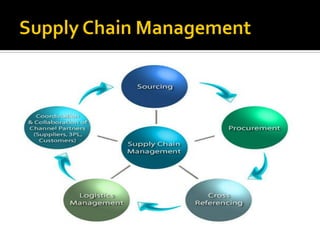
       Supply Chain Management
       E-marketing
       Customer relationship Management
       Change Management
       Analysis and Design: M-commerce
       Management of Mobile commerce services
 It is buying and selling products through the
  use of internet.
 It should be electronically mediated financial
  transactions between organizations and
  customers.
   Fundamentals of e-commerce
     The most important thing online is the user
      experience.
      ▪ It can be argued that everything else is secondary.
     Solid ‘on-site search’ functionality is vital.
      ▪ You need good-quality metadata to make it work properly.
     Well-defined information architectureand intuitive
      navigation is essential.
      ▪ Studies have shown that most people are ‘cognitive misers’.
        In plain English: people don’t like to think. Keep this in mind
        when wireframing your site.
 Clearly label categories and pages.
 Trust and credibility need to be reinforced,
  particularly in key purchase areas, and
  especially for new or unknown brands.
 Prioritize the key information users look for
  during the purchase decision-making process.
 Minimize distractions – keep the user focused
  on the purchase or conversion goal.
 Service the pre-purchase consumer
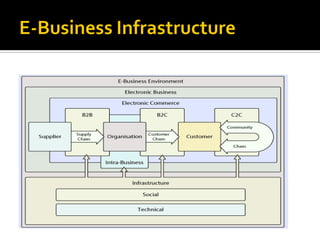
   E-business infrastructure is the architechture
    of hardware, software, content and data
    used    to deliver e-business services to
    employees, custom.ers and partners
   Risk Factors in an E-Commerce Environment
     Risk
      ▪ The overarching risk to any business doing online
        transactions is not having an overall E-commerce
        strategy, especially when it comes to the compliance
        requirements of which a merchant may or may not fully
        understand or even be aware.
     Availability
      ▪ lack of which is a big risk to an E-commerce
 Performance
  ▪ . Performance should be considered throughout the
    entire E-commerce environment—from network
    throughput to disk I/O and even memory or CPU
    utilization—as the single weakest link can cause the
    entire environment to respond poorly.
 Scalability
  ▪ Scalability for an E-commerce site or environment
    could mean different things to different merchants.
 Security
  ▪ Security is perhaps the broadest topic when it comes
    to an E-commerce site.
   E-commerce marketing is all about enticing
    web surfers to your site and, once there, to
    entice them into becoming a customer. While
    overall similar to marketing a physical
    business, e-commerce marketing has some
    unique ingredients.
   We divide web site marketing into three
    primary divisions:
     Enticing visitors (non-customers) to come to the
      site
     Converting visitors (non-customers) into
      customers
     Site Effectiveness
   The benefits of E-Marketing include:
     Speed
     Ease and Efficiency
     Low Cost
     Targeted
   Customer relationship management (CRM)
    is a widely implemented model for managing
    a company’s interactions with customers,
    clients, and sales prospects. It involves using
    technology to organize, automate, and
    synchronize business processes—principally
    sales     activities,   but      also     those
    for        marketing,    customer       service,
    and technical support..
   Benefits of Customer Relationship
    Management
     Quality and efficiency
     Decrease in overall costs
     Increase Profitability
   It is an approach to shifting individuals, teams
    and organizations from current state to a
    desired future state.
 Imagine for a moment that you owned a small
  corner store. As a conventional retailer, your
  potential market would extend to your
  immediate geographic region.
 Now imagine some          technology became
  available that would open up your reach to a
  much larger audience.
 The mobile industry today is rapidly growing
  because of its design , functionality and its
  services to the consumer.
 Content development and distribution to
  hand-held devices, content caching, pricing
  of mobile commerce services.
 The emerging issues in mobile commerce :
  The role of emerging wireless LANs and
  3G/4G wireless networks, personalized
  content    management,      implementation
  challenges in m-commerce, futuristic m-
  commerce services

E commerce(elective4 rex)

  • 2.
    This video is presented by USEP's BSCS student Rex Louie Pilongo under Mr. ND Arquillano as a partial fulfillment for Elective 4 -E-Commerce It talks about:  Introduction to e-business and e-commerce  E-commerce Fundamentals  E-business Infrastructure  E-environment  Supply Chain Management  E-marketing  Customer relationship Management  Change Management  Analysis and Design: M-commerce  Management of Mobile commerce services
  • 3.
     It isbuying and selling products through the use of internet.  It should be electronically mediated financial transactions between organizations and customers.
  • 4.
    Fundamentals of e-commerce  The most important thing online is the user experience. ▪ It can be argued that everything else is secondary.  Solid ‘on-site search’ functionality is vital. ▪ You need good-quality metadata to make it work properly.  Well-defined information architectureand intuitive navigation is essential. ▪ Studies have shown that most people are ‘cognitive misers’. In plain English: people don’t like to think. Keep this in mind when wireframing your site.
  • 5.
     Clearly labelcategories and pages.  Trust and credibility need to be reinforced, particularly in key purchase areas, and especially for new or unknown brands.  Prioritize the key information users look for during the purchase decision-making process.  Minimize distractions – keep the user focused on the purchase or conversion goal.  Service the pre-purchase consumer
  • 6.
    E-business infrastructure is the architechture of hardware, software, content and data used to deliver e-business services to employees, custom.ers and partners
  • 8.
    Risk Factors in an E-Commerce Environment  Risk ▪ The overarching risk to any business doing online transactions is not having an overall E-commerce strategy, especially when it comes to the compliance requirements of which a merchant may or may not fully understand or even be aware.  Availability ▪ lack of which is a big risk to an E-commerce
  • 9.
     Performance ▪ . Performance should be considered throughout the entire E-commerce environment—from network throughput to disk I/O and even memory or CPU utilization—as the single weakest link can cause the entire environment to respond poorly.  Scalability ▪ Scalability for an E-commerce site or environment could mean different things to different merchants.  Security ▪ Security is perhaps the broadest topic when it comes to an E-commerce site.
  • 11.
    E-commerce marketing is all about enticing web surfers to your site and, once there, to entice them into becoming a customer. While overall similar to marketing a physical business, e-commerce marketing has some unique ingredients.
  • 12.
    We divide web site marketing into three primary divisions:  Enticing visitors (non-customers) to come to the site  Converting visitors (non-customers) into customers  Site Effectiveness
  • 13.
    The benefits of E-Marketing include:  Speed  Ease and Efficiency  Low Cost  Targeted
  • 14.
    Customer relationship management (CRM) is a widely implemented model for managing a company’s interactions with customers, clients, and sales prospects. It involves using technology to organize, automate, and synchronize business processes—principally sales activities, but also those for marketing, customer service, and technical support..
  • 15.
    Benefits of Customer Relationship Management  Quality and efficiency  Decrease in overall costs  Increase Profitability
  • 16.
    It is an approach to shifting individuals, teams and organizations from current state to a desired future state.
  • 17.
     Imagine fora moment that you owned a small corner store. As a conventional retailer, your potential market would extend to your immediate geographic region.  Now imagine some technology became available that would open up your reach to a much larger audience.  The mobile industry today is rapidly growing because of its design , functionality and its services to the consumer.
  • 18.
     Content developmentand distribution to hand-held devices, content caching, pricing of mobile commerce services.  The emerging issues in mobile commerce : The role of emerging wireless LANs and 3G/4G wireless networks, personalized content management, implementation challenges in m-commerce, futuristic m- commerce services