
E-Comerce
By:
Viktor Immanuel Calonia
BSCS-4
Introduction to E-Business and E-
commerce
• Business transactions take place via telecommunications
  networks, especially the Internet.
• Buying and selling of products, services, and information via
  computer networks including the Internet.
• Doing business electronically.
• An electronically mediated financial transactions between
  organizations and customers.
E-commerce Fundamentals
• user experience.
• Solid ‘on-site search’ functionality is vital.
• Well-defined information architectureand intuitive navigation
  is essential.
• Clearly label categories and pages.
• Trust and credibility need to be reinforced, particularly in key
  purchase areas, and especially for new or unknown brands.
E-commerce Fundamentals
• Prioritise the key information users look for during the
  purchase decision-making process.
• Minimise distractions – keep the user focused on the purchase
  or conversion goal.
• Good copy.
• Images.
• Service the pre-purchase consumer
E-commerce Fundamentals
• No alarms and no surprises.
• Highly visible support options.
E-Business Infrastructure
• Architecture of hardware, software, content and data used to
  deliver e-business services to employees, custom.ers and
  partners.
• Vital to all companies adopting e-business as it affects directly
  the quality of service experience by users.
E- Environment
• Risk
  • The overarching risk to any business doing online transactions is
    not having an overall E-commerce strategy, especially when it
    comes to the compliance requirements of which a merchant may
    or may not fully understand or even be aware.
• Availability
      • lack of which is a big risk to an E-commerce
E- Environment
• Performance
      • . Performance should be considered throughout the entire E-
        commerce environment—from network throughput to disk I/O and
        even memory or CPU utilization—as the single weakest link can
        cause the entire environment to respond poorly.
• Scalability
      • Scalability for an E-commerce site or environment could mean
        different things to different merchants.
• Security
      • Security is perhaps the broadest topic when it comes to an E-
        commerce site.
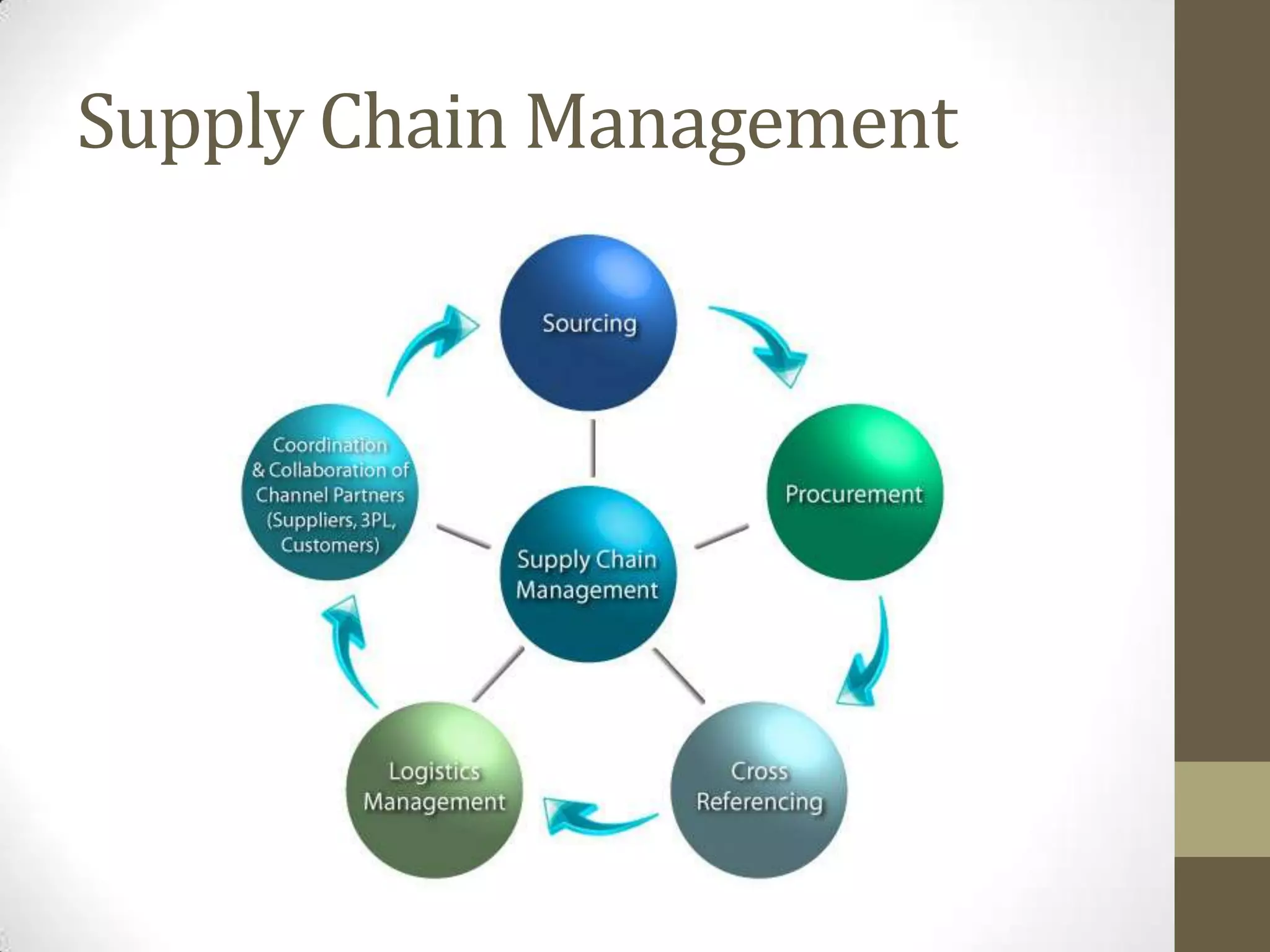
Supply Chain Management
E- Marketing
• Provides businesses and advertisers with an easily customized,
  efficient form of marketing to complement existing advertising
  strategies and close in on the elusive and profitable interactive
  market.
E- Marketing Priorities
• We divide web site marketing into three primary divisions:
  • Enticing visitors (non-customers) to come to the site
  • Converting visitors (non-customers) into customers
  • Site Effectiveness
E- Marketing Priorities
 • The benefits of E-Marketing include:
    •   Speed
    •   Ease and Efficiency
    •   Low Cost
    •   Targeted
    • Quality and efficiency
    • Decrease in overall costs
    • Increase Profitability
Customer Relationship
Management
• company-wide business strategy designed to reduce costs and
  increase profitability by solidifying customer satisfaction,
  loyalty, and advocacy.
• brings together information from all data sources within an
  organization.
Change Management
• Approach to shifting/transitioning individuals, teams, and
  organizations from a current state to a desired future state.
• Organizational process aimed at helping change stakeholders.
Analysis and Design:
M-commerce
• creating entirely new opportunities both for mobile devices
  and services.
• transactions using a wireless device and data connection
• The mobile industry today is rapidly growing because of
  its design , functionality and its services to the consumer.
Management of Mobile
commerce Services
• Content development and distribution to hand-held devices,
  content caching, pricing of mobile commerce services.
• The role of emerging wireless LANs and 3G/4G wireless
  networks, personalized content management, implementation
  challenges in m-commerce, futuristic m-commerce services.
• The emerging issues in mobile commerce is the emerging wireless
  LANs and 3G/4G wireless networks, personalized content
  management, implementation challenges in m-commerce, futuristic
  m-commerce services

E comerce calonia

  • 1.
  • 2.
    Introduction to E-Businessand E- commerce • Business transactions take place via telecommunications networks, especially the Internet. • Buying and selling of products, services, and information via computer networks including the Internet. • Doing business electronically. • An electronically mediated financial transactions between organizations and customers.
  • 3.
    E-commerce Fundamentals • userexperience. • Solid ‘on-site search’ functionality is vital. • Well-defined information architectureand intuitive navigation is essential. • Clearly label categories and pages. • Trust and credibility need to be reinforced, particularly in key purchase areas, and especially for new or unknown brands.
  • 4.
    E-commerce Fundamentals • Prioritisethe key information users look for during the purchase decision-making process. • Minimise distractions – keep the user focused on the purchase or conversion goal. • Good copy. • Images. • Service the pre-purchase consumer
  • 5.
    E-commerce Fundamentals • Noalarms and no surprises. • Highly visible support options.
  • 6.
    E-Business Infrastructure • Architectureof hardware, software, content and data used to deliver e-business services to employees, custom.ers and partners. • Vital to all companies adopting e-business as it affects directly the quality of service experience by users.
  • 7.
    E- Environment • Risk • The overarching risk to any business doing online transactions is not having an overall E-commerce strategy, especially when it comes to the compliance requirements of which a merchant may or may not fully understand or even be aware. • Availability • lack of which is a big risk to an E-commerce
  • 8.
    E- Environment • Performance • . Performance should be considered throughout the entire E- commerce environment—from network throughput to disk I/O and even memory or CPU utilization—as the single weakest link can cause the entire environment to respond poorly. • Scalability • Scalability for an E-commerce site or environment could mean different things to different merchants. • Security • Security is perhaps the broadest topic when it comes to an E- commerce site.
  • 9.
  • 10.
    E- Marketing • Providesbusinesses and advertisers with an easily customized, efficient form of marketing to complement existing advertising strategies and close in on the elusive and profitable interactive market.
  • 11.
    E- Marketing Priorities •We divide web site marketing into three primary divisions: • Enticing visitors (non-customers) to come to the site • Converting visitors (non-customers) into customers • Site Effectiveness
  • 12.
    E- Marketing Priorities • The benefits of E-Marketing include: • Speed • Ease and Efficiency • Low Cost • Targeted • Quality and efficiency • Decrease in overall costs • Increase Profitability
  • 13.
    Customer Relationship Management • company-widebusiness strategy designed to reduce costs and increase profitability by solidifying customer satisfaction, loyalty, and advocacy. • brings together information from all data sources within an organization.
  • 14.
    Change Management • Approachto shifting/transitioning individuals, teams, and organizations from a current state to a desired future state. • Organizational process aimed at helping change stakeholders.
  • 15.
    Analysis and Design: M-commerce •creating entirely new opportunities both for mobile devices and services. • transactions using a wireless device and data connection • The mobile industry today is rapidly growing because of its design , functionality and its services to the consumer.
  • 16.
    Management of Mobile commerceServices • Content development and distribution to hand-held devices, content caching, pricing of mobile commerce services. • The role of emerging wireless LANs and 3G/4G wireless networks, personalized content management, implementation challenges in m-commerce, futuristic m-commerce services. • The emerging issues in mobile commerce is the emerging wireless LANs and 3G/4G wireless networks, personalized content management, implementation challenges in m-commerce, futuristic m-commerce services