E-Business
E-Business Automation of business processes through electronic means. E-Business that includes a financial transaction is known as e-commerce. Benefits of e-business: Reduced costs Increased capability Improved communication Enhanced control Improved customer service Source of competitive advantage
E-business has been defined by IBM as ‘the transformation of key business processes through the use of internet technologies Includes:  On-line marketing and sales Supply chain Channel management Manufacturing and inventory control Financial operations Employee workflow procedures
E-business technologies empower: Employees Customers Suppliers Distributors Vendors partners
E-Commerce Electronic ordering Online ordering, payment and deliver services EFT Electronic share trading Commercial auctions Direct consumer marketing and after sales service
Benefits of E-Business Cost reduction – increased revenues Capability Communication Control and channel efficiency Visibility Customer service Competitive advantage
Barriers to E-Business E-business not relevant to some people Skills and expertise to use the internet Customers do not use e-business Country factor conditions Economic issues Culture Organizational type
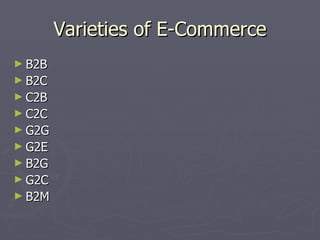
Varieties of E-Commerce B2B B2C C2B C2C G2G G2E B2G G2C B2M
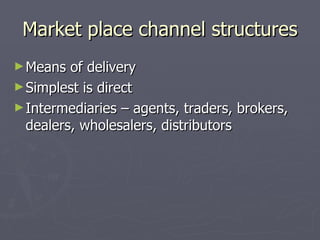
Market place channel structures Means of delivery Simplest is direct Intermediaries – agents, traders, brokers, dealers, wholesalers, distributors
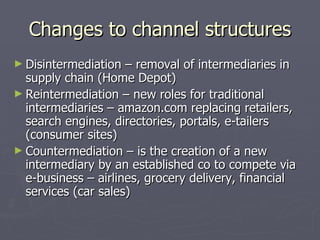
Changes to channel structures Disintermediation – removal of intermediaries in supply chain (Home Depot) Reintermediation – new roles for traditional intermediaries – amazon.com replacing retailers, search engines, directories, portals, e-tailers (consumer sites) Countermediation – is the creation of a new intermediary by an established co to compete via e-business – airlines, grocery delivery, financial services (car sales)
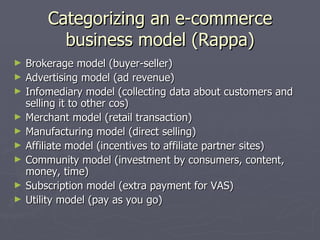
Categorizing an e-commerce business model (Rappa) Brokerage model (buyer-seller) Advertising model (ad revenue) Infomediary model (collecting data about customers and selling it to other cos) Merchant model (retail transaction) Manufacturing model (direct selling) Affiliate model (incentives to affiliate partner sites) Community model (investment by consumers, content, money, time) Subscription model (extra payment for VAS) Utility model (pay as you go)
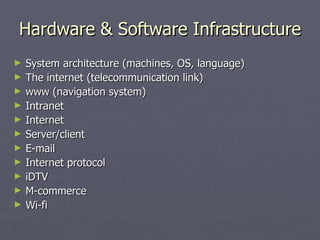
Hardware & Software Infrastructure System architecture (machines, OS, language) The internet (telecommunication link) www (navigation system) Intranet Internet Server/client E-mail Internet protocol iDTV M-commerce Wi-fi
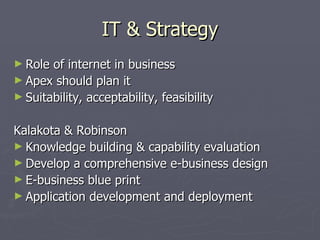
IT & Strategy Role of internet in business Apex should plan it Suitability, acceptability, feasibility  Kalakota & Robinson Knowledge building & capability evaluation Develop a comprehensive e-business design E-business blue print Application development and deployment
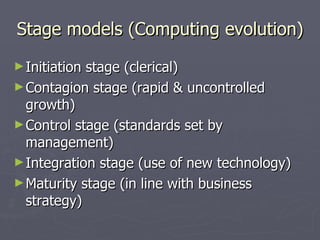
Stage models (Computing evolution) Initiation stage (clerical) Contagion stage (rapid & uncontrolled growth) Control stage (standards set by management) Integration stage (use of new technology) Maturity stage (in line with business strategy)
Supply Chain Management A supply chain encompasses all activities and information flows necessary for the transformation of goods from the origin of the raw material to when the product is finally consumed or discarded.
Push n Pull Models Push model – organization produces goods according to schedules on historical sales patterns Slow response, overstocking, bottlenecks, delays, unacceptable service levels, product obsolescence Pull model – where production and distribution are demand driven Reduced product obsolescence, higher service levels, reduced bull whip effect, use of electronic connections
Use of IS Value chain Value network To achieve Efficiency – profitability, capacity use, yield gain Effectiveness – allocation of resources

E business

  • 1.
  • 2.
    E-Business Automation ofbusiness processes through electronic means. E-Business that includes a financial transaction is known as e-commerce. Benefits of e-business: Reduced costs Increased capability Improved communication Enhanced control Improved customer service Source of competitive advantage
  • 3.
    E-business has beendefined by IBM as ‘the transformation of key business processes through the use of internet technologies Includes: On-line marketing and sales Supply chain Channel management Manufacturing and inventory control Financial operations Employee workflow procedures
  • 4.
    E-business technologies empower:Employees Customers Suppliers Distributors Vendors partners
  • 5.
    E-Commerce Electronic orderingOnline ordering, payment and deliver services EFT Electronic share trading Commercial auctions Direct consumer marketing and after sales service
  • 6.
    Benefits of E-BusinessCost reduction – increased revenues Capability Communication Control and channel efficiency Visibility Customer service Competitive advantage
  • 7.
    Barriers to E-BusinessE-business not relevant to some people Skills and expertise to use the internet Customers do not use e-business Country factor conditions Economic issues Culture Organizational type
  • 8.
    Varieties of E-CommerceB2B B2C C2B C2C G2G G2E B2G G2C B2M
  • 9.
    Market place channelstructures Means of delivery Simplest is direct Intermediaries – agents, traders, brokers, dealers, wholesalers, distributors
  • 10.
    Changes to channelstructures Disintermediation – removal of intermediaries in supply chain (Home Depot) Reintermediation – new roles for traditional intermediaries – amazon.com replacing retailers, search engines, directories, portals, e-tailers (consumer sites) Countermediation – is the creation of a new intermediary by an established co to compete via e-business – airlines, grocery delivery, financial services (car sales)
  • 11.
    Categorizing an e-commercebusiness model (Rappa) Brokerage model (buyer-seller) Advertising model (ad revenue) Infomediary model (collecting data about customers and selling it to other cos) Merchant model (retail transaction) Manufacturing model (direct selling) Affiliate model (incentives to affiliate partner sites) Community model (investment by consumers, content, money, time) Subscription model (extra payment for VAS) Utility model (pay as you go)
  • 12.
    Hardware & SoftwareInfrastructure System architecture (machines, OS, language) The internet (telecommunication link) www (navigation system) Intranet Internet Server/client E-mail Internet protocol iDTV M-commerce Wi-fi
  • 13.
    IT & StrategyRole of internet in business Apex should plan it Suitability, acceptability, feasibility Kalakota & Robinson Knowledge building & capability evaluation Develop a comprehensive e-business design E-business blue print Application development and deployment
  • 14.
    Stage models (Computingevolution) Initiation stage (clerical) Contagion stage (rapid & uncontrolled growth) Control stage (standards set by management) Integration stage (use of new technology) Maturity stage (in line with business strategy)
  • 15.
    Supply Chain ManagementA supply chain encompasses all activities and information flows necessary for the transformation of goods from the origin of the raw material to when the product is finally consumed or discarded.
  • 16.
    Push n PullModels Push model – organization produces goods according to schedules on historical sales patterns Slow response, overstocking, bottlenecks, delays, unacceptable service levels, product obsolescence Pull model – where production and distribution are demand driven Reduced product obsolescence, higher service levels, reduced bull whip effect, use of electronic connections
  • 17.
    Use of ISValue chain Value network To achieve Efficiency – profitability, capacity use, yield gain Effectiveness – allocation of resources