Approach to diagnosis of
Malformed Infant & Child
Mohammad Al-Haggar, MD.
Professor of Genetics
Dysmorphology vs. IEM.
• Abnormal structure ±
abnormal function 
minor vs. major
dysmorphism
• Normal structure but
with abnormal
function  IEMs
(enzymopathy).
Structure vs. Function
M. Al-Haggar, MD.
History
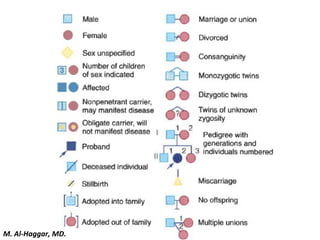
• Pedigree  inheritance, RR.
• Parental age  maternal, paternal
• Consanguinity.
• Abortion and still birth.
• Age of presentation and course.
M. Al-Haggar, MD.
Nomenclature
• Congenital vs Developmental / Genetic.
• Single vs multiple  Major vs minor.
• Sequence vs Syndrome.
• Deformity.
• Malformation.
• Disruption.
• Dysplasia.
M. Al-Haggar, MD.
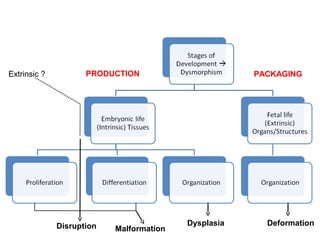
DeformationDysplasia
PACKAGINGPRODUCTION
Disruption Malformation
Extrinsic ?
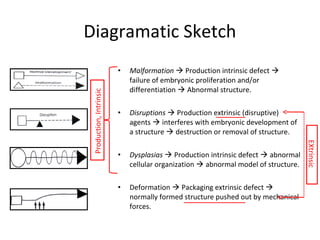
Diagramatic Sketch
• Malformation  Production intrinsic defect 
failure of embryonic proliferation and/or
differentiation  Abnormal structure.
• Disruptions  Production extrinsic (disruptive)
agents  interferes with embryonic development of
a structure  destruction or removal of structure.
• Dysplasias  Production intrinsic defect  abnormal
cellular organization  abnormal model of structure.
• Deformation  Packaging extrinsic defect 
normally formed structure pushed out by mechanical
forces.
Production,Intrinsic
EXtrinsic
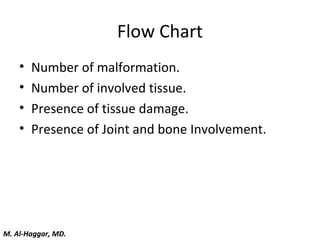
Flow Chart
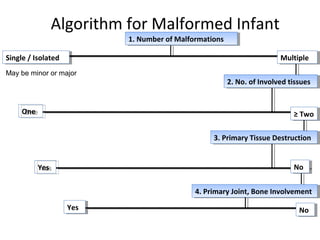
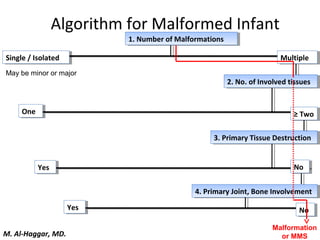
• Number of malformation.
• Number of involved tissue.
• Presence of tissue damage.
• Presence of Joint and bone Involvement.
M. Al-Haggar, MD.
Algorithm for Malformed Infant
1. Number of Malformations1. Number of Malformations
2. No. of Involved tissues2. No. of Involved tissues
3. Primary Tissue Destruction3. Primary Tissue Destruction
May be minor or major
Single / IsolatedSingle / Isolated MultipleMultiple
OneOne ≥ Two≥ Two
YesYes NoNo
4. Primary Joint, Bone Involvement4. Primary Joint, Bone Involvement
YesYes NoNo
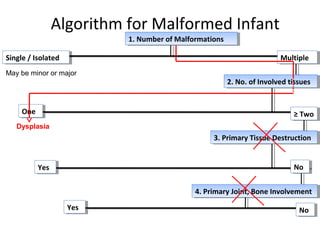
Dysplasia
M. Al-Haggar, MD.
Algorithm for Malformed Infant
1. Number of Malformations1. Number of Malformations
2. No. of Involved tissues2. No. of Involved tissues
3. Primary Tissue Destruction3. Primary Tissue Destruction
May be minor or major
Single / IsolatedSingle / Isolated MultipleMultiple
OneOne
Dysplasia
≥ Two≥ Two
YesYes NoNo
4. Primary Joint, Bone Involvement4. Primary Joint, Bone Involvement
YesYes NoNo
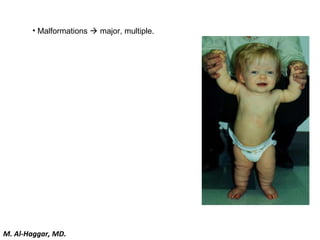
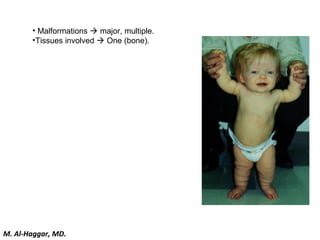
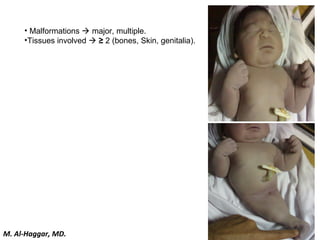
• Malformations  major, multiple.
M. Al-Haggar, MD.
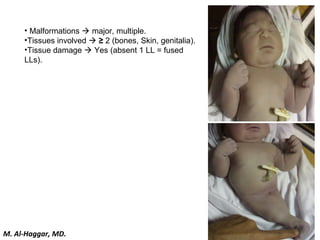
• Malformations  major, multiple.
•Tissues involved  One (bone).
M. Al-Haggar, MD.
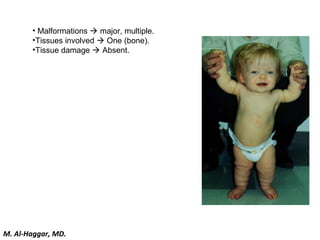
• Malformations  major, multiple.
•Tissues involved  One (bone).
•Tissue damage  Absent.
M. Al-Haggar, MD.
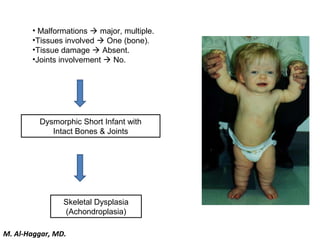
• Malformations  major, multiple.
•Tissues involved  One (bone).
•Tissue damage  Absent.
•Joints involvement  No.
Dysmorphic Short Infant with
Intact Bones & Joints
Skeletal Dysplasia
(Achondroplasia)
M. Al-Haggar, MD.
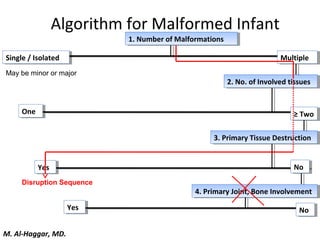
Disruption
M. Al-Haggar, MD.
Algorithm for Malformed Infant
1. Number of Malformations1. Number of Malformations
2. No. of Involved tissues2. No. of Involved tissues
3. Primary Tissue Destruction3. Primary Tissue Destruction
May be minor or major
Single / IsolatedSingle / Isolated MultipleMultiple
OneOne ≥ Two≥ Two
YesYes
Disruption Sequence
NoNo
4. Primary Joint, Bone Involvement4. Primary Joint, Bone Involvement
YesYes NoNo
M. Al-Haggar, MD.
M. Al-Haggar, MD.
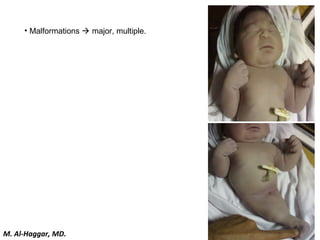
• Malformations  major, multiple.
M. Al-Haggar, MD.
• Malformations  major, multiple.
•Tissues involved  ≥ 2 (bones, Skin, genitalia).
M. Al-Haggar, MD.
• Malformations  major, multiple.
•Tissues involved  ≥ 2 (bones, Skin, genitalia).
•Tissue damage  Yes (absent 1 LL = fused
LLs).
M. Al-Haggar, MD.
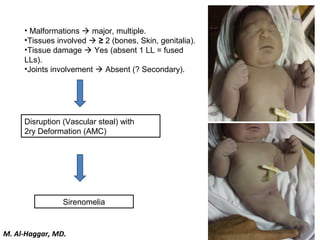
• Malformations  major, multiple.
•Tissues involved  ≥ 2 (bones, Skin, genitalia).
•Tissue damage  Yes (absent 1 LL = fused
LLs).
•Joints involvement  Absent (? Secondary).
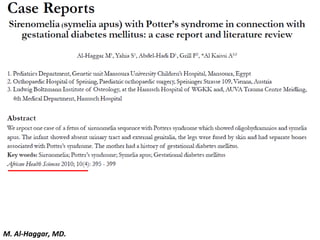
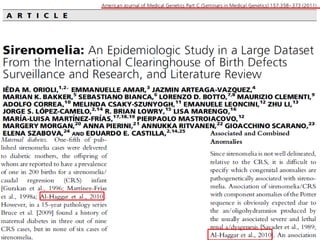
Disruption (Vascular steal) with
2ry Deformation (AMC)
Sirenomelia
M. Al-Haggar, MD.
Deformation
M. Al-Haggar, MD.
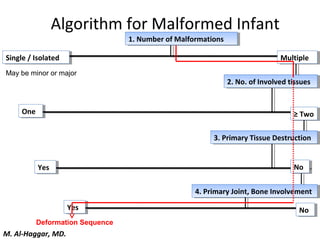
Algorithm for Malformed Infant
1. Number of Malformations1. Number of Malformations
2. No. of Involved tissues2. No. of Involved tissues
3. Primary Tissue Destruction3. Primary Tissue Destruction
May be minor or major
Single / IsolatedSingle / Isolated MultipleMultiple
OneOne ≥ Two≥ Two
YesYes
Deformation Sequence
NoNo
4. Primary Joint, Bone Involvement4. Primary Joint, Bone Involvement
YesYes NoNo
M. Al-Haggar, MD.
M. Al-Haggar, MD.
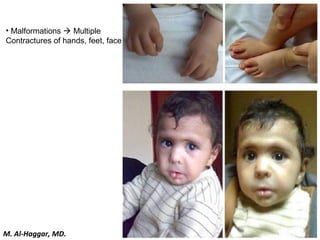
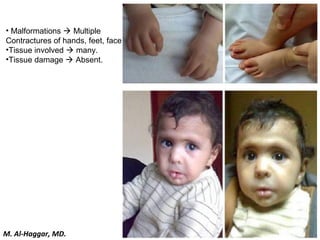
• Malformations  Multiple
Contractures of hands, feet, face
M. Al-Haggar, MD.
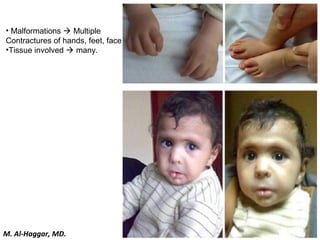
• Malformations  Multiple
Contractures of hands, feet, face
•Tissue involved  many.
M. Al-Haggar, MD.
• Malformations  Multiple
Contractures of hands, feet, face
•Tissue involved  many.
•Tissue damage  Absent.
M. Al-Haggar, MD.
• Malformations  Multiple
Contractures of hands, feet, face
•Tissue involved  many.
•Tissue damage  Absent.
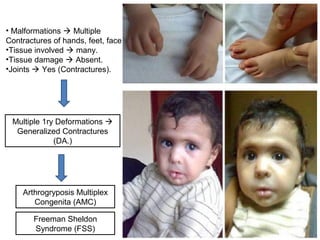
•Joints  Yes (Contractures).
Multiple 1ry Deformations 
Generalized Contractures
(DA.)
Arthrogryposis Multiplex
Congenita (AMC)
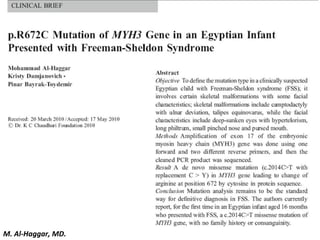
Freeman Sheldon
Syndrome (FSS)
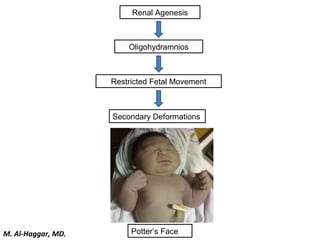
Secondary Deformations
Restricted Fetal Movement
Potter’s Face
Renal Agenesis
Oligohydramnios
M. Al-Haggar, MD.
Malformation Syndrome
M. Al-Haggar, MD.
Algorithm for Malformed Infant
1. Number of Malformations1. Number of Malformations
2. No. of Involved tissues2. No. of Involved tissues
3. Primary Tissue Destruction3. Primary Tissue Destruction
May be minor or major
Single / IsolatedSingle / Isolated MultipleMultiple
OneOne ≥ Two≥ Two
YesYes NoNo
4. Primary Joint, Bone Involvement4. Primary Joint, Bone Involvement
YesYes
Malformation
or MMS
NoNo
M. Al-Haggar, MD.
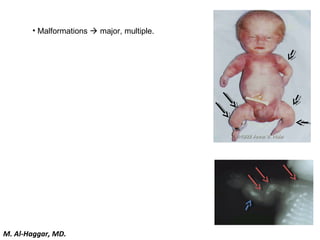
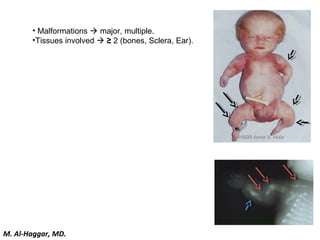
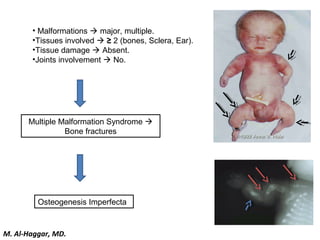
• Malformations  major, multiple.
M. Al-Haggar, MD.
• Malformations  major, multiple.
•Tissues involved  ≥ 2 (bones, Sclera, Ear).
M. Al-Haggar, MD.
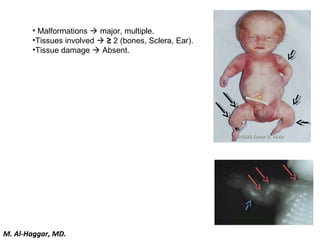
• Malformations  major, multiple.
•Tissues involved  ≥ 2 (bones, Sclera, Ear).
•Tissue damage  Absent.
M. Al-Haggar, MD.
• Malformations  major, multiple.
•Tissues involved  ≥ 2 (bones, Sclera, Ear).
•Tissue damage  Absent.
•Joints involvement  No.
Multiple Malformation Syndrome 
Bone fractures
Osteogenesis Imperfecta
M. Al-Haggar, MD.
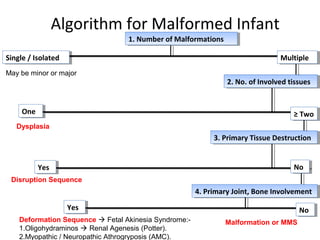
Algorithm for Malformed Infant
1. Number of Malformations1. Number of Malformations
2. No. of Involved tissues2. No. of Involved tissues
3. Primary Tissue Destruction3. Primary Tissue Destruction
May be minor or major
Single / IsolatedSingle / Isolated MultipleMultiple
OneOne
Dysplasia
≥ Two≥ Two
YesYes
Disruption Sequence
Deformation Sequence  Fetal Akinesia Syndrome:-
1.Oligohydraminos  Renal Agenesis (Potter).
2.Myopathic / Neuropathic Athrogryposis (AMC).
NoNo
4. Primary Joint, Bone Involvement4. Primary Joint, Bone Involvement
YesYes
Malformation or MMS
NoNo
Exercise
M. Al-Haggar, MD.
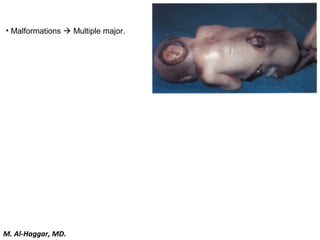
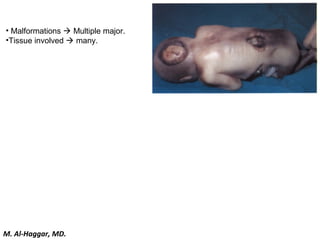
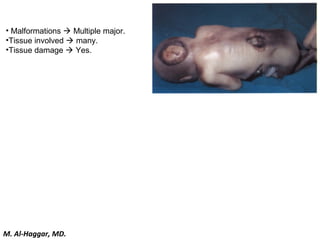
• Malformations  Multiple major.
M. Al-Haggar, MD.
• Malformations  Multiple major.
•Tissue involved  many.
M. Al-Haggar, MD.
• Malformations  Multiple major.
•Tissue involved  many.
•Tissue damage  Yes.
M. Al-Haggar, MD.
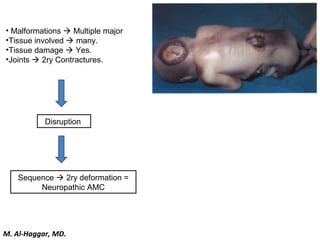
• Malformations  Multiple major
•Tissue involved  many.
•Tissue damage  Yes.
•Joints  2ry Contractures.
Disruption
Sequence  2ry deformation =
Neuropathic AMC
M. Al-Haggar, MD.
Multiple Malformation Syndrome
• Diagnostic dilemma….
1.Define.
2.Investigate.
3.Analyze.
4.Grub  scientific web.
5.Enquire  Consult.
6.Search  Publication, Citation.
M. Al-Haggar, MD.
Diagnosis
• Investigations  relevant.
• Differential diagnosis.
• Search engines.
• No place for bedside diagnosis.
M. Al-Haggar, MD.
Examination
• Systematic.
• Symmetry in bilateral organs  Goldenhar,
Silver Russel.
• Genitalia  Turner, Optiz.
• Psychomotor retardation  DS, FXS.
• Ear, Eye, Hands.
M. Al-Haggar, MD.
Dysmorphology Pearls
• Pursed up lips.
• Heterochromia iridis.
• Eversion of lateral third of lower eyelid.
• Webbing of the neck.
• Absent clavicles.
• Inverted nipples.
• Broad thumbs / great toes.
• Radial ray defects.
• Thrombocytopenia absent radius syndrome.
• Mitten hands.
• Hyper extensibility of skin and joints.
M. Al-Haggar, MD.
Dysmorphology
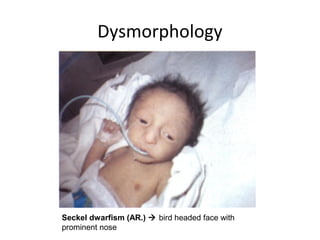
Seckel dwarfism (AR.)  bird headed face with
prominent nose
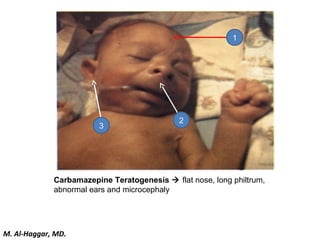
Carbamazepine Teratogenesis  flat nose, long philtrum,
abnormal ears and microcephaly
1
2
3
M. Al-Haggar, MD.
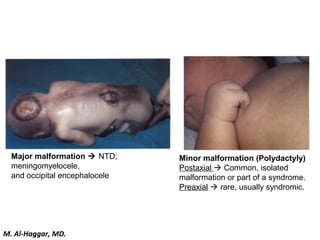
Major malformation  NTD;
meningomyelocele,
and occipital encephalocele
Minor malformation (Polydactyly)
Postaxial  Common, isolated
malformation or part of a syndrome.
Preaxial  rare, usually syndromic.
M. Al-Haggar, MD.
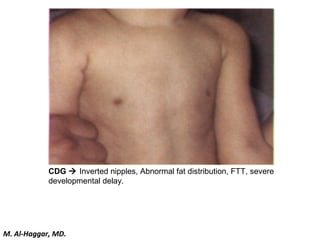
CDG  Inverted nipples, Abnormal fat distribution, FTT, severe
developmental delay.
M. Al-Haggar, MD.
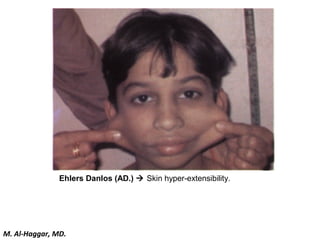
Ehlers Danlos (AD.)  Skin hyper-extensibility.
M. Al-Haggar, MD.
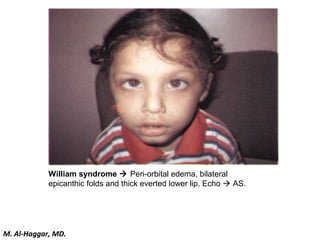
William syndrome  Peri-orbital edema, bilateral
epicanthic folds and thick everted lower lip, Echo  AS.
M. Al-Haggar, MD.
M. Al-Haggar, MD.
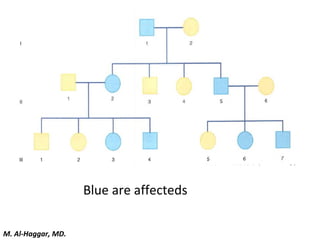
Blue are affecteds
M. Al-Haggar, MD.
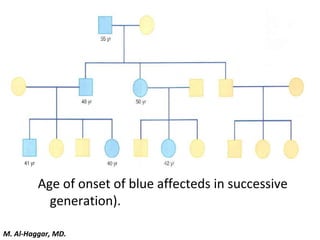
Age of onset of blue affecteds in successive
generation).
M. Al-Haggar, MD.
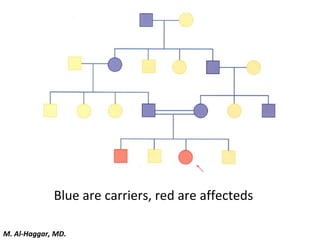
Blue are carriers, red are affecteds
M. Al-Haggar, MD.
M. Al-Haggar, MD.
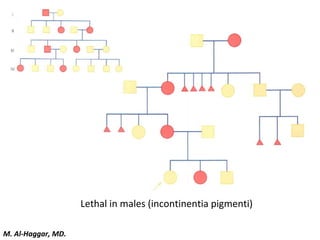
Lethal in males (incontinentia pigmenti)
M. Al-Haggar, MD.
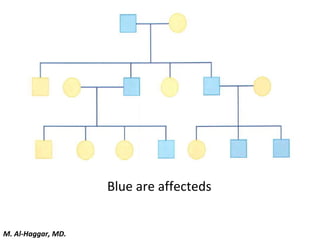
Blue are affecteds
M. Al-Haggar, MD.
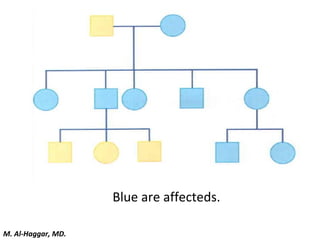
Blue are affecteds.
M. Al-Haggar, MD.
M. Al-Haggar, MD.

Approach to Dysmorphic Infant or Child

  • 1.
    Approach to diagnosisof Malformed Infant & Child Mohammad Al-Haggar, MD. Professor of Genetics
  • 2.
    Dysmorphology vs. IEM. •Abnormal structure ± abnormal function  minor vs. major dysmorphism • Normal structure but with abnormal function  IEMs (enzymopathy). Structure vs. Function M. Al-Haggar, MD.
  • 3.
    History • Pedigree inheritance, RR. • Parental age  maternal, paternal • Consanguinity. • Abortion and still birth. • Age of presentation and course. M. Al-Haggar, MD.
  • 4.
    Nomenclature • Congenital vsDevelopmental / Genetic. • Single vs multiple  Major vs minor. • Sequence vs Syndrome. • Deformity. • Malformation. • Disruption. • Dysplasia. M. Al-Haggar, MD.
  • 5.
  • 6.
    Diagramatic Sketch • Malformation Production intrinsic defect  failure of embryonic proliferation and/or differentiation  Abnormal structure. • Disruptions  Production extrinsic (disruptive) agents  interferes with embryonic development of a structure  destruction or removal of structure. • Dysplasias  Production intrinsic defect  abnormal cellular organization  abnormal model of structure. • Deformation  Packaging extrinsic defect  normally formed structure pushed out by mechanical forces. Production,Intrinsic EXtrinsic
  • 7.
    Flow Chart • Numberof malformation. • Number of involved tissue. • Presence of tissue damage. • Presence of Joint and bone Involvement. M. Al-Haggar, MD.
  • 8.
    Algorithm for MalformedInfant 1. Number of Malformations1. Number of Malformations 2. No. of Involved tissues2. No. of Involved tissues 3. Primary Tissue Destruction3. Primary Tissue Destruction May be minor or major Single / IsolatedSingle / Isolated MultipleMultiple OneOne ≥ Two≥ Two YesYes NoNo 4. Primary Joint, Bone Involvement4. Primary Joint, Bone Involvement YesYes NoNo
  • 9.
  • 10.
    Algorithm for MalformedInfant 1. Number of Malformations1. Number of Malformations 2. No. of Involved tissues2. No. of Involved tissues 3. Primary Tissue Destruction3. Primary Tissue Destruction May be minor or major Single / IsolatedSingle / Isolated MultipleMultiple OneOne Dysplasia ≥ Two≥ Two YesYes NoNo 4. Primary Joint, Bone Involvement4. Primary Joint, Bone Involvement YesYes NoNo
  • 11.
    • Malformations major, multiple. M. Al-Haggar, MD.
  • 12.
    • Malformations major, multiple. •Tissues involved  One (bone). M. Al-Haggar, MD.
  • 13.
    • Malformations major, multiple. •Tissues involved  One (bone). •Tissue damage  Absent. M. Al-Haggar, MD.
  • 14.
    • Malformations major, multiple. •Tissues involved  One (bone). •Tissue damage  Absent. •Joints involvement  No. Dysmorphic Short Infant with Intact Bones & Joints Skeletal Dysplasia (Achondroplasia) M. Al-Haggar, MD.
  • 15.
  • 16.
    Algorithm for MalformedInfant 1. Number of Malformations1. Number of Malformations 2. No. of Involved tissues2. No. of Involved tissues 3. Primary Tissue Destruction3. Primary Tissue Destruction May be minor or major Single / IsolatedSingle / Isolated MultipleMultiple OneOne ≥ Two≥ Two YesYes Disruption Sequence NoNo 4. Primary Joint, Bone Involvement4. Primary Joint, Bone Involvement YesYes NoNo M. Al-Haggar, MD.
  • 17.
  • 19.
    • Malformations major, multiple. M. Al-Haggar, MD.
  • 20.
    • Malformations major, multiple. •Tissues involved  ≥ 2 (bones, Skin, genitalia). M. Al-Haggar, MD.
  • 21.
    • Malformations major, multiple. •Tissues involved  ≥ 2 (bones, Skin, genitalia). •Tissue damage  Yes (absent 1 LL = fused LLs). M. Al-Haggar, MD.
  • 22.
    • Malformations major, multiple. •Tissues involved  ≥ 2 (bones, Skin, genitalia). •Tissue damage  Yes (absent 1 LL = fused LLs). •Joints involvement  Absent (? Secondary). Disruption (Vascular steal) with 2ry Deformation (AMC) Sirenomelia M. Al-Haggar, MD.
  • 23.
  • 24.
    Algorithm for MalformedInfant 1. Number of Malformations1. Number of Malformations 2. No. of Involved tissues2. No. of Involved tissues 3. Primary Tissue Destruction3. Primary Tissue Destruction May be minor or major Single / IsolatedSingle / Isolated MultipleMultiple OneOne ≥ Two≥ Two YesYes Deformation Sequence NoNo 4. Primary Joint, Bone Involvement4. Primary Joint, Bone Involvement YesYes NoNo M. Al-Haggar, MD.
  • 25.
  • 26.
    • Malformations Multiple Contractures of hands, feet, face M. Al-Haggar, MD.
  • 27.
    • Malformations Multiple Contractures of hands, feet, face •Tissue involved  many. M. Al-Haggar, MD.
  • 28.
    • Malformations Multiple Contractures of hands, feet, face •Tissue involved  many. •Tissue damage  Absent. M. Al-Haggar, MD.
  • 29.
    • Malformations Multiple Contractures of hands, feet, face •Tissue involved  many. •Tissue damage  Absent. •Joints  Yes (Contractures). Multiple 1ry Deformations  Generalized Contractures (DA.) Arthrogryposis Multiplex Congenita (AMC) Freeman Sheldon Syndrome (FSS)
  • 30.
    Secondary Deformations Restricted FetalMovement Potter’s Face Renal Agenesis Oligohydramnios M. Al-Haggar, MD.
  • 31.
  • 32.
    Algorithm for MalformedInfant 1. Number of Malformations1. Number of Malformations 2. No. of Involved tissues2. No. of Involved tissues 3. Primary Tissue Destruction3. Primary Tissue Destruction May be minor or major Single / IsolatedSingle / Isolated MultipleMultiple OneOne ≥ Two≥ Two YesYes NoNo 4. Primary Joint, Bone Involvement4. Primary Joint, Bone Involvement YesYes Malformation or MMS NoNo M. Al-Haggar, MD.
  • 33.
    • Malformations major, multiple. M. Al-Haggar, MD.
  • 34.
    • Malformations major, multiple. •Tissues involved  ≥ 2 (bones, Sclera, Ear). M. Al-Haggar, MD.
  • 35.
    • Malformations major, multiple. •Tissues involved  ≥ 2 (bones, Sclera, Ear). •Tissue damage  Absent. M. Al-Haggar, MD.
  • 36.
    • Malformations major, multiple. •Tissues involved  ≥ 2 (bones, Sclera, Ear). •Tissue damage  Absent. •Joints involvement  No. Multiple Malformation Syndrome  Bone fractures Osteogenesis Imperfecta M. Al-Haggar, MD.
  • 37.
    Algorithm for MalformedInfant 1. Number of Malformations1. Number of Malformations 2. No. of Involved tissues2. No. of Involved tissues 3. Primary Tissue Destruction3. Primary Tissue Destruction May be minor or major Single / IsolatedSingle / Isolated MultipleMultiple OneOne Dysplasia ≥ Two≥ Two YesYes Disruption Sequence Deformation Sequence  Fetal Akinesia Syndrome:- 1.Oligohydraminos  Renal Agenesis (Potter). 2.Myopathic / Neuropathic Athrogryposis (AMC). NoNo 4. Primary Joint, Bone Involvement4. Primary Joint, Bone Involvement YesYes Malformation or MMS NoNo
  • 38.
  • 39.
    • Malformations Multiple major. M. Al-Haggar, MD.
  • 40.
    • Malformations Multiple major. •Tissue involved  many. M. Al-Haggar, MD.
  • 41.
    • Malformations Multiple major. •Tissue involved  many. •Tissue damage  Yes. M. Al-Haggar, MD.
  • 42.
    • Malformations Multiple major •Tissue involved  many. •Tissue damage  Yes. •Joints  2ry Contractures. Disruption Sequence  2ry deformation = Neuropathic AMC M. Al-Haggar, MD.
  • 43.
    Multiple Malformation Syndrome •Diagnostic dilemma…. 1.Define. 2.Investigate. 3.Analyze. 4.Grub  scientific web. 5.Enquire  Consult. 6.Search  Publication, Citation. M. Al-Haggar, MD.
  • 44.
    Diagnosis • Investigations relevant. • Differential diagnosis. • Search engines. • No place for bedside diagnosis. M. Al-Haggar, MD.
  • 45.
    Examination • Systematic. • Symmetryin bilateral organs  Goldenhar, Silver Russel. • Genitalia  Turner, Optiz. • Psychomotor retardation  DS, FXS. • Ear, Eye, Hands. M. Al-Haggar, MD.
  • 46.
    Dysmorphology Pearls • Pursedup lips. • Heterochromia iridis. • Eversion of lateral third of lower eyelid. • Webbing of the neck. • Absent clavicles. • Inverted nipples. • Broad thumbs / great toes. • Radial ray defects. • Thrombocytopenia absent radius syndrome. • Mitten hands. • Hyper extensibility of skin and joints. M. Al-Haggar, MD.
  • 47.
    Dysmorphology Seckel dwarfism (AR.) bird headed face with prominent nose
  • 48.
    Carbamazepine Teratogenesis flat nose, long philtrum, abnormal ears and microcephaly 1 2 3 M. Al-Haggar, MD.
  • 49.
    Major malformation NTD; meningomyelocele, and occipital encephalocele Minor malformation (Polydactyly) Postaxial  Common, isolated malformation or part of a syndrome. Preaxial  rare, usually syndromic. M. Al-Haggar, MD.
  • 50.
    CDG  Invertednipples, Abnormal fat distribution, FTT, severe developmental delay. M. Al-Haggar, MD.
  • 51.
    Ehlers Danlos (AD.) Skin hyper-extensibility. M. Al-Haggar, MD.
  • 52.
    William syndrome Peri-orbital edema, bilateral epicanthic folds and thick everted lower lip, Echo  AS. M. Al-Haggar, MD.
  • 53.
  • 54.
    Blue are affecteds M.Al-Haggar, MD.
  • 55.
    Age of onsetof blue affecteds in successive generation). M. Al-Haggar, MD.
  • 56.
    Blue are carriers,red are affecteds M. Al-Haggar, MD.
  • 57.
  • 58.
    Lethal in males(incontinentia pigmenti) M. Al-Haggar, MD.
  • 59.
    Blue are affecteds M.Al-Haggar, MD.
  • 60.
    Blue are affecteds. M.Al-Haggar, MD.
  • 61.

Editor's Notes

  • #4 1. Pedigree (3-generation)  to recognize pattern of inheritance e.g. AR  Seckel syndrome, AD  Ehlers Danlos with hyperextensibility of joints and skin, X-linked  Aarskog syndrome (brachydactyly, hypertelorism, hypospadias and shawl scrotum)  RR 2. Parental ages at the time of conception. Advanced maternal age  numerical chromosomal anomalies e.g. trisomy 21, 13, and 18. However Turner 45, XO is not associated with advanced maternal age. Advanced paternal age  new mutations in single genes e.g. in AD conditions (Achondroplasia, Marfan and Apert syndrome). 3. Consanguinity  doubles risk of a malformation syndrome and increases RR of rare AR disorders. Conversely AR disorders with high gene frequency in the population, e.g. thalassemia, could occur without consanguinity. 4. Abortions, stillbirths (balanced chromosomal translocation in either parent, or an X linked dominant disorder with lethality in males e.g. Rett syndrome), Maternal illness (DM, PKU), infections (TORCH) and drugs and teratoges e.g. anticonvulsants  malformations. 5. Age of onset and course of disorder: progression symptoms/signs of (developmental delay/ abnormal behavior pattern)  some syndromes have very subtle features at onset BUT diagnosis will be made easy on follow up e.g. Noonan.
  • #7 Malformation  intrinsic  no structure e.g. Cleft lip and palate, VSD, Neural tube defect. Disruptions  extrinsic (disruptive) agents  destruction or removal structure. Disruptive agents can be amniotic bands (amputated limb or digit, craniofacial defect (encephalocele), congenital viral infections and tissue ischemia/ hemorrhage (caudal regression, intestinal atresia). RR is low. Dysplasias  Production Intrinsic defect  abnormally abnormal cellular organization  abnormal model of structure. It usually involves only one tissue type throughout the body secondary to mutations in relevant genes e.g. skeletal dysplasia and ectodermal dysplasia, osteogensis imperfecta, Lysosomal storage (MPS, ML). Deformation  (Packaging defect) normally formed structure pushed out by mechanical forces e.g. restricted fetal movements e.g. twins, oligohydramnios, uterine anomalies or fetal neurologic defects (spina bifida)  club feet (Talipes), distal arhrogryposis, hip dislocation. Good prognosis with a low RR. So, Deformity is altered shape of a part (outlier i.e. outside normal range).
  • #23 Extreme form of caudal regression syndrome (Lumbosacral dysgenesis).
  • #55 Autosomal Dominant
  • #56 Autosomal Dominant with Anticipation
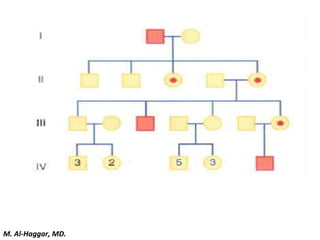
  • #57 Autosomal Recessive
  • #58 X-linked Recessive
  • #59 X-linked Dominant
  • #60 Y-linked Disease
  • #61 Maternal (Mitochondrial) Disease