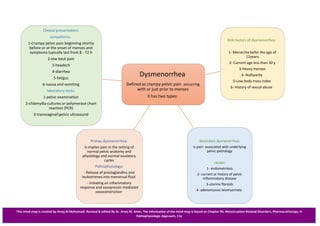
Dysmenorrhea
Defined as crampy pelvic pain occurring
with or just prior to menses
it has two types:
Primay dysmenorrhea:
is implies pain in the setting of
normal pelvic anatomy and
physiology and normal ovulatory
cycles
Pathophysiology:
- Release of prostaglandins and
leukotrienes into menstrual fluid
- initiating an inflammatory
response and vasopressin mediated
vasoconstriction
Secondary dysmenorrhea:
is pain associated with underlying
pelvic pathology
causes:
endometriosis1-
2- current or history of pelvic
inflammatory disease
3-uterine fibroids
4- adenomyosis leiomyomata
Risk factors of dysmenorrhea :
1- Menarche befor the age of
12years
2- Current age less than 30 y
3-Heavy menses
4- Nulliparity
5-Low body mass index
6- History of sexual abuse
Clinical presentation:
sympatoms::
1-Crampy pelvic pain beginning shortly
before or at the onset of menses and
symptoms typically last from 8 - 72 h
2-low back pain
3-headech
4-diarrhea
5-fatigus
6-nausa and vomiting
laboratory tests:
1-pelvic examination
2-chlamydia cultures or polymerase chain
reaction (PCR)
3-transvaginalpelvic ultrasound
This mind-map is created by Areej Al Mohamadi. Revised & edited By Dr. Arwa M. Amin. The information of the mind-map is based on Chapter 96: Menstruation-Related Disorders, Pharmacotherapy: A
Pathophysiologic Approach, 11e
Joseph T. DiPiro, Gary C. Yee, L. Michael Posey, Stuart T. Haines, Thomas D. Nolin, Vicki Ellingrod
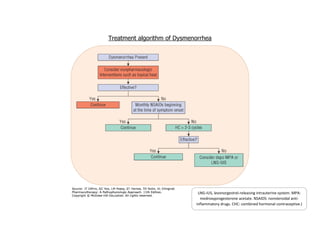
Treatment algorithm of Dysmenorrhea
LNG-IUS, levonorgestrel-releasing intrauterine system. MPA:
medroxyprogesterone acetate. NSAIDS: nonsteroidal anti-
inflammatory drugs. CHC: combined hormonal contraceptive.)
This mind-map is created by Areej Al Mohamadi. Revised & edited By Dr. Arwa M. Amin. The information of the mind-map is based on Chapter 96: Menstruation-Related Disorders, Pharmacotherapy: A
Pathophysiologic Approach, 11e

Dysmenorrhea Mind Maps

  • 1.
    Dysmenorrhea Defined as crampypelvic pain occurring with or just prior to menses it has two types: Primay dysmenorrhea: is implies pain in the setting of normal pelvic anatomy and physiology and normal ovulatory cycles Pathophysiology: - Release of prostaglandins and leukotrienes into menstrual fluid - initiating an inflammatory response and vasopressin mediated vasoconstriction Secondary dysmenorrhea: is pain associated with underlying pelvic pathology causes: endometriosis1- 2- current or history of pelvic inflammatory disease 3-uterine fibroids 4- adenomyosis leiomyomata Risk factors of dysmenorrhea : 1- Menarche befor the age of 12years 2- Current age less than 30 y 3-Heavy menses 4- Nulliparity 5-Low body mass index 6- History of sexual abuse Clinical presentation: sympatoms:: 1-Crampy pelvic pain beginning shortly before or at the onset of menses and symptoms typically last from 8 - 72 h 2-low back pain 3-headech 4-diarrhea 5-fatigus 6-nausa and vomiting laboratory tests: 1-pelvic examination 2-chlamydia cultures or polymerase chain reaction (PCR) 3-transvaginalpelvic ultrasound This mind-map is created by Areej Al Mohamadi. Revised & edited By Dr. Arwa M. Amin. The information of the mind-map is based on Chapter 96: Menstruation-Related Disorders, Pharmacotherapy: A Pathophysiologic Approach, 11e Joseph T. DiPiro, Gary C. Yee, L. Michael Posey, Stuart T. Haines, Thomas D. Nolin, Vicki Ellingrod
  • 2.
    Treatment algorithm ofDysmenorrhea LNG-IUS, levonorgestrel-releasing intrauterine system. MPA: medroxyprogesterone acetate. NSAIDS: nonsteroidal anti- inflammatory drugs. CHC: combined hormonal contraceptive.)
  • 3.
    This mind-map iscreated by Areej Al Mohamadi. Revised & edited By Dr. Arwa M. Amin. The information of the mind-map is based on Chapter 96: Menstruation-Related Disorders, Pharmacotherapy: A Pathophysiologic Approach, 11e