A Recipe for AAC 
in the Classroom 
“Begin with the End in Mind” Stephen Covey
Who are we? 
Rebecca Conrow MA CCC-SLP 
*Early Intervention Speech- Language 
Pathologist 
*Over 10 yrs. of experience in 
medical and educational settings 
helping people of all ages with 
complex communication needs find 
their voices. 
*Areas of special interest include: 
AAC, feeding/nutrition, ASD 
Victoria Simon Berg MA CCC-SLP 
*Early Intervention Speech-Language 
Pathologist 
*For more than 30 years Victoria has 
worked with families and young children 
in home, school and clinic environments 
to address significant communication 
delays and disorders. 
*Areas of special interest include: ASD, 
childhood motor speech disorders, 
Hanen parent trainings, AAC
Take Away: 
● Knowledge of AAC assessment and 
tool selection process 
● Familiarity with a range of AAC options 
● Ability to state at least 3 examples of students 
initiating communication using AAC 
● Understanding the difference between visual 
aids/supports and AAC 
● Recognition that there is no prerequisite for AAC
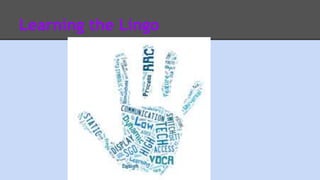
Learning the Lingo
Words to Know 
*AAC 
*Low vs. High Tech 
*VOCA; SGD 
*Dynamic vs Static Display 
*Switch (access and/ communication) 
*SETT process
Words to Know ... 
*Feature Match 
*Universal Design for Learning (UDL) 
* Symbolic representation 
* Aided Language Stimulations 
* Core vs Fringe vocabulary 
*Object, TOBI, Photo, Picture, Sign, 
Word
What are we going to bake? What 
are the ingredients we need, the 
materials and the steps to bake it? 
How do we know what we want the 
students to be able to do? 
-GOALS 
-CLASSROOM CURRICULUM 
-STATE STANDARDS 
-DEVELOPMENTAL NORMS 
-TYPICAL PEER ACTIVITIES
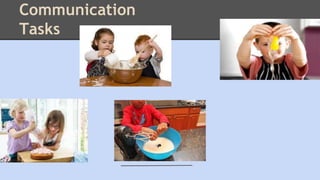
Communication 
Tasks
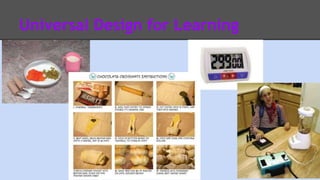
Universal Design for Learning
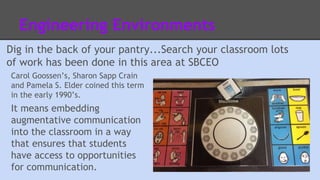
Engineering Environments 
Dig in the back of your pantry...Search your classroom lots 
of work has been done in this area at SBCEO 
Carol Goossen’s, Sharon Sapp Crain 
and Pamela S. Elder coined this term 
in the early 1990’s. 
It means embedding 
augmentative communication 
into the classroom in a way 
that ensures that students 
have access to opportunities 
for communication.
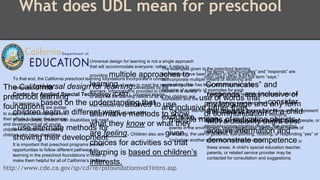
What does UDL mean for preschool 
Universal design for learning is not a single approach 
that will accommodate everyone; rather, it refers to 
providing multiple approaches to 
learning in order to meet the needs of diverse 
learners. Information is provided to children in a variety 
of ways so the learning needs of all of the children are 
To that end, the California preschool learning foundations incorporate a concept 
known as universal design for learning.Developed by the 
Center for Applied Special Technology (CAST), universal design 
The California 
preschool learning 
foundations are guides 
to support preschool programs in 
their efforts to foster the learning 
and development of all young 
children in California, including 
children who have disabilities. 
for learning is based on the understanding that 
children learn in different ways (CAST 2007). 
met. Children are allowed to use 
alternative methods to show 
what they know or what they 
are feeling. Children also are given 
choices for activities so that 
learning is based on children’s 
interests. 
In some cases, children with disabilities will need 
to use alternate methods for 
showing their development. 
It is important that preschool programs provide 
opportunities to follow different pathways to 
learning in the preschool foundations in order to 
make them helpful for all of California’s children. 
The examples given in the preschool learning 
foundations have been worded in such a way as 
to incorporate multiple means of receiving and 
expressing. This has been accomplished by the 
inclusion of a variety of examples for each 
Teachers should read each foundation and the 
foundation and the use of words that 
are inclusive rather than 
exclusive, as follows: 
accompanying examples, then consider 
the means by which a child 
with a disability might best 
acquire information and 
demonstrate competence in 
these areas. A child’s special education teacher, 
parents, or related service provider may be 
contacted for consultation and suggestions. 
The terms “identifies” and “indicates or points to” are often used to represent 
multiple means of indicating objects, people, or 
events in the environment. Examples include, among other means of 
indicating, the use of gestures, eye-pointing, nodding, or responding “yes” or 
“no” when another points to or touches an object. 
http://www.cde.ca.gov/sp/cd/re/psfoundationsvol1intro.asp 
The terms “communicates” and “responds” are 
often used rather than the term “says.” 
“Communicates” and 
“responds” are inclusive of 
any language and any form 
of communication, including 
speaking, sign language, finger spelling, pictures, 
electronic communication devices, eye-pointing, 
gesturing, and so forth.
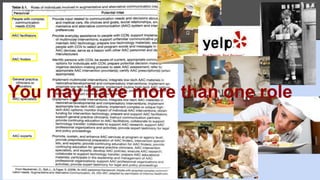
Too many cooks...Never! 
The team approach AAC … you can’t go it alone 
We all have unique roles 
and responsibilities 
“AAC is a multidisciplinary 
field that requires skills that 
transcend the typical discipline specific training 
received by speech-language pathologists, 
physical therapists, occupational therapists, educators, and other 
professionals who may serve on the AAC team.” ASHA, 2002.
You may have more than one role
Ready SETT Go... 
The SETT 
Joy Zabala 
What we know 
What we need to know
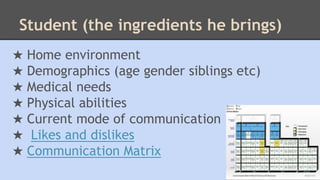
Student (the ingredients he brings) 
★ Home environment 
★ Demographics (age gender siblings etc) 
★ Medical needs 
★ Physical abilities 
★ Current mode of communication 
★ Likes and dislikes 
★ Communication Matrix
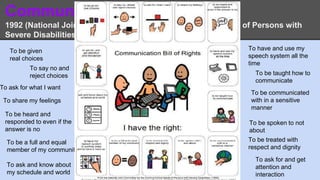
Communication Bill of Rights 
1992 (National Joint Committee for the Communication Needs of Persons with 
Severe Disabilities)(ASHA) 
To be given 
real choices 
To say no and 
reject choices 
To ask for what I want 
To share my feelings 
To be heard and 
responded to even if the 
answer is no 
To have and use my 
speech system all the 
time 
To be taught how to 
communicate 
To be communicated 
with in a sensitive 
manner 
To be spoken to not 
about 
To be treated with 
respect and dignity 
To be a full and equal 
member of my community 
To ask and know about 
my schedule and world 
To ask for and get 
attention and 
interaction
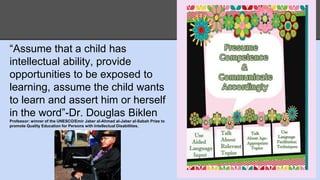
“Assume that a child has 
intellectual ability, provide 
opportunities to be exposed to 
learning, assume the child wants 
to learn and assert him or herself 
in the word”-Dr. Douglas Biklen 
Professor: winner of the UNESCO/Emir Jaber al-Ahmad al-Jaber al-Sabah Prize to 
promote Quality Education for Persons with Intellectual Disabilities.
…..Its more than just a nice idea 
The question is no longer 
who can be included or 
who can learn, but 
how can we achieve inclusive education. 
We begin by presuming competence. 
Douglas Biklen Dean of the School of Education 
Syracuse University 
To not presume competence is to assume 
that some individuals 
cannot learn, 
develop, 
or participate in the world. 
Presuming competence is nothing 
less than a Hippocratic oath (do no 
harm) for educators. 
It is a framework that says, approach each child 
as 
wanting to be fully included, 
wanting acceptance and appreciation, 
wanting to learn, 
wanting to be heard, 
wanting to contribute. 
By presuming competence, 
educators place the burden on 
themselves 
to come up with ever more 
creative, innovative ways for 
individuals to learn.
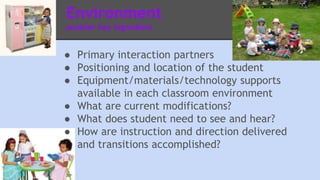
Environment 
another key ingredient 
● Primary interaction partners 
● Positioning and location of the student 
● Equipment/materials/technology supports 
available in each classroom environment 
● What are current modifications? 
● What does student need to see and hear? 
● How are instruction and direction delivered 
and transitions accomplished?
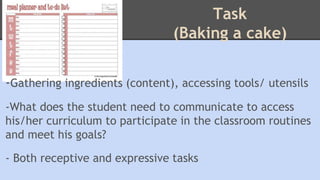
Task 
(Baking a cake) 
-Gathering ingredients (content), accessing tools/ utensils 
-What does the student need to communicate to access 
his/her curriculum to participate in the classroom routines 
and meet his goals? 
- Both receptive and expressive tasks
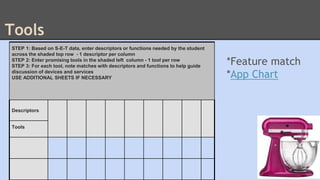
Tools 
*Feature match 
*App Chart 
STEP 1: Based on S-E-T data, enter descriptors or functions needed by the student 
across the shaded top row - 1 descriptor per column 
STEP 2: Enter promising tools in the shaded left column - 1 tool per row 
STEP 3: For each tool, note matches with descriptors and functions to help guide 
discussion of devices and services 
USE ADDITIONAL SHEETS IF NECESSARY 
Descriptors 
Tools
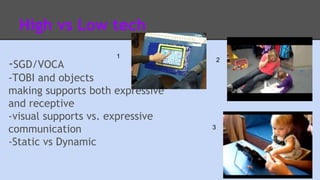
High vs Low tech 
1 
-SGD/VOCA 
-TOBI and objects 
making supports both expressive 
and receptive 
-visual supports vs. expressive 
communication 
-Static vs Dynamic 
2 
3
Taste Test 
-Trial 3 AAC approaches and 
document the results 
-Assessment is ongoing as the 
student needs communication 
expectations change and grow
Accessing Tools 
-In House resources : SLPs and OT; AT 
Committee; AT inventory; low 
incidence funds 
-Community resources: AT network, 
Loaner devices from companies, 
grants, service clubs, crowd funding.
IEP process and AAC 
Assessment: work with your team to 
determine formal/ informal and need for 
assessment plan 
Present levels: communication section 
Special factors: when to check yes 
considerations checklist 
AT Consideration Checklist 
Low incidence: Does your student have 
access to low incidence equipment
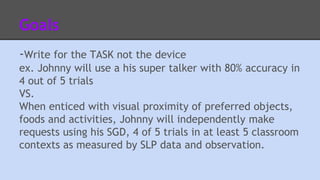
Goals 
-Write for the TASK not the device 
ex. Johnny will use a his super talker with 80% accuracy in 
4 out of 5 trials 
VS. 
When enticed with visual proximity of preferred objects, 
foods and activities, Johnny will independently make 
requests using his SGD, 4 of 5 trials in at least 5 classroom 
contexts as measured by SLP data and observation.
There many ways to make dessert 
Multi-modality outputs = “Dual Language 
Paradigm” 
Consider options in different environments for 
functional communication: 
● PECS AND single message switch 
● Words AND Picture Choices AND Go Talk 
● High Tech device AND PECS
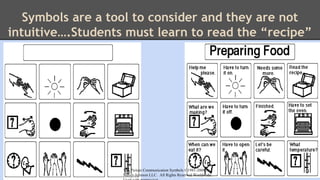
Symbols are a tool to consider and they are not 
intuitive….Students must learn to read the “recipe” 
The Picture Communication Symbols ©1981-2008 by 
Mayer-Johnson LLC. All Rights Reserved Worldwide. 
Used with permission.
How to teach a new 
language…. 
Specific protocols 
ex. PECS or PODD 
Specific Methodologies 
ex. Aided Language Stimulation 
Language Acquisition through Motor Planning
Aided Language 
Stimulation 
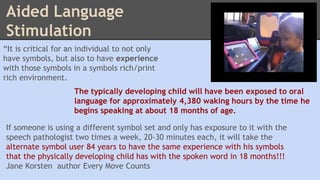
“It is critical for an individual to not only 
have symbols, but also to have experience 
with those symbols in a symbols rich/print 
rich environment. 
The typically developing child will have been exposed to oral 
language for approximately 4,380 waking hours by the time he 
begins speaking at about 18 months of age. 
If someone is using a different symbol set and only has exposure to it with the 
speech pathologist two times a week, 20-30 minutes each, it will take the 
alternate symbol user 84 years to have the same experience with his symbols 
that the physically developing child has with the spoken word in 18 months!!! 
Jane Korsten author Every Move Counts
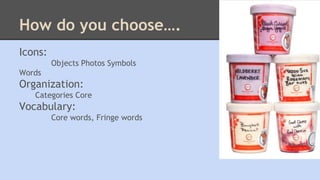
How do you choose…. 
Icons: 
Objects Photos Symbols 
Words 
Organization: 
Categories Core 
Vocabulary: 
Core words, Fringe words
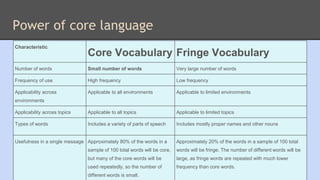
Power of core language 
Characteristic 
Core Vocabulary Fringe Vocabulary 
Number of words Small number of words Very large number of words 
Frequency of use High frequency Low frequency 
Applicability across 
environments 
Applicable to all environments Applicable to limited environments 
Applicability across topics Applicable to all topics Applicable to limited topics 
Types of words Includes a variety of parts of speech Includes mostly proper names and other nouns 
Usefulness in a single message Approximately 80% of the words in a 
sample of 100 total words will be core, 
but many of the core words will be 
used repeatedly, so the number of 
different words is small. 
Approximately 20% of the words in a sample of 100 total 
words will be fringe. The number of different words will be 
large, as fringe words are repeated with much lower 
frequency than core words.
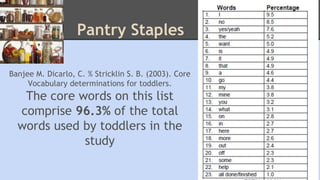
Pantry Staples 
Banjee M. Dicarlo, C. % Stricklin S. B. (2003). Core 
Vocabulary determinations for toddlers. 
The core words on this list 
comprise 96.3% of the total 
words used by toddlers in the 
study
Barriers to Implementation 
In AAC, The Participation Model (Beukelman & Mirenda, 
1988) delineates two main barriers to successful 
implementation. There are opportunity and access barriers. 
Opportunity barriers to participation are those imposed by 
people in the environment of the AAC user, while access 
barriers are present based on issues related to the individual 
who uses AAC.
There is always room for dessert 
How to keep a new system going 
-everyone in the classroom plays a role 
-audit the day and assign roles 
-home -school collaboration and communication 
-prep activities with vocab lists 
and be sure to have appropriate materials avail. 
examples
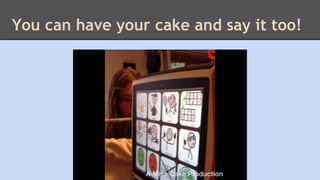
You can have your cake and say it too!
SlideShare 
This presentation is available
References 
● https://www.youtube.com/watch?v=wiBf7urAm1M 
● The Participation Model (Beukelman & Mirenda, 1988) 
● http://justineprice.wordpress.com/core-vocabulary/ 
● https://www.youtube.com/watch?v=0kjAaBVX8wg 
● www.wati.org/content/supports/free/pdf/Ch3-Communication.doc 
● http://www.wati.org/content/supports/free/pdf/form/Checklist-Form.pdf 
● https://www.youtube.com/watch?v=EnsA25kq83k 
● https://www.youtube.com/watch?v=kz3uzbiZbPU 
● https://www.youtube.com/watch?v=i5fKx6XdXFI 
● http://www.childrenshospital.org/~/media/Centers%20and%20Services/Pro 
grams/A_E/Audiology/PDFofFeatureChart.ashx
References cont. 
● http://www.unesco.org/new/en/media-services/single-view/ 
news/douglas_biklen_winner_of_unesco_kuwait_prize_begin_by_presuming_competence/#.VEv4GP 
nF91Y 
● USA 1992 (National Joint Committee for the Communication Needs of Persons with Severe 
Disabilities)(ASHA) 
● AAC Strategies for Individuals with Moderate to Severe Disabilities By Susan S. Johnston, Kathleen M 
Feeley, & Emily A. Jones Copyright 2012 by Paul A. Brooks Publishing Co , All Rights Reserved 
● http://www.communicationmatrix.org 
● http://www.joyzabala.com/uploads/CA_Kananaskis__SETT_Horses_Mouth.pd 
● Beukelman, David R. and Mirenda, Pat. 2014. Augmentative and Alternative Communication (4th Edition). 
Paul H. Brooke's Publishing, Baltimore Md. 
● http://www.bridgeschool.org/transition/docs/collab_teaming.pdf 
● http://www.cde.ca.gov/sp/cd/re/psfoundationsvol1intro.asp 
● http://www.gadoe.org/Curriculum-Instruction-and-Assessment/Special-Education- 
Services/Documents/What's%20It%20All%20About%20- 
%20Creating%20a%20Communicative%20Environment%20ppt.pdf

AAC in the Preschool Classroom

  • 1.
    A Recipe forAAC in the Classroom “Begin with the End in Mind” Stephen Covey
  • 2.
    Who are we? Rebecca Conrow MA CCC-SLP *Early Intervention Speech- Language Pathologist *Over 10 yrs. of experience in medical and educational settings helping people of all ages with complex communication needs find their voices. *Areas of special interest include: AAC, feeding/nutrition, ASD Victoria Simon Berg MA CCC-SLP *Early Intervention Speech-Language Pathologist *For more than 30 years Victoria has worked with families and young children in home, school and clinic environments to address significant communication delays and disorders. *Areas of special interest include: ASD, childhood motor speech disorders, Hanen parent trainings, AAC
  • 3.
    Take Away: ●Knowledge of AAC assessment and tool selection process ● Familiarity with a range of AAC options ● Ability to state at least 3 examples of students initiating communication using AAC ● Understanding the difference between visual aids/supports and AAC ● Recognition that there is no prerequisite for AAC
  • 4.
  • 5.
    Words to Know *AAC *Low vs. High Tech *VOCA; SGD *Dynamic vs Static Display *Switch (access and/ communication) *SETT process
  • 6.
    Words to Know... *Feature Match *Universal Design for Learning (UDL) * Symbolic representation * Aided Language Stimulations * Core vs Fringe vocabulary *Object, TOBI, Photo, Picture, Sign, Word
  • 7.
    What are wegoing to bake? What are the ingredients we need, the materials and the steps to bake it? How do we know what we want the students to be able to do? -GOALS -CLASSROOM CURRICULUM -STATE STANDARDS -DEVELOPMENTAL NORMS -TYPICAL PEER ACTIVITIES
  • 8.
  • 9.
  • 10.
    Engineering Environments Digin the back of your pantry...Search your classroom lots of work has been done in this area at SBCEO Carol Goossen’s, Sharon Sapp Crain and Pamela S. Elder coined this term in the early 1990’s. It means embedding augmentative communication into the classroom in a way that ensures that students have access to opportunities for communication.
  • 11.
    What does UDLmean for preschool Universal design for learning is not a single approach that will accommodate everyone; rather, it refers to providing multiple approaches to learning in order to meet the needs of diverse learners. Information is provided to children in a variety of ways so the learning needs of all of the children are To that end, the California preschool learning foundations incorporate a concept known as universal design for learning.Developed by the Center for Applied Special Technology (CAST), universal design The California preschool learning foundations are guides to support preschool programs in their efforts to foster the learning and development of all young children in California, including children who have disabilities. for learning is based on the understanding that children learn in different ways (CAST 2007). met. Children are allowed to use alternative methods to show what they know or what they are feeling. Children also are given choices for activities so that learning is based on children’s interests. In some cases, children with disabilities will need to use alternate methods for showing their development. It is important that preschool programs provide opportunities to follow different pathways to learning in the preschool foundations in order to make them helpful for all of California’s children. The examples given in the preschool learning foundations have been worded in such a way as to incorporate multiple means of receiving and expressing. This has been accomplished by the inclusion of a variety of examples for each Teachers should read each foundation and the foundation and the use of words that are inclusive rather than exclusive, as follows: accompanying examples, then consider the means by which a child with a disability might best acquire information and demonstrate competence in these areas. A child’s special education teacher, parents, or related service provider may be contacted for consultation and suggestions. The terms “identifies” and “indicates or points to” are often used to represent multiple means of indicating objects, people, or events in the environment. Examples include, among other means of indicating, the use of gestures, eye-pointing, nodding, or responding “yes” or “no” when another points to or touches an object. http://www.cde.ca.gov/sp/cd/re/psfoundationsvol1intro.asp The terms “communicates” and “responds” are often used rather than the term “says.” “Communicates” and “responds” are inclusive of any language and any form of communication, including speaking, sign language, finger spelling, pictures, electronic communication devices, eye-pointing, gesturing, and so forth.
  • 12.
    Too many cooks...Never! The team approach AAC … you can’t go it alone We all have unique roles and responsibilities “AAC is a multidisciplinary field that requires skills that transcend the typical discipline specific training received by speech-language pathologists, physical therapists, occupational therapists, educators, and other professionals who may serve on the AAC team.” ASHA, 2002.
  • 13.
    You may havemore than one role
  • 14.
    Ready SETT Go... The SETT Joy Zabala What we know What we need to know
  • 15.
    Student (the ingredientshe brings) ★ Home environment ★ Demographics (age gender siblings etc) ★ Medical needs ★ Physical abilities ★ Current mode of communication ★ Likes and dislikes ★ Communication Matrix
  • 16.
    Communication Bill ofRights 1992 (National Joint Committee for the Communication Needs of Persons with Severe Disabilities)(ASHA) To be given real choices To say no and reject choices To ask for what I want To share my feelings To be heard and responded to even if the answer is no To have and use my speech system all the time To be taught how to communicate To be communicated with in a sensitive manner To be spoken to not about To be treated with respect and dignity To be a full and equal member of my community To ask and know about my schedule and world To ask for and get attention and interaction
  • 17.
    “Assume that achild has intellectual ability, provide opportunities to be exposed to learning, assume the child wants to learn and assert him or herself in the word”-Dr. Douglas Biklen Professor: winner of the UNESCO/Emir Jaber al-Ahmad al-Jaber al-Sabah Prize to promote Quality Education for Persons with Intellectual Disabilities.
  • 18.
    …..Its more thanjust a nice idea The question is no longer who can be included or who can learn, but how can we achieve inclusive education. We begin by presuming competence. Douglas Biklen Dean of the School of Education Syracuse University To not presume competence is to assume that some individuals cannot learn, develop, or participate in the world. Presuming competence is nothing less than a Hippocratic oath (do no harm) for educators. It is a framework that says, approach each child as wanting to be fully included, wanting acceptance and appreciation, wanting to learn, wanting to be heard, wanting to contribute. By presuming competence, educators place the burden on themselves to come up with ever more creative, innovative ways for individuals to learn.
  • 19.
    Environment another keyingredient ● Primary interaction partners ● Positioning and location of the student ● Equipment/materials/technology supports available in each classroom environment ● What are current modifications? ● What does student need to see and hear? ● How are instruction and direction delivered and transitions accomplished?
  • 20.
    Task (Baking acake) -Gathering ingredients (content), accessing tools/ utensils -What does the student need to communicate to access his/her curriculum to participate in the classroom routines and meet his goals? - Both receptive and expressive tasks
  • 21.
    Tools *Feature match *App Chart STEP 1: Based on S-E-T data, enter descriptors or functions needed by the student across the shaded top row - 1 descriptor per column STEP 2: Enter promising tools in the shaded left column - 1 tool per row STEP 3: For each tool, note matches with descriptors and functions to help guide discussion of devices and services USE ADDITIONAL SHEETS IF NECESSARY Descriptors Tools
  • 22.
    High vs Lowtech 1 -SGD/VOCA -TOBI and objects making supports both expressive and receptive -visual supports vs. expressive communication -Static vs Dynamic 2 3
  • 23.
    Taste Test -Trial3 AAC approaches and document the results -Assessment is ongoing as the student needs communication expectations change and grow
  • 24.
    Accessing Tools -InHouse resources : SLPs and OT; AT Committee; AT inventory; low incidence funds -Community resources: AT network, Loaner devices from companies, grants, service clubs, crowd funding.
  • 25.
    IEP process andAAC Assessment: work with your team to determine formal/ informal and need for assessment plan Present levels: communication section Special factors: when to check yes considerations checklist AT Consideration Checklist Low incidence: Does your student have access to low incidence equipment
  • 26.
    Goals -Write forthe TASK not the device ex. Johnny will use a his super talker with 80% accuracy in 4 out of 5 trials VS. When enticed with visual proximity of preferred objects, foods and activities, Johnny will independently make requests using his SGD, 4 of 5 trials in at least 5 classroom contexts as measured by SLP data and observation.
  • 27.
    There many waysto make dessert Multi-modality outputs = “Dual Language Paradigm” Consider options in different environments for functional communication: ● PECS AND single message switch ● Words AND Picture Choices AND Go Talk ● High Tech device AND PECS
  • 28.
    Symbols are atool to consider and they are not intuitive….Students must learn to read the “recipe” The Picture Communication Symbols ©1981-2008 by Mayer-Johnson LLC. All Rights Reserved Worldwide. Used with permission.
  • 29.
    How to teacha new language…. Specific protocols ex. PECS or PODD Specific Methodologies ex. Aided Language Stimulation Language Acquisition through Motor Planning
  • 30.
    Aided Language Stimulation “It is critical for an individual to not only have symbols, but also to have experience with those symbols in a symbols rich/print rich environment. The typically developing child will have been exposed to oral language for approximately 4,380 waking hours by the time he begins speaking at about 18 months of age. If someone is using a different symbol set and only has exposure to it with the speech pathologist two times a week, 20-30 minutes each, it will take the alternate symbol user 84 years to have the same experience with his symbols that the physically developing child has with the spoken word in 18 months!!! Jane Korsten author Every Move Counts
  • 31.
    How do youchoose…. Icons: Objects Photos Symbols Words Organization: Categories Core Vocabulary: Core words, Fringe words
  • 32.
    Power of corelanguage Characteristic Core Vocabulary Fringe Vocabulary Number of words Small number of words Very large number of words Frequency of use High frequency Low frequency Applicability across environments Applicable to all environments Applicable to limited environments Applicability across topics Applicable to all topics Applicable to limited topics Types of words Includes a variety of parts of speech Includes mostly proper names and other nouns Usefulness in a single message Approximately 80% of the words in a sample of 100 total words will be core, but many of the core words will be used repeatedly, so the number of different words is small. Approximately 20% of the words in a sample of 100 total words will be fringe. The number of different words will be large, as fringe words are repeated with much lower frequency than core words.
  • 33.
    Pantry Staples BanjeeM. Dicarlo, C. % Stricklin S. B. (2003). Core Vocabulary determinations for toddlers. The core words on this list comprise 96.3% of the total words used by toddlers in the study
  • 34.
    Barriers to Implementation In AAC, The Participation Model (Beukelman & Mirenda, 1988) delineates two main barriers to successful implementation. There are opportunity and access barriers. Opportunity barriers to participation are those imposed by people in the environment of the AAC user, while access barriers are present based on issues related to the individual who uses AAC.
  • 35.
    There is alwaysroom for dessert How to keep a new system going -everyone in the classroom plays a role -audit the day and assign roles -home -school collaboration and communication -prep activities with vocab lists and be sure to have appropriate materials avail. examples
  • 36.
    You can haveyour cake and say it too!
  • 37.
  • 38.
    References ● https://www.youtube.com/watch?v=wiBf7urAm1M ● The Participation Model (Beukelman & Mirenda, 1988) ● http://justineprice.wordpress.com/core-vocabulary/ ● https://www.youtube.com/watch?v=0kjAaBVX8wg ● www.wati.org/content/supports/free/pdf/Ch3-Communication.doc ● http://www.wati.org/content/supports/free/pdf/form/Checklist-Form.pdf ● https://www.youtube.com/watch?v=EnsA25kq83k ● https://www.youtube.com/watch?v=kz3uzbiZbPU ● https://www.youtube.com/watch?v=i5fKx6XdXFI ● http://www.childrenshospital.org/~/media/Centers%20and%20Services/Pro grams/A_E/Audiology/PDFofFeatureChart.ashx
  • 39.
    References cont. ●http://www.unesco.org/new/en/media-services/single-view/ news/douglas_biklen_winner_of_unesco_kuwait_prize_begin_by_presuming_competence/#.VEv4GP nF91Y ● USA 1992 (National Joint Committee for the Communication Needs of Persons with Severe Disabilities)(ASHA) ● AAC Strategies for Individuals with Moderate to Severe Disabilities By Susan S. Johnston, Kathleen M Feeley, & Emily A. Jones Copyright 2012 by Paul A. Brooks Publishing Co , All Rights Reserved ● http://www.communicationmatrix.org ● http://www.joyzabala.com/uploads/CA_Kananaskis__SETT_Horses_Mouth.pd ● Beukelman, David R. and Mirenda, Pat. 2014. Augmentative and Alternative Communication (4th Edition). Paul H. Brooke's Publishing, Baltimore Md. ● http://www.bridgeschool.org/transition/docs/collab_teaming.pdf ● http://www.cde.ca.gov/sp/cd/re/psfoundationsvol1intro.asp ● http://www.gadoe.org/Curriculum-Instruction-and-Assessment/Special-Education- Services/Documents/What's%20It%20All%20About%20- %20Creating%20a%20Communicative%20Environment%20ppt.pdf

Editor's Notes

  • #2 photos of aac in classroom
  • #3 slides 1-7 3.5 mins
  • #4 Define AAC
  • #5 LEARNING A NEW LANGUAGE
  • #6 We want everyone to feel comfortable with the lingo; rather than bore you with definitions, we have devised a matching activity.YOu will be learning a “new language”
  • #7 Part of our “End in Mind” is for you all to know the meaning of these words and feel comfortable with the lingo
  • #8 We will use parameters of the IEP, school setting, and CA State mandates that drive curriculum
  • #9 4.0 mins examples of tasks communication expectations for preschool students -audience list some show video of students in classroom and ask audience what they are doing Show typical preschoolers interacting in classroom compare tasks emphasis aac is the bridge to allow all students to participate in age appropriate activities with peers and curriculum stop 3:10 Access to typical curriculum what is the best scenario what are specific communication tasks. one two three shout out a communication task you see here . then pick a few and move on
  • #10 2.5mins 9-10 UDL Defined: Learning activities are designed AT OUTSET for inclusion….(Audience can define) Talk about each picture and talk abou the switch to access and that that is a whole assessment piece unto itself for size shape placement ect. but in this context it is generic udl . Principles of UDL : Multiple means of Representation - Expression - Engagement • Multiple means of representation: – Provides learners with various ways of acquiring information and knowledge • Multiple means of expression: – Provides learners with alternatives for demonstrating what they know • Multiple means of engagement: – Taps into learners’ interests, challenges them appropriately, and motivates them to learn
  • #11 http://www.gadoe.org/Curriculum-Instruction-and-Assessment/Special-Education-Services/Documents/What's%20It%20All%20About%20-%20Creating%20a%20Communicative%20Environment%20ppt.pdf SBCEO has already done a lot to provide AAC inout and opportutnities
  • #12 2mins
  • #13 1 min Just like in the kitchen we all have different roles to play in this process….very similar to the IEP process. Click picture for example of tracking sheet http://www.bridgeschool.org/transition/docs/collab_teaming.pdf
  • #14 3 mins REBECCA bring book. refer to the SETT re student; relate back to SBCEO , STUDENT= customer/ diner, FACILITATORS= waitress, IAs parents teachers on the ground staff FINDERS= rest. critics/locators, drs. TCRC classroom teachers Gen Pract. Suos chef Specialist =exec chef Expert = triainer ref to AT/AAC comittee every one has different expertise our populatoinis so varried
  • #15 1.5mins The SETT is a tool to organize the way we plan for AT/AAC in the classroom, centered around a particular activity or task. This tool can be used for individual students or it can be modified to look at the udl needs for an entire class. http://www.joyzabala.com/uploads/CA_Kananaskis__SETT_Horses_Mouth.pd
  • #16 2 mins 1.reinforcement survey 2. graphic 3. levels of communicative function
  • #17  3.5 mins USA 1992 (National Joint Committee for the Communication Needs of Persons with Severe Disabilities)(ASHA)
  • #18 2.5 mins REBECCA http://www.unesco.org/new/en/media-services/single-view/news/douglas_biklen_winner_of_unesco_kuwait_prize_begin_by_presuming_competence/#.VEv4GPnF91Y
  • #19 REBECCA add caveat to hippo oath
  • #21 REBECCA What are the tasks we need to complete to get to the end product?
  • #22 pict of ex. rainbow aac app handout, wati feature match form
  • #23 second video play 1-2 mins
  • #24 Trials are important to document when it comes to funding or stating necessity in IEP
  • #25 Are there any other ways you have obtained funding??? to the audience
  • #26 recipe
  • #27 menu planner
  • #28 dessert; communication needs vary across contexts; CCN of different etiologies support multiple means ex. CAS vs. ASD vs. Mulitple Disabilities
  • #29 28-31 8 mins Refer to tool to start . What sort of an activity do you think this board is for, ask 5 different people www.wati.org/content/supports/free/pdf/Ch3-Communication.doc
  • #30 2
  • #31 Stop video at 40
  • #33  We need both, so need to remember to keep this in mind as we plan lessons and possibly have two ways to communicate http://justineprice.wordpress.com/core-vocabulary/
  • #34 want that, go here, go in, more out, more out, you go, what that SOME THAT What is it? you go out? I go in. that mine. is it off? Is it in here? I want some help!
  • #35 (time, resources, personal, knowledge)
  • #36 ball of dough
  • #37 Questions references wrap up