Executive Functioning  in the Classroom Dr. Edward M. Petrosky Licensed Psychologist Neuropsychological Evaluations Queens, NY (917) 520 – 4444  www.toolsforstudents.info (c) Dr. Edward M. Petrosky, 2010, neuropsychological evaluation, dyslexia, adhd, queens, ny
A Word on the Presenter Licensed psychologist Specializations include:  Dyslexia, other Learning Disability, & ADHD Testing Neuropsychological Evaluations Evaluations of Behavioral and Emotional Problems  Consultation School faculty training & development For people struggling in school, at home, or at work I conduct psychological evaluation to determine: What is the problem?  What is causing it?  What can be done to help? www.toolsforstudents.info (c) Dr. Edward M. Petrosky, 2010, neuropsychological evaluation, dyslexia, adhd, queens, ny
Facebook Fan Page For handouts and information on a wide range of psychology and education topics become a “fan” of my Facebook page:  “ Dr. Edward M. Petrosky.” (c) Dr. Edward M. Petrosky, 2010, neuropsychological evaluation, dyslexia, adhd, queens, ny
Executive Functioning A collection of skills used to organize and direct behavior towards purposeful goals. Helps us control and regulate our behavior. Self-monitor and guide our performance   (c) Dr. Edward M. Petrosky, 2010, neuropsychological evaluation, dyslexia, adhd, queens, ny
Disorders Characterized by Poor Executive Functioning ADHD Asperger’s  Autism Depression OCD Tourette’s Schizophrenia Others  (c) Dr. Edward M. Petrosky, 2010, neuropsychological evaluation, dyslexia, adhd, queens, ny
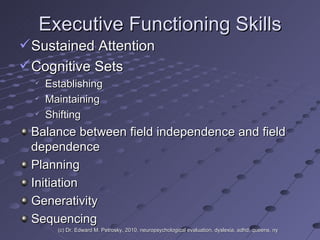
Executive Functioning Skills Sustained Attention Cognitive Sets Establishing Maintaining Shifting Balance between field independence and field dependence  Planning Initiation Generativity Sequencing (c) Dr. Edward M. Petrosky, 2010, neuropsychological evaluation, dyslexia, adhd, queens, ny
Sustained Attention The ability to  maintain  focus over a prolonged period of time.  Hold attention in one spot (c) Dr. Edward M. Petrosky, 2010, neuropsychological evaluation, dyslexia, adhd, queens, ny
How Poor Sustained Attention Shows up in the Classroom Poor attention Distractible Zones out (c) Dr. Edward M. Petrosky, 2010, neuropsychological evaluation, dyslexia, adhd, queens, ny
Strategies Inject novelty into instruction Frequent breaks Rotate subjects Extra review for material covered towards the end of a lesson Teach at a continuous pace; prepare in advance so that delays between tasks are minimized (c) Dr. Edward M. Petrosky, 2010, neuropsychological evaluation, dyslexia, adhd, queens, ny
Strategies Avoid rote drills Engage attention  Through challenge “ Few people know the answer to this…” Active student participation (c) Dr. Edward M. Petrosky, 2010, neuropsychological evaluation, dyslexia, adhd, queens, ny
Difficulty establishing  cognitive sets Difficulty catching on to what one is supposed to do (c) Dr. Edward M. Petrosky, 2010, neuropsychological evaluation, dyslexia, adhd, queens, ny
How this shows up  in the classroom Does not independently begin tasks E.g. sits and stares Does the wrong thing Can occur even with adequate listening comprehension:  student understands the words but can’t put together what you want them to do. (c) Dr. Edward M. Petrosky, 2010, neuropsychological evaluation, dyslexia, adhd, queens, ny
Strategies Check to make they understand and don’t take for granted that they do. Have them repeat back their understanding Have them complete a couple of practice items and check their work for understanding (c) Dr. Edward M. Petrosky, 2010, neuropsychological evaluation, dyslexia, adhd, queens, ny
Strategies Emphasize the  method  or  steps  needed to solve a problem.  Make explicit the process one uses to arrive at the correct answer.  Specifically outline exactly what s/he needs to do.  Number the steps and put them on an index card in order for the student to keep the steps “top of mind.” (c) Dr. Edward M. Petrosky, 2010, neuropsychological evaluation, dyslexia, adhd, queens, ny
Lose cognitive sets Lost track of what they’re supposed to do and veer off course (c) Dr. Edward M. Petrosky, 2010, neuropsychological evaluation, dyslexia, adhd, queens, ny
How this shows up  in the classroom Don’t follow the directions When students don’t follow the directions it is not always simply that they didn’t pay attention.  They may have difficulty staying on the same path.  They begin driving down one path and find themselves on another. Some answers are logical, others are incorrect and off task / uneven performance on the same task (i.e. they forgot what they were doing). (c) Dr. Edward M. Petrosky, 2010, neuropsychological evaluation, dyslexia, adhd, queens, ny
Strategies Can’t assume that just because the student gets off to a good start that s/he will continue down the right track Check in at regular intervals to ensure the student is  still  following the directions (c) Dr. Edward M. Petrosky, 2010, neuropsychological evaluation, dyslexia, adhd, queens, ny
Strategies Teach the student to (re)orient when answering questions by asking him/herself:  What information does the question want? What am I supposed to be doing? Have them write the end goal at the top of the page as a reminder E.g. “3 reasons why” (c) Dr. Edward M. Petrosky, 2010, neuropsychological evaluation, dyslexia, adhd, queens, ny
Shifting Cognitive Sets / Cognitive Flexibility Stop an old behavior and start a new behavior.  Ability to mentally “switch gears” Lack of cognitive flexibility is cognitive rigidity Causes perseveration:  keep repeating the same behavior despite the fact that the task requirements have changed  (c) Dr. Edward M. Petrosky, 2010, neuropsychological evaluation, dyslexia, adhd, queens, ny
How A Lack of Cognitive Flexibility Shows up in the Classroom Difficulty with transitions Repeat themselves Continue with same solution even though the problem has changed (c) Dr. Edward M. Petrosky, 2010, neuropsychological evaluation, dyslexia, adhd, queens, ny
Strategies Do not give worksheets with mixed problems (one worksheet for addition, one for subtraction) Clearly segregate different types of problems (e.g. addition problems on one page and subtraction problems on another page) Create labels and signs to signal transitions Make new information as distinctive from previous information as possible (c) Dr. Edward M. Petrosky, 2010, neuropsychological evaluation, dyslexia, adhd, queens, ny
Strategies Pause in between different chunks of information to allow the student to consolidate information and clear his / her mind for the next set of information.  Emphasize where one piece of information ends and the next begins (e.g. “That’s one point, here is the next point.” “O.K., moving on now to something different” etc.). (c) Dr. Edward M. Petrosky, 2010, neuropsychological evaluation, dyslexia, adhd, queens, ny
Strategies Change seat Change where standing Begin new unit after a break Ritual of putting one book away and taking out another (c) Dr. Edward M. Petrosky, 2010, neuropsychological evaluation, dyslexia, adhd, queens, ny
Field Dependent Behavior When behavior is determined or driven by the environment, as opposed to one’s thoughts or reflections. Not necessarily bad.  Sometimes you  want  to let the environment determine your behavior (e.g. when a car is swerving towards you when you’re crossing the street) (c) Dr. Edward M. Petrosky, 2010, neuropsychological evaluation, dyslexia, adhd, queens, ny
How this shows up in the classroom Impulsivity Running across the room and picking up a pencil that has dropped Eating cotton balls Running to the window to see snow Excessive exploratory behavior Ripping apart an electrical socket Opening drawers and doors Simply because they are there (c) Dr. Edward M. Petrosky, 2010, neuropsychological evaluation, dyslexia, adhd, queens, ny
Strategies Minimize salient environmental stimuli (e.g. put the book away) Visual aids (e.g. holding up a cardboard stop sign) Tune the student back into his or her thoughts by asking questions What are we working on? What are we supposed to be doing? What’s the easiest / most difficult part of this assignment? (c) Dr. Edward M. Petrosky, 2010, neuropsychological evaluation, dyslexia, adhd, queens, ny
Planning The ability to think ahead and formulate a solution to a problem, as oppose to diving in and working on it haphazardly (c) Dr. Edward M. Petrosky, 2010, neuropsychological evaluation, dyslexia, adhd, queens, ny
How this shows up  in the classroom Run out time miss deadlines don’t finish exams money – spend all of their allowance during the first minute of the school fair room on the paper, things are squished Complete tasks inefficiently with a lot of unnecessary mistakes (c) Dr. Edward M. Petrosky, 2010, neuropsychological evaluation, dyslexia, adhd, queens, ny
Strategies Envisioning the end goal Identifying resources you will need (people, materials) Breaking it down into steps Specifying what will need to do each step of the way Writing – rough drafts, prewriting exercises Verbal mediation Brainstorming consequences Many, many others (c) Dr. Edward M. Petrosky, 2010, neuropsychological evaluation, dyslexia, adhd, queens, ny
Thank You Very Much! Call or Email me with Any Questions Dr. Edward M. Petrosky Licensed Psychologist (917) 520 – 4444  www.toolsforstudents.info (c) Dr. Edward M. Petrosky, 2010, neuropsychological evaluation, dyslexia, adhd, queens, ny

Executive Functioning In The Classroom

  • 1.
    Executive Functioning in the Classroom Dr. Edward M. Petrosky Licensed Psychologist Neuropsychological Evaluations Queens, NY (917) 520 – 4444 www.toolsforstudents.info (c) Dr. Edward M. Petrosky, 2010, neuropsychological evaluation, dyslexia, adhd, queens, ny
  • 2.
    A Word onthe Presenter Licensed psychologist Specializations include: Dyslexia, other Learning Disability, & ADHD Testing Neuropsychological Evaluations Evaluations of Behavioral and Emotional Problems Consultation School faculty training & development For people struggling in school, at home, or at work I conduct psychological evaluation to determine: What is the problem? What is causing it? What can be done to help? www.toolsforstudents.info (c) Dr. Edward M. Petrosky, 2010, neuropsychological evaluation, dyslexia, adhd, queens, ny
  • 3.
    Facebook Fan PageFor handouts and information on a wide range of psychology and education topics become a “fan” of my Facebook page: “ Dr. Edward M. Petrosky.” (c) Dr. Edward M. Petrosky, 2010, neuropsychological evaluation, dyslexia, adhd, queens, ny
  • 4.
    Executive Functioning Acollection of skills used to organize and direct behavior towards purposeful goals. Helps us control and regulate our behavior. Self-monitor and guide our performance   (c) Dr. Edward M. Petrosky, 2010, neuropsychological evaluation, dyslexia, adhd, queens, ny
  • 5.
    Disorders Characterized byPoor Executive Functioning ADHD Asperger’s Autism Depression OCD Tourette’s Schizophrenia Others (c) Dr. Edward M. Petrosky, 2010, neuropsychological evaluation, dyslexia, adhd, queens, ny
  • 6.
    Executive Functioning SkillsSustained Attention Cognitive Sets Establishing Maintaining Shifting Balance between field independence and field dependence Planning Initiation Generativity Sequencing (c) Dr. Edward M. Petrosky, 2010, neuropsychological evaluation, dyslexia, adhd, queens, ny
  • 7.
    Sustained Attention Theability to maintain focus over a prolonged period of time. Hold attention in one spot (c) Dr. Edward M. Petrosky, 2010, neuropsychological evaluation, dyslexia, adhd, queens, ny
  • 8.
    How Poor SustainedAttention Shows up in the Classroom Poor attention Distractible Zones out (c) Dr. Edward M. Petrosky, 2010, neuropsychological evaluation, dyslexia, adhd, queens, ny
  • 9.
    Strategies Inject noveltyinto instruction Frequent breaks Rotate subjects Extra review for material covered towards the end of a lesson Teach at a continuous pace; prepare in advance so that delays between tasks are minimized (c) Dr. Edward M. Petrosky, 2010, neuropsychological evaluation, dyslexia, adhd, queens, ny
  • 10.
    Strategies Avoid rotedrills Engage attention Through challenge “ Few people know the answer to this…” Active student participation (c) Dr. Edward M. Petrosky, 2010, neuropsychological evaluation, dyslexia, adhd, queens, ny
  • 11.
    Difficulty establishing cognitive sets Difficulty catching on to what one is supposed to do (c) Dr. Edward M. Petrosky, 2010, neuropsychological evaluation, dyslexia, adhd, queens, ny
  • 12.
    How this showsup in the classroom Does not independently begin tasks E.g. sits and stares Does the wrong thing Can occur even with adequate listening comprehension: student understands the words but can’t put together what you want them to do. (c) Dr. Edward M. Petrosky, 2010, neuropsychological evaluation, dyslexia, adhd, queens, ny
  • 13.
    Strategies Check tomake they understand and don’t take for granted that they do. Have them repeat back their understanding Have them complete a couple of practice items and check their work for understanding (c) Dr. Edward M. Petrosky, 2010, neuropsychological evaluation, dyslexia, adhd, queens, ny
  • 14.
    Strategies Emphasize the method or steps needed to solve a problem. Make explicit the process one uses to arrive at the correct answer. Specifically outline exactly what s/he needs to do. Number the steps and put them on an index card in order for the student to keep the steps “top of mind.” (c) Dr. Edward M. Petrosky, 2010, neuropsychological evaluation, dyslexia, adhd, queens, ny
  • 15.
    Lose cognitive setsLost track of what they’re supposed to do and veer off course (c) Dr. Edward M. Petrosky, 2010, neuropsychological evaluation, dyslexia, adhd, queens, ny
  • 16.
    How this showsup in the classroom Don’t follow the directions When students don’t follow the directions it is not always simply that they didn’t pay attention. They may have difficulty staying on the same path. They begin driving down one path and find themselves on another. Some answers are logical, others are incorrect and off task / uneven performance on the same task (i.e. they forgot what they were doing). (c) Dr. Edward M. Petrosky, 2010, neuropsychological evaluation, dyslexia, adhd, queens, ny
  • 17.
    Strategies Can’t assumethat just because the student gets off to a good start that s/he will continue down the right track Check in at regular intervals to ensure the student is still following the directions (c) Dr. Edward M. Petrosky, 2010, neuropsychological evaluation, dyslexia, adhd, queens, ny
  • 18.
    Strategies Teach thestudent to (re)orient when answering questions by asking him/herself: What information does the question want? What am I supposed to be doing? Have them write the end goal at the top of the page as a reminder E.g. “3 reasons why” (c) Dr. Edward M. Petrosky, 2010, neuropsychological evaluation, dyslexia, adhd, queens, ny
  • 19.
    Shifting Cognitive Sets/ Cognitive Flexibility Stop an old behavior and start a new behavior. Ability to mentally “switch gears” Lack of cognitive flexibility is cognitive rigidity Causes perseveration: keep repeating the same behavior despite the fact that the task requirements have changed (c) Dr. Edward M. Petrosky, 2010, neuropsychological evaluation, dyslexia, adhd, queens, ny
  • 20.
    How A Lackof Cognitive Flexibility Shows up in the Classroom Difficulty with transitions Repeat themselves Continue with same solution even though the problem has changed (c) Dr. Edward M. Petrosky, 2010, neuropsychological evaluation, dyslexia, adhd, queens, ny
  • 21.
    Strategies Do notgive worksheets with mixed problems (one worksheet for addition, one for subtraction) Clearly segregate different types of problems (e.g. addition problems on one page and subtraction problems on another page) Create labels and signs to signal transitions Make new information as distinctive from previous information as possible (c) Dr. Edward M. Petrosky, 2010, neuropsychological evaluation, dyslexia, adhd, queens, ny
  • 22.
    Strategies Pause inbetween different chunks of information to allow the student to consolidate information and clear his / her mind for the next set of information. Emphasize where one piece of information ends and the next begins (e.g. “That’s one point, here is the next point.” “O.K., moving on now to something different” etc.). (c) Dr. Edward M. Petrosky, 2010, neuropsychological evaluation, dyslexia, adhd, queens, ny
  • 23.
    Strategies Change seatChange where standing Begin new unit after a break Ritual of putting one book away and taking out another (c) Dr. Edward M. Petrosky, 2010, neuropsychological evaluation, dyslexia, adhd, queens, ny
  • 24.
    Field Dependent BehaviorWhen behavior is determined or driven by the environment, as opposed to one’s thoughts or reflections. Not necessarily bad. Sometimes you want to let the environment determine your behavior (e.g. when a car is swerving towards you when you’re crossing the street) (c) Dr. Edward M. Petrosky, 2010, neuropsychological evaluation, dyslexia, adhd, queens, ny
  • 25.
    How this showsup in the classroom Impulsivity Running across the room and picking up a pencil that has dropped Eating cotton balls Running to the window to see snow Excessive exploratory behavior Ripping apart an electrical socket Opening drawers and doors Simply because they are there (c) Dr. Edward M. Petrosky, 2010, neuropsychological evaluation, dyslexia, adhd, queens, ny
  • 26.
    Strategies Minimize salientenvironmental stimuli (e.g. put the book away) Visual aids (e.g. holding up a cardboard stop sign) Tune the student back into his or her thoughts by asking questions What are we working on? What are we supposed to be doing? What’s the easiest / most difficult part of this assignment? (c) Dr. Edward M. Petrosky, 2010, neuropsychological evaluation, dyslexia, adhd, queens, ny
  • 27.
    Planning The abilityto think ahead and formulate a solution to a problem, as oppose to diving in and working on it haphazardly (c) Dr. Edward M. Petrosky, 2010, neuropsychological evaluation, dyslexia, adhd, queens, ny
  • 28.
    How this showsup in the classroom Run out time miss deadlines don’t finish exams money – spend all of their allowance during the first minute of the school fair room on the paper, things are squished Complete tasks inefficiently with a lot of unnecessary mistakes (c) Dr. Edward M. Petrosky, 2010, neuropsychological evaluation, dyslexia, adhd, queens, ny
  • 29.
    Strategies Envisioning theend goal Identifying resources you will need (people, materials) Breaking it down into steps Specifying what will need to do each step of the way Writing – rough drafts, prewriting exercises Verbal mediation Brainstorming consequences Many, many others (c) Dr. Edward M. Petrosky, 2010, neuropsychological evaluation, dyslexia, adhd, queens, ny
  • 30.
    Thank You VeryMuch! Call or Email me with Any Questions Dr. Edward M. Petrosky Licensed Psychologist (917) 520 – 4444 www.toolsforstudents.info (c) Dr. Edward M. Petrosky, 2010, neuropsychological evaluation, dyslexia, adhd, queens, ny