Experimental Study of Hidden-node Problem in IEEE802.11
                                    *
                  Wireless Networks
                                         ※                                              #                         #
                  Ping Chung Ng , Soung Chang Liew, Ka Chi Sha and Wai Ting To
                          Dept. of Information Engineering, The Chinese University of Hong Kong
                           {pcng3, soung}@ie.cuhk.edu.hk ; {kcsha2i, wtto2i}@ine.cuhk.edu.hk
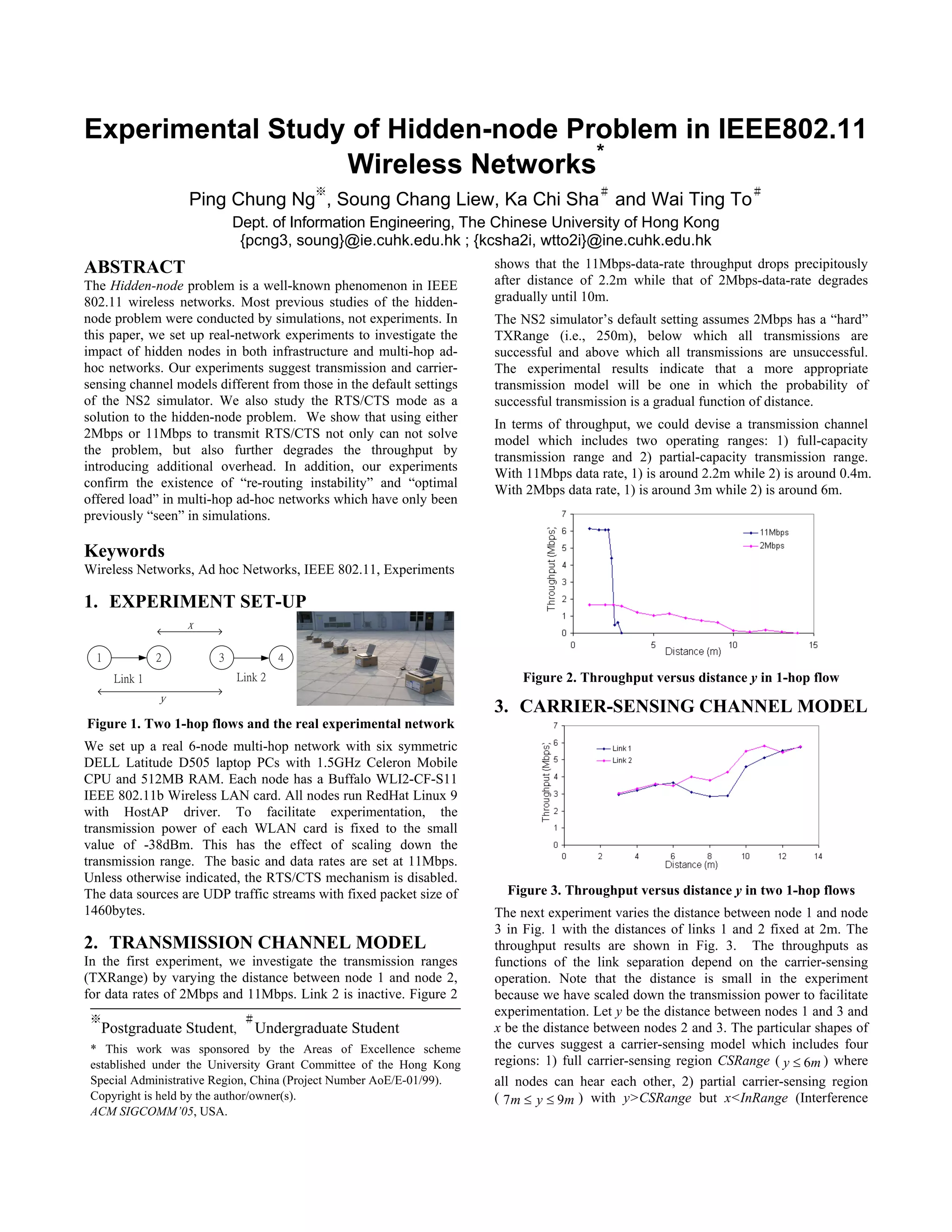
ABSTRACT                                                              shows that the 11Mbps-data-rate throughput drops precipitously
The Hidden-node problem is a well-known phenomenon in IEEE            after distance of 2.2m while that of 2Mbps-data-rate degrades
802.11 wireless networks. Most previous studies of the hidden-        gradually until 10m.
node problem were conducted by simulations, not experiments. In       The NS2 simulator’s default setting assumes 2Mbps has a “hard”
this paper, we set up real-network experiments to investigate the     TXRange (i.e., 250m), below which all transmissions are
impact of hidden nodes in both infrastructure and multi-hop ad-       successful and above which all transmissions are unsuccessful.
hoc networks. Our experiments suggest transmission and carrier-       The experimental results indicate that a more appropriate
sensing channel models different from those in the default settings   transmission model will be one in which the probability of
of the NS2 simulator. We also study the RTS/CTS mode as a             successful transmission is a gradual function of distance.
solution to the hidden-node problem. We show that using either
                                                                      In terms of throughput, we could devise a transmission channel
2Mbps or 11Mbps to transmit RTS/CTS not only can not solve
                                                                      model which includes two operating ranges: 1) full-capacity
the problem, but also further degrades the throughput by
                                                                      transmission range and 2) partial-capacity transmission range.
introducing additional overhead. In addition, our experiments
                                                                      With 11Mbps data rate, 1) is around 2.2m while 2) is around 0.4m.
confirm the existence of “re-routing instability” and “optimal
                                                                      With 2Mbps data rate, 1) is around 3m while 2) is around 6m.
offered load” in multi-hop ad-hoc networks which have only been
previously “seen” in simulations.

Keywords
Wireless Networks, Ad hoc Networks, IEEE 802.11, Experiments

1. EXPERIMENT SET-UP


                                                                          Figure 2. Throughput versus distance y in 1-hop flow

                                                                      3. CARRIER-SENSING CHANNEL MODEL
Figure 1. Two 1-hop flows and the real experimental network
We set up a real 6-node multi-hop network with six symmetric
DELL Latitude D505 laptop PCs with 1.5GHz Celeron Mobile
CPU and 512MB RAM. Each node has a Buffalo WLI2-CF-S11
IEEE 802.11b Wireless LAN card. All nodes run RedHat Linux 9
with HostAP driver. To facilitate experimentation, the
transmission power of each WLAN card is fixed to the small
value of -38dBm. This has the effect of scaling down the
transmission range. The basic and data rates are set at 11Mbps.
Unless otherwise indicated, the RTS/CTS mechanism is disabled.
The data sources are UDP traffic streams with fixed packet size of      Figure 3. Throughput versus distance y in two 1-hop flows
1460bytes.                                                            The next experiment varies the distance between node 1 and node
                                                                      3 in Fig. 1 with the distances of links 1 and 2 fixed at 2m. The
2. TRANSMISSION CHANNEL MODEL                                         throughput results are shown in Fig. 3. The throughputs as
In the first experiment, we investigate the transmission ranges       functions of the link separation depend on the carrier-sensing
(TXRange) by varying the distance between node 1 and node 2,          operation. Note that the distance is small in the experiment
for data rates of 2Mbps and 11Mbps. Link 2 is inactive. Figure 2      because we have scaled down the transmission power to facilitate
 ※                          #
                                                                      experimentation. Let y be the distance between nodes 1 and 3 and
   Postgraduate Student,      Undergraduate Student                   x be the distance between nodes 2 and 3. The particular shapes of
 * This work was sponsored by the Areas of Excellence scheme          the curves suggest a carrier-sensing model which includes four
 established under the University Grant Committee of the Hong Kong    regions: 1) full carrier-sensing region CSRange ( y ≤ 6m ) where
 Special Administrative Region, China (Project Number AoE/E-01/99).   all nodes can hear each other, 2) partial carrier-sensing region
 Copyright is held by the author/owner(s).                            ( 7m ≤ y ≤ 9m ) with y>CSRange but x<InRange (Interference
 ACM SIGCOMM’05, USA.
Range), 3) partial carrier-sensing region ( 10m ≤ y ≤ 12m ) with
y>CSRange and CSRange>x>InRange, and 4) decoupled region
( y > 12m ) where all nodes can not sense each other. In region 3),
the arrival orders of signals determine whether a signal can be
received successfully.
Figure 4 shows the simulation results of NS2 with default settings.
The nodes of each link are separated by 250m. From Fig. 4, four                a.
regions can also be observed. However, all of them have
deterministic barriers. These “hard” regions do not exist in real-
network experiments as shown by Fig. 3. Thus, we believe a
probabilistic model in which the probability of carrier-sensing is a
gradual function of distance will be a more accurate model. In
addition, the throughputs of link 1 in region 2) ( 560m ≤ y ≤ 690m )
severely degrade to zero which are different from experimental
results. Due to space limitation, we defer detailed explanations of
our transmission and carrier-sensing channel models to the final                 b.
poster.                                                                   Figure 6. Throughput versus time a) with and b) without
                                                                                         AODV routing protocol

                                                                       6. OPTIMAL OFFERED LOAD


Figure 4. Simulation results of throughput versus distance y in
                       two 1-hop flows                                  Figure 7. End-to-end throughput versus offered load in a 6-
                                                                                                node flow
4. RTS/CTS                                                             Reference [2] proposed to control the offered load at the source of
                                                                       a multi-hop traffic flow to eliminate high packet-loss rate and
                                                                       unfairness problems due to self interference. The existence of an
                                                                       “optimal offered load” was derived by simulation and analysis.
                                                                       However, it is not clear whether this exists in real multi-hop
                                                                       networks. Here, we set up a 6-node multi-hop ad-hoc network and
a.                                b.                                   our experiment confirms the results of [2]. As shown in Fig. 7, the
Figure 5. Throughput versus distance y when using a) 2Mbps             experimental optimal offered load is obtained at 1.25Mbps.
          and b) 11Mbps for transmitting RTS/CTS                       Beyond this value, the offered load is unsustainable – high
                                                                       packet-loss rate is incurred and the throughput obtained is lower
Next, we turn on the RTS/CTS mechanism. Figures 5a and 5b              than the maximum possible throughput.
show that using either 2Mbps or 11Mbps to transmit RTS/CTS
can not prevent the hidden-terminal problem since RTS from             7. CONCLUSION
node 1 will collide with DATA from node 3 at node 2. In addition,      We have performed experiments to verify 1) the existence of
the RTS/CTS mechanism introduces additional overheads. The             throughput degradation and re-routing instability due to the
throughput of link 1 degrades to less than 2Mbps, which is even        hidden-node problem, 2) the ineffectiveness of RTS/CTS to solve
worse than that without RTS/CTS.                                       the problem, and 3) the existence of an optimal offered load in a
                                                                       self-interfered multi-hop traffic flow. All these results have only
5. RE-ROUTING INSTABILITY                                              previously been demonstrated in simulations and analyses.
Reference [1] reported the “re-routing instability” problem in         Besides confirmation of the above results, additional experiments
wireless ad-hoc networks observed from simulation. Here we             by us suggest transmission and carrier-sensing models that differ
investigate whether such instability occurs in real networks. In       from the default settings in the popular NS2 simulator. Due to
this experiment, both links 1 and 2 use AODV as the routing            space limitation, we defer most details of our work to the final
protocol. Figure 6a shows link 2 breaks down for 10 seconds from       poster.
50ths to 60ths due to the triggering of the re-routing function in
AODV. The associated throughput oscillations are not acceptable        8. REFERENCE
for real-time applications such as video conferencing and voice        [1] P. C. Ng, S. C. Liew, “Re-routing Instability in IEEE 802.11 Multi-hop
over IP. When AODV is turned off, as shown in Fig. 6b, link 1          Ad-hoc Networks”, IEEE WLN’04, Nov. 2004, Tampa, USA.
has a relatively more stable throughput, although the hidden-node      [2] P. C. Ng, S. C. Liew, “Offered Load Control in IEEE 802.11 Multi-hop
phenomenon still exists.                                               Ad-hoc Networks”, IEEE MASS’04, Nov. 2004, Florida, USA.

Hn analysis

  • 1.
    Experimental Study ofHidden-node Problem in IEEE802.11 * Wireless Networks ※ # # Ping Chung Ng , Soung Chang Liew, Ka Chi Sha and Wai Ting To Dept. of Information Engineering, The Chinese University of Hong Kong {pcng3, soung}@ie.cuhk.edu.hk ; {kcsha2i, wtto2i}@ine.cuhk.edu.hk ABSTRACT shows that the 11Mbps-data-rate throughput drops precipitously The Hidden-node problem is a well-known phenomenon in IEEE after distance of 2.2m while that of 2Mbps-data-rate degrades 802.11 wireless networks. Most previous studies of the hidden- gradually until 10m. node problem were conducted by simulations, not experiments. In The NS2 simulator’s default setting assumes 2Mbps has a “hard” this paper, we set up real-network experiments to investigate the TXRange (i.e., 250m), below which all transmissions are impact of hidden nodes in both infrastructure and multi-hop ad- successful and above which all transmissions are unsuccessful. hoc networks. Our experiments suggest transmission and carrier- The experimental results indicate that a more appropriate sensing channel models different from those in the default settings transmission model will be one in which the probability of of the NS2 simulator. We also study the RTS/CTS mode as a successful transmission is a gradual function of distance. solution to the hidden-node problem. We show that using either In terms of throughput, we could devise a transmission channel 2Mbps or 11Mbps to transmit RTS/CTS not only can not solve model which includes two operating ranges: 1) full-capacity the problem, but also further degrades the throughput by transmission range and 2) partial-capacity transmission range. introducing additional overhead. In addition, our experiments With 11Mbps data rate, 1) is around 2.2m while 2) is around 0.4m. confirm the existence of “re-routing instability” and “optimal With 2Mbps data rate, 1) is around 3m while 2) is around 6m. offered load” in multi-hop ad-hoc networks which have only been previously “seen” in simulations. Keywords Wireless Networks, Ad hoc Networks, IEEE 802.11, Experiments 1. EXPERIMENT SET-UP Figure 2. Throughput versus distance y in 1-hop flow 3. CARRIER-SENSING CHANNEL MODEL Figure 1. Two 1-hop flows and the real experimental network We set up a real 6-node multi-hop network with six symmetric DELL Latitude D505 laptop PCs with 1.5GHz Celeron Mobile CPU and 512MB RAM. Each node has a Buffalo WLI2-CF-S11 IEEE 802.11b Wireless LAN card. All nodes run RedHat Linux 9 with HostAP driver. To facilitate experimentation, the transmission power of each WLAN card is fixed to the small value of -38dBm. This has the effect of scaling down the transmission range. The basic and data rates are set at 11Mbps. Unless otherwise indicated, the RTS/CTS mechanism is disabled. The data sources are UDP traffic streams with fixed packet size of Figure 3. Throughput versus distance y in two 1-hop flows 1460bytes. The next experiment varies the distance between node 1 and node 3 in Fig. 1 with the distances of links 1 and 2 fixed at 2m. The 2. TRANSMISSION CHANNEL MODEL throughput results are shown in Fig. 3. The throughputs as In the first experiment, we investigate the transmission ranges functions of the link separation depend on the carrier-sensing (TXRange) by varying the distance between node 1 and node 2, operation. Note that the distance is small in the experiment for data rates of 2Mbps and 11Mbps. Link 2 is inactive. Figure 2 because we have scaled down the transmission power to facilitate ※ # experimentation. Let y be the distance between nodes 1 and 3 and Postgraduate Student, Undergraduate Student x be the distance between nodes 2 and 3. The particular shapes of * This work was sponsored by the Areas of Excellence scheme the curves suggest a carrier-sensing model which includes four established under the University Grant Committee of the Hong Kong regions: 1) full carrier-sensing region CSRange ( y ≤ 6m ) where Special Administrative Region, China (Project Number AoE/E-01/99). all nodes can hear each other, 2) partial carrier-sensing region Copyright is held by the author/owner(s). ( 7m ≤ y ≤ 9m ) with y>CSRange but x<InRange (Interference ACM SIGCOMM’05, USA.
  • 2.
    Range), 3) partialcarrier-sensing region ( 10m ≤ y ≤ 12m ) with y>CSRange and CSRange>x>InRange, and 4) decoupled region ( y > 12m ) where all nodes can not sense each other. In region 3), the arrival orders of signals determine whether a signal can be received successfully. Figure 4 shows the simulation results of NS2 with default settings. The nodes of each link are separated by 250m. From Fig. 4, four a. regions can also be observed. However, all of them have deterministic barriers. These “hard” regions do not exist in real- network experiments as shown by Fig. 3. Thus, we believe a probabilistic model in which the probability of carrier-sensing is a gradual function of distance will be a more accurate model. In addition, the throughputs of link 1 in region 2) ( 560m ≤ y ≤ 690m ) severely degrade to zero which are different from experimental results. Due to space limitation, we defer detailed explanations of our transmission and carrier-sensing channel models to the final b. poster. Figure 6. Throughput versus time a) with and b) without AODV routing protocol 6. OPTIMAL OFFERED LOAD Figure 4. Simulation results of throughput versus distance y in two 1-hop flows Figure 7. End-to-end throughput versus offered load in a 6- node flow 4. RTS/CTS Reference [2] proposed to control the offered load at the source of a multi-hop traffic flow to eliminate high packet-loss rate and unfairness problems due to self interference. The existence of an “optimal offered load” was derived by simulation and analysis. However, it is not clear whether this exists in real multi-hop networks. Here, we set up a 6-node multi-hop ad-hoc network and a. b. our experiment confirms the results of [2]. As shown in Fig. 7, the Figure 5. Throughput versus distance y when using a) 2Mbps experimental optimal offered load is obtained at 1.25Mbps. and b) 11Mbps for transmitting RTS/CTS Beyond this value, the offered load is unsustainable – high packet-loss rate is incurred and the throughput obtained is lower Next, we turn on the RTS/CTS mechanism. Figures 5a and 5b than the maximum possible throughput. show that using either 2Mbps or 11Mbps to transmit RTS/CTS can not prevent the hidden-terminal problem since RTS from 7. CONCLUSION node 1 will collide with DATA from node 3 at node 2. In addition, We have performed experiments to verify 1) the existence of the RTS/CTS mechanism introduces additional overheads. The throughput degradation and re-routing instability due to the throughput of link 1 degrades to less than 2Mbps, which is even hidden-node problem, 2) the ineffectiveness of RTS/CTS to solve worse than that without RTS/CTS. the problem, and 3) the existence of an optimal offered load in a self-interfered multi-hop traffic flow. All these results have only 5. RE-ROUTING INSTABILITY previously been demonstrated in simulations and analyses. Reference [1] reported the “re-routing instability” problem in Besides confirmation of the above results, additional experiments wireless ad-hoc networks observed from simulation. Here we by us suggest transmission and carrier-sensing models that differ investigate whether such instability occurs in real networks. In from the default settings in the popular NS2 simulator. Due to this experiment, both links 1 and 2 use AODV as the routing space limitation, we defer most details of our work to the final protocol. Figure 6a shows link 2 breaks down for 10 seconds from poster. 50ths to 60ths due to the triggering of the re-routing function in AODV. The associated throughput oscillations are not acceptable 8. REFERENCE for real-time applications such as video conferencing and voice [1] P. C. Ng, S. C. Liew, “Re-routing Instability in IEEE 802.11 Multi-hop over IP. When AODV is turned off, as shown in Fig. 6b, link 1 Ad-hoc Networks”, IEEE WLN’04, Nov. 2004, Tampa, USA. has a relatively more stable throughput, although the hidden-node [2] P. C. Ng, S. C. Liew, “Offered Load Control in IEEE 802.11 Multi-hop phenomenon still exists. Ad-hoc Networks”, IEEE MASS’04, Nov. 2004, Florida, USA.