http://www.iaeme.com/IJEET/index.asp 169 editor@iaeme.com
International Journal of Electrical Engineering & Technology (IJEET)
Volume 7, Issue 3, May–June, 2016, pp.169–179, Article ID: IJEET_07_03_014
Available online at
http://www.iaeme.com/ijeet/issues.asp?JType=IJEET&VType=7&IType=3
ISSN Print: 0976-6545 and ISSN Online: 0976-6553
Journal Impact Factor (2016): 8.1891 (Calculated by GISI) www.jifactor.com
© IAEME Publication
DYNAMIC STABILITY ENHANCEMENT IN
MULTIMACHINE POWER SYSTEMS BY
DIFFERENT FACTS DEVICE
Muqueem M Khan
PG Student [EPS], Dept. of Electrical, SSBT’s COET
Bambhori, Jalgaon, Maharashtra, India
M M Ansari
Assistant Professor, Dept. of Electrical, SSBT’s COET,
Bambhori, Jalgaon, Maharashtra, India
ABSTRACT
Modern Power system are becoming increasingly stressed due to
increasing demand of electricity and restriction on new transmission network
.This effect of power network is that transmission power loss increases and
decreasing power transmission capability of network. And also stability of
synchronous alternator is lost. There are electronic based FACTS (Flexible
AC Transmission system) devises is established to enhance the power
transmitting capacity. A major important function of FACTS devises is to
enhanced power transmission capacity of power system network without
increasing power generation capacity of power system. Because system
voltage is inversely proportional to transmission loses. Hence system voltage
increases by connecting different FACTS devises in the system then overall
loses of power transmission reduces. Stability enhancement is also important
function of FACTS devises. In this paper we analyses the performance of
different power system stabilizer at the time of fault occur in the power
transmission network, and comprised the performance of different FACTS
controller that which one is best for technical point of view.
Key words: Flexible AC Transmission Systems (FACTS), FACTS
Controllers, STATCOM, SVC, Power Systems, Power System Stability,
Transient Stability, Voltage Stability. SSSC, TCSC
Cite this Article: Muqueem M Khan and M M Ansari, Dynamic Stability
Enhancement In Multimachine Power Systems by Different Facts Device.
International Journal of Electrical Engineering & Technology, 7(3), 2016, pp.
169–179.
http://www.iaeme.com/ijeet/issues.asp?JType=IJEET&VType=7&IType=3
Muqueem M Khan and M M Ansari
http://www.iaeme.com/IJEET/index.asp 170 editor@iaeme.com
1. INTRODUCTION
A generating power station in allover world are interconnected to each other due to
obtaining integrity of power of power ie,whenever a fault occur in any one of the line
or any one plant of power station is shutdown so continuous power is to be taken from
another generating power plant. But due to interconnected system electromechanical
oscillation is introduce. Also increasing loading condition and interconnection the
transmission system become weak and inadequate, and load characteristics added to
the problem causing oscillation. These uncontrolled electromechanical oscillation
may responsible to total or partial power interruption [1].
The basic static var compensator (SVC) controls strategies to enhancing the
dynamic and transient stabilities in simple two machine system [3]. The control
aspects of Thyristor Controlled Series Capacitor (TCSC) to schedule line power and
damp system oscillation in a single machine Infinite Bus (SMIB) system was
analyzed in [4]. The model of Static Synchronous Compensator (STASCOM) for
voltage and angle stability studied in [5]. The impact of static synchronous series
compensator (SSSC) control mode on the small signal and transient stability of a
single machine infinite bus was established in [6]. The efficiency of STATCOM and
SSSC controllers in improving the damping power and synchronizing of SMIB was
investigated [7]. The interfacing technique and modeling of TCSC and SVC for a long
term dynamic simulation was studied in [8]. The Phillips heffron model of the
multimachine power system was used for analyzing the small signal stability with
Unified power flow Controller (UPFC) in [9]. Speed deviation signal was used as the
damping controller input. Damping impotent in SMIB system using SSSC and
STATCOM was established using energy function method [10]. The dynamic
behavior of source convertor based FACTS devices for simulation studied was
discussed in [11]. The concept of induced synchronizing and damping torque due to
SVC based stabilizer in a multimachine power system is elaborated in [11,12].
2. CLASSIFICATION OF FACTS DEVICES
Figure 1 Classification of FACTS devices [13]
FACTS
Series compensation Shunt compensation
TCSC STATCOMSSSS SVC
Combined Series-Shunt
Compensator
TCR TSR TSC
UPFC
Dynamic Stability Enhancement In Multimachine Power Systems by Different Facts Device
http://www.iaeme.com/IJEET/index.asp 171 editor@iaeme.com
STATIC VAR COMPENSATOR (SVC)
A shunt connected static VAR absorber whose output is adjusted to exchange
capacitive or inductive current so as to control specific parameter of electrical power
system.
STATIC SYNCHRONOUS COMPENSATOR (STATCOM)
Static synchronous compensator operated as shunt connected devices whose
capacitive or inductive output current current can be controlled independent of the ac
system voltage.
THYRISTOR CONTROLLED SERIES CAPACITOR (TCSC)
A capacitive reactor compensator which consists of series capacitor bank shunted by a
thyristor controlled reactor in order to provide a smooth variable series capacitive
reactor.
STATIC SERIES SYNCHRONOUS COMPENSATOR (SSSC)
Static Series Synchronous Compensator is operated without an external electric
energy source as a series compensator whose output voltage is an quadrature with and
controllable independently of, the line current for the purpose of increasing or
decreasing the overall reactive voltage drop across the line and controlling the
transmission power. SSSC operation like STATCOM but its output voltage is in
series with the line.
UNIFIED POWER FLOW CONTROLLER (UPFC)
A combination of static synchronous compensator (STATCOM) and Static series
compensator (SSSC) connected via DC link to pass flow of real power between the
series output terminal of SSSC and shunt output terminal of STATCOM.
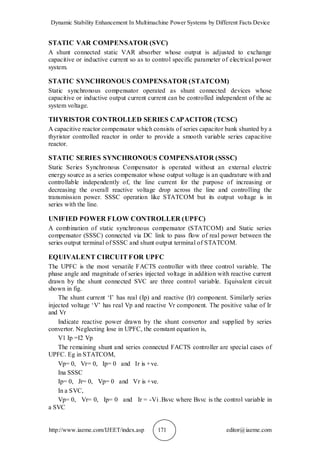
EQUIVALENT CIRCUIT FOR UPFC
The UPFC is the most versatile FACTS controller with three control variable. The
phase angle and magnitude of series injected voltage in addition with reactive current
drawn by the shunt connected SVC are three control variable. Equivalent circuit
shown in fig.
The shunt current ‘I’ has real (Ip) and reactive (Ir) component. Similarly series
injected voltage ‘V’ has real Vp and reactive Vr component. The positive value of Ir
and Vr
Indicate reactive power drawn by the shunt convertor and supplied by series
convertor. Neglecting lose in UPFC, the constant equation is,
V1 Ip =I2 Vp
The remaining shunt and series connected FACTS controller are special cases of
UPFC. Eg in STATCOM,
Vp= 0, Vr= 0, Ip= 0 and Ir is +ve.
Ina SSSC
Ip= 0, Jr= 0, Vp= 0 and Vr is +ve.
In a SVC,
Vp= 0, Vr= 0, Ip= 0 and Ir = -Vi .Bsvc where Bsvc is the control variable in
a SVC
Muqueem M Khan and M M Ansari
http://www.iaeme.com/IJEET/index.asp 172 editor@iaeme.com
Figure 2 Equivalent circuit of UPFC
3. POWER SYSTEM STABILITY
Stability of power system is the ability of system to remain in synchronism when
several faults occur in the system. It may be classified into three categories.
 Rotor Angle Stability
 Voltage Stability
 Frequency Stability
4. SYSTEM MODELLING
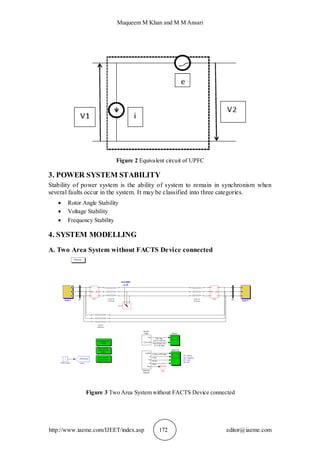
A. Two Area System without FACTS Device connected
Figure 3 Two Area System without FACTS Device connected
Dynamic Stability Enhancement In Multimachine Power Systems by Different Facts Device
http://www.iaeme.com/IJEET/index.asp 173 editor@iaeme.com
Graph 1 Rotor Angle, Power, Terminal Voltage Vs. time
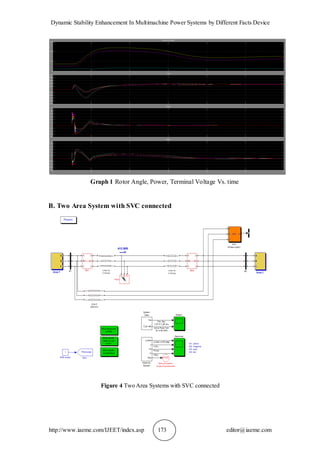
B. Two Area System with SVC connected
Figure 4 Two Area Systems with SVC connected
Muqueem M Khan and M M Ansari
http://www.iaeme.com/IJEET/index.asp 174 editor@iaeme.com
Graph 2 Rotor Angle, Power, Terminal Voltage Vs. time
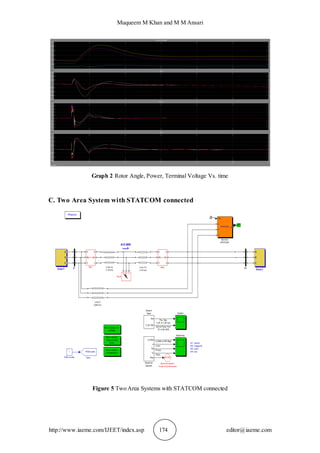
C. Two Area System with STATCOM connected
Figure 5 Two Area Systems with STATCOM connected
Dynamic Stability Enhancement In Multimachine Power Systems by Different Facts Device
http://www.iaeme.com/IJEET/index.asp 175 editor@iaeme.com
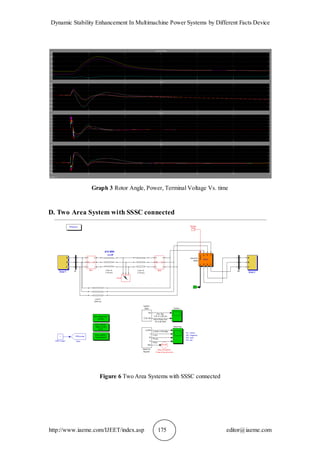
Graph 3 Rotor Angle, Power, Terminal Voltage Vs. time
D. Two Area System with SSSC connected
Figure 6 Two Area Systems with SSSC connected
Muqueem M Khan and M M Ansari
http://www.iaeme.com/IJEET/index.asp 176 editor@iaeme.com
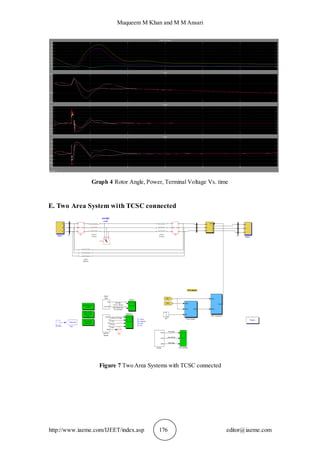
Graph 4 Rotor Angle, Power, Terminal Voltage Vs. time
E. Two Area System with TCSC connected
Figure 7 Two Area Systems with TCSC connected
Dynamic Stability Enhancement In Multimachine Power Systems by Different Facts Device
http://www.iaeme.com/IJEET/index.asp 177 editor@iaeme.com
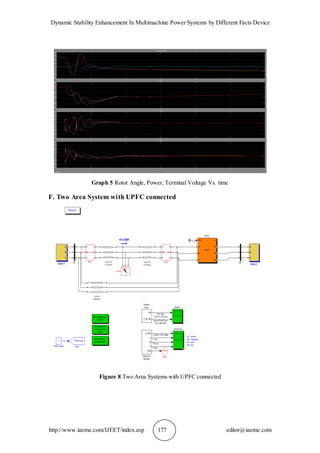
Graph 5 Rotor Angle, Power, Terminal Voltage Vs. time
F. Two Area System with UPFC connected
Figure 8 Two Area Systems with UPFC connected
Muqueem M Khan and M M Ansari
http://www.iaeme.com/IJEET/index.asp 178 editor@iaeme.com
Graph 6 Rotor Angle, Power, Terminal Voltage Vs. time
5. CONCLUSION
The analysis of different FACTS devises is carried out. In this analysis we conclude
that different FACTS devises is beneficial to power system network when a fault
occur in the system. The power electronics controller act quite fast and hence regulate
voltage and power flow during steady sate and dynamic condition. In shunt connected
FACTS controller we conclude that STATCOM give better performance than SVC,
and in series connected FACTS device SSSC give fast performance than other. And
critical clearing time for TCSC is minimum The increasing use of FACTS controller
in future is guaranteed.
REFERANCES
[1] P. Kundur, Power System Stability and Control, McGraw-Hill, 1994.
[2] R. Mohan Mathur, Rajiv K. Varma, Thyristor-Based FACTS Controllers for
Electrical Transmission Systems, IEEE Press, John Wiley & Sons, 2002.
[3] A.E.Hammad, Analysis of Power System Stability Enhancement by Static Var
Compensators, IEEETrans. Power Syst., 1(4), pp.222–228, Nov 1986.
[4] Nelson Martins, Herminio J.C.P. Pinto, John J.Paserba, Using a tcsc for line
power scheduling and system oscillation damping- small signal and transient
stability studies, IEEE Power Engineering Society Winter Meeting, 2(2), pp.
1455–1461, 2000.
[5] Claudio A. Canizares, Massimo Pozzi, Sandro Corsi, Edvina Uzunovic, Statcom
modeling for voltage and angle stability studies, Electric Power & Energy
Systems, 25(6), pp.431-441, 2003.
[6] M.S.Castro, H.M.Ayres, V.F.da Costa, L.C.P.da Silva, Impacts of the SSSC
control modes on small-signal and transient stability of a power system, Electric
Power Systems Research, 77(1), pp.1–9, 2007.
Dynamic Stability Enhancement In Multimachine Power Systems by Different Facts Device
http://www.iaeme.com/IJEET/index.asp 179 editor@iaeme.com
[7] Fawzi Al-Jowder, Improvement of synchronizing power and damping power by
means of sssc and statcom: A comparative study, Electric Power Systems
Research, 77(8), pp.1112–1117, 2007.
[8] K.Keerthivasan, V.Sharmila Deve, Jovitha Jerome and R.Ramanujam, Modeling
of svc and tcsc for power system dynamic simulation, IEEE Seventh Intl. Conf.
on Power Engineering, pp.696–700, 2005.
[9] H.Wang, A unified Model for the analysis of FACTS devices in damping power
system oscillations- Part III: unified power flow Controller, IEEE Trans. Power
Delivery, 15(3), July 2000.
[10] M.H.Haque, Damping improvement by facts devices: A comparison between
statcom and sssc, Electric Power Systems Research, 76(9–10), pp.865– 872,
2007.
[11] W.Freitas and A.Morelato, A generalized current injection approach for modeling
of FACTS in power system dynamic simulation, IEEE Seventh International
Conf. ACDC Power Transmission, pp.175–180, 2001.
[12] G.Kumar, P.S.Raju, Study of Dstatcom In Improved Custom Power Park For
Power Quality Improvement. International Journal of Electrical Engineering &
Technology, 2(2), 2012, pp. 12–20.
[13] Youssef A. Mobarak, Rabigh, SVC, Statcom, and Transmission Line Rating
Enhancments on Induction Generator Driven by Wind Turbine. International
Journal of Electrical Engineering & Technology,3(1), 2012, pp. 326–343.
[14] Dr Naarisetti Srinivasa Rao and Dasam Srinivas, An Experimental Design To
Improve Power Quality on Statcom. International Journal of Electrical
Engineering & Technology, 4(5), 2013, pp. 96–103.
[15] Michael J.Gibbard, David j.Vowles, Pouyan Pourbeik, Interactions between, and
effectiveness of power system stabilizers and facts device stabilizers in
multimachine systems, IEEE Trans. on Power Syst., 15(2), pp 748–755, 2000.
[16] P D Kothari, I J Nagrath, Modern Power System Analysis, Fourth Edition, Mc
Graw Hill.

DYNAMIC STABILITY ENHANCEMENT IN MULTIMACHINE POWER SYSTEMS BY DIFFERENT FACTS DEVICE

  • 1.
    http://www.iaeme.com/IJEET/index.asp 169 editor@iaeme.com InternationalJournal of Electrical Engineering & Technology (IJEET) Volume 7, Issue 3, May–June, 2016, pp.169–179, Article ID: IJEET_07_03_014 Available online at http://www.iaeme.com/ijeet/issues.asp?JType=IJEET&VType=7&IType=3 ISSN Print: 0976-6545 and ISSN Online: 0976-6553 Journal Impact Factor (2016): 8.1891 (Calculated by GISI) www.jifactor.com © IAEME Publication DYNAMIC STABILITY ENHANCEMENT IN MULTIMACHINE POWER SYSTEMS BY DIFFERENT FACTS DEVICE Muqueem M Khan PG Student [EPS], Dept. of Electrical, SSBT’s COET Bambhori, Jalgaon, Maharashtra, India M M Ansari Assistant Professor, Dept. of Electrical, SSBT’s COET, Bambhori, Jalgaon, Maharashtra, India ABSTRACT Modern Power system are becoming increasingly stressed due to increasing demand of electricity and restriction on new transmission network .This effect of power network is that transmission power loss increases and decreasing power transmission capability of network. And also stability of synchronous alternator is lost. There are electronic based FACTS (Flexible AC Transmission system) devises is established to enhance the power transmitting capacity. A major important function of FACTS devises is to enhanced power transmission capacity of power system network without increasing power generation capacity of power system. Because system voltage is inversely proportional to transmission loses. Hence system voltage increases by connecting different FACTS devises in the system then overall loses of power transmission reduces. Stability enhancement is also important function of FACTS devises. In this paper we analyses the performance of different power system stabilizer at the time of fault occur in the power transmission network, and comprised the performance of different FACTS controller that which one is best for technical point of view. Key words: Flexible AC Transmission Systems (FACTS), FACTS Controllers, STATCOM, SVC, Power Systems, Power System Stability, Transient Stability, Voltage Stability. SSSC, TCSC Cite this Article: Muqueem M Khan and M M Ansari, Dynamic Stability Enhancement In Multimachine Power Systems by Different Facts Device. International Journal of Electrical Engineering & Technology, 7(3), 2016, pp. 169–179. http://www.iaeme.com/ijeet/issues.asp?JType=IJEET&VType=7&IType=3
  • 2.
    Muqueem M Khanand M M Ansari http://www.iaeme.com/IJEET/index.asp 170 editor@iaeme.com 1. INTRODUCTION A generating power station in allover world are interconnected to each other due to obtaining integrity of power of power ie,whenever a fault occur in any one of the line or any one plant of power station is shutdown so continuous power is to be taken from another generating power plant. But due to interconnected system electromechanical oscillation is introduce. Also increasing loading condition and interconnection the transmission system become weak and inadequate, and load characteristics added to the problem causing oscillation. These uncontrolled electromechanical oscillation may responsible to total or partial power interruption [1]. The basic static var compensator (SVC) controls strategies to enhancing the dynamic and transient stabilities in simple two machine system [3]. The control aspects of Thyristor Controlled Series Capacitor (TCSC) to schedule line power and damp system oscillation in a single machine Infinite Bus (SMIB) system was analyzed in [4]. The model of Static Synchronous Compensator (STASCOM) for voltage and angle stability studied in [5]. The impact of static synchronous series compensator (SSSC) control mode on the small signal and transient stability of a single machine infinite bus was established in [6]. The efficiency of STATCOM and SSSC controllers in improving the damping power and synchronizing of SMIB was investigated [7]. The interfacing technique and modeling of TCSC and SVC for a long term dynamic simulation was studied in [8]. The Phillips heffron model of the multimachine power system was used for analyzing the small signal stability with Unified power flow Controller (UPFC) in [9]. Speed deviation signal was used as the damping controller input. Damping impotent in SMIB system using SSSC and STATCOM was established using energy function method [10]. The dynamic behavior of source convertor based FACTS devices for simulation studied was discussed in [11]. The concept of induced synchronizing and damping torque due to SVC based stabilizer in a multimachine power system is elaborated in [11,12]. 2. CLASSIFICATION OF FACTS DEVICES Figure 1 Classification of FACTS devices [13] FACTS Series compensation Shunt compensation TCSC STATCOMSSSS SVC Combined Series-Shunt Compensator TCR TSR TSC UPFC
  • 3.
    Dynamic Stability EnhancementIn Multimachine Power Systems by Different Facts Device http://www.iaeme.com/IJEET/index.asp 171 editor@iaeme.com STATIC VAR COMPENSATOR (SVC) A shunt connected static VAR absorber whose output is adjusted to exchange capacitive or inductive current so as to control specific parameter of electrical power system. STATIC SYNCHRONOUS COMPENSATOR (STATCOM) Static synchronous compensator operated as shunt connected devices whose capacitive or inductive output current current can be controlled independent of the ac system voltage. THYRISTOR CONTROLLED SERIES CAPACITOR (TCSC) A capacitive reactor compensator which consists of series capacitor bank shunted by a thyristor controlled reactor in order to provide a smooth variable series capacitive reactor. STATIC SERIES SYNCHRONOUS COMPENSATOR (SSSC) Static Series Synchronous Compensator is operated without an external electric energy source as a series compensator whose output voltage is an quadrature with and controllable independently of, the line current for the purpose of increasing or decreasing the overall reactive voltage drop across the line and controlling the transmission power. SSSC operation like STATCOM but its output voltage is in series with the line. UNIFIED POWER FLOW CONTROLLER (UPFC) A combination of static synchronous compensator (STATCOM) and Static series compensator (SSSC) connected via DC link to pass flow of real power between the series output terminal of SSSC and shunt output terminal of STATCOM. EQUIVALENT CIRCUIT FOR UPFC The UPFC is the most versatile FACTS controller with three control variable. The phase angle and magnitude of series injected voltage in addition with reactive current drawn by the shunt connected SVC are three control variable. Equivalent circuit shown in fig. The shunt current ‘I’ has real (Ip) and reactive (Ir) component. Similarly series injected voltage ‘V’ has real Vp and reactive Vr component. The positive value of Ir and Vr Indicate reactive power drawn by the shunt convertor and supplied by series convertor. Neglecting lose in UPFC, the constant equation is, V1 Ip =I2 Vp The remaining shunt and series connected FACTS controller are special cases of UPFC. Eg in STATCOM, Vp= 0, Vr= 0, Ip= 0 and Ir is +ve. Ina SSSC Ip= 0, Jr= 0, Vp= 0 and Vr is +ve. In a SVC, Vp= 0, Vr= 0, Ip= 0 and Ir = -Vi .Bsvc where Bsvc is the control variable in a SVC
  • 4.
    Muqueem M Khanand M M Ansari http://www.iaeme.com/IJEET/index.asp 172 editor@iaeme.com Figure 2 Equivalent circuit of UPFC 3. POWER SYSTEM STABILITY Stability of power system is the ability of system to remain in synchronism when several faults occur in the system. It may be classified into three categories.  Rotor Angle Stability  Voltage Stability  Frequency Stability 4. SYSTEM MODELLING A. Two Area System without FACTS Device connected Figure 3 Two Area System without FACTS Device connected
  • 5.
    Dynamic Stability EnhancementIn Multimachine Power Systems by Different Facts Device http://www.iaeme.com/IJEET/index.asp 173 editor@iaeme.com Graph 1 Rotor Angle, Power, Terminal Voltage Vs. time B. Two Area System with SVC connected Figure 4 Two Area Systems with SVC connected
  • 6.
    Muqueem M Khanand M M Ansari http://www.iaeme.com/IJEET/index.asp 174 editor@iaeme.com Graph 2 Rotor Angle, Power, Terminal Voltage Vs. time C. Two Area System with STATCOM connected Figure 5 Two Area Systems with STATCOM connected
  • 7.
    Dynamic Stability EnhancementIn Multimachine Power Systems by Different Facts Device http://www.iaeme.com/IJEET/index.asp 175 editor@iaeme.com Graph 3 Rotor Angle, Power, Terminal Voltage Vs. time D. Two Area System with SSSC connected Figure 6 Two Area Systems with SSSC connected
  • 8.
    Muqueem M Khanand M M Ansari http://www.iaeme.com/IJEET/index.asp 176 editor@iaeme.com Graph 4 Rotor Angle, Power, Terminal Voltage Vs. time E. Two Area System with TCSC connected Figure 7 Two Area Systems with TCSC connected
  • 9.
    Dynamic Stability EnhancementIn Multimachine Power Systems by Different Facts Device http://www.iaeme.com/IJEET/index.asp 177 editor@iaeme.com Graph 5 Rotor Angle, Power, Terminal Voltage Vs. time F. Two Area System with UPFC connected Figure 8 Two Area Systems with UPFC connected
  • 10.
    Muqueem M Khanand M M Ansari http://www.iaeme.com/IJEET/index.asp 178 editor@iaeme.com Graph 6 Rotor Angle, Power, Terminal Voltage Vs. time 5. CONCLUSION The analysis of different FACTS devises is carried out. In this analysis we conclude that different FACTS devises is beneficial to power system network when a fault occur in the system. The power electronics controller act quite fast and hence regulate voltage and power flow during steady sate and dynamic condition. In shunt connected FACTS controller we conclude that STATCOM give better performance than SVC, and in series connected FACTS device SSSC give fast performance than other. And critical clearing time for TCSC is minimum The increasing use of FACTS controller in future is guaranteed. REFERANCES [1] P. Kundur, Power System Stability and Control, McGraw-Hill, 1994. [2] R. Mohan Mathur, Rajiv K. Varma, Thyristor-Based FACTS Controllers for Electrical Transmission Systems, IEEE Press, John Wiley & Sons, 2002. [3] A.E.Hammad, Analysis of Power System Stability Enhancement by Static Var Compensators, IEEETrans. Power Syst., 1(4), pp.222–228, Nov 1986. [4] Nelson Martins, Herminio J.C.P. Pinto, John J.Paserba, Using a tcsc for line power scheduling and system oscillation damping- small signal and transient stability studies, IEEE Power Engineering Society Winter Meeting, 2(2), pp. 1455–1461, 2000. [5] Claudio A. Canizares, Massimo Pozzi, Sandro Corsi, Edvina Uzunovic, Statcom modeling for voltage and angle stability studies, Electric Power & Energy Systems, 25(6), pp.431-441, 2003. [6] M.S.Castro, H.M.Ayres, V.F.da Costa, L.C.P.da Silva, Impacts of the SSSC control modes on small-signal and transient stability of a power system, Electric Power Systems Research, 77(1), pp.1–9, 2007.
  • 11.
    Dynamic Stability EnhancementIn Multimachine Power Systems by Different Facts Device http://www.iaeme.com/IJEET/index.asp 179 editor@iaeme.com [7] Fawzi Al-Jowder, Improvement of synchronizing power and damping power by means of sssc and statcom: A comparative study, Electric Power Systems Research, 77(8), pp.1112–1117, 2007. [8] K.Keerthivasan, V.Sharmila Deve, Jovitha Jerome and R.Ramanujam, Modeling of svc and tcsc for power system dynamic simulation, IEEE Seventh Intl. Conf. on Power Engineering, pp.696–700, 2005. [9] H.Wang, A unified Model for the analysis of FACTS devices in damping power system oscillations- Part III: unified power flow Controller, IEEE Trans. Power Delivery, 15(3), July 2000. [10] M.H.Haque, Damping improvement by facts devices: A comparison between statcom and sssc, Electric Power Systems Research, 76(9–10), pp.865– 872, 2007. [11] W.Freitas and A.Morelato, A generalized current injection approach for modeling of FACTS in power system dynamic simulation, IEEE Seventh International Conf. ACDC Power Transmission, pp.175–180, 2001. [12] G.Kumar, P.S.Raju, Study of Dstatcom In Improved Custom Power Park For Power Quality Improvement. International Journal of Electrical Engineering & Technology, 2(2), 2012, pp. 12–20. [13] Youssef A. Mobarak, Rabigh, SVC, Statcom, and Transmission Line Rating Enhancments on Induction Generator Driven by Wind Turbine. International Journal of Electrical Engineering & Technology,3(1), 2012, pp. 326–343. [14] Dr Naarisetti Srinivasa Rao and Dasam Srinivas, An Experimental Design To Improve Power Quality on Statcom. International Journal of Electrical Engineering & Technology, 4(5), 2013, pp. 96–103. [15] Michael J.Gibbard, David j.Vowles, Pouyan Pourbeik, Interactions between, and effectiveness of power system stabilizers and facts device stabilizers in multimachine systems, IEEE Trans. on Power Syst., 15(2), pp 748–755, 2000. [16] P D Kothari, I J Nagrath, Modern Power System Analysis, Fourth Edition, Mc Graw Hill.