01010010
01000001
01001011
01001001
01000010
01010010
01000001
01001011
01001001
01000010
Dynamic Memory Allocation
Dynamic memory allocation refers to performing
manual memory management for dynamic
memory allocation in the C programming language
via a group of functions in the C standard library.
C Dynamic Memory Allocation
01010010 01000001
01001011 01001001
01000010
Why Dynamic Memory Allocation ?
In many situations the
programmer requires
greater flexibility in
managing the lifetime of
allocated memory.
01010010 01000001
01001011 01001001
01000010
As you know, an array is a collection of a fixed number of
values. Once the size of an array is declared, you cannot change
it.
Sometimes the size of the array you declared may be
insufficient. To solve this issue, you can allocate memory
manually during run-time. This is known as dynamic memory
allocation in C programming.
01010010 01000001
01001011 01001001
01000010
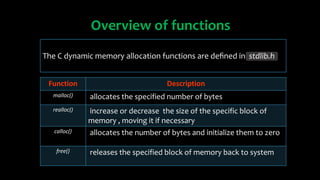
Overview of functions
Function Description
malloc() allocates the specified number of bytes
realloc() increase or decrease the size of the specific block of
memory , moving it if necessary
calloc() allocates the number of bytes and initialize them to zero
free() releases the specified block of memory back to system
The C dynamic memory allocation functions are defined in stdlib.h
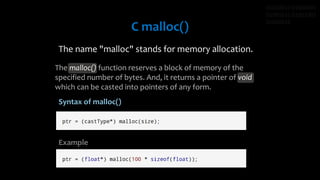
The name "malloc" stands for memory allocation.
C malloc()
01010010 01000001
01001011 01001001
01000010
Syntax of malloc()
Example
The malloc() function reserves a block of memory of the
specified number of bytes. And, it returns a pointer of void
which can be casted into pointers of any form.
The name "calloc" stands for contiguous allocation.
C calloc()
01010010 01000001
01001011 01001001
01000010
Syntax of calloc()
Example
The malloc() function allocates memory and leaves the memory
uninitialized. Whereas, the calloc() function allocates memory
and initializes all bits to zero.
C free()
01010010 01000001
01001011 01001001
01000010
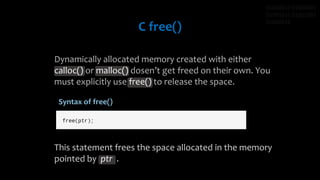
Syntax of free()
Dynamically allocated memory created with either
calloc() or malloc() dosen’t get freed on their own. You
must explicitly use free() to release the space.
This statement frees the space allocated in the memory
pointed by ptr .
C realoc()
If the dynamically allocated memory is insufficient or
more than required, you can change the size of previously
allocated memory using the realloc() function.
Syntax of realloc()
Here ptr is reallocated with a new size x .
01010010 01000001
01001011 01001001
01000010
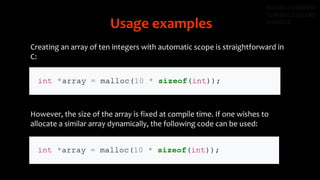
Usage examples
Creating an array of ten integers with automatic scope is straightforward in
C:
However, the size of the array is fixed at compile time. If one wishes to
allocate a similar array dynamically, the following code can be used:
01010010 01000001
01001011 01001001
01000010
Because malloc() might not be able to service the request , it might be return
a null pointer and it is good programming practice to check this:
When the program no longer needs the dynamic array, it must eventually call
free to return the memory it occupies to the free store:
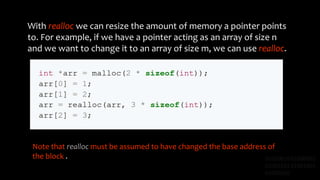
With realloc we can resize the amount of memory a pointer points
to. For example, if we have a pointer acting as an array of size n
and we want to change it to an array of size m, we can use realloc.
Note that realloc must be assumed to have changed the base address of
the block . 01010010 01000001
01001011 01001001
01000010
Example 1: malloc()
and free()
Here, we have dynamically allocated
the memory for n number of int .
01010010 01000001
01001011 01001001
01000010
Example 2: calloc()
and free()
01010010 01000001
01001011 01001001
01000010
Example 3: realloc()
When you run the program, the output will be:
01010010 01000001
01001011 01001001
01000010
THANK YOU
01010010 01000001
01001011 01001001
01000010
01010010 01000001
01001011 01001001
01000010

Dynamic memory allocation

  • 1.
  • 2.
    Dynamic memory allocationrefers to performing manual memory management for dynamic memory allocation in the C programming language via a group of functions in the C standard library. C Dynamic Memory Allocation 01010010 01000001 01001011 01001001 01000010
  • 3.
    Why Dynamic MemoryAllocation ? In many situations the programmer requires greater flexibility in managing the lifetime of allocated memory. 01010010 01000001 01001011 01001001 01000010
  • 4.
    As you know,an array is a collection of a fixed number of values. Once the size of an array is declared, you cannot change it. Sometimes the size of the array you declared may be insufficient. To solve this issue, you can allocate memory manually during run-time. This is known as dynamic memory allocation in C programming. 01010010 01000001 01001011 01001001 01000010
  • 5.
    Overview of functions FunctionDescription malloc() allocates the specified number of bytes realloc() increase or decrease the size of the specific block of memory , moving it if necessary calloc() allocates the number of bytes and initialize them to zero free() releases the specified block of memory back to system The C dynamic memory allocation functions are defined in stdlib.h
  • 6.
    The name "malloc"stands for memory allocation. C malloc() 01010010 01000001 01001011 01001001 01000010 Syntax of malloc() Example The malloc() function reserves a block of memory of the specified number of bytes. And, it returns a pointer of void which can be casted into pointers of any form.
  • 7.
    The name "calloc"stands for contiguous allocation. C calloc() 01010010 01000001 01001011 01001001 01000010 Syntax of calloc() Example The malloc() function allocates memory and leaves the memory uninitialized. Whereas, the calloc() function allocates memory and initializes all bits to zero.
  • 8.
    C free() 01010010 01000001 0100101101001001 01000010 Syntax of free() Dynamically allocated memory created with either calloc() or malloc() dosen’t get freed on their own. You must explicitly use free() to release the space. This statement frees the space allocated in the memory pointed by ptr .
  • 9.
    C realoc() If thedynamically allocated memory is insufficient or more than required, you can change the size of previously allocated memory using the realloc() function. Syntax of realloc() Here ptr is reallocated with a new size x . 01010010 01000001 01001011 01001001 01000010
  • 10.
    Usage examples Creating anarray of ten integers with automatic scope is straightforward in C: However, the size of the array is fixed at compile time. If one wishes to allocate a similar array dynamically, the following code can be used: 01010010 01000001 01001011 01001001 01000010
  • 11.
    Because malloc() mightnot be able to service the request , it might be return a null pointer and it is good programming practice to check this: When the program no longer needs the dynamic array, it must eventually call free to return the memory it occupies to the free store:
  • 12.
    With realloc wecan resize the amount of memory a pointer points to. For example, if we have a pointer acting as an array of size n and we want to change it to an array of size m, we can use realloc. Note that realloc must be assumed to have changed the base address of the block . 01010010 01000001 01001011 01001001 01000010
  • 13.
    Example 1: malloc() andfree() Here, we have dynamically allocated the memory for n number of int . 01010010 01000001 01001011 01001001 01000010
  • 14.
    Example 2: calloc() andfree() 01010010 01000001 01001011 01001001 01000010
  • 15.
    Example 3: realloc() Whenyou run the program, the output will be: 01010010 01000001 01001011 01001001 01000010
  • 16.
    THANK YOU 01010010 01000001 0100101101001001 01000010 01010010 01000001 01001011 01001001 01000010