 Memory    is the processes by which
 information is encoded, stored and
 retrieved. Encoding allow information
 that is from the outside world to reach
 our senses in the forms of chemical
 and physical stimuli.
   An alloation is something that you set
    aside for use .for instance if you want to
    set aside a certain amount of hard drive
    space for an application,you can
    allocate how much in the settings.
   The placement of blocks of information in a
    memory system is called memory
    allocation.
   To allocate memory it is necessary to keep
    in information of available memory in the
    system.If memory management system finds
    sufficient free memory,it allocates only as
    much memory as needed ,keeping the rest
    available to satisfy future request .
   If sufficient memory is not available,
    swapping of blocks is done.
   In static memory allocation, size of the
    memory may be required for the
    calculation that must be define before
    loading and executing the program.
 Two methods are used for dynamic
  memory allocation:
1-Nonpreemptive allocation
2-preemptive allocation
   Consider M1 as a main memory and M2
    as a secondry memory and a block K of
    n words is to be transferred from M2 to
    M1.for such memory allocation it is
    necessary to find or create an available
    reason of n or more words to
    accommodate K.This process is known
    as nonpreemptive allocation.
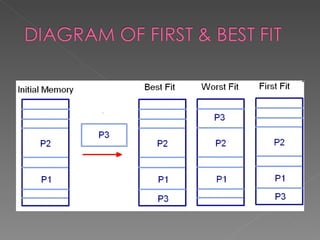
   In this algorithm, searching is started
    either at the beginning of the memory or
    where the previous first fit search ended.
   In this algorithm, all free memory blocks
    are searched and smallest free memory
    block which is large enough to
    accommodate desired block K is used to
    allocate K.
   Nonpreemptive allocation can’t make
    efficient use of memory in all situation.
    Due scattered memory blocks larger free
    memory blocks may not be available.
    Much more efficient us of the available
    memory space is possible if the
    occupied space can be re allocated to
    make room for incoming blocks by a
    method called as compaction.
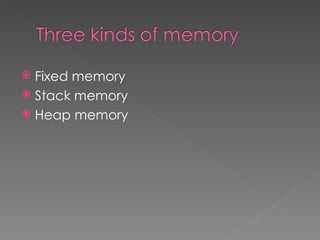
 Fixed memory
 Stack memory
 Heap memory
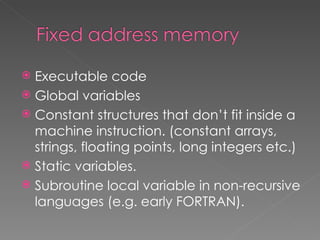
 Executable code
 Global variables
 Constant structures that don’t fit inside a
  machine instruction. (constant arrays,
  strings, floating points, long integers etc.)
 Static variables.
 Subroutine local variable in non-recursive
  languages (e.g. early FORTRAN).
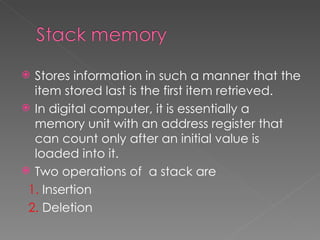
 Stores information in such a manner that the
  item stored last is the first item retrieved.
 In digital computer, it is essentially a
  memory unit with an address register that
  can count only after an initial value is
  loaded into it.
 Two operations of a stack are
 1. Insertion
 2. Deletion
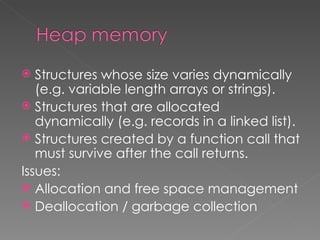
  Structures whose size varies dynamically
   (e.g. variable length arrays or strings).
 Structures that are allocated
   dynamically (e.g. records in a linked list).
 Structures created by a function call that
   must survive after the call returns.
Issues:
 Allocation and free space management
 Deallocation / garbage collection
Memory allocation (4)

Memory allocation (4)

  • 3.
     Memory is the processes by which information is encoded, stored and retrieved. Encoding allow information that is from the outside world to reach our senses in the forms of chemical and physical stimuli.
  • 4.
    An alloation is something that you set aside for use .for instance if you want to set aside a certain amount of hard drive space for an application,you can allocate how much in the settings.
  • 5.
    The placement of blocks of information in a memory system is called memory allocation.  To allocate memory it is necessary to keep in information of available memory in the system.If memory management system finds sufficient free memory,it allocates only as much memory as needed ,keeping the rest available to satisfy future request .  If sufficient memory is not available, swapping of blocks is done.
  • 6.
    In static memory allocation, size of the memory may be required for the calculation that must be define before loading and executing the program.
  • 7.
     Two methodsare used for dynamic memory allocation: 1-Nonpreemptive allocation 2-preemptive allocation
  • 8.
    Consider M1 as a main memory and M2 as a secondry memory and a block K of n words is to be transferred from M2 to M1.for such memory allocation it is necessary to find or create an available reason of n or more words to accommodate K.This process is known as nonpreemptive allocation.
  • 9.
    In this algorithm, searching is started either at the beginning of the memory or where the previous first fit search ended.
  • 10.
    In this algorithm, all free memory blocks are searched and smallest free memory block which is large enough to accommodate desired block K is used to allocate K.
  • 12.
    Nonpreemptive allocation can’t make efficient use of memory in all situation. Due scattered memory blocks larger free memory blocks may not be available. Much more efficient us of the available memory space is possible if the occupied space can be re allocated to make room for incoming blocks by a method called as compaction.
  • 13.
     Fixed memory Stack memory  Heap memory
  • 14.
     Executable code Global variables  Constant structures that don’t fit inside a machine instruction. (constant arrays, strings, floating points, long integers etc.)  Static variables.  Subroutine local variable in non-recursive languages (e.g. early FORTRAN).
  • 15.
     Stores informationin such a manner that the item stored last is the first item retrieved.  In digital computer, it is essentially a memory unit with an address register that can count only after an initial value is loaded into it.  Two operations of a stack are 1. Insertion 2. Deletion
  • 16.
     Structureswhose size varies dynamically (e.g. variable length arrays or strings).  Structures that are allocated dynamically (e.g. records in a linked list).  Structures created by a function call that must survive after the call returns. Issues:  Allocation and free space management  Deallocation / garbage collection