Modern British Poetry 1890-1945Dylan Thomas 1914-1953Sarah Law Modern British Poetry 1890-1945
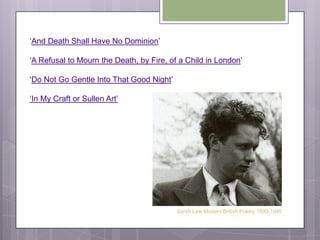
Sarah Law Modern British Poetry 1890-1945‘And Death Shall Have No Dominion’‘A Refusal to Mourn the Death, by Fire, of a Child in London’‘Do Not Go Gentle Into That Good Night’‘In My Craft or Sullen Art’
1934 Eighteen Poems publishedKey themes: the unity of time, the similarity between creative & destructive forces in the universe, the correspondence of all living things"He analogizes the anatomy of man to the structure of the universe . . . and sees the human microcosm as an image of the macrocosm, and conversely."  (Elder Olson, The Poetry of Dylan Thomas)Sarah Law Modern British Poetry 1890-1945
1936 ‘Twenty-Five Poems’"The work of this very young man (he is twenty-two years of age) is on a huge scale, both in theme and structurally. . . . I could not name one poet of this, the youngest generation, who shows so great a promise, and even so great an achievement." (Dame Edith Sitwell in the Sunday Times )Contains ten ‘religious’ sonnets ‘Altarwise by Owl-light’Sarah Law Modern British Poetry 1890-1945
Sarah Law Modern British Poetry 1890-1945‘And Death Shall Have No Dominion’ – Thomas chose to place at the end of the collection[this poem was] ‘published in a time when notes of affirmation—philosophical, political, or otherwise—did not resound among intelligent liberal humanists, [and thus] it answered an emotional need’ Clarke Emory)
A religious poet?‘ That which he celebrates is creation, and more particularly the human condition.’ (W. S. Merwin)‘He has been called a pagan, a mystic, and a humanistic agnostic; his God has been identified with Nature, Sex, Love, Process, the Life Force, and with Thomas himself.’  (R. B. Kershner: Dylan Thomas, the Poet and his critics)‘Written for the Love of Man and in praise of God’ (DT note to collected poems)A Pantheist? Sarah Law Modern British Poetry 1890-1945
1939 ‘The Map of Love’16 poems and 17 storiesLess successful commercially (outbreak of war)‘I make this in a warring absence’ of his marriage‘On no word of words’ poetic uncertainty‘After the Funeral’ elegy for auntSarah Law Modern British Poetry 1890-1945
1946 Deaths and Entrances‘the figures and landscapes have a new solidity, a new self-sufficiency, and the dialectic vision no longer penetrates them as though they were no more than windows opening on a timeless universe.’ (Jacob Korg) Incls. ‘A Refusal to Mourn the Death, by Fire, of a Child in London’, ‘Poem in October’, ‘Fern Hill’. Sarah Law Modern British Poetry 1890-1945
A surrealist?Reacting against the political concerns of the thirties?‘Surrealist poetry has been described a perpetual flow of irrational thoughts in the form of images.’ (David Gascoyne)‘I do not mind from where the images of a poem are dragged up; drag them up, if you like, from the nethermost sea of the hidden self; but, before they reach paper, they must go through all the rational processes of the intellect.’ (DT)Sarah Law Modern British Poetry 1890-1945
The New Apocalyspe1939, 1941, 1944 anthologies ed. by J F Hendry & Henry Treece incl. Thomas, Norman McCaig, Vernon Watkins, George Barker, D. H. LawrenceA romantic reaction against the classicism of AudenConcerned with imagery & the unconscious, like surrealism.Hendry’s essay ‘Writers and the Apocalypse’ identified the need to find a synthesis between man & the exterior world.Sarah Law Modern British Poetry 1890-1945
StyleSound as important as sense to Thomas.Use of alliteration, assonance, internal rhyme, and approximate rhymeIn The Craft and Art of Dylan Thomas, William T. Moynihan describes his rhythm as ‘accentual syllabic’ May have been influenced by Hopkins’ ‘Sprung Rhythm’Sarah Law Modern British Poetry 1890-1945
‘Thomas may, in fact, have depended upon an iambic expectancy, as he varied his rhythms beyond any customary iambic formulation and then—by completely unprecedented innovations—created his own rhythm, which is very close to iambic.’ (Moynihan) Sarah Law Modern British Poetry 1890-1945
‘An image must be born and die in another; and any sequence of my images must be a sequence of creations, recreations, destructions, contradictions.…Out of the inevitable conflict of images…I try to make that momentary peace which is a poem.’ (DT to Henry Treece)Sarah Law Modern British Poetry 1890-1945
1952 Country SleepIncls. ‘Poem on His Birthday’, ‘Do not go Gentle into that Good Night’.Wrote Scripts for the BBC during the War (Under Milk Wood initially written for BBC, finalised before his death)Toured America four times before his death. Subject of scandalous biography Dylan Thomas in America by John Malcolm BrinninSarah Law Modern British Poetry 1890-1945
Was Thomas a great poet?‘His range was severely limited, he overdid a handful of images and phrases...many of his poems are clotted with an excess of parallel-seeking metaphors’‘It is enough that he wrote some poems that the world will not willingly let die’(both quotes David Daiches, from his 1954 essay)Sarah Law Modern British Poetry 1890-1945

Dylan Thomas

  • 1.
    Modern British Poetry1890-1945Dylan Thomas 1914-1953Sarah Law Modern British Poetry 1890-1945
  • 2.
    Sarah Law ModernBritish Poetry 1890-1945‘And Death Shall Have No Dominion’‘A Refusal to Mourn the Death, by Fire, of a Child in London’‘Do Not Go Gentle Into That Good Night’‘In My Craft or Sullen Art’
  • 3.
    1934 Eighteen PoemspublishedKey themes: the unity of time, the similarity between creative & destructive forces in the universe, the correspondence of all living things"He analogizes the anatomy of man to the structure of the universe . . . and sees the human microcosm as an image of the macrocosm, and conversely." (Elder Olson, The Poetry of Dylan Thomas)Sarah Law Modern British Poetry 1890-1945
  • 4.
    1936 ‘Twenty-Five Poems’"Thework of this very young man (he is twenty-two years of age) is on a huge scale, both in theme and structurally. . . . I could not name one poet of this, the youngest generation, who shows so great a promise, and even so great an achievement." (Dame Edith Sitwell in the Sunday Times )Contains ten ‘religious’ sonnets ‘Altarwise by Owl-light’Sarah Law Modern British Poetry 1890-1945
  • 5.
    Sarah Law ModernBritish Poetry 1890-1945‘And Death Shall Have No Dominion’ – Thomas chose to place at the end of the collection[this poem was] ‘published in a time when notes of affirmation—philosophical, political, or otherwise—did not resound among intelligent liberal humanists, [and thus] it answered an emotional need’ Clarke Emory)
  • 6.
    A religious poet?‘That which he celebrates is creation, and more particularly the human condition.’ (W. S. Merwin)‘He has been called a pagan, a mystic, and a humanistic agnostic; his God has been identified with Nature, Sex, Love, Process, the Life Force, and with Thomas himself.’ (R. B. Kershner: Dylan Thomas, the Poet and his critics)‘Written for the Love of Man and in praise of God’ (DT note to collected poems)A Pantheist? Sarah Law Modern British Poetry 1890-1945
  • 7.
    1939 ‘The Mapof Love’16 poems and 17 storiesLess successful commercially (outbreak of war)‘I make this in a warring absence’ of his marriage‘On no word of words’ poetic uncertainty‘After the Funeral’ elegy for auntSarah Law Modern British Poetry 1890-1945
  • 8.
    1946 Deaths andEntrances‘the figures and landscapes have a new solidity, a new self-sufficiency, and the dialectic vision no longer penetrates them as though they were no more than windows opening on a timeless universe.’ (Jacob Korg) Incls. ‘A Refusal to Mourn the Death, by Fire, of a Child in London’, ‘Poem in October’, ‘Fern Hill’. Sarah Law Modern British Poetry 1890-1945
  • 9.
    A surrealist?Reacting againstthe political concerns of the thirties?‘Surrealist poetry has been described a perpetual flow of irrational thoughts in the form of images.’ (David Gascoyne)‘I do not mind from where the images of a poem are dragged up; drag them up, if you like, from the nethermost sea of the hidden self; but, before they reach paper, they must go through all the rational processes of the intellect.’ (DT)Sarah Law Modern British Poetry 1890-1945
  • 10.
    The New Apocalyspe1939,1941, 1944 anthologies ed. by J F Hendry & Henry Treece incl. Thomas, Norman McCaig, Vernon Watkins, George Barker, D. H. LawrenceA romantic reaction against the classicism of AudenConcerned with imagery & the unconscious, like surrealism.Hendry’s essay ‘Writers and the Apocalypse’ identified the need to find a synthesis between man & the exterior world.Sarah Law Modern British Poetry 1890-1945
  • 11.
    StyleSound as importantas sense to Thomas.Use of alliteration, assonance, internal rhyme, and approximate rhymeIn The Craft and Art of Dylan Thomas, William T. Moynihan describes his rhythm as ‘accentual syllabic’ May have been influenced by Hopkins’ ‘Sprung Rhythm’Sarah Law Modern British Poetry 1890-1945
  • 12.
    ‘Thomas may, infact, have depended upon an iambic expectancy, as he varied his rhythms beyond any customary iambic formulation and then—by completely unprecedented innovations—created his own rhythm, which is very close to iambic.’ (Moynihan) Sarah Law Modern British Poetry 1890-1945
  • 13.
    ‘An image mustbe born and die in another; and any sequence of my images must be a sequence of creations, recreations, destructions, contradictions.…Out of the inevitable conflict of images…I try to make that momentary peace which is a poem.’ (DT to Henry Treece)Sarah Law Modern British Poetry 1890-1945
  • 14.
    1952 Country SleepIncls.‘Poem on His Birthday’, ‘Do not go Gentle into that Good Night’.Wrote Scripts for the BBC during the War (Under Milk Wood initially written for BBC, finalised before his death)Toured America four times before his death. Subject of scandalous biography Dylan Thomas in America by John Malcolm BrinninSarah Law Modern British Poetry 1890-1945
  • 15.
    Was Thomas agreat poet?‘His range was severely limited, he overdid a handful of images and phrases...many of his poems are clotted with an excess of parallel-seeking metaphors’‘It is enough that he wrote some poems that the world will not willingly let die’(both quotes David Daiches, from his 1954 essay)Sarah Law Modern British Poetry 1890-1945