Walchand College of Arts & Science, Solapur
Dr. S. N. Battin
(shankarbattin@gmail.com)
Associate Professor, Head, Dept. of Chemistry
Walchand College of Arts and Science, Solapur
(www.wcas.org)
Dyes and Their Classification
1
Walchand College of Arts & Science, Solapur
Learning Objectives
After this session, you will be able to explain-
• Meaning and Qualities of a Dye and
• Classification of Synthetic Dyes
2
Walchand College of Arts & Science, Solapur
Contents
• Meaning of a Dye
• Qualities of an Ideal Dye
• Witt’s theory- Chromophore-Auxochrome Theory
• Classification of Dyes
3
Walchand College of Arts & Science, Solapur
Meaning of a Dye
• Dye- A coloured organic substance having the
property of imparting colour to other substrates like
fibre, paper, leather, plastic, hair, foodstuff etc.
• Colour imparted should not wear out easily with
water, soap or sunlight
• Also used as indicators, in colour photography, in
histological and bacteriological studies
4
Walchand College of Arts & Science, Solapur
Qualities of an Ideal Dye
Dyes must have attractive colour and offer wide range of
shades
Must be permanent and able to fix itself or being fixed
to the substrate
Should not be affected by water, soap, acid and sunlight
Must be cheap and easy to handle
Easily soluble and must form a stable and good
dispersion in water
Should not be harmful to skin or body
5
Walchand College of Arts & Science, Solapur
Witt’s Theory
 Chromophore- Auxochrome theory
 Explains relation between colour and chemical structure of a substance
 A dye molecule must possess chromophore and auxochrome
 Chromophore- unsaturated group responsible for colour of a dye e.g. nitro,
nitroso, azo, o-or p- quinonoid, ethylenic, carbonyl group etc.
 Auxochrome-acidic or basic group which deepens the colour and also fixes dye
to the substrate e.g. –OH, SO3H, -COOH, -NH2, -NHR, -NRR, -OCH3, -OCOCH3 etc.
6
Walchand College of Arts & Science, Solapur
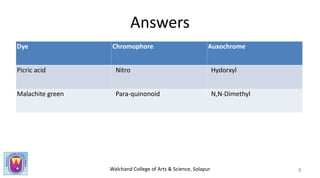
• Identify 1. Chromophore 2. Auxochrome in following dyes-
Picric acid Malachite green
7
Walchand College of Arts & Science, Solapur
Answers
Dye Chromophore Auxochrome
Picric acid Nitro Hydorxyl
Malachite green Para-quinonoid N,N-Dimethyl
8
Walchand College of Arts & Science, Solapur
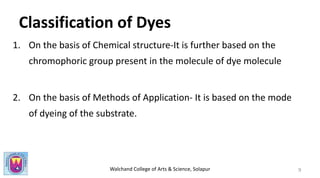
Classification of Dyes
1. On the basis of Chemical structure-It is further based on the
chromophoric group present in the molecule of dye molecule
2. On the basis of Methods of Application- It is based on the mode
of dyeing of the substrate.
9
Walchand College of Arts & Science, Solapur
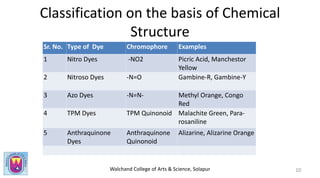
Classification on the basis of Chemical
Structure
10
Sr. No. Type of Dye Chromophore Examples
1 Nitro Dyes -NO2 Picric Acid, Manchestor
Yellow
2 Nitroso Dyes -N=O Gambine-R, Gambine-Y
3 Azo Dyes -N=N- Methyl Orange, Congo
Red
4 TPM Dyes TPM Quinonoid Malachite Green, Para-
rosaniline
5 Anthraquinone
Dyes
Anthraquinone
Quinonoid
Alizarine, Alizarine Orange
Walchand College of Arts & Science, Solapur
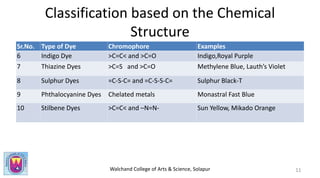
Classification based on the Chemical
Structure
Sr.No. Type of Dye Chromophore Examples
6 Indigo Dye >C=C< and >C=O Indigo,Royal Purple
7 Thiazine Dyes >C=S and >C=O Methylene Blue, Lauth’s Violet
8 Sulphur Dyes =C-S-C= and =C-S-S-C= Sulphur Black-T
9 Phthalocyanine Dyes Chelated metals Monastral Fast Blue
10 Stilbene Dyes >C=C< and –N=N- Sun Yellow, Mikado Orange
11
Walchand College of Arts & Science, Solapur
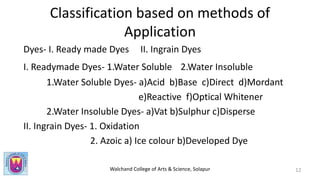
Classification based on methods of
Application
Dyes- I. Ready made Dyes II. Ingrain Dyes
I. Readymade Dyes- 1.Water Soluble 2.Water Insoluble
1.Water Soluble Dyes- a)Acid b)Base c)Direct d)Mordant
e)Reactive f)Optical Whitener
2.Water Insoluble Dyes- a)Vat b)Sulphur c)Disperse
II. Ingrain Dyes- 1. Oxidation
2. Azoic a) Ice colour b)Developed Dye
12
Walchand College of Arts & Science, Solapur
• I.Ready made Dyes- Dyes ready for use by dissolving in suitable
solvent.
• Water Soluble Dyes- contain polar groups such as COOH, -SO3H, -
NH2, -NHR etc.
a)Acid Dyes- contain acidic groups like –COOH, -SO3H, -OH etc
e.g. Orange-II, Manchestor Yellow
b)Basic Dyes- contain basic groups like –NH2, -NHR, -NRR etc
e.g. Malachite Green, Crystal Violet
13
Walchand College of Arts & Science, Solapur
c)Direct Dyes- these dyes are directly used to dye fibre swollen in
hot water (salt dyes) e.g. Congo Red, Brilliant Yellow
d)Mordant Dyes- fixed to fabric by using some binding material
e.g. Alizarine, EB-T
e)Reactive Dyes-these dyes get fixed to fibres by covalent bond
formation e.g. Chlorinated Triazines
f)Optical Whiteners-water soluble dyes which make fabric look
whiter e.g. Pyrazolones, Stilbenes
14
Walchand College of Arts & Science, Solapur
• 2. Water Insoluble Dyes
a) Vat Dyes- insoluble in water but on reduction become water
soluble lueco-bases and fixed to fibre by hydrogen bonding
e.g. Indigo, Indanthrene Blue
b)Sulphur Dyes- sulphur containing, water insoluble hence made
water soluble leuco-bases by reduction. e.g.Sulphur black-T
c)Disperse Dyes- these dyes are applied on the synthetic fibres
in the form of colloidal dispersions e.g. Disperse red- G
15
Walchand College of Arts & Science, Solapur
• II. Ingrain Dyes- These dyes are formed on the fibre itself.
• 1.Oxidation Dyes-these dyes are formed on the fibre after their
oxidation. e.g. Aniline black
2.Azoic Dyes-
a)Ice Colours- developed on the fibre at 0-5⁰C e.g. Para red
b)Developed Diazotised Dye-diazotisation is done on the fibres
16
Walchand College of Arts & Science, Solapur
References
1.Dyeing by Dr. V. Shenai
2.Advanced Organic Chemistry by B. S. Bahl and Arun Bahl
S. Chand and Co. N. Delhi
3.Organic Chemistry Volume I and II by I. L.Finar, ELBS, London
17
Walchand College of Arts & Science, Solapur
Thank you…
18

Dyes and their classification

  • 1.
    Walchand College ofArts & Science, Solapur Dr. S. N. Battin (shankarbattin@gmail.com) Associate Professor, Head, Dept. of Chemistry Walchand College of Arts and Science, Solapur (www.wcas.org) Dyes and Their Classification 1
  • 2.
    Walchand College ofArts & Science, Solapur Learning Objectives After this session, you will be able to explain- • Meaning and Qualities of a Dye and • Classification of Synthetic Dyes 2
  • 3.
    Walchand College ofArts & Science, Solapur Contents • Meaning of a Dye • Qualities of an Ideal Dye • Witt’s theory- Chromophore-Auxochrome Theory • Classification of Dyes 3
  • 4.
    Walchand College ofArts & Science, Solapur Meaning of a Dye • Dye- A coloured organic substance having the property of imparting colour to other substrates like fibre, paper, leather, plastic, hair, foodstuff etc. • Colour imparted should not wear out easily with water, soap or sunlight • Also used as indicators, in colour photography, in histological and bacteriological studies 4
  • 5.
    Walchand College ofArts & Science, Solapur Qualities of an Ideal Dye Dyes must have attractive colour and offer wide range of shades Must be permanent and able to fix itself or being fixed to the substrate Should not be affected by water, soap, acid and sunlight Must be cheap and easy to handle Easily soluble and must form a stable and good dispersion in water Should not be harmful to skin or body 5
  • 6.
    Walchand College ofArts & Science, Solapur Witt’s Theory  Chromophore- Auxochrome theory  Explains relation between colour and chemical structure of a substance  A dye molecule must possess chromophore and auxochrome  Chromophore- unsaturated group responsible for colour of a dye e.g. nitro, nitroso, azo, o-or p- quinonoid, ethylenic, carbonyl group etc.  Auxochrome-acidic or basic group which deepens the colour and also fixes dye to the substrate e.g. –OH, SO3H, -COOH, -NH2, -NHR, -NRR, -OCH3, -OCOCH3 etc. 6
  • 7.
    Walchand College ofArts & Science, Solapur • Identify 1. Chromophore 2. Auxochrome in following dyes- Picric acid Malachite green 7
  • 8.
    Walchand College ofArts & Science, Solapur Answers Dye Chromophore Auxochrome Picric acid Nitro Hydorxyl Malachite green Para-quinonoid N,N-Dimethyl 8
  • 9.
    Walchand College ofArts & Science, Solapur Classification of Dyes 1. On the basis of Chemical structure-It is further based on the chromophoric group present in the molecule of dye molecule 2. On the basis of Methods of Application- It is based on the mode of dyeing of the substrate. 9
  • 10.
    Walchand College ofArts & Science, Solapur Classification on the basis of Chemical Structure 10 Sr. No. Type of Dye Chromophore Examples 1 Nitro Dyes -NO2 Picric Acid, Manchestor Yellow 2 Nitroso Dyes -N=O Gambine-R, Gambine-Y 3 Azo Dyes -N=N- Methyl Orange, Congo Red 4 TPM Dyes TPM Quinonoid Malachite Green, Para- rosaniline 5 Anthraquinone Dyes Anthraquinone Quinonoid Alizarine, Alizarine Orange
  • 11.
    Walchand College ofArts & Science, Solapur Classification based on the Chemical Structure Sr.No. Type of Dye Chromophore Examples 6 Indigo Dye >C=C< and >C=O Indigo,Royal Purple 7 Thiazine Dyes >C=S and >C=O Methylene Blue, Lauth’s Violet 8 Sulphur Dyes =C-S-C= and =C-S-S-C= Sulphur Black-T 9 Phthalocyanine Dyes Chelated metals Monastral Fast Blue 10 Stilbene Dyes >C=C< and –N=N- Sun Yellow, Mikado Orange 11
  • 12.
    Walchand College ofArts & Science, Solapur Classification based on methods of Application Dyes- I. Ready made Dyes II. Ingrain Dyes I. Readymade Dyes- 1.Water Soluble 2.Water Insoluble 1.Water Soluble Dyes- a)Acid b)Base c)Direct d)Mordant e)Reactive f)Optical Whitener 2.Water Insoluble Dyes- a)Vat b)Sulphur c)Disperse II. Ingrain Dyes- 1. Oxidation 2. Azoic a) Ice colour b)Developed Dye 12
  • 13.
    Walchand College ofArts & Science, Solapur • I.Ready made Dyes- Dyes ready for use by dissolving in suitable solvent. • Water Soluble Dyes- contain polar groups such as COOH, -SO3H, - NH2, -NHR etc. a)Acid Dyes- contain acidic groups like –COOH, -SO3H, -OH etc e.g. Orange-II, Manchestor Yellow b)Basic Dyes- contain basic groups like –NH2, -NHR, -NRR etc e.g. Malachite Green, Crystal Violet 13
  • 14.
    Walchand College ofArts & Science, Solapur c)Direct Dyes- these dyes are directly used to dye fibre swollen in hot water (salt dyes) e.g. Congo Red, Brilliant Yellow d)Mordant Dyes- fixed to fabric by using some binding material e.g. Alizarine, EB-T e)Reactive Dyes-these dyes get fixed to fibres by covalent bond formation e.g. Chlorinated Triazines f)Optical Whiteners-water soluble dyes which make fabric look whiter e.g. Pyrazolones, Stilbenes 14
  • 15.
    Walchand College ofArts & Science, Solapur • 2. Water Insoluble Dyes a) Vat Dyes- insoluble in water but on reduction become water soluble lueco-bases and fixed to fibre by hydrogen bonding e.g. Indigo, Indanthrene Blue b)Sulphur Dyes- sulphur containing, water insoluble hence made water soluble leuco-bases by reduction. e.g.Sulphur black-T c)Disperse Dyes- these dyes are applied on the synthetic fibres in the form of colloidal dispersions e.g. Disperse red- G 15
  • 16.
    Walchand College ofArts & Science, Solapur • II. Ingrain Dyes- These dyes are formed on the fibre itself. • 1.Oxidation Dyes-these dyes are formed on the fibre after their oxidation. e.g. Aniline black 2.Azoic Dyes- a)Ice Colours- developed on the fibre at 0-5⁰C e.g. Para red b)Developed Diazotised Dye-diazotisation is done on the fibres 16
  • 17.
    Walchand College ofArts & Science, Solapur References 1.Dyeing by Dr. V. Shenai 2.Advanced Organic Chemistry by B. S. Bahl and Arun Bahl S. Chand and Co. N. Delhi 3.Organic Chemistry Volume I and II by I. L.Finar, ELBS, London 17
  • 18.
    Walchand College ofArts & Science, Solapur Thank you… 18