Fabric Dyeing, Printing, and
Finishes
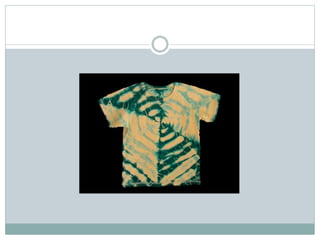
Dyeing
A method of giving color
to textiles using coloring
agents called dyes.
Dyeing
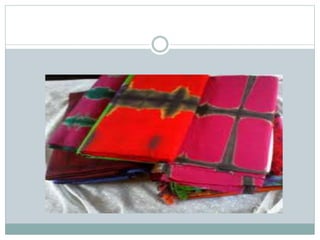
 is the application of dyes or pigments
on textile materials such as fibers.
 Dyeing is normally done in a special
solution containing dyes and particular
chemical material.
The primary source of dye,
 historically, has been nature, with the
dyes being extracted from animals or
plants.
 Since the mid-19th century, however,
humans have produced artificial dyes.
 to achieve a broader range of colors
and to render the dyes more stable to
washing and general use.
principle
Dye molecules are fixed to the
fiber by absorption, diffusion, or
bonding with temperature and
time being key controlling
factors.
 The bond between dye molecule and fiber
may be strong or weak, depending on the
dye used.
 Dyeing and printing are different
applications; in printing color is applied to a
localized area with desired patterns and
 in dyeing it is applied to the entire textile
Selection of dyes
 Selection of the appropriate dye is important
because any given dye is not applicable on
every type of fiber.
 Furthermore, resistance to washing, rubbing
and light differ among dyes.
 The choice of dye depends on the objective
in dyeing and which material is to be dyed
Materials and Equipment
Fabric
 Suitable fabrics include cotton, silk,
and wool.
 Synthetic fabrics (nylon, ployester, acrylics) will not
take a dye, so cannot be used.
• String, twine, cord, thread, and elastic bands
can be used as binders.
The finer the cord, the more lacy and delicate lines
are produced.
 Dyes
Generally for bril1iant colors use one package dye to
four cups boiling water and add one
 teaspoon.
 Newspapers
(to protect the floor or work surface)
 Rubber gloves
Wear old clothes, an old apron., or large garbage bag
to protect clothes.
 Rags (for cleaning up)
 Chemicals
 Working area
 Pen or pencil
 Bucket
 Heat sorce(stove)
 Scissor
 Table
 Water
Methods
 General Notes
Bindings must be wrapped and tied TIGHTLY to get
good color variations.
 Fabric may be rinsed under cold water after dyeing.
This gives a more hazy effect than
unrinsed work.
 When dyeing with two or more colors, fabric may be
dyed one color, then dried, then dyed
 Dipping into Dye: A quick dip into the dyebath
means the dye has less time to penetrate and
 you get bigger white and light areas. A longer time in
the dye (3 or 4 minutes) allows dye to
 penetrate more so you get more dark areas and less
white and light areas. Lines from
 crisscross bindings are less noticeable in a longer dip
than in a quick dunk. Dip small areas into
 the dye at one time or the background color will be
splotchy from overcrowding
Binding Methods
Spot Technique
 Plan carefully where they are to go because the spots
themselves
 aren't too exciting.
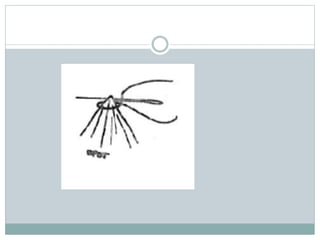
 Pick up tiny piece of fabric with needle.
 Wrap sewing thread around directly below needle.
 Tie tight.
 Remove needle.
 Dip in dye.
 Remove thread.
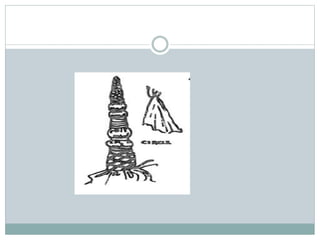
Circle Technique
 Pick up centre of circle and smooth folds formed
from it.
 Bind, dye, untie, dry.
 Radius of the circle is determined by the distance
from the point to the
 bottom of the bindings.
 Square Technique
 Fold fabric lengthwise through
 centre.
 Fold crosswise.
 Bind, dye, untie, dry.
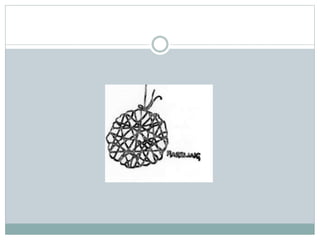
Marbling
 Makes a beautifully hazy background for other media
such as stitchery
 and block printing.
 Squash fabric up into a ball.
 Bind in all directions until it is fairly hard.
 Dip in dye, remove, untie, dry.
 For second and/or third color, repeat bunching and
binding, trying to
 get cloth not already colored close to the surface.
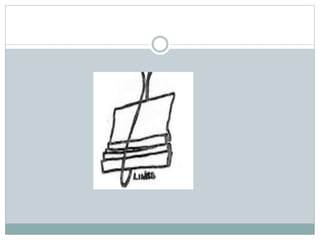
Lines of Stripes
 fold fabric
 lengthwise, crosswise, or diagonally.
 Bind, dye, untie, dry
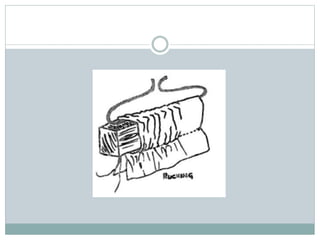
Ruching
 Fold fabric along centre of stripe.
 Place a line of machine stitching below fold, forming a casing.
 only large enough to slip a ruler or piece of wood through.
 Slip casing over wood and gather all the fabric up at one end of
 the stick.
 Bind and dye.
 Remove binding and machine stitching (and the ruler!).
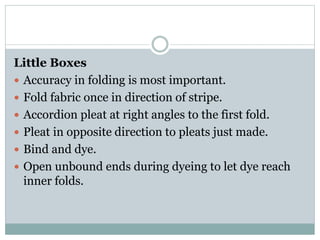
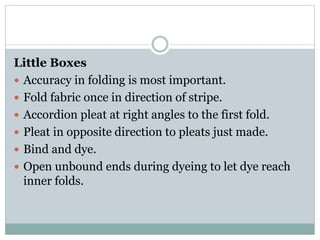
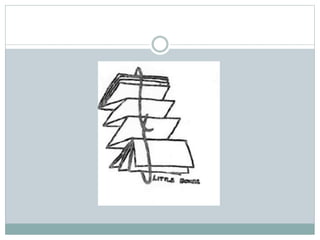
Little Boxes
 Accuracy in folding is most important.
 Fold fabric once in direction of stripe.
 Accordion pleat at right angles to the first fold.
 Pleat in opposite direction to pleats just made.
 Bind and dye.
 Open unbound ends during dyeing to let dye reach
inner folds.
Little Boxes
 Accuracy in folding is most important.
 Fold fabric once in direction of stripe.
 Accordion pleat at right angles to the first fold.
 Pleat in opposite direction to pleats just made.
 Bind and dye.
 Open unbound ends during dyeing to let dye reach
inner folds.
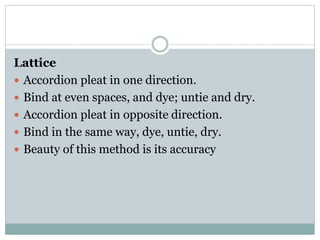
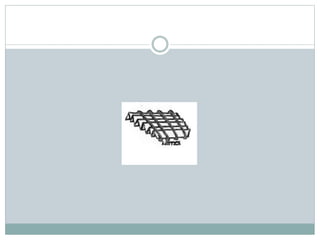
Lattice
 Accordion pleat in one direction.
 Bind at even spaces, and dye; untie and dry.
 Accordion pleat in opposite direction.
 Bind in the same way, dye, untie, dry.
 Beauty of this method is its accuracy
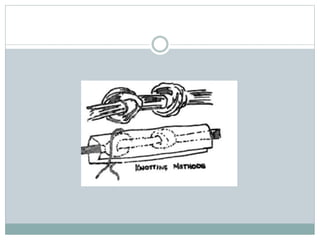
Knotting
 Use fine fabric for these. Burlap and other heavy fabrics
 won't tie well.
 Roll or fold up fabric into a string, then tie it into knots
and
 dye.
 An alternate method is to tie a thick rope into knots and
 roll or fold cloth around it.
 Bind to the rope and dye.
Rope Technique
 Fabric may be rolled, twisted, or bunched into a
rope.
 Add bindings, dye, untie, let dry
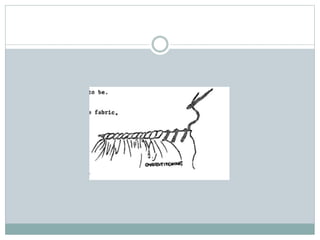
Overstitching
 Fold fabric where design is to be.
 Taking deep stitches into the fabric, sew over top of
 the folds.
 Draw thread so tightly that it straightens out and the
 fold coils around it.
 Dip in dye; remove thread, let dry.
Colorfast
implies that the color in a fabric
will not fade or change with normal
use and care.
Textile products are dyed at the following stages:
Fiber (Excellent)
Yarn (Best)
Piece (Better)
Garment (Good)
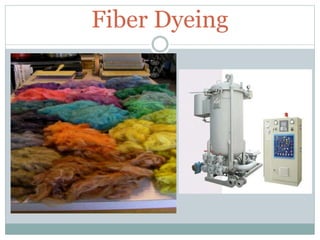
Fiber Dyeing
Involves dyeing the fibers before
they are spun into yarns.
Advantages include:
Good colorfastness
Uniform color throughout fiber
Clear, rich colors
Fiber Dyeing
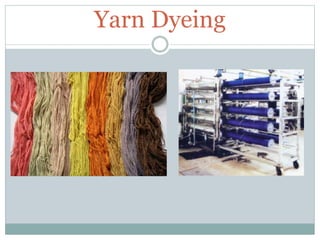
Yarn Dyeing
Involves dyeing the yarns before
weaving or knitting them into
fabric.
Advantages include:
Good color absorption
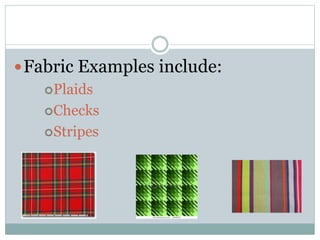
Fabric Examples include:
Plaids
Checks
Stripes
Yarn Dyeing
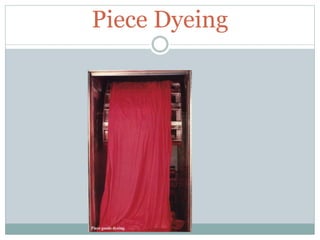
Piece Dyeing
Involves dyeing the fabric after it is
woven or knitted.
Advantages include:
Most common dyeing method
Lease expensive
Very fast
Disadvantages include:
Mostly solid colors
Less dye penetration into the fibers
and yarns
Piece Dyeing
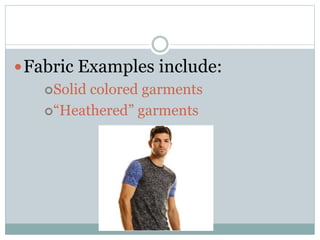
Fabric Examples include:
Solid colored garments
“Heathered” garments
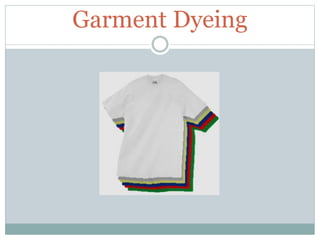
Garment Dyeing
Involves dyeing the garments to fill
retail orders for requested colors.
Advantages include:
This method is gaining in popularity.
Garment producers can wait and dye
only the colors ordered by stores.
Garment Dyeing
Fabric Printing
A process for adding color, pattern
or design to the surface of fabric.
It is done on the right side of the
fabric with the wrong side being
unprinted or much lighter than the
right side.
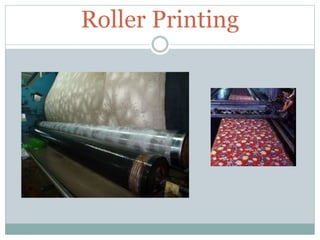
Roller Printing
Color for the design is applied to
fabric as it goes through a series of
rollers.
Rollers are engraved (carved) with the
design to be printed.
Each color has a different roller.
Advantages include:
Simple and fast
Inexpensive
Most common printing method
Roller Printing
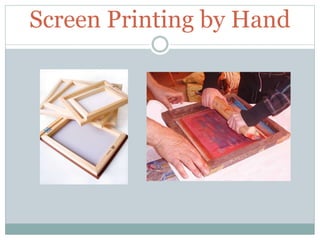
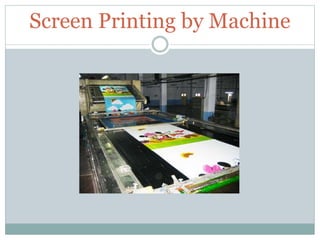
Screen Printing
Done on flat screen frames and is
similar to stenciling.
Each color has its own screen.
Advantages include:
Good for large designs
Better quality designs than roller
printing method
Disadvantages include:
Slow printing method
Screen Printing by Hand
Screen Printing by Machine
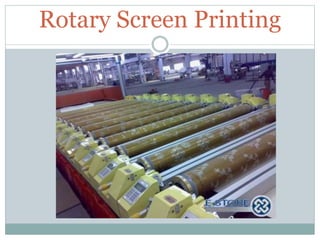
Rotary Screen Printing
A combination of roller and screen
printing.
Dye is transferred through screens
that roll over the fabric.
Advantages include:
Can print large designs
Accurate and fast
This method is gaining in popularity.
Rotary Screen Printing
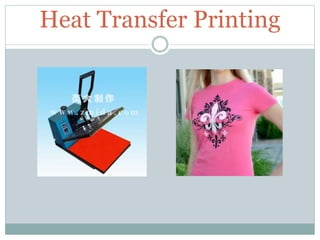
Heat Transfer Printing
The desired dyes and patterns are
placed onto paper using a rotary
screen printer. The paper is placed
on the fabric and with heat and
pressure the colors and patterns are
transferred to the fabric.
T-shirts are printed using this
method.
Like a “temporary tattoo” for fabric
Heat Transfer Printing
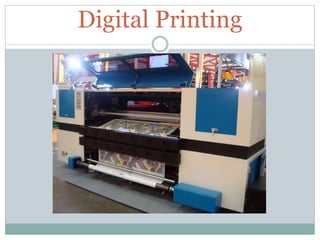
Digital Printing
The newest method of fabric
printing. It is like ink-jet printing
with a computer but rolls the fabric
through an extra-wide printer.
Droplets of color are “spit” onto the
fabric.
Advantages include:
Fast
Inexpensive
Environmentally safe
Can print small or large amounts of
fabric at the same time
Digital Printing
Vat dying process in scientific study...

Vat dying process in scientific study...

  • 1.
  • 2.
    Dyeing A method ofgiving color to textiles using coloring agents called dyes.
  • 3.
    Dyeing  is theapplication of dyes or pigments on textile materials such as fibers.  Dyeing is normally done in a special solution containing dyes and particular chemical material.
  • 4.
    The primary sourceof dye,  historically, has been nature, with the dyes being extracted from animals or plants.  Since the mid-19th century, however, humans have produced artificial dyes.  to achieve a broader range of colors and to render the dyes more stable to washing and general use.
  • 5.
    principle Dye molecules arefixed to the fiber by absorption, diffusion, or bonding with temperature and time being key controlling factors.
  • 6.
     The bondbetween dye molecule and fiber may be strong or weak, depending on the dye used.  Dyeing and printing are different applications; in printing color is applied to a localized area with desired patterns and  in dyeing it is applied to the entire textile
  • 7.
    Selection of dyes Selection of the appropriate dye is important because any given dye is not applicable on every type of fiber.  Furthermore, resistance to washing, rubbing and light differ among dyes.  The choice of dye depends on the objective in dyeing and which material is to be dyed
  • 12.
    Materials and Equipment Fabric Suitable fabrics include cotton, silk, and wool.  Synthetic fabrics (nylon, ployester, acrylics) will not take a dye, so cannot be used.
  • 13.
    • String, twine,cord, thread, and elastic bands can be used as binders. The finer the cord, the more lacy and delicate lines are produced.  Dyes Generally for bril1iant colors use one package dye to four cups boiling water and add one
  • 14.
     teaspoon.  Newspapers (toprotect the floor or work surface)  Rubber gloves Wear old clothes, an old apron., or large garbage bag to protect clothes.  Rags (for cleaning up)  Chemicals
  • 15.
     Working area Pen or pencil  Bucket  Heat sorce(stove)  Scissor  Table  Water
  • 16.
    Methods  General Notes Bindingsmust be wrapped and tied TIGHTLY to get good color variations.  Fabric may be rinsed under cold water after dyeing. This gives a more hazy effect than unrinsed work.  When dyeing with two or more colors, fabric may be dyed one color, then dried, then dyed
  • 17.
     Dipping intoDye: A quick dip into the dyebath means the dye has less time to penetrate and  you get bigger white and light areas. A longer time in the dye (3 or 4 minutes) allows dye to  penetrate more so you get more dark areas and less white and light areas. Lines from  crisscross bindings are less noticeable in a longer dip than in a quick dunk. Dip small areas into  the dye at one time or the background color will be splotchy from overcrowding
  • 18.
    Binding Methods Spot Technique Plan carefully where they are to go because the spots themselves  aren't too exciting.  Pick up tiny piece of fabric with needle.  Wrap sewing thread around directly below needle.  Tie tight.  Remove needle.  Dip in dye.  Remove thread.
  • 20.
    Circle Technique  Pickup centre of circle and smooth folds formed from it.  Bind, dye, untie, dry.  Radius of the circle is determined by the distance from the point to the
  • 21.
     bottom ofthe bindings.  Square Technique  Fold fabric lengthwise through  centre.  Fold crosswise.  Bind, dye, untie, dry.
  • 23.
    Marbling  Makes abeautifully hazy background for other media such as stitchery  and block printing.  Squash fabric up into a ball.  Bind in all directions until it is fairly hard.  Dip in dye, remove, untie, dry.  For second and/or third color, repeat bunching and binding, trying to  get cloth not already colored close to the surface.
  • 25.
    Lines of Stripes fold fabric  lengthwise, crosswise, or diagonally.  Bind, dye, untie, dry
  • 27.
    Ruching  Fold fabricalong centre of stripe.  Place a line of machine stitching below fold, forming a casing.  only large enough to slip a ruler or piece of wood through.  Slip casing over wood and gather all the fabric up at one end of  the stick.  Bind and dye.  Remove binding and machine stitching (and the ruler!).
  • 29.
    Little Boxes  Accuracyin folding is most important.  Fold fabric once in direction of stripe.  Accordion pleat at right angles to the first fold.  Pleat in opposite direction to pleats just made.  Bind and dye.  Open unbound ends during dyeing to let dye reach inner folds.
  • 30.
    Little Boxes  Accuracyin folding is most important.  Fold fabric once in direction of stripe.  Accordion pleat at right angles to the first fold.  Pleat in opposite direction to pleats just made.  Bind and dye.  Open unbound ends during dyeing to let dye reach inner folds.
  • 32.
    Lattice  Accordion pleatin one direction.  Bind at even spaces, and dye; untie and dry.  Accordion pleat in opposite direction.  Bind in the same way, dye, untie, dry.  Beauty of this method is its accuracy
  • 34.
    Knotting  Use finefabric for these. Burlap and other heavy fabrics  won't tie well.  Roll or fold up fabric into a string, then tie it into knots and  dye.  An alternate method is to tie a thick rope into knots and  roll or fold cloth around it.  Bind to the rope and dye.
  • 36.
    Rope Technique  Fabricmay be rolled, twisted, or bunched into a rope.  Add bindings, dye, untie, let dry
  • 37.
    Overstitching  Fold fabricwhere design is to be.  Taking deep stitches into the fabric, sew over top of  the folds.  Draw thread so tightly that it straightens out and the  fold coils around it.  Dip in dye; remove thread, let dry.
  • 40.
    Colorfast implies that thecolor in a fabric will not fade or change with normal use and care.
  • 41.
    Textile products aredyed at the following stages: Fiber (Excellent) Yarn (Best) Piece (Better) Garment (Good)
  • 42.
    Fiber Dyeing Involves dyeingthe fibers before they are spun into yarns. Advantages include: Good colorfastness Uniform color throughout fiber Clear, rich colors
  • 43.
  • 44.
    Yarn Dyeing Involves dyeingthe yarns before weaving or knitting them into fabric. Advantages include: Good color absorption
  • 45.
  • 46.
  • 47.
    Piece Dyeing Involves dyeingthe fabric after it is woven or knitted. Advantages include: Most common dyeing method Lease expensive Very fast
  • 48.
    Disadvantages include: Mostly solidcolors Less dye penetration into the fibers and yarns
  • 49.
  • 50.
    Fabric Examples include: Solidcolored garments “Heathered” garments
  • 51.
    Garment Dyeing Involves dyeingthe garments to fill retail orders for requested colors. Advantages include: This method is gaining in popularity. Garment producers can wait and dye only the colors ordered by stores.
  • 52.
  • 53.
    Fabric Printing A processfor adding color, pattern or design to the surface of fabric. It is done on the right side of the fabric with the wrong side being unprinted or much lighter than the right side.
  • 54.
    Roller Printing Color forthe design is applied to fabric as it goes through a series of rollers. Rollers are engraved (carved) with the design to be printed. Each color has a different roller.
  • 55.
    Advantages include: Simple andfast Inexpensive Most common printing method
  • 56.
  • 57.
    Screen Printing Done onflat screen frames and is similar to stenciling. Each color has its own screen.
  • 58.
    Advantages include: Good forlarge designs Better quality designs than roller printing method
  • 59.
  • 60.
  • 61.
  • 62.
    Rotary Screen Printing Acombination of roller and screen printing. Dye is transferred through screens that roll over the fabric.
  • 63.
    Advantages include: Can printlarge designs Accurate and fast This method is gaining in popularity.
  • 64.
  • 65.
    Heat Transfer Printing Thedesired dyes and patterns are placed onto paper using a rotary screen printer. The paper is placed on the fabric and with heat and pressure the colors and patterns are transferred to the fabric.
  • 66.
    T-shirts are printedusing this method. Like a “temporary tattoo” for fabric
  • 67.
  • 68.
    Digital Printing The newestmethod of fabric printing. It is like ink-jet printing with a computer but rolls the fabric through an extra-wide printer. Droplets of color are “spit” onto the fabric.
  • 69.
    Advantages include: Fast Inexpensive Environmentally safe Canprint small or large amounts of fabric at the same time
  • 70.