Presented By
Peter Zaidel
KPA Product Manager
pzaidel@kpaonline.com
303-228-2397
Questions
• If you have questions
during the presentation,
please submit them using
the “Questions” feature
• Questions will be
answered at the end of the
webinar
KPA – Company Profile
• Nationwide compliance
expert on
Safety, Environmental, H
R
• Colorado Headquarters
• 23 Years Experience
• 3000 + Clients
– Dealerships, Service, Re
pair
• 20 Offices Serving 41
States
• Compliance products
and services
– OSHA
– DOT
– EPA
– Workers’ Comp
– Background checking
– Onboarding
– Harassment
– Red Flags
– Onsite inspections
– Online and onsite training
and tracking
– And many more…
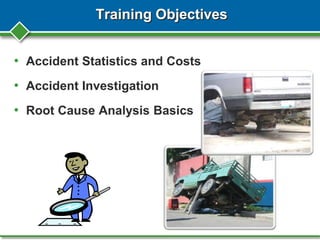
Training Objectives
• Accident Statistics and Costs
• Accident Investigation
• Root Cause Analysis Basics
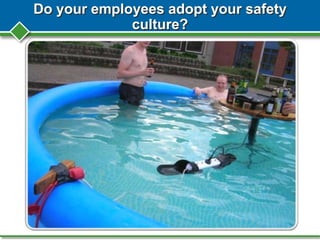
Do your employees adopt your safety
culture?
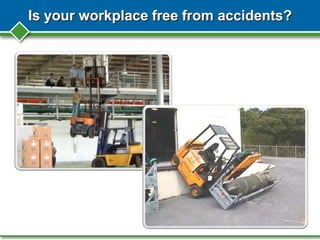
Is your workplace free from accidents?
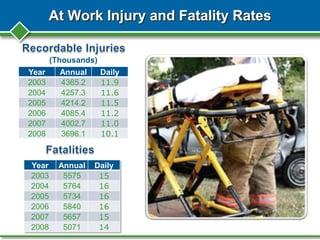
Year Annual Daily
2003 5575 15
2004 5764 16
2005 5734 16
2006 5840 16
2007 5657 15
2008 5071 14
At Work Injury and Fatality Rates
Year Annual Daily
2003 4365.2 11.9
2004 4257.3 11.6
2005 4214.2 11.5
2006 4085.4 11.2
2007 4002.7 11.0
2008 3696.1 10.1
(Thousands)
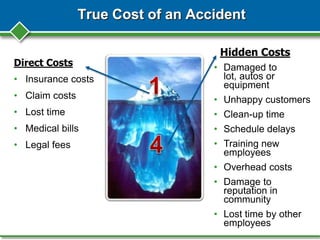
True Cost of an Accident
Hidden Costs
• Damaged to
lot, autos or
equipment
• Unhappy customers
• Clean-up time
• Schedule delays
• Training new
employees
• Overhead costs
• Damage to
reputation in
community
• Lost time by other
employees
Direct Costs
• Insurance costs
• Claim costs
• Lost time
• Medical bills
• Legal fees
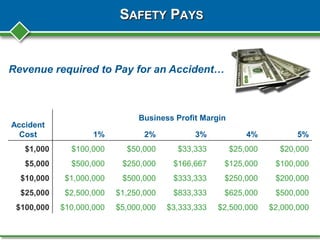
SAFETY PAYS
Revenue required to Pay for an Accident…
Accident
Cost
Business Profit Margin
1% 2% 3% 4% 5%
$1,000 $100,000 $50,000 $33,333 $25,000 $20,000
$5,000 $500,000 $250,000 $166,667 $125,000 $100,000
$10,000 $1,000,000 $500,000 $333,333 $250,000 $200,000
$25,000 $2,500,000 $1,250,000 $833,333 $625,000 $500,000
$100,000 $10,000,000 $5,000,000 $3,333,333 $2,500,000 $2,000,000
Accident Pyramid
1 Major Accident
29 Minor Accidents
300 Near Misses
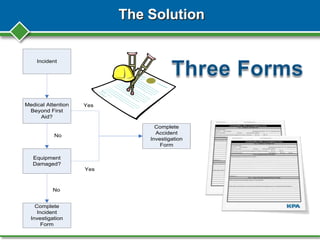
The Solution
Incident
Medical Attention
Beyond First
Aid?
Equipment
Damaged?
No
No
Yes
Yes
Complete
Accident
Investigation
Form
Complete
Incident
Investigation
Form
Root Cause Analysis
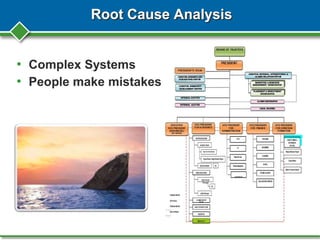
• Complex Systems
• People make mistakes
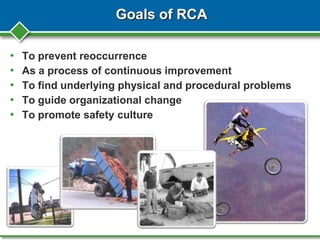
Goals of RCA
• To prevent reoccurrence
• As a process of continuous improvement
• To find underlying physical and procedural problems
• To guide organizational change
• To promote safety culture
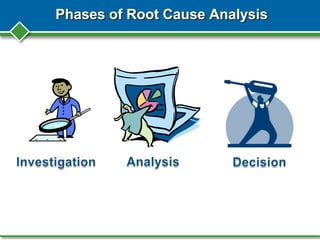
Phases of Root Cause Analysis
The Investigation
• Beware of the Bias Trap
• Timely Investigation
• Pictures
• Service Records
Analysis
What is Root Cause Analysis?
It is whatever YOU make it!
Should focus on….
People!
Focus
An evidence-based endeavor designed to
help people discover how their behavior
contributed to an incident...
To such an extent that their
behavior will change in the future.
Traps
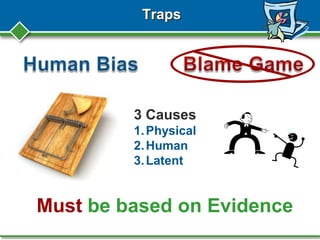
3 Causes
1.Physical
2.Human
3.Latent
Must be based on Evidence
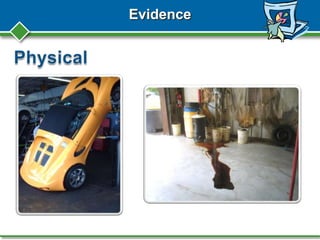
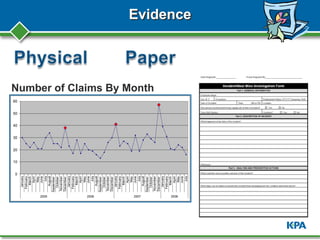
Evidence
0
10
20
30
40
50
60
January
February
March
April
May
June
July
August
September
October
November
December
January
February
March
April
May
June
July
August
September
October
November
December
January
February
March
April
May
June
July
August
September
October
November
December
January
February
March
April
May
June
July
2005 2006 2007 2008
Number of Claims By Month
Evidence
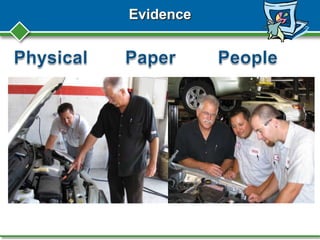
Evidence
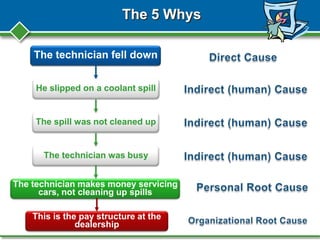
The 5 Whys
The technician fell down
He slipped on a coolant spill
The spill was not cleaned up
The technician was busy
The technician makes money servicing
cars, not cleaning up spills
This is the pay structure at the
dealership
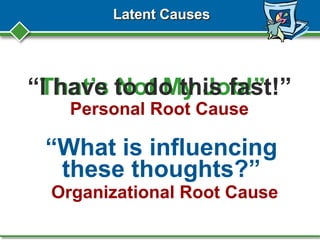
“That’s Not My Job!”
Latent Causes
“I have to do this fast!”
“What is influencing
these thoughts?”
Personal Root Cause
Organizational Root Cause
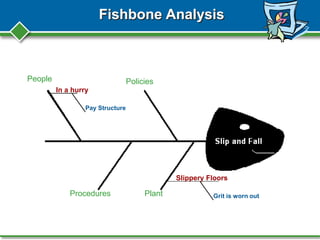
Fishbone Analysis
People Policies
Procedures Plant
In a hurry
Slippery Floors
Pay Structure
Grit is worn out
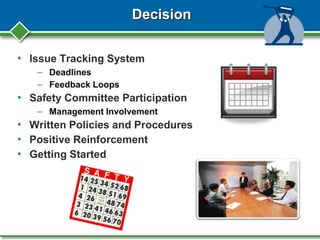
Decision
• Issue Tracking System
– Deadlines
– Feedback Loops
• Safety Committee Participation
– Management Involvement
• Written Policies and Procedures
• Positive Reinforcement
• Getting Started
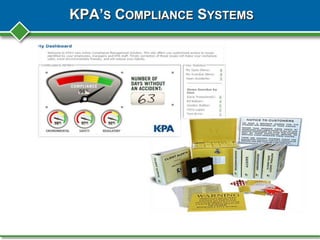
KPA’S COMPLIANCE SYSTEMS
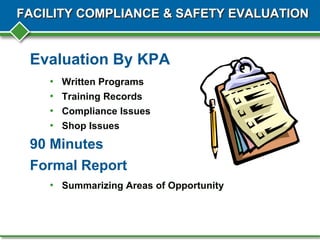
FACILITY COMPLIANCE & SAFETY EVALUATION
Evaluation By KPA
• Written Programs
• Training Records
• Compliance Issues
• Shop Issues
90 Minutes
Formal Report
• Summarizing Areas of Opportunity
FREE CONSULTING TIME!!!
www.kpaonline.com
info@kpaonline.com
866-356-1735
32
A copy of the recorded webinar and presentation will be emailed to
you today.

Root Cause Analysis and Accident Investigation

Editor's Notes

  • #13 Let’s discuss a little accident theory and then we’ll move onto what to do about it.
  • #15 We form organizations to get work done. As the work we want to do gets larger and more complex, so do our organizations. As these organizations grow, we develop various systems to manage our organizations. Since we as humans regularly make mistakes, often our systems fail due to mistakes in process or system design flaws. Root Cause Analysis is a process of continuous improvement, it is used to find faults with our systems and make them better in the future. It is used whenever there is a gap between actual and desired performance. If you want your problems to go away, your best option is to kill them at the root. Hence the root cause analysis!
  • #23 Paper evidence includes trends from the past, training rosters, incident investigation forms and even our minutes.
  • #24 Finally you gather people evidence by interviewing the people involved, and looking for what motivated them to behave the way they did.