DRUGS FOR COUGH
Dr. D. K. Brahma
Associate Professor
Department of Pharmacology
NEIGRIHMS, Shillong
WHAT IS COUGH ?
 It’s a protective reflex – for expulsion of
respiratory secretions and foreign
particles from air passages
Respiratory secretions ! – URT - LRT
 Stimulation of mechano or chemoreceptor
– throat, respiratory passages and stretch
receptors in the lungs
 Afferent fibres in vagus & sympathetic -
impulses to cough center – medulla
 Cough Mechanism !
COUGH – TYPES AND MERITS
 Non-productive (Dry Cough) and Productive
 Nonproductive ones need suppression –
cerebral hypoxia, rupture of bullas and fracture
ribs etc.
 Productive – needs to clear airway
 May be harmful if suppressed !
 Amount of product Vs effort of coughing
 Most of the time, coughing is beneficial
 Removes excessive secretions
 Removes potentially harmful foreign substances
 In some situations, coughing can be harmful, such as
after hernia repair surgery
COUGH ETIOLOGY
1. Upper/Lower Respiratory Tract Infection
2. Postnasal drip due to sinusitis, rhinitis
3. Smoking/Chronic Bronchitis
4. Pulmonary Tuberculosis
5. Asthmatic cough
6. Gastrointestinal reflux
7. Drugs – Captopril and Iodides ……
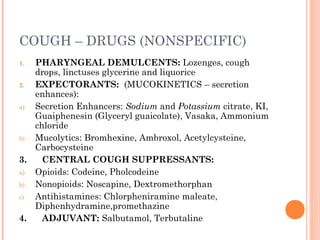
COUGH – DRUGS (NONSPECIFIC)
1. PHARYNGEAL DEMULCENTS: Lozenges, cough
drops, linctuses glycerine and liquorice
2. EXPECTORANTS: (MUCOKINETICS – secretion
enhances):
a) Secretion Enhancers: Sodium and Potassium citrate, KI,
Guaiphenesin (Glyceryl guaicolate), Vasaka, Ammonium
chloride
b) Mucolytics: Bromhexine, Ambroxol, Acetylcysteine,
Carbocysteine
3. CENTRAL COUGH SUPPRESSANTS:
a) Opioids: Codeine, Pholcodeine
b) Nonopioids: Noscapine, Dextromethorphan
c) Antihistamines: Chlorpheniramine maleate,
Diphenhydramine,promethazine
4. ADJUVANT: Salbutamol, Terbutaline
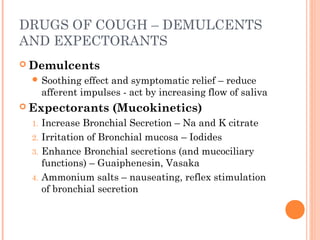
DRUGS OF COUGH – DEMULCENTS
AND EXPECTORANTS
 Demulcents
 Soothing effect and symptomatic relief – reduce
afferent impulses - act by increasing flow of saliva
 Expectorants (Mucokinetics)
1. Increase Bronchial Secretion – Na and K citrate
2. Irritation of Bronchial mucosa – Iodides
3. Enhance Bronchial secretions (and mucociliary
functions) – Guaiphenesin, Vasaka
4. Ammonium salts – nauseating, reflex stimulation
of bronchial secretion
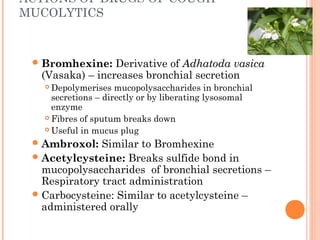
ACTIONS OF DRUGS OF COUGH –
MUCOLYTICS
Bromhexine: Derivative of Adhatoda vasica
(Vasaka) – increases bronchial secretion
 Depolymerises mucopolysaccharides in bronchial
secretions – directly or by liberating lysosomal
enzyme
 Fibres of sputum breaks down
 Useful in mucus plug
Ambroxol: Similar to Bromhexine
Acetylcysteine: Breaks sulfide bond in
mucopolysaccharides of bronchial secretions –
Respiratory tract administration
Carbocysteine: Similar to acetylcysteine –
administered orally
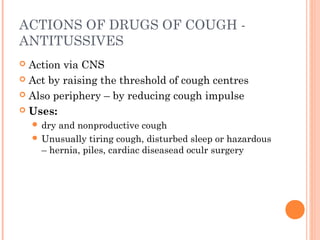
ACTIONS OF DRUGS OF COUGH -
ANTITUSSIVES
 Action via CNS
 Act by raising the threshold of cough centres
 Also periphery – by reducing cough impulse
 Uses:
 dry and nonproductive cough
 Unusually tiring cough, disturbed sleep or hazardous
– hernia, piles, cardiac diseasead oculr surgery
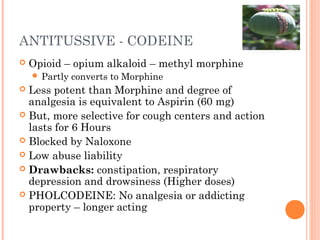
ANTITUSSIVE - CODEINE
 Opioid – opium alkaloid – methyl morphine
 Partly converts to Morphine
 Less potent than Morphine and degree of
analgesia is equivalent to Aspirin (60 mg)
 But, more selective for cough centers and action
lasts for 6 Hours
 Blocked by Naloxone
 Low abuse liability
 Drawbacks: constipation, respiratory
depression and drowsiness (Higher doses)
 PHOLCODEINE: No analgesia or addicting
property – longer acting
COUGH DRUGS - NONOPIOIDS
 Noscapine: Opium alakaloid
 Depresses cough, but no analgesic, narcotic or
dependence liability
 Equipotent with codeine – spasmodic cough
 Histamine release – no in asthma
 Dextromethorphan:
 Synthetic – d-isomer (antitussive) and l-isomer
(analgesic)
 Effective as codeine but no addicting and constipating
effect – No impairment of mucocilliary function
 But, dissociative effect – recreational drug?
 In Combination – Paracetamol (acetaminophen)
COUGH DRUGS
 Antihistamine:
Chlorpheniramine, Diphenhydramine and
Promethazine
MOA: Sedative and anticholinergic
Useful in allergic cough
 Bronchodilators:
Bronchospasm can induce cough and
constriction
Hyperactivity of Bronchial smooth muscles
Bronchodilators – relieves cough and improves
clearance during cough
THANK YOU/KHUBLEI SHIBUN
Cough syrups, remedies for cough and cold are
FREELY AVAILABLE
however, needs rational prescribing

drugsforcough-141102114834-conversion-gate02.pdf

  • 1.
    DRUGS FOR COUGH Dr.D. K. Brahma Associate Professor Department of Pharmacology NEIGRIHMS, Shillong
  • 2.
    WHAT IS COUGH?  It’s a protective reflex – for expulsion of respiratory secretions and foreign particles from air passages Respiratory secretions ! – URT - LRT  Stimulation of mechano or chemoreceptor – throat, respiratory passages and stretch receptors in the lungs  Afferent fibres in vagus & sympathetic - impulses to cough center – medulla  Cough Mechanism !
  • 3.
    COUGH – TYPESAND MERITS  Non-productive (Dry Cough) and Productive  Nonproductive ones need suppression – cerebral hypoxia, rupture of bullas and fracture ribs etc.  Productive – needs to clear airway  May be harmful if suppressed !  Amount of product Vs effort of coughing  Most of the time, coughing is beneficial  Removes excessive secretions  Removes potentially harmful foreign substances  In some situations, coughing can be harmful, such as after hernia repair surgery
  • 4.
    COUGH ETIOLOGY 1. Upper/LowerRespiratory Tract Infection 2. Postnasal drip due to sinusitis, rhinitis 3. Smoking/Chronic Bronchitis 4. Pulmonary Tuberculosis 5. Asthmatic cough 6. Gastrointestinal reflux 7. Drugs – Captopril and Iodides ……
  • 5.
    COUGH – DRUGS(NONSPECIFIC) 1. PHARYNGEAL DEMULCENTS: Lozenges, cough drops, linctuses glycerine and liquorice 2. EXPECTORANTS: (MUCOKINETICS – secretion enhances): a) Secretion Enhancers: Sodium and Potassium citrate, KI, Guaiphenesin (Glyceryl guaicolate), Vasaka, Ammonium chloride b) Mucolytics: Bromhexine, Ambroxol, Acetylcysteine, Carbocysteine 3. CENTRAL COUGH SUPPRESSANTS: a) Opioids: Codeine, Pholcodeine b) Nonopioids: Noscapine, Dextromethorphan c) Antihistamines: Chlorpheniramine maleate, Diphenhydramine,promethazine 4. ADJUVANT: Salbutamol, Terbutaline
  • 6.
    DRUGS OF COUGH– DEMULCENTS AND EXPECTORANTS  Demulcents  Soothing effect and symptomatic relief – reduce afferent impulses - act by increasing flow of saliva  Expectorants (Mucokinetics) 1. Increase Bronchial Secretion – Na and K citrate 2. Irritation of Bronchial mucosa – Iodides 3. Enhance Bronchial secretions (and mucociliary functions) – Guaiphenesin, Vasaka 4. Ammonium salts – nauseating, reflex stimulation of bronchial secretion
  • 7.
    ACTIONS OF DRUGSOF COUGH – MUCOLYTICS Bromhexine: Derivative of Adhatoda vasica (Vasaka) – increases bronchial secretion  Depolymerises mucopolysaccharides in bronchial secretions – directly or by liberating lysosomal enzyme  Fibres of sputum breaks down  Useful in mucus plug Ambroxol: Similar to Bromhexine Acetylcysteine: Breaks sulfide bond in mucopolysaccharides of bronchial secretions – Respiratory tract administration Carbocysteine: Similar to acetylcysteine – administered orally
  • 8.
    ACTIONS OF DRUGSOF COUGH - ANTITUSSIVES  Action via CNS  Act by raising the threshold of cough centres  Also periphery – by reducing cough impulse  Uses:  dry and nonproductive cough  Unusually tiring cough, disturbed sleep or hazardous – hernia, piles, cardiac diseasead oculr surgery
  • 9.
    ANTITUSSIVE - CODEINE Opioid – opium alkaloid – methyl morphine  Partly converts to Morphine  Less potent than Morphine and degree of analgesia is equivalent to Aspirin (60 mg)  But, more selective for cough centers and action lasts for 6 Hours  Blocked by Naloxone  Low abuse liability  Drawbacks: constipation, respiratory depression and drowsiness (Higher doses)  PHOLCODEINE: No analgesia or addicting property – longer acting
  • 10.
    COUGH DRUGS -NONOPIOIDS  Noscapine: Opium alakaloid  Depresses cough, but no analgesic, narcotic or dependence liability  Equipotent with codeine – spasmodic cough  Histamine release – no in asthma  Dextromethorphan:  Synthetic – d-isomer (antitussive) and l-isomer (analgesic)  Effective as codeine but no addicting and constipating effect – No impairment of mucocilliary function  But, dissociative effect – recreational drug?  In Combination – Paracetamol (acetaminophen)
  • 11.
    COUGH DRUGS  Antihistamine: Chlorpheniramine,Diphenhydramine and Promethazine MOA: Sedative and anticholinergic Useful in allergic cough  Bronchodilators: Bronchospasm can induce cough and constriction Hyperactivity of Bronchial smooth muscles Bronchodilators – relieves cough and improves clearance during cough
  • 12.
    THANK YOU/KHUBLEI SHIBUN Coughsyrups, remedies for cough and cold are FREELY AVAILABLE however, needs rational prescribing