Explaining
Drug Use
and Abuse
Chapter 2
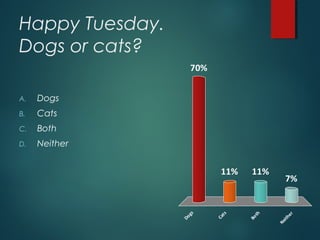
Happy Tuesday.
Dogs or cats?
A. Dogs
B. Cats
C. Both
D. Neither
Dogs
Cats
Both
Neither
70%
7%
11%11%
Why Do People Use Drugs?
 What causes people to subject their bodies and
minds to the harmful effects of nonmedical
and/or recreational drug use that often leads to
drug addiction?
 Why is drug use a more serious problem today
than in the past?
 Why are some people attracted to recreational
drug use?
Ten Reasons Why Drug Use
Is More Serious Today
 From 1960 to the present, drug use has become a widespread
phenomenon.
 Drugs are much more potent than they were years ago.
 Drug use remains extremely popular. Drugs sales are a
multibillion-dollar-a-year business, with major influence on
many national economies.
 More so today than years ago, both licit and illicit drugs are
experimented with by youths at an increasingly younger age.
These drugs are often supplied by older siblings, friends, and
acquaintances.
Ten Reasons Why Drug Use Is More
Serious Today (continued)
 Through the media (such as television, radio, magazine, and
newspaper advertising), people in today’s society are more
directly exposed to drug advertising.
 Greater availability and wider dissemination of drug information
through emails, drug websites for purchasing prescription drugs
without prescriptions, chat rooms, and methods and instructions
on how to make drugs.
 Crack as well as crystal methamphetamine and other
manufactured “newer” drugs offer potent effects at a low cost.
Ten Reasons Why Drug Use Is
More Serious Today (continued)
 Drug use endangers the future of a society by harming its
youth and potentially destroying the lives of many young
men and women.
 Drug use and especially drug dealing are becoming major
factors in the growth of crime rates among the young.
 Seven in ten drug users work full-time and this increases
the possibility of serious accidents in the workplace.
Basic Reasons People Take
Drugs
 Searching for pleasure
 Relieve pain, stress, tension, or depression
 Peer pressure
 Enhance religious or mystical experiences
 Enhance social experiences
 Enhance work performance, (i.e. amphetamine-types of drugs
and cocaine)
 Drugs (primarily performance-enhancing drugs) can be used to
improve athletic performance
 Relieve pain or symptoms of illness
Can you think of any additional reasons not listed above?
Binge drinking (5 or more drinks in
one sitting) is common among
college students. Have you done
this in the last 30 days?
A. Yes
B. No
Yes
No
46%
54%
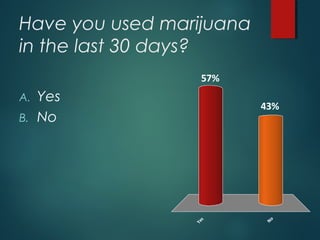
Have you used marijuana
in the last 30 days?
A. Yes
B. No
Yes
No
43%
57%
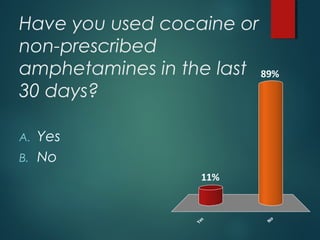
Have you used cocaine or
non-prescribed
amphetamines in the last
30 days?
A. Yes
B. No
Yes
No
89%
11%
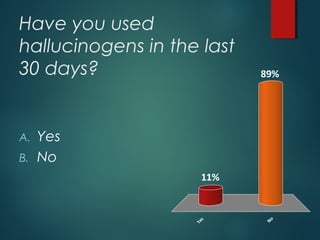
Have you used
hallucinogens in the last
30 days?
A. Yes
B. No
Yes
No
89%
11%
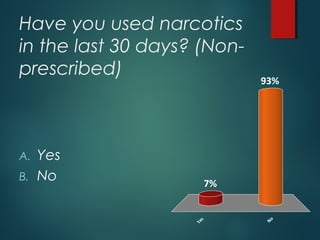
Have you used narcotics
in the last 30 days? (Non-
prescribed)
A. Yes
B. No
Yes
No
93%
7%
Nature of Addiction
Should addiction be considered:
 A bad habit?
 A failure of healthy choices?
 A failure of morality?
 A symptom of other problems?
 A chronic disease?
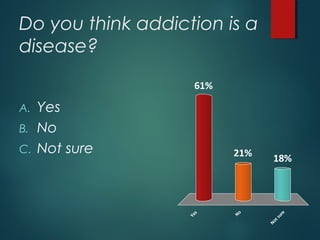
Do you think addiction is a
disease?
A. Yes
B. No
C. Not sure
Yes
No
Notsure
61%
18%
21%
Costs of Addiction
 As a major social problem, the public’s view of drug
abuse and addiction has been debatable over the past
20 years while the social costs of addiction have not.
 The total criminal justice, health insurance, and other costs
in the United States are roughly estimated at $90 to $185
billion annually.
Major Factors Affecting Alcohol
and Drug Use
 Body size: smaller or thinner persons experience the effects of drugs
more intensely
 Gender: physical make-up of women have reduced tolerance to
drugs in comparison to men
 Other drugs (poly drug use): taking multiple drugs can dramatically
increase drug impairment
 Fatigue or illness: increases drug effects
 Empty stomach: increases drug effects
 Strength (alcohol proof) and how the amount of the drug affects
one’s reaction
 Mindset: uncontrollable or impulse drinking and/or use of drugs
dramatically increases drug effects
Defining Addiction
 The term addiction is derived from the Latin verb addicere,
which refers to the process of binding to things. Today, the word
largely refers to a chronic adherence (attachment) to drugs.
 Originally, the World Health Organization (WHO) defined it as “a
state of periodic or chronic intoxication detrimental to the
individual and society, which is characterized by an
overwhelming desire to continue taking the drug and to obtain
it by any means” (1964, pp. 9–10).
 Addiction is a complex disease.
Another Definition of
Addiction
 The National Institute on Drug Abuse (NIDA)
defines addiction as “. . . a chronic, relapsing
brain disease that is characterized by
compulsive drug-seeking and use, despite
harmful consequences. It is considered a brain
disease because drugs change the brain—they
change its structure and how it works. These
brain changes can be long lasting and can lead
to the harmful behaviors seen in people who
abuse drugs” (NIDA 2008a, p. 5).
The Diagnostic and Statistical Manual of
Mental Disorders, fifth edition (DSM-5) (APA
2013)
 DSM-5 combines substance abuse and substance
dependence into a single condition called substance use
disorder.
 The diagnosis of substance use disorder includes the
following:
 Pharmacological – taking the substance in larger doses
 Excessive time spent obtaining the substance
 Craving the drug
The Diagnostic and Statistical Manual of
Mental Disorders, fifth edition (DSM-5) (APA
2013) (cont’d)
 Social impairment: failure to meet goals and obligations
 Risky use of the substance: despite physical and/or psychological
problems encountered
 Tolerance: The individual needs increased amounts to achieve the
diminishing effects of the drug
 Withdrawal: Symptoms that can often leading to renewed
substance dependence
Addiction Includes Physical
and Psychological
Dependence
 Physical dependence refers to the body’s need to constantly
have the drug or drugs.
 Psychological dependence refers to the mental inability to stop
using the drug or drugs.
© Corbis
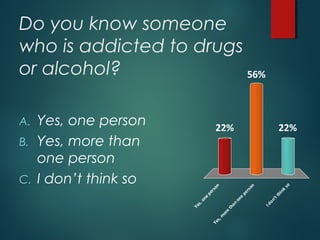
Do you know someone
who is addicted to drugs
or alcohol?
A. Yes, one person
B. Yes, more than
one person
C. I don’t think so
Yes,one
personYes,m
ore
than
one
person
Idon’tthink
so
22% 22%
56%
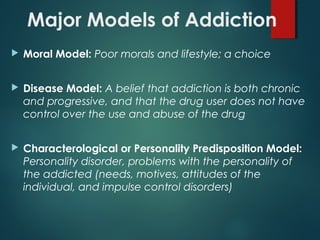
Major Models of Addiction
 Moral Model: Poor morals and lifestyle; a choice
 Disease Model: A belief that addiction is both chronic
and progressive, and that the drug user does not have
control over the use and abuse of the drug
 Characterological or Personality Predisposition Model:
Personality disorder, problems with the personality of
the addicted (needs, motives, attitudes of the
individual, and impulse control disorders)
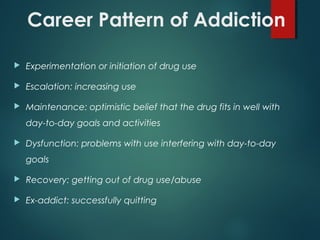
Career Pattern of Addiction
 Experimentation or initiation of drug use
 Escalation: increasing use
 Maintenance: optimistic belief that the drug fits in well with
day-to-day goals and activities
 Dysfunction: problems with use interfering with day-to-day
goals
 Recovery: getting out of drug use/abuse
 Ex-addict: successfully quitting
Are you here?
Wednesday
A. Yes
B. No
C. In body only.
Yes
No
In
bodyonly.
69%
19%
12%
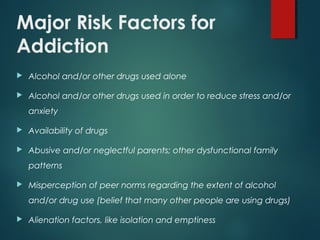
Major Risk Factors for
Addiction
 Alcohol and/or other drugs used alone
 Alcohol and/or other drugs used in order to reduce stress and/or
anxiety
 Availability of drugs
 Abusive and/or neglectful parents; other dysfunctional family
patterns
 Misperception of peer norms regarding the extent of alcohol
and/or drug use (belief that many other people are using drugs)
 Alienation factors, like isolation and emptiness
Major Risk Factors for
Adolescents
 Physical or sexual abuse (past and/or present)
 Peer norms favoring drug use
 Misperception and/or power of age group peer norms
 Conflicts, such as dependence versus independence, adult
maturational tasks versus fear, and low self-esteem.
© BananaStock/age fotostock
Major Risk Factors for
Adolescents (continued)
 Teenage risk-taking and view of being omnipotent and
invulnerable to drug effects
 Drug use viewed as a rite of passage into adulthood
 Drug use perceived as glamorous, fun, facilitating, and intimate
Electronic social media influences like photos of drinking posted
on MySpace
© Simone van den Berg/ShutterStock, Inc.
Major Risk Factors for Adults
 Loss of meaningful role or occupational identity due to
pending retirement
 Loss, grief, or isolation due to divorce, loss of parents, or
departure of children (“empty nest syndrome”)
 Loss of positive body image
 Dealing with a newly diagnosed illness (e.g., diabetes,
heart problems, arthritis, cancer)
 Disappointment when life’s expectations are clearly not
met
Biological Explanations for
the Use and Abuse of Drugs
 Biological: Genetic and biophysiological theories
 Addiction is based on genes, brain dysfunction, and
biochemical patterns
 Biological explanations emphasize the effects of drugs on the
central nervous system (CNS)
 Reward centers in some people are more sensitive to drugs,
resulting in more pleasure and greater rewarding experiences
from the use of drugs
- Drugs interfere with functioning neurotransmitters
(neurotransmitters are chemical messengers used for
communication between brain regions)
Three Principle Biological
Theories
 Abused Drugs are Positive Reinforcers
 Most drugs with abuse potential enhance pleasure centers by
causing the release of specific brain neurotransmitters such as
dopamine
 Drug Abuse and Psychiatric Disorders
 Biological explanations are thought to be responsible for the
substantial overlap that exists between drug addiction and mental
illness
 Genetic Explanations
 Inherited traits can predispose some individuals to drug addiction.
Abused Drugs as Positive
Reinforcers
This explanation believes that most drugs with abuse
potential enhance the pleasure centers by causing the
release of dopamine, which is a specific brain
neurotransmitter.
Genetic Explanations for
Contribution to Drug Abuse
Vulnerability
 Character traits, such as insecurity and vulnerability, which is
often found in many drug users/abusers may be genetically
determined.
 Factors that determine how difficult it will be to break a drug
addiction may be genetically determined.
Genetic Factors Contribute to
Drug Abuse Vulnerability
 Psychiatric disorders may be relieved by taking drugs
of abuse, thus encouraging their use.
 Drug users may have reward centers in the brain that
may be especially sensitive to addictive drugs.
 Addiction is a medical condition in the brain of
addicts.
 Addiction is genetically determined, and people
with this predisposition are less likely to abandon their
drug of abuse.
Happy Friday! Watching
the Hawks this weekend??
A. Of course. I
bleed blue
B. Probably not.
C. Do they play
soccer?
Ofcourse.Ibleed
blue
Probablynot.
Do
theyplay
soccer?
43%
19%
38%
Psychological Explanations for
Drug Use/Abuse
 Psychological theories regarding drug use and addiction mostly
focus on mental or emotional states of drug users, the possible
existence of unconscious motivations that are within all of us,
and social and environmental factors.
 The American Psychiatric Association classifies severe drug
dependence as a form of psychiatric disorder.
 Drugs that are abused can cause mental conditions that mimic
major psychiatric illness.
Psychological Explanations for Drug
Use/Abuse (continued)
 Psychological factors of addiction include:
 Escape from reality
 Boredom
 Inability to cope with anxiety
 Destructive self-indulgence (constantly desiring
intoxicants)
 Blind compliance with drug-abusing peers
 Self-destructiveness
 Blindly using drugs without wanting to understand
the harmful effects of drug use
 Self medicating (need the drug to feel better)
Theories Based on Learning
Humans acquire drug use behavior by the close association or
pairing of one significant reinforcing stimulus (like friendship and
intimacy) with another less significant or neutral stimulus (e.g., initial
use of alcohol, marijuana, ecstasy, cocaine). In learning to use
drugs the following occurs:
 Conditioning: The close association of significant reinforcing
stimulus with another less significant or neutral stimulus
 Habituation: Repeating certain patterns of behavior until they
become established or habitual
 “Addiction to pleasure” theory: Assumes it is biologically normal to
continue a pleasure stimulus when once begun
Who Is at Risk?
 People who are at a high risk for drug use and addiction are
often known as drug sensation-seeking individuals or simply,
sensation-seekers.
 Sensation-seekers continually search for new or novel thrills
in their experiences, and are known to have a relentless
desire to pursue physical and psychological stimulation
often involving dangerous behavior.
 Sensation-seekers attracted to drug are more likely to
maintain a constant preoccupation with altering their
consciousness (getting high).
Social Psychological Learning
Theories
If the effects of drug use become personally rewarding, “or
become reinforcing through conditioning, the chances of
continuing to use are greater than stopping” (Akers 1992, p. 86).
Primary conditions determining drug use are:
 Amount of exposure to drug-using peers
 Extent of drug use in a given neighborhood
 Age of first use (exposure to drugs at younger ages results in
greater difficulty in stopping drug use)
 Frequency of drug use among peers
Sociological Explanations
 Social Influence Theories: Focus on microscopic
explanations that concentrate on the roles played by
significant others and their impact on the individual.
 Structural Influence Theories: Focus on macroscopic
explanations of drug use and the assumption that the
organizational structure of society has a major impact on
individual drug use.
Social Influence Theories
 Social learning theory explains drug use as a form of
learned behavior.
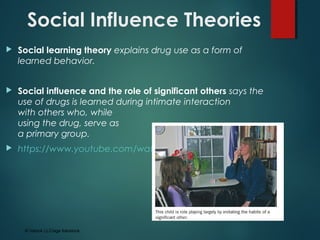
 Social influence and the role of significant others says the
use of drugs is learned during intimate interaction
with others who, while
using the drug, serve as
a primary group.
 https://www.youtube.com/watch?v=NjTxQy_U3ac
© Vstock LLC/age fotostock
Social Influence Theories
(continued)
 Labeling theory says people whose opinions we value have a
determining influence over our self-image. Key factors in
labeling theory include:
• Primary deviance
• Secondary deviance
• Master status
• Retrospective interpretation
- Can you define these four key factors used in
labeling theory?
 Subculture theory explains that peer pressure is a determining
cause of drug experimentation, use, and/or abuse.
Structural Influence Theories
 Structural Influence Theories: Focus on how the organization of
a society, group, or subculture is largely responsible for drug
abuse by its members
 Social Disorganization and Social Strain Theories: Drug use is
caused by rapid and disruptive social change in society
 Control Theories: Belief that if people are left without
attachments (bonds) to other groups (family, peers, social
institutions), they have a tendency to deviate from expected
cultural values, norms, and attitudes and use drugs
 Socialization: Internal and external controls
Danger Signals of Drug
Abuse
 Do those close to you often ask about your drug use? Have
they noticed changes in your moods or behavior?
 Are you defensive if a friend or relative mentions your drug or
alcohol use?
 Are you sometimes embarrassed or frightened by your
behavior under the influence of drugs or alcohol?
Danger Signals of Drug Abuse
(continued)
 Have you ever gone to see a new doctor because your
regular physician would not prescribe the drug you wanted?
 When you are under pressure or feel anxious, do you
automatically take a depressant, stimulant, or drink?
 Do you take drugs more often or for purposes other than
those recommended by your doctor?
Danger Signals of Drug
Abuse (continued)
 Do you mix other types of drugs with alcohol?
 Do you drink or take drugs regularly to help you sleep?
 Do you have to take drugs to relieve boredom or get through the
day?
 Do you personally think you may have a drug problem?
 Do you avoid people who do not use drugs?
 Do you believe you cannot have fun without alcohol or other
drugs?
Low-Risk and High-Risk
Drug Choices
 Low-risk drug choices refer to values and attitudes that lead to
controlling the use of alcohol or drugs—self-monitoring your
drug use, behavior, and abstinence.
 High-risk drug choices refer to developing values and attitudes
that lead to using drugs both habitually and addictively, such
as constantly searching for drinking and drug parties and
hanging with drug abusers.

Drugs & Society Chapter 2

  • 1.
  • 2.
    Happy Tuesday. Dogs orcats? A. Dogs B. Cats C. Both D. Neither Dogs Cats Both Neither 70% 7% 11%11%
  • 3.
    Why Do PeopleUse Drugs?  What causes people to subject their bodies and minds to the harmful effects of nonmedical and/or recreational drug use that often leads to drug addiction?  Why is drug use a more serious problem today than in the past?  Why are some people attracted to recreational drug use?
  • 4.
    Ten Reasons WhyDrug Use Is More Serious Today  From 1960 to the present, drug use has become a widespread phenomenon.  Drugs are much more potent than they were years ago.  Drug use remains extremely popular. Drugs sales are a multibillion-dollar-a-year business, with major influence on many national economies.  More so today than years ago, both licit and illicit drugs are experimented with by youths at an increasingly younger age. These drugs are often supplied by older siblings, friends, and acquaintances.
  • 5.
    Ten Reasons WhyDrug Use Is More Serious Today (continued)  Through the media (such as television, radio, magazine, and newspaper advertising), people in today’s society are more directly exposed to drug advertising.  Greater availability and wider dissemination of drug information through emails, drug websites for purchasing prescription drugs without prescriptions, chat rooms, and methods and instructions on how to make drugs.  Crack as well as crystal methamphetamine and other manufactured “newer” drugs offer potent effects at a low cost.
  • 6.
    Ten Reasons WhyDrug Use Is More Serious Today (continued)  Drug use endangers the future of a society by harming its youth and potentially destroying the lives of many young men and women.  Drug use and especially drug dealing are becoming major factors in the growth of crime rates among the young.  Seven in ten drug users work full-time and this increases the possibility of serious accidents in the workplace.
  • 7.
    Basic Reasons PeopleTake Drugs  Searching for pleasure  Relieve pain, stress, tension, or depression  Peer pressure  Enhance religious or mystical experiences  Enhance social experiences  Enhance work performance, (i.e. amphetamine-types of drugs and cocaine)  Drugs (primarily performance-enhancing drugs) can be used to improve athletic performance  Relieve pain or symptoms of illness Can you think of any additional reasons not listed above?
  • 8.
    Binge drinking (5or more drinks in one sitting) is common among college students. Have you done this in the last 30 days? A. Yes B. No Yes No 46% 54%
  • 9.
    Have you usedmarijuana in the last 30 days? A. Yes B. No Yes No 43% 57%
  • 10.
    Have you usedcocaine or non-prescribed amphetamines in the last 30 days? A. Yes B. No Yes No 89% 11%
  • 11.
    Have you used hallucinogensin the last 30 days? A. Yes B. No Yes No 89% 11%
  • 12.
    Have you usednarcotics in the last 30 days? (Non- prescribed) A. Yes B. No Yes No 93% 7%
  • 13.
    Nature of Addiction Shouldaddiction be considered:  A bad habit?  A failure of healthy choices?  A failure of morality?  A symptom of other problems?  A chronic disease?
  • 14.
    Do you thinkaddiction is a disease? A. Yes B. No C. Not sure Yes No Notsure 61% 18% 21%
  • 15.
    Costs of Addiction As a major social problem, the public’s view of drug abuse and addiction has been debatable over the past 20 years while the social costs of addiction have not.  The total criminal justice, health insurance, and other costs in the United States are roughly estimated at $90 to $185 billion annually.
  • 16.
    Major Factors AffectingAlcohol and Drug Use  Body size: smaller or thinner persons experience the effects of drugs more intensely  Gender: physical make-up of women have reduced tolerance to drugs in comparison to men  Other drugs (poly drug use): taking multiple drugs can dramatically increase drug impairment  Fatigue or illness: increases drug effects  Empty stomach: increases drug effects  Strength (alcohol proof) and how the amount of the drug affects one’s reaction  Mindset: uncontrollable or impulse drinking and/or use of drugs dramatically increases drug effects
  • 17.
    Defining Addiction  Theterm addiction is derived from the Latin verb addicere, which refers to the process of binding to things. Today, the word largely refers to a chronic adherence (attachment) to drugs.  Originally, the World Health Organization (WHO) defined it as “a state of periodic or chronic intoxication detrimental to the individual and society, which is characterized by an overwhelming desire to continue taking the drug and to obtain it by any means” (1964, pp. 9–10).  Addiction is a complex disease.
  • 18.
    Another Definition of Addiction The National Institute on Drug Abuse (NIDA) defines addiction as “. . . a chronic, relapsing brain disease that is characterized by compulsive drug-seeking and use, despite harmful consequences. It is considered a brain disease because drugs change the brain—they change its structure and how it works. These brain changes can be long lasting and can lead to the harmful behaviors seen in people who abuse drugs” (NIDA 2008a, p. 5).
  • 19.
    The Diagnostic andStatistical Manual of Mental Disorders, fifth edition (DSM-5) (APA 2013)  DSM-5 combines substance abuse and substance dependence into a single condition called substance use disorder.  The diagnosis of substance use disorder includes the following:  Pharmacological – taking the substance in larger doses  Excessive time spent obtaining the substance  Craving the drug
  • 20.
    The Diagnostic andStatistical Manual of Mental Disorders, fifth edition (DSM-5) (APA 2013) (cont’d)  Social impairment: failure to meet goals and obligations  Risky use of the substance: despite physical and/or psychological problems encountered  Tolerance: The individual needs increased amounts to achieve the diminishing effects of the drug  Withdrawal: Symptoms that can often leading to renewed substance dependence
  • 21.
    Addiction Includes Physical andPsychological Dependence  Physical dependence refers to the body’s need to constantly have the drug or drugs.  Psychological dependence refers to the mental inability to stop using the drug or drugs. © Corbis
  • 22.
    Do you knowsomeone who is addicted to drugs or alcohol? A. Yes, one person B. Yes, more than one person C. I don’t think so Yes,one personYes,m ore than one person Idon’tthink so 22% 22% 56%
  • 23.
    Major Models ofAddiction  Moral Model: Poor morals and lifestyle; a choice  Disease Model: A belief that addiction is both chronic and progressive, and that the drug user does not have control over the use and abuse of the drug  Characterological or Personality Predisposition Model: Personality disorder, problems with the personality of the addicted (needs, motives, attitudes of the individual, and impulse control disorders)
  • 24.
    Career Pattern ofAddiction  Experimentation or initiation of drug use  Escalation: increasing use  Maintenance: optimistic belief that the drug fits in well with day-to-day goals and activities  Dysfunction: problems with use interfering with day-to-day goals  Recovery: getting out of drug use/abuse  Ex-addict: successfully quitting
  • 25.
    Are you here? Wednesday A.Yes B. No C. In body only. Yes No In bodyonly. 69% 19% 12%
  • 26.
    Major Risk Factorsfor Addiction  Alcohol and/or other drugs used alone  Alcohol and/or other drugs used in order to reduce stress and/or anxiety  Availability of drugs  Abusive and/or neglectful parents; other dysfunctional family patterns  Misperception of peer norms regarding the extent of alcohol and/or drug use (belief that many other people are using drugs)  Alienation factors, like isolation and emptiness
  • 27.
    Major Risk Factorsfor Adolescents  Physical or sexual abuse (past and/or present)  Peer norms favoring drug use  Misperception and/or power of age group peer norms  Conflicts, such as dependence versus independence, adult maturational tasks versus fear, and low self-esteem. © BananaStock/age fotostock
  • 28.
    Major Risk Factorsfor Adolescents (continued)  Teenage risk-taking and view of being omnipotent and invulnerable to drug effects  Drug use viewed as a rite of passage into adulthood  Drug use perceived as glamorous, fun, facilitating, and intimate Electronic social media influences like photos of drinking posted on MySpace © Simone van den Berg/ShutterStock, Inc.
  • 29.
    Major Risk Factorsfor Adults  Loss of meaningful role or occupational identity due to pending retirement  Loss, grief, or isolation due to divorce, loss of parents, or departure of children (“empty nest syndrome”)  Loss of positive body image  Dealing with a newly diagnosed illness (e.g., diabetes, heart problems, arthritis, cancer)  Disappointment when life’s expectations are clearly not met
  • 30.
    Biological Explanations for theUse and Abuse of Drugs  Biological: Genetic and biophysiological theories  Addiction is based on genes, brain dysfunction, and biochemical patterns  Biological explanations emphasize the effects of drugs on the central nervous system (CNS)  Reward centers in some people are more sensitive to drugs, resulting in more pleasure and greater rewarding experiences from the use of drugs - Drugs interfere with functioning neurotransmitters (neurotransmitters are chemical messengers used for communication between brain regions)
  • 31.
    Three Principle Biological Theories Abused Drugs are Positive Reinforcers  Most drugs with abuse potential enhance pleasure centers by causing the release of specific brain neurotransmitters such as dopamine  Drug Abuse and Psychiatric Disorders  Biological explanations are thought to be responsible for the substantial overlap that exists between drug addiction and mental illness  Genetic Explanations  Inherited traits can predispose some individuals to drug addiction.
  • 32.
    Abused Drugs asPositive Reinforcers This explanation believes that most drugs with abuse potential enhance the pleasure centers by causing the release of dopamine, which is a specific brain neurotransmitter.
  • 33.
    Genetic Explanations for Contributionto Drug Abuse Vulnerability  Character traits, such as insecurity and vulnerability, which is often found in many drug users/abusers may be genetically determined.  Factors that determine how difficult it will be to break a drug addiction may be genetically determined.
  • 34.
    Genetic Factors Contributeto Drug Abuse Vulnerability  Psychiatric disorders may be relieved by taking drugs of abuse, thus encouraging their use.  Drug users may have reward centers in the brain that may be especially sensitive to addictive drugs.  Addiction is a medical condition in the brain of addicts.  Addiction is genetically determined, and people with this predisposition are less likely to abandon their drug of abuse.
  • 35.
    Happy Friday! Watching theHawks this weekend?? A. Of course. I bleed blue B. Probably not. C. Do they play soccer? Ofcourse.Ibleed blue Probablynot. Do theyplay soccer? 43% 19% 38%
  • 36.
    Psychological Explanations for DrugUse/Abuse  Psychological theories regarding drug use and addiction mostly focus on mental or emotional states of drug users, the possible existence of unconscious motivations that are within all of us, and social and environmental factors.  The American Psychiatric Association classifies severe drug dependence as a form of psychiatric disorder.  Drugs that are abused can cause mental conditions that mimic major psychiatric illness.
  • 37.
    Psychological Explanations forDrug Use/Abuse (continued)  Psychological factors of addiction include:  Escape from reality  Boredom  Inability to cope with anxiety  Destructive self-indulgence (constantly desiring intoxicants)  Blind compliance with drug-abusing peers  Self-destructiveness  Blindly using drugs without wanting to understand the harmful effects of drug use  Self medicating (need the drug to feel better)
  • 38.
    Theories Based onLearning Humans acquire drug use behavior by the close association or pairing of one significant reinforcing stimulus (like friendship and intimacy) with another less significant or neutral stimulus (e.g., initial use of alcohol, marijuana, ecstasy, cocaine). In learning to use drugs the following occurs:  Conditioning: The close association of significant reinforcing stimulus with another less significant or neutral stimulus  Habituation: Repeating certain patterns of behavior until they become established or habitual  “Addiction to pleasure” theory: Assumes it is biologically normal to continue a pleasure stimulus when once begun
  • 39.
    Who Is atRisk?  People who are at a high risk for drug use and addiction are often known as drug sensation-seeking individuals or simply, sensation-seekers.  Sensation-seekers continually search for new or novel thrills in their experiences, and are known to have a relentless desire to pursue physical and psychological stimulation often involving dangerous behavior.  Sensation-seekers attracted to drug are more likely to maintain a constant preoccupation with altering their consciousness (getting high).
  • 40.
    Social Psychological Learning Theories Ifthe effects of drug use become personally rewarding, “or become reinforcing through conditioning, the chances of continuing to use are greater than stopping” (Akers 1992, p. 86). Primary conditions determining drug use are:  Amount of exposure to drug-using peers  Extent of drug use in a given neighborhood  Age of first use (exposure to drugs at younger ages results in greater difficulty in stopping drug use)  Frequency of drug use among peers
  • 41.
    Sociological Explanations  SocialInfluence Theories: Focus on microscopic explanations that concentrate on the roles played by significant others and their impact on the individual.  Structural Influence Theories: Focus on macroscopic explanations of drug use and the assumption that the organizational structure of society has a major impact on individual drug use.
  • 42.
    Social Influence Theories Social learning theory explains drug use as a form of learned behavior.  Social influence and the role of significant others says the use of drugs is learned during intimate interaction with others who, while using the drug, serve as a primary group.  https://www.youtube.com/watch?v=NjTxQy_U3ac © Vstock LLC/age fotostock
  • 43.
    Social Influence Theories (continued) Labeling theory says people whose opinions we value have a determining influence over our self-image. Key factors in labeling theory include: • Primary deviance • Secondary deviance • Master status • Retrospective interpretation - Can you define these four key factors used in labeling theory?  Subculture theory explains that peer pressure is a determining cause of drug experimentation, use, and/or abuse.
  • 44.
    Structural Influence Theories Structural Influence Theories: Focus on how the organization of a society, group, or subculture is largely responsible for drug abuse by its members  Social Disorganization and Social Strain Theories: Drug use is caused by rapid and disruptive social change in society  Control Theories: Belief that if people are left without attachments (bonds) to other groups (family, peers, social institutions), they have a tendency to deviate from expected cultural values, norms, and attitudes and use drugs  Socialization: Internal and external controls
  • 45.
    Danger Signals ofDrug Abuse  Do those close to you often ask about your drug use? Have they noticed changes in your moods or behavior?  Are you defensive if a friend or relative mentions your drug or alcohol use?  Are you sometimes embarrassed or frightened by your behavior under the influence of drugs or alcohol?
  • 46.
    Danger Signals ofDrug Abuse (continued)  Have you ever gone to see a new doctor because your regular physician would not prescribe the drug you wanted?  When you are under pressure or feel anxious, do you automatically take a depressant, stimulant, or drink?  Do you take drugs more often or for purposes other than those recommended by your doctor?
  • 47.
    Danger Signals ofDrug Abuse (continued)  Do you mix other types of drugs with alcohol?  Do you drink or take drugs regularly to help you sleep?  Do you have to take drugs to relieve boredom or get through the day?  Do you personally think you may have a drug problem?  Do you avoid people who do not use drugs?  Do you believe you cannot have fun without alcohol or other drugs?
  • 48.
    Low-Risk and High-Risk DrugChoices  Low-risk drug choices refer to values and attitudes that lead to controlling the use of alcohol or drugs—self-monitoring your drug use, behavior, and abstinence.  High-risk drug choices refer to developing values and attitudes that lead to using drugs both habitually and addictively, such as constantly searching for drinking and drug parties and hanging with drug abusers.