Drugs and the Kidney
Drugs and the Kidney 1 Renal Physiology and Pharmacokinetics 2 Drugs and the normal kidney 3 Drugs toxic to the kidney 4 Prescribing in kidney disease
Normal Kidney Function  1 Extra Cellular Fluid Volume control 2 Electrolyte balance 3 Waste product excretion 4 Drug and hormone elimination/metabolism 5 Blood pressure regulation 6 Regulation of haematocrit 7 regulation of calcium/phosphate balance (vitamin D3 metabolism)
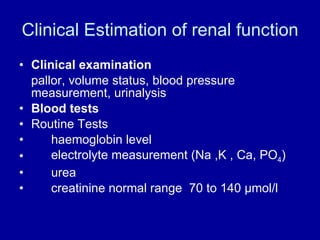
Clinical Estimation of renal function Clinical examination pallor, volume status, blood pressure measurement, urinalysis Blood tests Routine Tests haemoglobin level electrolyte measurement (Na ,K , Ca, PO 4 ) urea creatinine normal range  70 to 140  μ mol/l
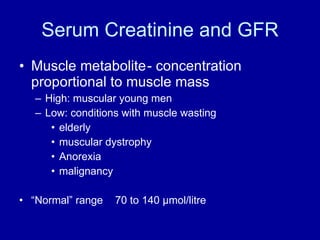
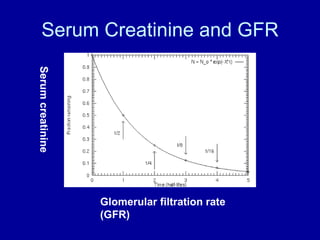
Serum Creatinine and GFR Muscle metabolite - concentration  proportional to muscle mass High: muscular young men Low: conditions with muscle wasting elderly muscular dystrophy Anorexia malignancy “ Normal” range  70 to 140  μ mol/litre
Serum Creatinine and GFR Serum creatinine Glomerular filtration rate  (GFR)
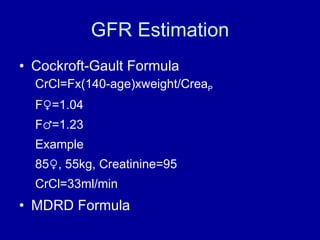
GFR Estimation Cockroft-Gault Formula CrCl=Fx(140-age)xweight/Crea P   F ♀=1.04 F♂=1.23 Example 85♀, 55kg, Creatinine=95 CrCl=33ml/min MDRD Formula
Tests of renal function cont. 24h Urine sample-Creatinine  clearance chromium EDTA Clearance gold standard Inulin clearance
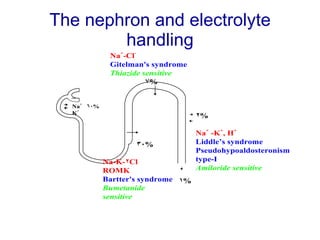
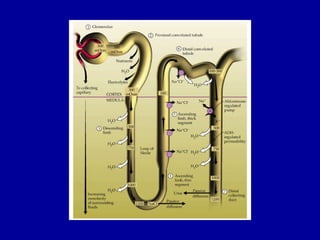
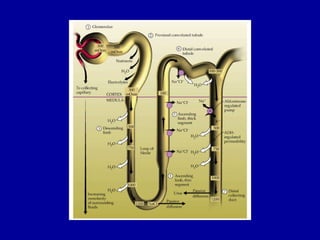
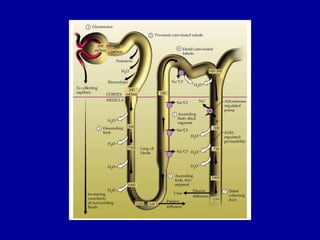
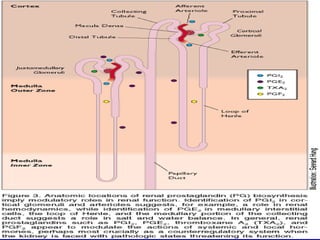
The nephron and electrolyte handling
 
Pharmacokinetics Absorption Distribution Metabolism Elimination filtration secretion
Diuretics Loop Thiazide Aldosterone antagonist Osmotic
Diuretics Indications for use heart failure ( acute or chronic ) pulmonary oedema hypertension nephrotic syndrome hypercalcaemia hypercalciuria
Loop diuretics Frusemide, Bumetanide Indication Fluid overload Hypertension Hypercalcaemia Mechanism of action Blockade of NaK2Cl (NKCC2) transporter in the thick ascending loop of Henle
 
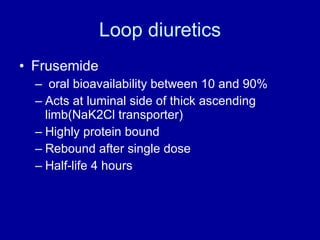
Loop diuretics Frusemide oral bioavailability between 10 and 90% Acts at luminal side of thick ascending limb(NaK2Cl transporter) Highly protein bound Rebound after single dose Half-life 4 hours
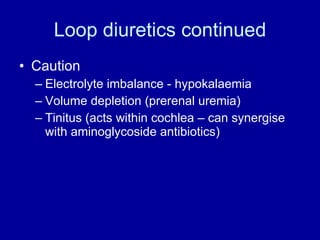
Loop diuretics continued Caution Electrolyte imbalance - hypokalaemia Volume depletion (prerenal uremia) Tinitus (acts within cochlea – can synergise with aminoglycoside antibiotics)
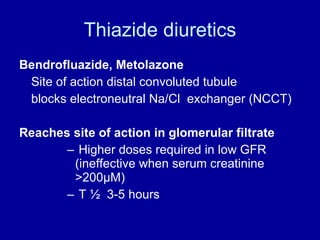
Thiazide diuretics Bendrofluazide, Metolazone Site of action distal convoluted tubule blocks electroneutral Na/Cl  exchanger (NCCT) Reaches site of action in glomerular filtrate Higher doses required in low GFR (ineffective when serum creatinine >200 μ M) T ½  3-5 hours
 
Thiazides Indications Antihypertensive: especially in combination with ACE inhibitor/ARB (A+D) In combination with loop diuretic for profound oedema Cautions Metabolic side effects – hyperuricaemia, impaired glucose tolerance & electrolyte disturbance (hypokalaemia and hyponatraemia) Volume depletion
Major Outcomes in High Risk Hypertensive Patients Randomized to Angiotensin-Converting Enzyme Inhibitor or Calcium Channel Blocker vs Diuretic The Antihypertensive and Lipid-Lowering Treatment to Prevent Heart Attack Trial (ALLHAT) The ALLHAT Collaborative Research Group Sponsored by the National Heart, Lung, and Blood Institute (NHLBI) JAMA. 2002;288:2981-2997 ALLHAT
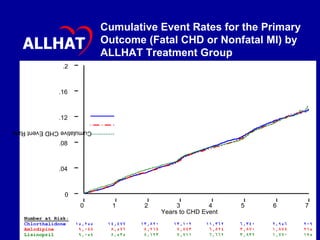
Cumulative Event Rates for the Primary Outcome (Fatal CHD or Nonfatal MI) by ALLHAT Treatment Group   Chlorthalidone Amlodipine Lisinopril Years to CHD Event 0 1 2 3 4 5 6 7 Cumulative CHD Event Rate 0 .04 .08 .12 .16 .2 0.81 0.99 (0.91-1.08) L/C 0.65 0.98 (0.90-1.07) A/C p value RR (95% CI) ALLHAT
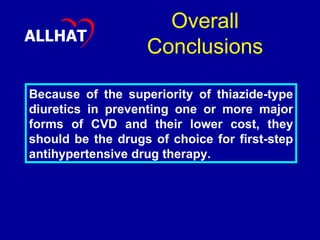
Overall Conclusions Because of the superiority of thiazide-type diuretics in preventing one or more major forms of CVD and their lower cost, they should be the drugs of choice for first-step antihypertensive drug therapy. ALLHAT
Amiloride and Spironolactone Amiloride  Blocks ENaC (channel for Na secretion in collecting duct under aldosterone control) Spironolactone Aldosterone receptor antagonist  Reaches DCT via blood stream (not dependent on GFR) Often Combined with loop or thiazides to capitalise on K-sparing action
 
Nephrotoxic Drugs Dose dependant toxicity NSAIDs including COX 2 Aminoglycosides Radio opaque contrast materials Idiosyncratic Renal Damage NSAIDs Penicillins Gold, penicillamine
NSAIDs (Non-steroidal anti inflammatory drugs) Commonly used Interfere with prostaglandin production,  disrupt regulation of renal medullary blood flow and salt water balance Chronic renal impairment Habitual use Exacerbated by other drugs ( anti-hypertensives, ACE inhibitors) Typical radiological features when advanced
 
Aminoglycosides Highly effective antimicrobials Particularly useful in gram -ve sepsis bactericidal BUT Nephrotoxic  Ototoxic  Narrow therapeutic range
Prescribing Aminoglycosides Once daily regimen now recommended in patients with normal kidneys High peak concentration enhances efficacy  long post dose effect Single daily dose less nephrotoxic Dose depends on size  and renal function Measure levels!
Intravenous contrast Used commonly   CT scanning, IV urography, Angiography Unsafe in patients with pre-existing renal impairment Risk increased in diabetic nephropathy, heart failure & dehydration Can precipitate end-stage renal failure Cumulative effect on repeated administration Risk reduced by using Acetylcysteine ? see N Engl J Med 2000; 343:180-184
Prescribing in Kidney Disease Patients with renal impairment  Patients on Dialysis Patients with renal transplants
Principles Establish type of kidney disease Most patients with kidney failure will already be taking a number of drugs  Interactions are common Care needed to avoid drug toxicity Patients with renal impairment and renal failure Antihypertensives Phosphate binders
Dosing in renal impairment Loading dose does not change (usually) Maintenance dose or dosing interval does T ½  often prolonged Reduce dose OR Increase dosing interval Some drugs have active metabolites that are themselves excreted renally Warfarin, diazepam
Past Papers Write short notes on the following Spironolactone (Dec2000) Amphotericin (June99) Cyclosporin (June99)
Past Papers Discuss the treatment of patients with  Digoxin toxicity Lithium toxicity Following both deliberate and Iatrogenic overdose. Which treatments have been shown to improve survival?
Spironolactone Class Potassium sparing diuretic Mode of action Antagonises the effect of aldosterone at levels MR Mineralocorticoid receptor (MR)–aldosterone complex translocates to nucleus to affect gene transcription Indication Prevent hypokalaemia in patients taking diuretics or digoxin Improves survival in advanced heart failure (RALES 1999 Randomised Aldactone Evaluation Study) Antihypertensive (adjunctive third line therapy for hypertension or first line for conns patients) Ascites in patients with cirrhosis
Spironolactone Side effects Antiandrogenic effects through the antagonism of DHT (testosterone) at its binding site.  Gynaecomastia, impotence, reduced libido Interactions Other potassium sparing drugs e.g. ACE inhibitors/ARBs & potassium supplements (remember ‘LoSalt’ used as NaCl substitute in cooking)
Amphotericin Class Anti fungal agent for topical and systemic use Mode of action Lipid soluble drug. Binds steroid alcohols (ergosterol) in the fungal cell membrane causing leakage of cellular content and death. Effective against candida species Fungistatic or fungicidal depending on the concentration Broad spectrum (candida, cryptosporidium)
Amphotericin Indications  iv administration for systemic invasive fungal infections Oral for GI mycosis Side effects Local/systemic effects with infusion (fever) Chronic kidney dysfunction Decline in GFR with prolonged use Tubular dysfunction (membrane permeability) Hypokalaemia, renal tubular acidosis (bicarb wasting type 1/distal), diabetes insipidus, hypomagnesaemia Pre hydration/saline loading may avoid problems Toxicity can be reduced substantially by liposomal packing of Amphotericin
Lithium toxicity Lithium carbonate -  Rx for bipolar affective disorder Toxicity closely related to serum levels Symptoms  CVS  arrhythmias (especially junctional dysrrythmias) CNS  tremor – confusion - coma Treatment Supportive  - Haemodialysis and colonic irrigation for severe levels Inadvertent intoxication from interaction with  ACEI &  loop/thiazide diuretic Carbamezepine and other anti epileptics increase neurotoxicity
Digoxin toxicity Incidence  High levels demonstrated in 10% and toxicity reported in 4% of a series of 4000 digoxin samples Kinetics  large volume of distribution (reservoir is skeletal muscle) about 30% of stores excreted in urine/day
Treatment of digoxin toxicity Supportive Correction of electrolyte imbalances Atropine for bradycardia avoid cardio stimulants because arrythmogenic Limitation of absorption Charcoal effective within 8 hours (or cholestyramine) Specific measures DIGIBIND  Fab digoxin specific antibodies. Binds plasma digoxin and complex eliminated by kidneys (used when OD is high/near arrest) Enhanced elimination Dialysis is ineffective. Charcoal/cholestyramine interrupt enterohepatic cycling.

Drugs And The Kidney

  • 1.
  • 2.
    Drugs and theKidney 1 Renal Physiology and Pharmacokinetics 2 Drugs and the normal kidney 3 Drugs toxic to the kidney 4 Prescribing in kidney disease
  • 3.
    Normal Kidney Function 1 Extra Cellular Fluid Volume control 2 Electrolyte balance 3 Waste product excretion 4 Drug and hormone elimination/metabolism 5 Blood pressure regulation 6 Regulation of haematocrit 7 regulation of calcium/phosphate balance (vitamin D3 metabolism)
  • 4.
    Clinical Estimation ofrenal function Clinical examination pallor, volume status, blood pressure measurement, urinalysis Blood tests Routine Tests haemoglobin level electrolyte measurement (Na ,K , Ca, PO 4 ) urea creatinine normal range 70 to 140 μ mol/l
  • 5.
    Serum Creatinine andGFR Muscle metabolite - concentration proportional to muscle mass High: muscular young men Low: conditions with muscle wasting elderly muscular dystrophy Anorexia malignancy “ Normal” range 70 to 140 μ mol/litre
  • 6.
    Serum Creatinine andGFR Serum creatinine Glomerular filtration rate (GFR)
  • 7.
    GFR Estimation Cockroft-GaultFormula CrCl=Fx(140-age)xweight/Crea P F ♀=1.04 F♂=1.23 Example 85♀, 55kg, Creatinine=95 CrCl=33ml/min MDRD Formula
  • 8.
    Tests of renalfunction cont. 24h Urine sample-Creatinine clearance chromium EDTA Clearance gold standard Inulin clearance
  • 9.
    The nephron andelectrolyte handling
  • 10.
  • 11.
    Pharmacokinetics Absorption DistributionMetabolism Elimination filtration secretion
  • 12.
    Diuretics Loop ThiazideAldosterone antagonist Osmotic
  • 13.
    Diuretics Indications foruse heart failure ( acute or chronic ) pulmonary oedema hypertension nephrotic syndrome hypercalcaemia hypercalciuria
  • 14.
    Loop diuretics Frusemide,Bumetanide Indication Fluid overload Hypertension Hypercalcaemia Mechanism of action Blockade of NaK2Cl (NKCC2) transporter in the thick ascending loop of Henle
  • 15.
  • 16.
    Loop diuretics Frusemideoral bioavailability between 10 and 90% Acts at luminal side of thick ascending limb(NaK2Cl transporter) Highly protein bound Rebound after single dose Half-life 4 hours
  • 17.
    Loop diuretics continuedCaution Electrolyte imbalance - hypokalaemia Volume depletion (prerenal uremia) Tinitus (acts within cochlea – can synergise with aminoglycoside antibiotics)
  • 18.
    Thiazide diuretics Bendrofluazide,Metolazone Site of action distal convoluted tubule blocks electroneutral Na/Cl exchanger (NCCT) Reaches site of action in glomerular filtrate Higher doses required in low GFR (ineffective when serum creatinine >200 μ M) T ½ 3-5 hours
  • 19.
  • 20.
    Thiazides Indications Antihypertensive:especially in combination with ACE inhibitor/ARB (A+D) In combination with loop diuretic for profound oedema Cautions Metabolic side effects – hyperuricaemia, impaired glucose tolerance & electrolyte disturbance (hypokalaemia and hyponatraemia) Volume depletion
  • 21.
    Major Outcomes inHigh Risk Hypertensive Patients Randomized to Angiotensin-Converting Enzyme Inhibitor or Calcium Channel Blocker vs Diuretic The Antihypertensive and Lipid-Lowering Treatment to Prevent Heart Attack Trial (ALLHAT) The ALLHAT Collaborative Research Group Sponsored by the National Heart, Lung, and Blood Institute (NHLBI) JAMA. 2002;288:2981-2997 ALLHAT
  • 22.
    Cumulative Event Ratesfor the Primary Outcome (Fatal CHD or Nonfatal MI) by ALLHAT Treatment Group Chlorthalidone Amlodipine Lisinopril Years to CHD Event 0 1 2 3 4 5 6 7 Cumulative CHD Event Rate 0 .04 .08 .12 .16 .2 0.81 0.99 (0.91-1.08) L/C 0.65 0.98 (0.90-1.07) A/C p value RR (95% CI) ALLHAT
  • 23.
    Overall Conclusions Becauseof the superiority of thiazide-type diuretics in preventing one or more major forms of CVD and their lower cost, they should be the drugs of choice for first-step antihypertensive drug therapy. ALLHAT
  • 24.
    Amiloride and SpironolactoneAmiloride Blocks ENaC (channel for Na secretion in collecting duct under aldosterone control) Spironolactone Aldosterone receptor antagonist Reaches DCT via blood stream (not dependent on GFR) Often Combined with loop or thiazides to capitalise on K-sparing action
  • 25.
  • 26.
    Nephrotoxic Drugs Dosedependant toxicity NSAIDs including COX 2 Aminoglycosides Radio opaque contrast materials Idiosyncratic Renal Damage NSAIDs Penicillins Gold, penicillamine
  • 27.
    NSAIDs (Non-steroidal antiinflammatory drugs) Commonly used Interfere with prostaglandin production, disrupt regulation of renal medullary blood flow and salt water balance Chronic renal impairment Habitual use Exacerbated by other drugs ( anti-hypertensives, ACE inhibitors) Typical radiological features when advanced
  • 28.
  • 29.
    Aminoglycosides Highly effectiveantimicrobials Particularly useful in gram -ve sepsis bactericidal BUT Nephrotoxic Ototoxic Narrow therapeutic range
  • 30.
    Prescribing Aminoglycosides Oncedaily regimen now recommended in patients with normal kidneys High peak concentration enhances efficacy long post dose effect Single daily dose less nephrotoxic Dose depends on size and renal function Measure levels!
  • 31.
    Intravenous contrast Usedcommonly CT scanning, IV urography, Angiography Unsafe in patients with pre-existing renal impairment Risk increased in diabetic nephropathy, heart failure & dehydration Can precipitate end-stage renal failure Cumulative effect on repeated administration Risk reduced by using Acetylcysteine ? see N Engl J Med 2000; 343:180-184
  • 32.
    Prescribing in KidneyDisease Patients with renal impairment Patients on Dialysis Patients with renal transplants
  • 33.
    Principles Establish typeof kidney disease Most patients with kidney failure will already be taking a number of drugs Interactions are common Care needed to avoid drug toxicity Patients with renal impairment and renal failure Antihypertensives Phosphate binders
  • 34.
    Dosing in renalimpairment Loading dose does not change (usually) Maintenance dose or dosing interval does T ½ often prolonged Reduce dose OR Increase dosing interval Some drugs have active metabolites that are themselves excreted renally Warfarin, diazepam
  • 35.
    Past Papers Writeshort notes on the following Spironolactone (Dec2000) Amphotericin (June99) Cyclosporin (June99)
  • 36.
    Past Papers Discussthe treatment of patients with Digoxin toxicity Lithium toxicity Following both deliberate and Iatrogenic overdose. Which treatments have been shown to improve survival?
  • 37.
    Spironolactone Class Potassiumsparing diuretic Mode of action Antagonises the effect of aldosterone at levels MR Mineralocorticoid receptor (MR)–aldosterone complex translocates to nucleus to affect gene transcription Indication Prevent hypokalaemia in patients taking diuretics or digoxin Improves survival in advanced heart failure (RALES 1999 Randomised Aldactone Evaluation Study) Antihypertensive (adjunctive third line therapy for hypertension or first line for conns patients) Ascites in patients with cirrhosis
  • 38.
    Spironolactone Side effectsAntiandrogenic effects through the antagonism of DHT (testosterone) at its binding site. Gynaecomastia, impotence, reduced libido Interactions Other potassium sparing drugs e.g. ACE inhibitors/ARBs & potassium supplements (remember ‘LoSalt’ used as NaCl substitute in cooking)
  • 39.
    Amphotericin Class Antifungal agent for topical and systemic use Mode of action Lipid soluble drug. Binds steroid alcohols (ergosterol) in the fungal cell membrane causing leakage of cellular content and death. Effective against candida species Fungistatic or fungicidal depending on the concentration Broad spectrum (candida, cryptosporidium)
  • 40.
    Amphotericin Indications iv administration for systemic invasive fungal infections Oral for GI mycosis Side effects Local/systemic effects with infusion (fever) Chronic kidney dysfunction Decline in GFR with prolonged use Tubular dysfunction (membrane permeability) Hypokalaemia, renal tubular acidosis (bicarb wasting type 1/distal), diabetes insipidus, hypomagnesaemia Pre hydration/saline loading may avoid problems Toxicity can be reduced substantially by liposomal packing of Amphotericin
  • 41.
    Lithium toxicity Lithiumcarbonate - Rx for bipolar affective disorder Toxicity closely related to serum levels Symptoms CVS arrhythmias (especially junctional dysrrythmias) CNS tremor – confusion - coma Treatment Supportive - Haemodialysis and colonic irrigation for severe levels Inadvertent intoxication from interaction with ACEI & loop/thiazide diuretic Carbamezepine and other anti epileptics increase neurotoxicity
  • 42.
    Digoxin toxicity Incidence High levels demonstrated in 10% and toxicity reported in 4% of a series of 4000 digoxin samples Kinetics large volume of distribution (reservoir is skeletal muscle) about 30% of stores excreted in urine/day
  • 43.
    Treatment of digoxintoxicity Supportive Correction of electrolyte imbalances Atropine for bradycardia avoid cardio stimulants because arrythmogenic Limitation of absorption Charcoal effective within 8 hours (or cholestyramine) Specific measures DIGIBIND Fab digoxin specific antibodies. Binds plasma digoxin and complex eliminated by kidneys (used when OD is high/near arrest) Enhanced elimination Dialysis is ineffective. Charcoal/cholestyramine interrupt enterohepatic cycling.