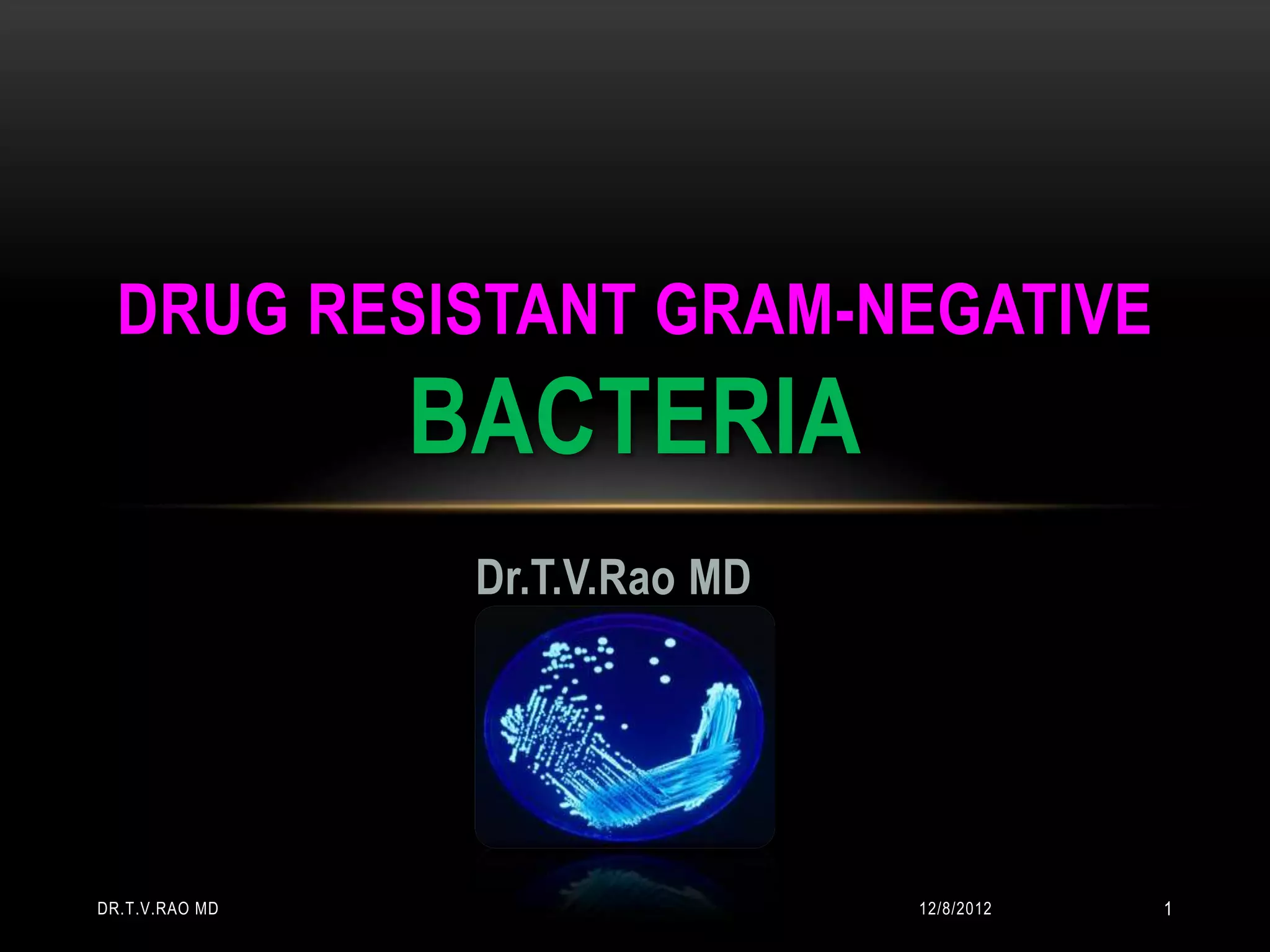
DRUG RESISTANT GRAM-NEGATIVE
                BACTERIA
                 Dr.T.V.Rao MD


DR.T.V.RAO MD                    12/8/2012   1
NO ESKAPE ? FROM PATHOGENS
Bugs, No Drugs: No ESKAPE
   – Enterococcus faecium (E), Staphylococcus aureus (S), Klebsiella
     pneumoniae (K), Acinetobacter baumannii (A), Pseudomonas aeruginosa
     (P), and Enterobacter spp. (E)ate-stage clinical development
     pipeline remains unacceptably lean
   – Some important molecules for problematic pathogens
     such as MRSA
   – Few novel molecules for other ESKAPE pathogens
   – No new drugs for infection due to multidrug-resistant Gram-negative
     bacilli (eg, A. baumannii and P. aeruginosa)
   – None represent more than an incremental advance over currently
     available therapies
    DR.T.V.RAO MD                                       12/8/2012          2
EXTENDED-SPECTRUM Β-LACTAMASES (ESBLS):
THE FORGOTTEN (AND UNDERRATED) MDR GNB
• Most commonly identified in enterobacteriaceae
• Plasmid-mediated
• Impart decreased susceptibility to β-lactam
  antimicrobials
  • Often co-resistance to
    aminoglycosides, fluoroquinolones
• Carbapenems are drugs of choice for invasive
  infections due to ESBL-producers
  DR.T.V.RAO MD                         12/8/2012   3
WHAT ARE ESBL
• ESBLs are enzymes
  capable of
  hydrolysing
  penicillins, broad-
  spectrum
  cephalosporins and
  Monobactams, and
  are generally derived
  from TEM and SHV-
  type enzymes
DR.T.V.RAO MD               12/8/2012   4
ALEXANDER FLEMING
NOBEL LECTURE, DECEMBER 11, 1945

                “It arose simply from a fortunate occurrence which happened when I
                was working on a purely academic bacteriological problem which had
                nothing to do with antagonism, or moulds, or antiseptics, or
                antibiotics.”


                                                                            www.nobelprize.org
                                                                                Google images


DR.T.V.RAO MD                                                   12/8/2012                    5
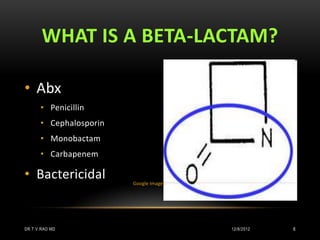
WHAT IS A BETA-LACTAM?

• Abx
      • Penicillin
      • Cephalosporin
      • Monobactam
      • Carbapenem

• Bactericidal          Google Images


DR.T.V.RAO MD                           12/8/2012   6
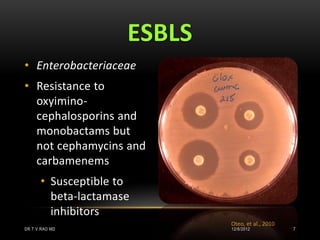
ESBLS
• Enterobacteriaceae
• Resistance to
  oxyimino-
  cephalosporins and
  monobactams but
  not cephamycins and
  carbamenems
      • Susceptible to
        beta-lactamase
        inhibitors
                             Oteo, et al., 2010
DR.T.V.RAO MD                12/8/2012            7
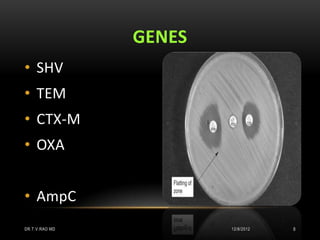
GENES
• SHV
• TEM
• CTX-M
• OXA


• AmpC
DR.T.V.RAO MD           12/8/2012   8
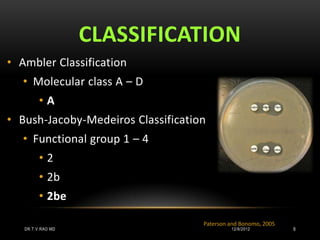
CLASSIFICATION
• Ambler Classification
   • Molecular class A – D
         •A
• Bush-Jacoby-Medeiros Classification
   • Functional group 1 – 4
         •2
         • 2b
         • 2be

                                    Paterson and Bonomo, 2005
   DR.T.V.RAO MD                             12/8/2012          9
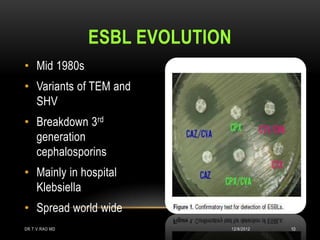
ESBL EVOLUTION
• Mid 1980s
• Variants of TEM and
  SHV
• Breakdown 3rd
  generation
  cephalosporins
• Mainly in hospital
  Klebsiella
• Spread world wide
DR.T.V.RAO MD                    12/8/2012   10
WHERE ESBL ARE LOCATED
                • ESBLs are often
                  located on
                  plasmids that are
                  transferable from
                  strain to strain and
                  between bacterial
                  species.

DR.T.V.RAO MD             12/8/2012   11
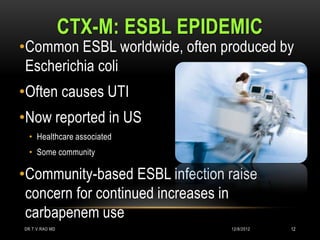
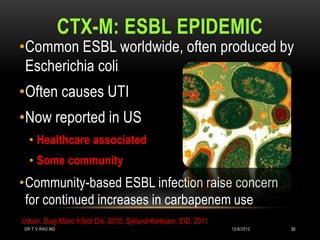
CTX-M: ESBL EPIDEMIC
•Common ESBL worldwide, often produced by
 Escherichia coli
•Often causes UTI
•Now reported in US
 • Healthcare associated
 • Some community

•Community-based ESBL infection raise
 concern for continued increases in
 carbapenem use
DR.T.V.RAO MD                    12/8/2012   12
WHY WE NEED ESBL DETECTION
• ESBL-producing Enterobacteriaceae have been
  responsible for numerous outbreaks of infection
  throughout the world and pose challenging infection
  control issues. Clinical outcomes data indicate that
  ESBLs are clinically significant and, when
  detected, indicate the need for the use of appropriate
  antibacterial agents.
• Unfortunately, the laboratory detection of ESBLs can be
  complex and, at times, misleading.

DR.T.V.RAO MD                                12/8/2012     13
ESBL PRODUCING BACTERIA ARE MORE
                 COMPLEX ?
• Antibacterial choice is often complicated by
  multi-resistance. Many ESBLproducing
  organisms also expressAmpC â-
  lactamases and may be co-transferredwith
  plasmids mediating aminoglycoside
  resistance. In addition, there is an
  increasing association between ESBL
  production and fluoroquinolone resistance
DR.T.V.RAO MD                      12/8/2012   14
DYNAMICS OF ANTIBIOTIC
                     RESISTANCE


DR.T.V.RAO MD                      12/8/2012   15
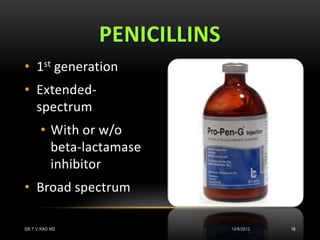
PENICILLINS
• 1st generation
• Extended-
  spectrum
      • With or w/o
        beta-lactamase
        inhibitor
• Broad spectrum

DR.T.V.RAO MD                 12/8/2012   16
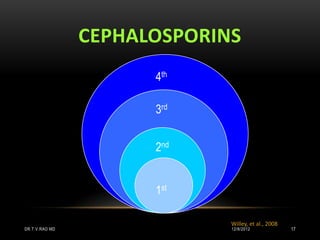
CEPHALOSPORINS
                      4th

                      3rd


                      2nd


                      1st

                             Willey, et al., 2008
DR.T.V.RAO MD                12/8/2012              17
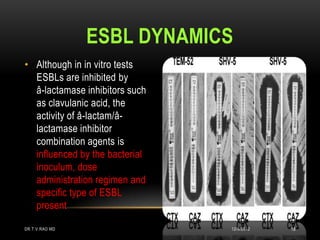
ESBL DYNAMICS
• Although in in vitro tests
  ESBLs are inhibited by
  â-lactamase inhibitors such
  as clavulanic acid, the
  activity of â-lactam/â-
  lactamase inhibitor
  combination agents is
  influenced by the bacterial
  inoculum, dose
  administration regimen and
  specific type of ESBL
  present

DR.T.V.RAO MD                   12/8/2012   18
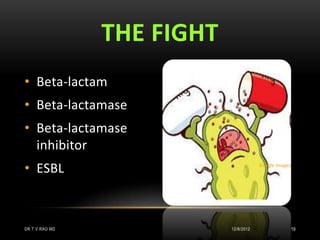
THE FIGHT
• Beta-lactam
• Beta-lactamase
• Beta-lactamase
  inhibitor
• ESBL                                  Google Images


DR.T.V.RAO MD               12/8/2012                   19
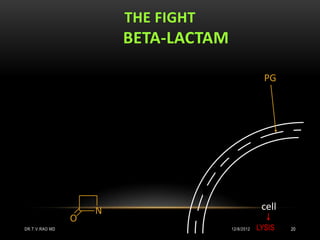
THE FIGHT
                        BETA-LACTAM

                                                    PG


                    N                              cell
                O
DR.T.V.RAO MD                         12/8/2012   LYSIS   20
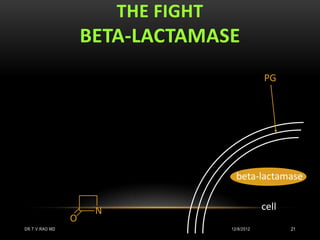
THE FIGHT
                    BETA-LACTAMASE
                                                 PG


                                       beta-lactamase


                     N                           cell
                O
DR.T.V.RAO MD                        12/8/2012          21
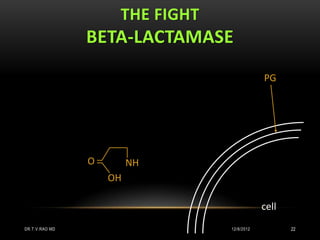
THE FIGHT
                BETA-LACTAMASE
                                             PG


                O        NH
                    OH

                                             cell
DR.T.V.RAO MD                    12/8/2012          22
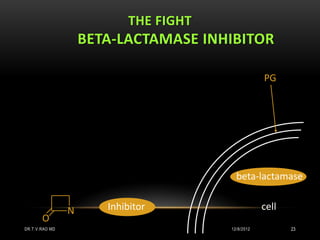
THE FIGHT
                    BETA-LACTAMASE INHIBITOR

                                                   PG


                                         beta-lactamase


                N      Inhibitor                   cell
       O
DR.T.V.RAO MD                          12/8/2012          23
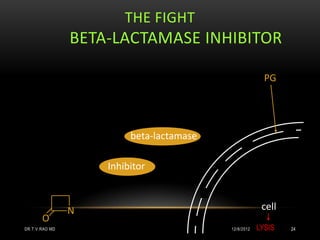
THE FIGHT
                BETA-LACTAMASE INHIBITOR

                                                        PG


                         beta-lactamase

                    Inhibitor


                N                                      cell
       O
DR.T.V.RAO MD                             12/8/2012   LYSIS   24
WHAT ARE EXTENDED-SPECTRUM
               Β-LACTAMASES?
• ESBLs are enzymes that mediate
  resistance to extended-spectrum (third
  generation) cephalosporins
  (e.g., ceftazidime, cefotaxime, and
  ceftriaxone) and monobactams
  (e.g., aztreonam) but do not affect
  cephamycins (e.g., cefoxitin and cefotetan)
  or Carbapenems (e.g., meropenem or
  imipenem
DR.T.V.RAO MD                     12/8/2012     25
WHY SHOULD CLINICAL LABORATORY PERSONNEL BE
       CONCERNED ABOUT DETECTING THESE ENZYMES?
• The presence of an ESBL-producing organism in a clinical
  infection can result in treatment failure if one of the above
  classes of drugs is used. ESBLs can be difficult to detect
  because they have different levels of activity against
  various cephalosporins. Thus, the choice of which
  antimicrobial agents to test is critical. For example, one
  enzyme may actively hydrolyze ceftazidime, resulting in
  ceftazidime minimum inhibitory concentrations (MICs) of
  256 µg/ml, but have poor activity on cefotaxime, producing
  MICs of only 4 µg/ml. If an ESBL is detected, all
  penicillins, cephalosporins, and aztreonam should be
  reported as resistant, even if in vitro test results indicate
 DR.T.V.RAO MD                                 12/8/2012    26
  susceptibility
HOW CAN CLINICAL LABORATORY
  PERSONNEL CONFIRM ESBL PRODUCTION?
• NCCLS recommends performing phenotypic confirmation of
  potential ESBL-producing isolates of K. pneumoniae, K.
  oxytoca, or E. coli by testing both cefotaxime and
  ceftazidime, alone and in combination with clavulanic acid .
  Testing can be performed by the broth micro dilution method or
  by disk diffusion. For MIC testing, a decrease of > 3 doubling
  dilutions in an MIC for either cefotaxime or ceftazidime tested in
  combination with 4 µg/ml clavulanic acid, versus its MIC when
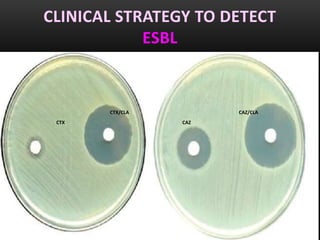
  tested alone, confirms an ESBL-producing organism. For disk
  diffusion testing, a > 5 mm increase in a zone diameter for either
  antimicrobial agent tested in combination with clavulanic acid
  versus its zone when tested alone confirms an ESBL-producing
  organism.
DR.T.V.RAO MD                                       12/8/2012      27
CLINICAL STRATEGY TO DETECT
            ESBL


       CTX/CLA         CAZ/CLA
 CTX             CAZ
HOW SHOULD LABORATORY PERSONNEL TEST FOR
    CEFOTAXIME AND CEFTAZIDIME IN COMBINATION WITH
                  CLAVULANIC ACID?

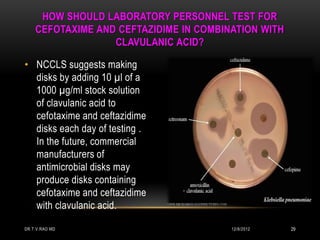
• NCCLS suggests making
  disks by adding 10 µl of a
  1000 µg/ml stock solution
  of clavulanic acid to
  cefotaxime and ceftazidime
  disks each day of testing .
  In the future, commercial
  manufacturers of
  antimicrobial disks may
  produce disks containing
  cefotaxime and ceftazidime
  with clavulanic acid.

DR.T.V.RAO MD                           12/8/2012    29
CTX-M: ESBL EPIDEMIC
•Common ESBL worldwide, often produced by
 Escherichia coli
•Often causes UTI
•Now reported in US
  • Healthcare associated
  • Some community
•Community-based ESBL infection raise concern
 for continued increases in carbapenem use
Urban, Diag Micro Infect Dis, 2010; Sjölund-Karlsson, EID, 2011
DR.T.V.RAO MD                                                     12/8/2012   30
CARBAPENEM RESISTANCE
• Emerging problem in Pseudomonas
  aeruginosa, Acinetobacter
  baumannii, Enterobacteriaceae (CRE)
• Risk factors include ICU stay, prolonged
  exposures to healthcare, indwelling
  devices, antibiotic exposures
    • Long-term acute care centers (LTACs)
• Severely limits treatment options
    • Increased use of older, toxic agents such as
      colistin
DR.T.V.RAO MD                            12/8/2012   31
KLEBSIELLA PNEUMONIAE CARBAPENEMASES (KPCS)
                     • Plasmid-mediated carbapenemases
• KPC-producing strains of Klebsiella pneumonia and other
  enterobacteriaceae
    • KPC-2, KPC-3
• Endemicity in many locales in the US
    • Hyperendemicity in NYC
    • 24% of K. pneumoniae infections were due to KPCs in 2
      hospitals
• Country-wide outbreak ongoing in Israel, Greece, Columbia and
  others
                                                              32
*
     DR.T.V.RAO MD                               12/8/2012
KPCS (CONT)
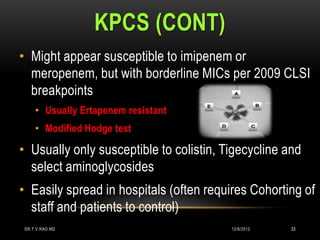
• Might appear susceptible to imipenem or
  meropenem, but with borderline MICs per 2009 CLSI
  breakpoints
     • Usually Ertapenem resistant
     • Modified Hodge test

• Usually only susceptible to colistin, Tigecycline and
  select aminoglycosides
• Easily spread in hospitals (often requires Cohorting of
  staff and patients to control)
 DR.T.V.RAO MD                           12/8/2012   33
DO ISOLATES OTHER THAN K.
       PNEUMONIAE, K. OXYTOCA, OR E. COLI
               PRODUCE ESBL’S?
•     Other isolates of
     Enterobacteriaceae, such
     as Salmonella species and
     Proteus mirabilis, and
     isolates of Pseudomonas
     aeruginosa produce
     ESBLs. However, at this
     time, methods for screening
     and phenotypic
     confirmatory testing of
     these isolates have not
     been determined by
     NCCLS.


DR.T.V.RAO MD                      12/8/2012   34
HOW SHOULD CEPHALOSPORIN AND
    PENICILLIN RESULTS BE REPORTED?
• If an isolate is confirmed as an ESBL-producer by the
  NCCLS-recommended phenotypic confirmatory test
  procedure, all penicillins, cephalosporins, and
  aztreonam should be reported as resistant. This list
  does not include the Cephamycins (cefotetan and
  cefoxitin), which should be reported according to their
  routine test results. If an isolate is not confirmed as an
  ESBL-producer, current recommendations suggest
  reporting results as for routine testing. Do not change
  interpretations of penicillins, cephalosporins, and
  aztreonam for isolates not confirmed as ESBL
DR.T.V.RAO MD                                 12/8/2012        35
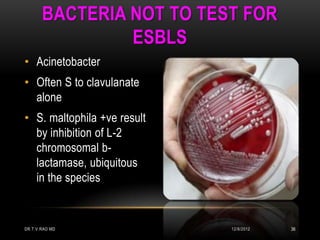
BACTERIA NOT TO TEST FOR
                ESBLS
• Acinetobacter
• Often S to clavulanate
  alone
• S. maltophila +ve result
  by inhibition of L-2
  chromosomal b-
  lactamase, ubiquitous
  in the species


DR.T.V.RAO MD                12/8/2012   36
NEW DELHI METALLO-BETA-LACTAMASE-1
                         (NDM-1)
• Carbapenemases mediating broad spectrum
  resistance
     • Usually found in Klebsiella pneumonia, E. coli
• Initially identified in India, Pakistan, Bangladesh
• Recovered in
  Australia, France, Japan, Kenya, North
  America, Singapore, Taiwan, and the United
  Kingdom, Australia, Canada
• Recovered in the US (Massachussetts, Illinois and
  California)
 DR.T.V.RAO MD                                 12/8/2012   37
MDR GNB IN LONG TERM CARE
• Quinolone resistance increasingly common in
  hospitals, long-term care and in some community
  settings
• B-lactam resistance established in hospitals, many
  long-term care settings
• Risk factors in long-term care for resistant Gram-
  negative bacilli
     • Indwelling devices
     • Poor functional status
     • Pressure ulcers/wounds
     • Antimicrobial/quinolone exposure
     • Prior hospitalization
 DR.T.V.RAO MD                             12/8/2012   38
STRATEGIES TO CONTROL THE
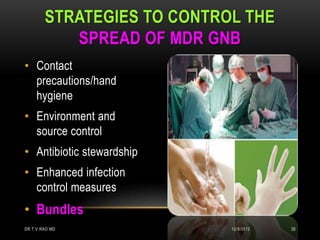
           SPREAD OF MDR GNB
• Contact
  precautions/hand
  hygiene
• Environment and
  source control
• Antibiotic stewardship
• Enhanced infection
  control measures
• Bundles
DR.T.V.RAO MD               12/8/2012   39
ROLE OF THE ENVIRONMENT
• Environmental sources of contamination/infection
  • Increasingly recognized as sources of infection
• Particularly important with pathogens such as
  Clostridium difficile, Norovirus, Acinetobacter
  spp.
• Bleach preparations are more effective for some
  pathogens (still need cleaning)
• Latest technology being tested: UV
  light, hydrogen peroxide vapor
   DR.T.V.RAO MD                         12/8/2012   40
ENVIRONMENTAL CLEANING
• Adequacy of cleaning of patients’ rooms
  suboptimal
• Improve monitoring and feedback of efficacy of
  cleaning
    • Direct observation and culturing not efficient, time-
      consuming and expensive
• Other options: ATP bioluminescence and
  fluorescent dyes
    • Monitor process, efficacy of cleaning
DR.T.V.RAO MD                                   12/8/2012     41
SUPPLEMENTS TO ROUTINE ENVIRONMENTAL
                  CLEANING
 • Disinfection units that decontaminate
   environmental surfaces
 • Must remove debris and dirt in order for
   these units to be effective
 • Two most common methods
      • UV light
      • Hydrogen peroxide (HP)
  DR.T.V.RAO MD                   12/8/2012   42
CHLORHEXIDINE GLUCONATE (CHG)
• Broad-spectrum
  antimicrobial disinfectant
• Preferred agent for skin
  preparation prior to
  insertion of vascular
  catheter and prior to
  surgery
• Studied for “source
  control”, decrease in
  degree of contamination of
  patients by problem
  hospital pathogens

DR.T.V.RAO MD                  12/8/2012   43
ENHANCED INFECTION CONTROL PROCESSES

                         • Active Surveillance
     • Use of “screening” cultures to identify patients colonized with
       pathogens (usually MDR) of interest
     • Goal is to prevent spread in the hospital by identifying patients who
       are colonized and intervening to prevent spread
     • Most experience is with Gram positive pathogens
     • Limited use for some pathogens (due to low sensitivity)
• Cohorting of patients

• Dedicated staff

 DR.T.V.RAO MD                                         12/8/2012      44
ANTIMICROBIAL STEWARDSHIP - GOALS
    • Optimize appropriate use of antimicrobials
         • The right agent, dose, timing, duration, route
    • Optimize clinical outcomes
         • Reduce emergence of resistance
         • Limit drug-related adverse events
         • Minimize risk of unintentional consequences
    • Help reduce antimicrobial resistance
         • The combination of effective antimicrobial stewardship and
           infection control has been shown to limit the emergence and
           transmission of antimicrobial-resistant bacteria
Dellit TH et al. Clin Infect Dis. 2007;44(2):159–177; . Drew RH. J Manag Care Pharm.
2009;15(2 Suppl):S18–S23; Drew RH et al. Pharmacotherapy. 2009;29(5):593–607.
     DR.T.V.RAO MD                                             12/8/2012       45
BUNDLES
• A bundle is a structured
  way of improving the
  processes of care and
  patient outcomes: a
  small, straightforward
  set of evidence-based
  practices that, when
  performed collectively
  and reliably, have been
  proven to improve
  patient outcomes.


  Resar R, Joint Commission Journal
DR.T.V.RAO MD                           12/8/2012   46
       on Quality and Patient Safety.
CONCLUSIONS
• MDR GNB are growing in prevalence in multiple
  geographic locales
• Occur in a variety of healthcare associated
  settings
    • Even in the community
• Antimicrobial stewardship is here to stay
• Problem is compounded by dry pharmaceutical
  pipeline
• Novel methods to control spread of MDROs are
  attractive but not clearly effective/cost-effective
 DR.T.V.RAO MD                        12/8/2012   47
NEW DELHI METALLO-BETA-LACTAMASE-1
                         (NDM-1)
• Carbapenemases mediating broad spectrum
  resistance
     • Usually found in Klebsiella pneumonia, E. coli
• Initially identified in India, Pakistan, Bangladesh
• Recovered in
  Australia, France, Japan, Kenya, North
  America, Singapore, Taiwan, and the United
  Kingdom, Australia, Canada
• Recovered in the US (Massachussetts, Illinois and
  California)
 DR.T.V.RAO MD                                 12/8/2012   48
STILL THE BEST WAY TO PREVENT SPREAD OF
      INFECTIONS AND DRUG RESISTANCE IS ……


DR.T.V.RAO MD                      12/8/2012   49
VISIT ME FOR MORE ARTICLES OF INTEREST
        ON INFECTIOUS DISEASES ……


DR.T.V.RAO MD                 12/8/2012   50
• Programme Created by Dr.T.V.Rao MD
     for Microbiologists in the Developing
                    World
                        • Email
                • doctortvrao@gmail.com


DR.T.V.RAO MD                       12/8/2012   51

Drug resistant gram - ve bacteria

  • 1.
    DRUG RESISTANT GRAM-NEGATIVE BACTERIA Dr.T.V.Rao MD DR.T.V.RAO MD 12/8/2012 1
  • 2.
    NO ESKAPE ?FROM PATHOGENS Bugs, No Drugs: No ESKAPE – Enterococcus faecium (E), Staphylococcus aureus (S), Klebsiella pneumoniae (K), Acinetobacter baumannii (A), Pseudomonas aeruginosa (P), and Enterobacter spp. (E)ate-stage clinical development pipeline remains unacceptably lean – Some important molecules for problematic pathogens such as MRSA – Few novel molecules for other ESKAPE pathogens – No new drugs for infection due to multidrug-resistant Gram-negative bacilli (eg, A. baumannii and P. aeruginosa) – None represent more than an incremental advance over currently available therapies DR.T.V.RAO MD 12/8/2012 2
  • 3.
    EXTENDED-SPECTRUM Β-LACTAMASES (ESBLS): THEFORGOTTEN (AND UNDERRATED) MDR GNB • Most commonly identified in enterobacteriaceae • Plasmid-mediated • Impart decreased susceptibility to β-lactam antimicrobials • Often co-resistance to aminoglycosides, fluoroquinolones • Carbapenems are drugs of choice for invasive infections due to ESBL-producers DR.T.V.RAO MD 12/8/2012 3
  • 4.
    WHAT ARE ESBL •ESBLs are enzymes capable of hydrolysing penicillins, broad- spectrum cephalosporins and Monobactams, and are generally derived from TEM and SHV- type enzymes DR.T.V.RAO MD 12/8/2012 4
  • 5.
    ALEXANDER FLEMING NOBEL LECTURE,DECEMBER 11, 1945 “It arose simply from a fortunate occurrence which happened when I was working on a purely academic bacteriological problem which had nothing to do with antagonism, or moulds, or antiseptics, or antibiotics.” www.nobelprize.org Google images DR.T.V.RAO MD 12/8/2012 5
  • 6.
    WHAT IS ABETA-LACTAM? • Abx • Penicillin • Cephalosporin • Monobactam • Carbapenem • Bactericidal Google Images DR.T.V.RAO MD 12/8/2012 6
  • 7.
    ESBLS • Enterobacteriaceae • Resistanceto oxyimino- cephalosporins and monobactams but not cephamycins and carbamenems • Susceptible to beta-lactamase inhibitors Oteo, et al., 2010 DR.T.V.RAO MD 12/8/2012 7
  • 8.
    GENES • SHV • TEM •CTX-M • OXA • AmpC DR.T.V.RAO MD 12/8/2012 8
  • 9.
    CLASSIFICATION • Ambler Classification • Molecular class A – D •A • Bush-Jacoby-Medeiros Classification • Functional group 1 – 4 •2 • 2b • 2be Paterson and Bonomo, 2005 DR.T.V.RAO MD 12/8/2012 9
  • 10.
    ESBL EVOLUTION • Mid1980s • Variants of TEM and SHV • Breakdown 3rd generation cephalosporins • Mainly in hospital Klebsiella • Spread world wide DR.T.V.RAO MD 12/8/2012 10
  • 11.
    WHERE ESBL ARELOCATED • ESBLs are often located on plasmids that are transferable from strain to strain and between bacterial species. DR.T.V.RAO MD 12/8/2012 11
  • 12.
    CTX-M: ESBL EPIDEMIC •CommonESBL worldwide, often produced by Escherichia coli •Often causes UTI •Now reported in US • Healthcare associated • Some community •Community-based ESBL infection raise concern for continued increases in carbapenem use DR.T.V.RAO MD 12/8/2012 12
  • 13.
    WHY WE NEEDESBL DETECTION • ESBL-producing Enterobacteriaceae have been responsible for numerous outbreaks of infection throughout the world and pose challenging infection control issues. Clinical outcomes data indicate that ESBLs are clinically significant and, when detected, indicate the need for the use of appropriate antibacterial agents. • Unfortunately, the laboratory detection of ESBLs can be complex and, at times, misleading. DR.T.V.RAO MD 12/8/2012 13
  • 14.
    ESBL PRODUCING BACTERIAARE MORE COMPLEX ? • Antibacterial choice is often complicated by multi-resistance. Many ESBLproducing organisms also expressAmpC â- lactamases and may be co-transferredwith plasmids mediating aminoglycoside resistance. In addition, there is an increasing association between ESBL production and fluoroquinolone resistance DR.T.V.RAO MD 12/8/2012 14
  • 15.
    DYNAMICS OF ANTIBIOTIC RESISTANCE DR.T.V.RAO MD 12/8/2012 15
  • 16.
    PENICILLINS • 1st generation •Extended- spectrum • With or w/o beta-lactamase inhibitor • Broad spectrum DR.T.V.RAO MD 12/8/2012 16
  • 17.
    CEPHALOSPORINS 4th 3rd 2nd 1st Willey, et al., 2008 DR.T.V.RAO MD 12/8/2012 17
  • 18.
    ESBL DYNAMICS • Althoughin in vitro tests ESBLs are inhibited by â-lactamase inhibitors such as clavulanic acid, the activity of â-lactam/â- lactamase inhibitor combination agents is influenced by the bacterial inoculum, dose administration regimen and specific type of ESBL present DR.T.V.RAO MD 12/8/2012 18
  • 19.
    THE FIGHT • Beta-lactam •Beta-lactamase • Beta-lactamase inhibitor • ESBL Google Images DR.T.V.RAO MD 12/8/2012 19
  • 20.
    THE FIGHT BETA-LACTAM PG N cell O DR.T.V.RAO MD 12/8/2012 LYSIS 20
  • 21.
    THE FIGHT BETA-LACTAMASE PG beta-lactamase N cell O DR.T.V.RAO MD 12/8/2012 21
  • 22.
    THE FIGHT BETA-LACTAMASE PG O NH OH cell DR.T.V.RAO MD 12/8/2012 22
  • 23.
    THE FIGHT BETA-LACTAMASE INHIBITOR PG beta-lactamase N Inhibitor cell O DR.T.V.RAO MD 12/8/2012 23
  • 24.
    THE FIGHT BETA-LACTAMASE INHIBITOR PG beta-lactamase Inhibitor N cell O DR.T.V.RAO MD 12/8/2012 LYSIS 24
  • 25.
    WHAT ARE EXTENDED-SPECTRUM Β-LACTAMASES? • ESBLs are enzymes that mediate resistance to extended-spectrum (third generation) cephalosporins (e.g., ceftazidime, cefotaxime, and ceftriaxone) and monobactams (e.g., aztreonam) but do not affect cephamycins (e.g., cefoxitin and cefotetan) or Carbapenems (e.g., meropenem or imipenem DR.T.V.RAO MD 12/8/2012 25
  • 26.
    WHY SHOULD CLINICALLABORATORY PERSONNEL BE CONCERNED ABOUT DETECTING THESE ENZYMES? • The presence of an ESBL-producing organism in a clinical infection can result in treatment failure if one of the above classes of drugs is used. ESBLs can be difficult to detect because they have different levels of activity against various cephalosporins. Thus, the choice of which antimicrobial agents to test is critical. For example, one enzyme may actively hydrolyze ceftazidime, resulting in ceftazidime minimum inhibitory concentrations (MICs) of 256 µg/ml, but have poor activity on cefotaxime, producing MICs of only 4 µg/ml. If an ESBL is detected, all penicillins, cephalosporins, and aztreonam should be reported as resistant, even if in vitro test results indicate DR.T.V.RAO MD 12/8/2012 26 susceptibility
  • 27.
    HOW CAN CLINICALLABORATORY PERSONNEL CONFIRM ESBL PRODUCTION? • NCCLS recommends performing phenotypic confirmation of potential ESBL-producing isolates of K. pneumoniae, K. oxytoca, or E. coli by testing both cefotaxime and ceftazidime, alone and in combination with clavulanic acid . Testing can be performed by the broth micro dilution method or by disk diffusion. For MIC testing, a decrease of > 3 doubling dilutions in an MIC for either cefotaxime or ceftazidime tested in combination with 4 µg/ml clavulanic acid, versus its MIC when tested alone, confirms an ESBL-producing organism. For disk diffusion testing, a > 5 mm increase in a zone diameter for either antimicrobial agent tested in combination with clavulanic acid versus its zone when tested alone confirms an ESBL-producing organism. DR.T.V.RAO MD 12/8/2012 27
  • 28.
    CLINICAL STRATEGY TODETECT ESBL CTX/CLA CAZ/CLA CTX CAZ
  • 29.
    HOW SHOULD LABORATORYPERSONNEL TEST FOR CEFOTAXIME AND CEFTAZIDIME IN COMBINATION WITH CLAVULANIC ACID? • NCCLS suggests making disks by adding 10 µl of a 1000 µg/ml stock solution of clavulanic acid to cefotaxime and ceftazidime disks each day of testing . In the future, commercial manufacturers of antimicrobial disks may produce disks containing cefotaxime and ceftazidime with clavulanic acid. DR.T.V.RAO MD 12/8/2012 29
  • 30.
    CTX-M: ESBL EPIDEMIC •CommonESBL worldwide, often produced by Escherichia coli •Often causes UTI •Now reported in US • Healthcare associated • Some community •Community-based ESBL infection raise concern for continued increases in carbapenem use Urban, Diag Micro Infect Dis, 2010; Sjölund-Karlsson, EID, 2011 DR.T.V.RAO MD 12/8/2012 30
  • 31.
    CARBAPENEM RESISTANCE • Emergingproblem in Pseudomonas aeruginosa, Acinetobacter baumannii, Enterobacteriaceae (CRE) • Risk factors include ICU stay, prolonged exposures to healthcare, indwelling devices, antibiotic exposures • Long-term acute care centers (LTACs) • Severely limits treatment options • Increased use of older, toxic agents such as colistin DR.T.V.RAO MD 12/8/2012 31
  • 32.
    KLEBSIELLA PNEUMONIAE CARBAPENEMASES(KPCS) • Plasmid-mediated carbapenemases • KPC-producing strains of Klebsiella pneumonia and other enterobacteriaceae • KPC-2, KPC-3 • Endemicity in many locales in the US • Hyperendemicity in NYC • 24% of K. pneumoniae infections were due to KPCs in 2 hospitals • Country-wide outbreak ongoing in Israel, Greece, Columbia and others 32 * DR.T.V.RAO MD 12/8/2012
  • 33.
    KPCS (CONT) • Mightappear susceptible to imipenem or meropenem, but with borderline MICs per 2009 CLSI breakpoints • Usually Ertapenem resistant • Modified Hodge test • Usually only susceptible to colistin, Tigecycline and select aminoglycosides • Easily spread in hospitals (often requires Cohorting of staff and patients to control) DR.T.V.RAO MD 12/8/2012 33
  • 34.
    DO ISOLATES OTHERTHAN K. PNEUMONIAE, K. OXYTOCA, OR E. COLI PRODUCE ESBL’S? • Other isolates of Enterobacteriaceae, such as Salmonella species and Proteus mirabilis, and isolates of Pseudomonas aeruginosa produce ESBLs. However, at this time, methods for screening and phenotypic confirmatory testing of these isolates have not been determined by NCCLS. DR.T.V.RAO MD 12/8/2012 34
  • 35.
    HOW SHOULD CEPHALOSPORINAND PENICILLIN RESULTS BE REPORTED? • If an isolate is confirmed as an ESBL-producer by the NCCLS-recommended phenotypic confirmatory test procedure, all penicillins, cephalosporins, and aztreonam should be reported as resistant. This list does not include the Cephamycins (cefotetan and cefoxitin), which should be reported according to their routine test results. If an isolate is not confirmed as an ESBL-producer, current recommendations suggest reporting results as for routine testing. Do not change interpretations of penicillins, cephalosporins, and aztreonam for isolates not confirmed as ESBL DR.T.V.RAO MD 12/8/2012 35
  • 36.
    BACTERIA NOT TOTEST FOR ESBLS • Acinetobacter • Often S to clavulanate alone • S. maltophila +ve result by inhibition of L-2 chromosomal b- lactamase, ubiquitous in the species DR.T.V.RAO MD 12/8/2012 36
  • 37.
    NEW DELHI METALLO-BETA-LACTAMASE-1 (NDM-1) • Carbapenemases mediating broad spectrum resistance • Usually found in Klebsiella pneumonia, E. coli • Initially identified in India, Pakistan, Bangladesh • Recovered in Australia, France, Japan, Kenya, North America, Singapore, Taiwan, and the United Kingdom, Australia, Canada • Recovered in the US (Massachussetts, Illinois and California) DR.T.V.RAO MD 12/8/2012 37
  • 38.
    MDR GNB INLONG TERM CARE • Quinolone resistance increasingly common in hospitals, long-term care and in some community settings • B-lactam resistance established in hospitals, many long-term care settings • Risk factors in long-term care for resistant Gram- negative bacilli • Indwelling devices • Poor functional status • Pressure ulcers/wounds • Antimicrobial/quinolone exposure • Prior hospitalization DR.T.V.RAO MD 12/8/2012 38
  • 39.
    STRATEGIES TO CONTROLTHE SPREAD OF MDR GNB • Contact precautions/hand hygiene • Environment and source control • Antibiotic stewardship • Enhanced infection control measures • Bundles DR.T.V.RAO MD 12/8/2012 39
  • 40.
    ROLE OF THEENVIRONMENT • Environmental sources of contamination/infection • Increasingly recognized as sources of infection • Particularly important with pathogens such as Clostridium difficile, Norovirus, Acinetobacter spp. • Bleach preparations are more effective for some pathogens (still need cleaning) • Latest technology being tested: UV light, hydrogen peroxide vapor DR.T.V.RAO MD 12/8/2012 40
  • 41.
    ENVIRONMENTAL CLEANING • Adequacyof cleaning of patients’ rooms suboptimal • Improve monitoring and feedback of efficacy of cleaning • Direct observation and culturing not efficient, time- consuming and expensive • Other options: ATP bioluminescence and fluorescent dyes • Monitor process, efficacy of cleaning DR.T.V.RAO MD 12/8/2012 41
  • 42.
    SUPPLEMENTS TO ROUTINEENVIRONMENTAL CLEANING • Disinfection units that decontaminate environmental surfaces • Must remove debris and dirt in order for these units to be effective • Two most common methods • UV light • Hydrogen peroxide (HP) DR.T.V.RAO MD 12/8/2012 42
  • 43.
    CHLORHEXIDINE GLUCONATE (CHG) •Broad-spectrum antimicrobial disinfectant • Preferred agent for skin preparation prior to insertion of vascular catheter and prior to surgery • Studied for “source control”, decrease in degree of contamination of patients by problem hospital pathogens DR.T.V.RAO MD 12/8/2012 43
  • 44.
    ENHANCED INFECTION CONTROLPROCESSES • Active Surveillance • Use of “screening” cultures to identify patients colonized with pathogens (usually MDR) of interest • Goal is to prevent spread in the hospital by identifying patients who are colonized and intervening to prevent spread • Most experience is with Gram positive pathogens • Limited use for some pathogens (due to low sensitivity) • Cohorting of patients • Dedicated staff DR.T.V.RAO MD 12/8/2012 44
  • 45.
    ANTIMICROBIAL STEWARDSHIP -GOALS • Optimize appropriate use of antimicrobials • The right agent, dose, timing, duration, route • Optimize clinical outcomes • Reduce emergence of resistance • Limit drug-related adverse events • Minimize risk of unintentional consequences • Help reduce antimicrobial resistance • The combination of effective antimicrobial stewardship and infection control has been shown to limit the emergence and transmission of antimicrobial-resistant bacteria Dellit TH et al. Clin Infect Dis. 2007;44(2):159–177; . Drew RH. J Manag Care Pharm. 2009;15(2 Suppl):S18–S23; Drew RH et al. Pharmacotherapy. 2009;29(5):593–607. DR.T.V.RAO MD 12/8/2012 45
  • 46.
    BUNDLES • A bundleis a structured way of improving the processes of care and patient outcomes: a small, straightforward set of evidence-based practices that, when performed collectively and reliably, have been proven to improve patient outcomes. Resar R, Joint Commission Journal DR.T.V.RAO MD 12/8/2012 46 on Quality and Patient Safety.
  • 47.
    CONCLUSIONS • MDR GNBare growing in prevalence in multiple geographic locales • Occur in a variety of healthcare associated settings • Even in the community • Antimicrobial stewardship is here to stay • Problem is compounded by dry pharmaceutical pipeline • Novel methods to control spread of MDROs are attractive but not clearly effective/cost-effective DR.T.V.RAO MD 12/8/2012 47
  • 48.
    NEW DELHI METALLO-BETA-LACTAMASE-1 (NDM-1) • Carbapenemases mediating broad spectrum resistance • Usually found in Klebsiella pneumonia, E. coli • Initially identified in India, Pakistan, Bangladesh • Recovered in Australia, France, Japan, Kenya, North America, Singapore, Taiwan, and the United Kingdom, Australia, Canada • Recovered in the US (Massachussetts, Illinois and California) DR.T.V.RAO MD 12/8/2012 48
  • 49.
    STILL THE BESTWAY TO PREVENT SPREAD OF INFECTIONS AND DRUG RESISTANCE IS …… DR.T.V.RAO MD 12/8/2012 49
  • 50.
    VISIT ME FORMORE ARTICLES OF INTEREST ON INFECTIOUS DISEASES …… DR.T.V.RAO MD 12/8/2012 50
  • 51.
    • Programme Createdby Dr.T.V.Rao MD for Microbiologists in the Developing World • Email • doctortvrao@gmail.com DR.T.V.RAO MD 12/8/2012 51