1
BETA LACTAMASE
GUIDEBETA LACTAMASE
GUIDE
Your Loyal Companion in ScienceTM
1
WHAT IS BETA-LACTAMASE?
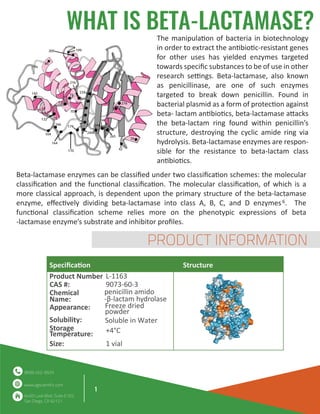
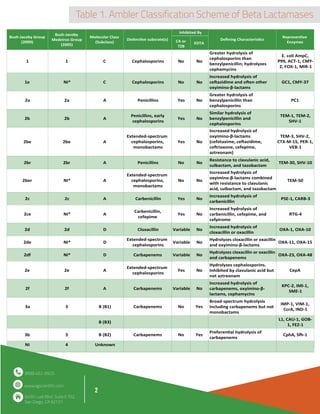
Beta-lactamase enzymes can be classified under two classifica�on schemes: the molecular
classifica�on and the func�onal classifica�on. The molecular classifica�on, of which is a
more classical approach, is dependent upon the primary structure of the beta-lactamase
enzyme, effec�vely dividing beta-lactamase into class A, B, C, and D enzymes . The
func�onal classifica�on scheme relies more on the phenotypic expressions of beta
-lactamase enzyme’s substrate and inhibitor profiles.
The manipula�on of bacteria in biotechnology
in order to extract the an�bio�c-resistant genes
for other uses has yielded enzymes targeted
towards specific substances to be of use in other
research se�ngs. Beta-lactamase, also known
as penicillinase, are one of such enzymes
targeted to break down penicillin. Found in
bacterial plasmid as a form of protec�on against
beta- lactam an�bio�cs, beta-lactamase a�acks
the beta-lactam ring found within penicillin’s
structure, destroying the cyclic amide ring via
hydrolysis. Beta-lactamase enzymes are respon-
sible for the resistance to beta-lactam class
an�bio�cs.
PRODUCT INFORMATION
Specifica�on
Product Number
CAS #:
Chemical
Name:
Appearance:
Solubility:
Storage
Temperature:
Size:
Structure
L-1163
9073-60-3
penicillin amido
-β-lactam hydrolase
Freeze dried
powder
Soluble in Water
+4°C
1 vial
Specifica�on Structure
www.agscientific.com
(858) 452-9925
6450 Lusk Blvd. Suite E102,
San Diego, CA 92121
6
2
www.agscientific.com
(858) 452-9925
6450 Lusk Blvd. Suite E102,
San Diego, CA 92121
Table 1. Ambler Classification Scheme of Beta Lactamases
Bush-Jacoby Group
(2009)
Bush-Jacoby
Medeiros Group
(2005)
Molecular Class
(Subclass)
Dis�nc�ve subsrate(s) CA or
TZB
EDTA
Defining Characteris�cs
Represen�ve
Enzymes
1 1 C Cephalosporins No No
Greater hydrolysis of
cephalosporins than
benzylpenicillin; hydrolyzes
cephamycins
E. coli AmpC,
P99, ACT-1, CMY-
2, FOX-1, MIR-1
1e NI* C Cephalosporins No No
Increased hydrolysis of
ce�azidime and o�en other
oxyimino-β-lactams
GC1, CMY-37
2a 2a A Penicillins Yes No
Greater hydrolysis of
benzylpenicillin than
cephalosporins
PC1
2b 2b A
Penicillins, early
cephalosporins
Yes No
Similar hydrolysis of
benzylpenicillin and
cephalosporins
TEM-1, TEM-2,
SHV-1
2be 2be A
Extended-spectrum
cephalosporins,
monobactams
Yes No
Increased hydrolysis of
oxyimino-β-lactams
(cefotaxime, ce�azidime,
ce�riaxone, cefepime,
aztreonam)
TEM-3, SHV-2,
CTX-M-15, PER-1,
VEB-1
2br 2br A Penicillins No No
Resistance to clavulanic acid,
sulbactam, and tazobactam
TEM-30, SHV-10
2ber NI* A
Extended-spectrum
cephalosporins,
monobactams
No No
Increased hydrolysis of
oxyimino-β-lactams combined
with resistance to clavulanic
acid, sulbactam, and tazobactam
TEM-50
2c 2c A Carbenicillin Yes No
Increased hydrolysis of
carbenicillin
PSE-1, CARB-3
2ce NI* A
Carbenicillin,
cefepime
Yes No
Increased hydrolysis of
carbenicillin, cefepime, and
cefpirome
RTG-4
2d 2d D Cloxacillin Variable No
Increased hydrolysis of
cloxacillin or oxacillin
OXA-1, OXA-10
2de NI* D
Extended-spectrum
cephalosporins
Variable No
Hydrolyzes cloxacillin or oxacillin
and oxyimino-β-lactams
OXA-11, OXA-15
2df NI* D Carbapenems Variable No
Hydrolyzes cloxacillin or oxacillin
and carbapenems
OXA-23, OXA-48
2e 2e A
Extended-spectrum
cephalosporins
Yes No
Hydrolyzes cephalosporins.
Inhibited by clavulanic acid but
not aztreonam
CepA
2f 2f A Carbapenems Variable No
Increased hydrolysis of
carbapenems, oxyimino-β-
lactams, cephamycins
KPC-2, IMI-1,
SME-1
3a 3 B (B1) Carbapenems No Yes
Broad-spectrum hydrolysis
including carbapenems but not
monobactams
IMP-1, VIM-1,
CcrA, IND-1
B (B3)
L1, CAU-1, GOB-
1, FEZ-1
3b 3 B (B2) Carbapenems No Yes
Preferen�al hydrolysis of
carbapenems
CphA, S�-1
NI 4 Unknown
Inhibited By
MECHANISM OF β-LACTAM DRUGS
3
www.agscientific.com
(858) 452-9925
6450 Lusk Blvd. Suite E102,
San Diego, CA 92121
Beta-lactam an�bio�cs are similar in structure of the terminal amino acid residues of the small
proteins comprising the pep�doglycan matrix, and thus act as antagonis�c drugs by binding to
the ac�ve site. The nature of the binding between beta lactam an�bio�cs and the penicillin-bind-
ing protein ac�ve sites are both irreversible and inhibitory, disrup�ng the forma�on of the
pep�doglycan layer. This inhibi�on causes the bacterial cell to shed its cell wall, forming a
spheroplast that is fragile to its environment. The bacterial cell, suscep�ble to death due to the
lack of protec�on, fails in its a�empt of undergoing binary fission.
Beta-lactam an�bio�cs, such as cephams and penicillin deriva�ves, contain a four-member cyclic
amide ring, which inhibits the pep�doglycan layer synthesis in bacteria. A woven complex of
sugar and protein pieces, these first class bacteriocidal drugs destroy the integrity of the
pep�doglycan layer. This method of bacterial cellular death is especially effec�ve to Gram-
posi�ve bacteria due to the pep�doglycan layer providing the outermost resistance to
encapsulated bacterial innards. In binary fission, the process which bacterial cells undergo for
reproduc�ve means, the bacterial cell furrows to form a cell plate comprising of the cell wall and,
consequently, the pep�doglycan layer as the cell divides into two daughter cells. The bacteria rely
on penicillin-binding proteins to facilitate the synthesis of a new cellular wall in a process called
'transpep�da�on'.
PENICILLIN RESISTANCE
4
www.agscientific.com
(858) 452-9925
6450 Lusk Blvd. Suite E102,
San Diego, CA 92121
Various strains of bacteria have now developed
a form of resistance to beta-lactam an�bio�cs.
Beta-lactamase hydrolyzes the beta-lactam
ring, which characterizes beta-lactam an�biot-
ics, adding a hydroxyl group to the structure. By
adding the hydroxyl group, the beta-lactam
ring’s structure is destroyed, and the an�bio�c
is rendered useless. The gene expression for
beta-lactamase may be induced by repeated
exposure to beta-lactam an�bio�cs, increasing
the selec�ve pressure for bacteria to obtain the
enzyme.
In order to combat bacterial an�bio�c resistance, beta-lactam an�bio�cs can be administered
with beta-lactamase inhibitors such as augmen�n, which is an an�bio�c comprised of amoxicillin
(found within the beta-lactam an�bio�c family) and clavulanic acid. Clavulanic acid acts by using
its structure, of which is analogous to beta-lactam molecules, as a site for beta-lactamase to bind
to instead of the beta-lactam ring located on the an�bio�c. This allows for beta-lactamase to
hydrolyze the beta-lactam ring in clavulanic acid, keeping the integrity of the beta-lactam
an�bio�c’s structure and allowing beta-lactam an�bio�cs to inhibit pep�doglycan synthesis.
Carbapenems also inhibit class A beta-lactamase enzymes through hydrolysis, and are very
effec�ve against extended spectrum beta-lactamases.
BETA LACTAMASE APPLICATIONS
Beta-lactamase is especially effec-
�ve in body fluids and thus have 2
main applica�ons in clinical labora-
tory se�ngs.
Bacterial infec�ons are diagnosed by preparing a
blood culture. The results of these blood cultures
o�en assist in customizing an�microbrial therapy.
An�bio�cs, however, may alter the results of the
blood cultures, yielding false nega�ve results which
may hinder the crea�on of an effec�ve an�microbrial
therapy treatment. Beta-lactamase can be added into
these blood cultures in order to prevent false
nega�ve responses.
BLOOD CULTURES
AMINOGLYCOSIDE
ANTIBIOTIC ASSAY
5
www.agscientific.com
(858) 452-9925
6450 Lusk Blvd. Suite E102,
San Diego, CA 92121
Assays are performed on poten�ally nephrotoxic
aminoglycosidic an�bio�cs by tradi�onal means. Beta-lactam
an�bio�cs are commonly prescribed alongside aminoglyco-
side an�bio�cs during treatment; however, beta- lactam an�-
bio�cs complicate assays. To simplify the assay performed,
beta-lactam an�bio�cs can be inac�vated u�lizing beta-
lactamase. Incuba�on of the serum will allow beta-lactamase
enough �me to hydrolyze the beta-lactam an�bio�cs located
within the sample, which can then be tested for complete
an�bio�c inac�va�on.
BLOOD CULTURE
PROTOCOL
Blood cultures are a means of assessing the
contents of blood within a pa�ent, screening
for any possible infec�ons in order to devise
an an�-microbrial treatment. Beta-lactam
an�bio�cs may cause false nega�ve results;
therefore, inac�va�ng beta-lactam
an�bio�cs by using beta-lactamase can be a
solu�on to purifying a blood culture.
Assemble a mixture of one vial of
beta-lactamase in 5 ml sterile water.
Add 1 ml of the beta-lactamase solu�on
to 100 ml of the cultured medium.
Incubate the culture medium and
nutrient broth at 37°C for 18-24 hours or
according to preferred protocol. The
dilu�on of the an�bio�cs in the culture
medium ensures effec�ve inac�va�on of
beta-lactam an�bio�cs when coupled
with long incuba�on �me.
AMINOGLYCOSIDE ANTIBIOTIC
ASSAY METHODOLOGY
Assemble a mixture of one vial of
beta-lactamase in 5 ml sterile water.
Add 0.2 ml of the enzyme solu�on to 1.0 ml
serum or cerebrospinal fluid.
Incubate the mixture at room temperature
for 5 minutes.
Use the incubated sample in the assay
method of preference.
OPTIONAL: If the sample is too small to allow
for accurate enzyme dilution, the beta-
lactamase can be incorporated into the assay
medium.
A�er autoclaving and addi�on of test
organism, add 0.2 ml beta-lactamase
solu�on to 10 ml tryp�case soy agar.
Mix thoroughly and pour suspension into
petri dishes or glass tubes.
Storage at 4°C is possible for
up to one week, without significant loss of
beta-lactamase ac�vity.
Beta-lactamase is a freeze-dried product which contains buffer
salts and zinc. It is soluble in water and is prepared into vials.
Store beta-lactamase vials in 4°C.
STORAGE AND HANDLING
6
www.agscientific.com
(858) 452-9925
6450 Lusk Blvd. Suite E102,
San Diego, CA 92121
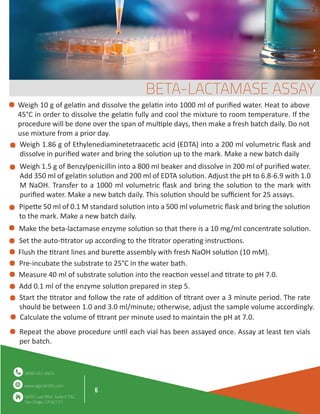
Weigh 10 g of gela�n and dissolve the gela�n into 1000 ml of purified water. Heat to above
45°C in order to dissolve the gela�n fully and cool the mixture to room temperature. If the
procedure will be done over the span of mul�ple days, then make a fresh batch daily. Do not
use mixture from a prior day.
Mix thoroughly and pour suspension into
petri dishes or glass tubes.
Weigh 1.86 g of Ethylenediaminetetraace�c acid (EDTA) into a 200 ml volumetric flask and
dissolve in purified water and bring the solu�on up to the mark. Make a new batch daily
Weigh 1.5 g of Benzylpenicillin into a 800 ml beaker and dissolve in 200 ml of purified water.
Add 350 ml of gela�n solu�on and 200 ml of EDTA solu�on. Adjust the pH to 6.8-6.9 with 1.0
M NaOH. Transfer to a 1000 ml volumetric flask and bring the solu�on to the mark with
purified water. Make a new batch daily. This solu�on should be sufficient for 25 assays.
Pipe�e 50 ml of 0.1 M standard solu�on into a 500 ml volumetric flask and bring the solu�on
to the mark. Make a new batch daily.
Make the beta-lactamase enzyme solu�on so that there is a 10 mg/ml concentrate solu�on.
Set the auto-�trator up according to the �trator opera�ng instruc�ons.
Flush the �trant lines and bure�e assembly with fresh NaOH solu�on (10 mM).
Pre-incubate the substrate to 25°C in the water bath.
Measure 40 ml of substrate solu�on into the reac�on vessel and �trate to pH 7.0.
Add 0.1 ml of the enzyme solu�on prepared in step 5.
Start the �trator and follow the rate of addi�on of �trant over a 3 minute period. The rate
should be between 1.0 and 3.0 ml/minute; otherwise, adjust the sample volume accordingly.
Calculate the volume of �trant per minute used to maintain the pH at 7.0.
Repeat the above procedure un�l each vial has been assayed once. Assay at least ten vials
per batch.
BETA-LACTAMASE ASSAY
REFERENCES
7
www.agscientific.com
(858) 452-9925
6450 Lusk Blvd. Suite E102,
San Diego, CA 92121
1. Fisher JF, Meroueh SO, Mobashery S. Bacterial Resistance to β-Lactam An�bio�cs: Compelling
Opportunism, Compelling Opportunity. Chemical Reviews. 2005;105(2):395-424. doi:
10.1021/cr030102i.
2. Bush K, Jacoby GA. Updated Func�onal Classifica�on of β-Lactamases. Antimicrobial Agents and
Chemotherapy. 2010;54(3):969-976. doi:10.1128/AAC.01009-09.
3. Brown TD, Charlier P, Herman R, Schofiel C. Structural Basis for the Interac�on of Lac�vicins with
Serine Beta-Lactamases. Journal of Medicinal Chemistry. 2012;53(15):5890-5894. doi:10.1021/-
jm100437u.
4. Tada Y, Yamaguchi J. Spheroplast Induc�on in Clinical Isolates of Serra�a Marcescens in the Presence
of Ca2+ or Mg2+. Journal of Clinical Microbiology. 1987;25(11):2154-2158.
5. Kelly J, Dideberg O, Charlier P. On the Origin of Bacterial Resistance to Penicillin: Comparison of a
Beta-Lactamase and a Penicillin Target. Science New Series. 1986;231(4744):1429-1431. doi:10.1126/-
science.3082007.
6. Matagne A, Lamo�e-Brasseur J, Frere JM. Cataly�c Proper�es of Class A Beta-Lactamases: Efficiency
and Diversity. Biochemical Journal. 1998;330(2):581-598.
7. Bacterial Drug Resistance. Essential Biochemistry. h�p://www.wiley.com/college/prat-
t/0471393878/instructor/ac�vi�es/bacterial_drug_resistance/index.html. Accessed September 26,
2016.
8. Reading C, Hepburn P. The Inhibi�on of Staphylococcal Beta-Lactamase by Clavulanic Acid. Biochem-
ical Journal. 1979;179(1):67-76.
9. Prod’hom G, Durussel C, Blanc D, Croxa�o A, Greub G. Early Detec�on of Extended-Spectrum β-lact-
amase From Blood Culture Posi�ve for an Enterobacteriaceae using βLACTA Test. New Microbes and
New Infections. 2015;8(1):1-3. doi:10.1016/j.nmni.2015.05.007.
10. Nukaga M, Bethel CR, Thomson JM, et al. Inhibi�on of Class A β-Lactamases by Carbapenems:
Crystallographic Observa�on of Two Conforma�ons of Meropenem in SHV-1. Journal of the American
Chemical Society. 2008;130(38):12656-12662. doi:10.1021/ja7111146.
11. Abraham EP, Chain E. An Enzyme From Bacteria Able to Destroy Penicillin. Nature.
1940;46(3713):837–837. doi:10.1038/146837a0.
REFERENCES CONTINUED
8
www.agscientific.com
(858) 452-9925
6450 Lusk Blvd. Suite E102,
San Diego, CA 92121
Your Loyal Companion in ScienceTM
12. Neu HC. Effect of Beta-Lactamase Loca�on in Escherichia Coli on Penicillin Synergy. Appl Microbiol.
1969;17(6):783–6. PMC 377810.PMID4894721
13. Ambler RP. The Structure of Beta-Lactamases. Philos. Trans. R. Soc. Lond., B, Biol. Sci.
1980;289(1036): 321–31. doi:10.1098/rstb.1980.0049.
14. Genzyme Diagnos�cs. Penicillinase and β-Lactamase [PDF]. Charlo�etown, Canada: Genzyme
Diagnos�cs.

BLG_fin

  • 1.
  • 2.
    1 WHAT IS BETA-LACTAMASE? Beta-lactamaseenzymes can be classified under two classifica�on schemes: the molecular classifica�on and the func�onal classifica�on. The molecular classifica�on, of which is a more classical approach, is dependent upon the primary structure of the beta-lactamase enzyme, effec�vely dividing beta-lactamase into class A, B, C, and D enzymes . The func�onal classifica�on scheme relies more on the phenotypic expressions of beta -lactamase enzyme’s substrate and inhibitor profiles. The manipula�on of bacteria in biotechnology in order to extract the an�bio�c-resistant genes for other uses has yielded enzymes targeted towards specific substances to be of use in other research se�ngs. Beta-lactamase, also known as penicillinase, are one of such enzymes targeted to break down penicillin. Found in bacterial plasmid as a form of protec�on against beta- lactam an�bio�cs, beta-lactamase a�acks the beta-lactam ring found within penicillin’s structure, destroying the cyclic amide ring via hydrolysis. Beta-lactamase enzymes are respon- sible for the resistance to beta-lactam class an�bio�cs. PRODUCT INFORMATION Specifica�on Product Number CAS #: Chemical Name: Appearance: Solubility: Storage Temperature: Size: Structure L-1163 9073-60-3 penicillin amido -β-lactam hydrolase Freeze dried powder Soluble in Water +4°C 1 vial Specifica�on Structure www.agscientific.com (858) 452-9925 6450 Lusk Blvd. Suite E102, San Diego, CA 92121 6
  • 3.
    2 www.agscientific.com (858) 452-9925 6450 LuskBlvd. Suite E102, San Diego, CA 92121 Table 1. Ambler Classification Scheme of Beta Lactamases Bush-Jacoby Group (2009) Bush-Jacoby Medeiros Group (2005) Molecular Class (Subclass) Dis�nc�ve subsrate(s) CA or TZB EDTA Defining Characteris�cs Represen�ve Enzymes 1 1 C Cephalosporins No No Greater hydrolysis of cephalosporins than benzylpenicillin; hydrolyzes cephamycins E. coli AmpC, P99, ACT-1, CMY- 2, FOX-1, MIR-1 1e NI* C Cephalosporins No No Increased hydrolysis of ce�azidime and o�en other oxyimino-β-lactams GC1, CMY-37 2a 2a A Penicillins Yes No Greater hydrolysis of benzylpenicillin than cephalosporins PC1 2b 2b A Penicillins, early cephalosporins Yes No Similar hydrolysis of benzylpenicillin and cephalosporins TEM-1, TEM-2, SHV-1 2be 2be A Extended-spectrum cephalosporins, monobactams Yes No Increased hydrolysis of oxyimino-β-lactams (cefotaxime, ce�azidime, ce�riaxone, cefepime, aztreonam) TEM-3, SHV-2, CTX-M-15, PER-1, VEB-1 2br 2br A Penicillins No No Resistance to clavulanic acid, sulbactam, and tazobactam TEM-30, SHV-10 2ber NI* A Extended-spectrum cephalosporins, monobactams No No Increased hydrolysis of oxyimino-β-lactams combined with resistance to clavulanic acid, sulbactam, and tazobactam TEM-50 2c 2c A Carbenicillin Yes No Increased hydrolysis of carbenicillin PSE-1, CARB-3 2ce NI* A Carbenicillin, cefepime Yes No Increased hydrolysis of carbenicillin, cefepime, and cefpirome RTG-4 2d 2d D Cloxacillin Variable No Increased hydrolysis of cloxacillin or oxacillin OXA-1, OXA-10 2de NI* D Extended-spectrum cephalosporins Variable No Hydrolyzes cloxacillin or oxacillin and oxyimino-β-lactams OXA-11, OXA-15 2df NI* D Carbapenems Variable No Hydrolyzes cloxacillin or oxacillin and carbapenems OXA-23, OXA-48 2e 2e A Extended-spectrum cephalosporins Yes No Hydrolyzes cephalosporins. Inhibited by clavulanic acid but not aztreonam CepA 2f 2f A Carbapenems Variable No Increased hydrolysis of carbapenems, oxyimino-β- lactams, cephamycins KPC-2, IMI-1, SME-1 3a 3 B (B1) Carbapenems No Yes Broad-spectrum hydrolysis including carbapenems but not monobactams IMP-1, VIM-1, CcrA, IND-1 B (B3) L1, CAU-1, GOB- 1, FEZ-1 3b 3 B (B2) Carbapenems No Yes Preferen�al hydrolysis of carbapenems CphA, S�-1 NI 4 Unknown Inhibited By
  • 4.
    MECHANISM OF β-LACTAMDRUGS 3 www.agscientific.com (858) 452-9925 6450 Lusk Blvd. Suite E102, San Diego, CA 92121 Beta-lactam an�bio�cs are similar in structure of the terminal amino acid residues of the small proteins comprising the pep�doglycan matrix, and thus act as antagonis�c drugs by binding to the ac�ve site. The nature of the binding between beta lactam an�bio�cs and the penicillin-bind- ing protein ac�ve sites are both irreversible and inhibitory, disrup�ng the forma�on of the pep�doglycan layer. This inhibi�on causes the bacterial cell to shed its cell wall, forming a spheroplast that is fragile to its environment. The bacterial cell, suscep�ble to death due to the lack of protec�on, fails in its a�empt of undergoing binary fission. Beta-lactam an�bio�cs, such as cephams and penicillin deriva�ves, contain a four-member cyclic amide ring, which inhibits the pep�doglycan layer synthesis in bacteria. A woven complex of sugar and protein pieces, these first class bacteriocidal drugs destroy the integrity of the pep�doglycan layer. This method of bacterial cellular death is especially effec�ve to Gram- posi�ve bacteria due to the pep�doglycan layer providing the outermost resistance to encapsulated bacterial innards. In binary fission, the process which bacterial cells undergo for reproduc�ve means, the bacterial cell furrows to form a cell plate comprising of the cell wall and, consequently, the pep�doglycan layer as the cell divides into two daughter cells. The bacteria rely on penicillin-binding proteins to facilitate the synthesis of a new cellular wall in a process called 'transpep�da�on'.
  • 5.
    PENICILLIN RESISTANCE 4 www.agscientific.com (858) 452-9925 6450Lusk Blvd. Suite E102, San Diego, CA 92121 Various strains of bacteria have now developed a form of resistance to beta-lactam an�bio�cs. Beta-lactamase hydrolyzes the beta-lactam ring, which characterizes beta-lactam an�biot- ics, adding a hydroxyl group to the structure. By adding the hydroxyl group, the beta-lactam ring’s structure is destroyed, and the an�bio�c is rendered useless. The gene expression for beta-lactamase may be induced by repeated exposure to beta-lactam an�bio�cs, increasing the selec�ve pressure for bacteria to obtain the enzyme. In order to combat bacterial an�bio�c resistance, beta-lactam an�bio�cs can be administered with beta-lactamase inhibitors such as augmen�n, which is an an�bio�c comprised of amoxicillin (found within the beta-lactam an�bio�c family) and clavulanic acid. Clavulanic acid acts by using its structure, of which is analogous to beta-lactam molecules, as a site for beta-lactamase to bind to instead of the beta-lactam ring located on the an�bio�c. This allows for beta-lactamase to hydrolyze the beta-lactam ring in clavulanic acid, keeping the integrity of the beta-lactam an�bio�c’s structure and allowing beta-lactam an�bio�cs to inhibit pep�doglycan synthesis. Carbapenems also inhibit class A beta-lactamase enzymes through hydrolysis, and are very effec�ve against extended spectrum beta-lactamases. BETA LACTAMASE APPLICATIONS Beta-lactamase is especially effec- �ve in body fluids and thus have 2 main applica�ons in clinical labora- tory se�ngs. Bacterial infec�ons are diagnosed by preparing a blood culture. The results of these blood cultures o�en assist in customizing an�microbrial therapy. An�bio�cs, however, may alter the results of the blood cultures, yielding false nega�ve results which may hinder the crea�on of an effec�ve an�microbrial therapy treatment. Beta-lactamase can be added into these blood cultures in order to prevent false nega�ve responses. BLOOD CULTURES
  • 6.
    AMINOGLYCOSIDE ANTIBIOTIC ASSAY 5 www.agscientific.com (858) 452-9925 6450Lusk Blvd. Suite E102, San Diego, CA 92121 Assays are performed on poten�ally nephrotoxic aminoglycosidic an�bio�cs by tradi�onal means. Beta-lactam an�bio�cs are commonly prescribed alongside aminoglyco- side an�bio�cs during treatment; however, beta- lactam an�- bio�cs complicate assays. To simplify the assay performed, beta-lactam an�bio�cs can be inac�vated u�lizing beta- lactamase. Incuba�on of the serum will allow beta-lactamase enough �me to hydrolyze the beta-lactam an�bio�cs located within the sample, which can then be tested for complete an�bio�c inac�va�on. BLOOD CULTURE PROTOCOL Blood cultures are a means of assessing the contents of blood within a pa�ent, screening for any possible infec�ons in order to devise an an�-microbrial treatment. Beta-lactam an�bio�cs may cause false nega�ve results; therefore, inac�va�ng beta-lactam an�bio�cs by using beta-lactamase can be a solu�on to purifying a blood culture. Assemble a mixture of one vial of beta-lactamase in 5 ml sterile water. Add 1 ml of the beta-lactamase solu�on to 100 ml of the cultured medium. Incubate the culture medium and nutrient broth at 37°C for 18-24 hours or according to preferred protocol. The dilu�on of the an�bio�cs in the culture medium ensures effec�ve inac�va�on of beta-lactam an�bio�cs when coupled with long incuba�on �me. AMINOGLYCOSIDE ANTIBIOTIC ASSAY METHODOLOGY Assemble a mixture of one vial of beta-lactamase in 5 ml sterile water. Add 0.2 ml of the enzyme solu�on to 1.0 ml serum or cerebrospinal fluid. Incubate the mixture at room temperature for 5 minutes. Use the incubated sample in the assay method of preference. OPTIONAL: If the sample is too small to allow for accurate enzyme dilution, the beta- lactamase can be incorporated into the assay medium. A�er autoclaving and addi�on of test organism, add 0.2 ml beta-lactamase solu�on to 10 ml tryp�case soy agar. Mix thoroughly and pour suspension into petri dishes or glass tubes. Storage at 4°C is possible for up to one week, without significant loss of beta-lactamase ac�vity. Beta-lactamase is a freeze-dried product which contains buffer salts and zinc. It is soluble in water and is prepared into vials. Store beta-lactamase vials in 4°C. STORAGE AND HANDLING
  • 7.
    6 www.agscientific.com (858) 452-9925 6450 LuskBlvd. Suite E102, San Diego, CA 92121 Weigh 10 g of gela�n and dissolve the gela�n into 1000 ml of purified water. Heat to above 45°C in order to dissolve the gela�n fully and cool the mixture to room temperature. If the procedure will be done over the span of mul�ple days, then make a fresh batch daily. Do not use mixture from a prior day. Mix thoroughly and pour suspension into petri dishes or glass tubes. Weigh 1.86 g of Ethylenediaminetetraace�c acid (EDTA) into a 200 ml volumetric flask and dissolve in purified water and bring the solu�on up to the mark. Make a new batch daily Weigh 1.5 g of Benzylpenicillin into a 800 ml beaker and dissolve in 200 ml of purified water. Add 350 ml of gela�n solu�on and 200 ml of EDTA solu�on. Adjust the pH to 6.8-6.9 with 1.0 M NaOH. Transfer to a 1000 ml volumetric flask and bring the solu�on to the mark with purified water. Make a new batch daily. This solu�on should be sufficient for 25 assays. Pipe�e 50 ml of 0.1 M standard solu�on into a 500 ml volumetric flask and bring the solu�on to the mark. Make a new batch daily. Make the beta-lactamase enzyme solu�on so that there is a 10 mg/ml concentrate solu�on. Set the auto-�trator up according to the �trator opera�ng instruc�ons. Flush the �trant lines and bure�e assembly with fresh NaOH solu�on (10 mM). Pre-incubate the substrate to 25°C in the water bath. Measure 40 ml of substrate solu�on into the reac�on vessel and �trate to pH 7.0. Add 0.1 ml of the enzyme solu�on prepared in step 5. Start the �trator and follow the rate of addi�on of �trant over a 3 minute period. The rate should be between 1.0 and 3.0 ml/minute; otherwise, adjust the sample volume accordingly. Calculate the volume of �trant per minute used to maintain the pH at 7.0. Repeat the above procedure un�l each vial has been assayed once. Assay at least ten vials per batch. BETA-LACTAMASE ASSAY
  • 8.
    REFERENCES 7 www.agscientific.com (858) 452-9925 6450 LuskBlvd. Suite E102, San Diego, CA 92121 1. Fisher JF, Meroueh SO, Mobashery S. Bacterial Resistance to β-Lactam An�bio�cs: Compelling Opportunism, Compelling Opportunity. Chemical Reviews. 2005;105(2):395-424. doi: 10.1021/cr030102i. 2. Bush K, Jacoby GA. Updated Func�onal Classifica�on of β-Lactamases. Antimicrobial Agents and Chemotherapy. 2010;54(3):969-976. doi:10.1128/AAC.01009-09. 3. Brown TD, Charlier P, Herman R, Schofiel C. Structural Basis for the Interac�on of Lac�vicins with Serine Beta-Lactamases. Journal of Medicinal Chemistry. 2012;53(15):5890-5894. doi:10.1021/- jm100437u. 4. Tada Y, Yamaguchi J. Spheroplast Induc�on in Clinical Isolates of Serra�a Marcescens in the Presence of Ca2+ or Mg2+. Journal of Clinical Microbiology. 1987;25(11):2154-2158. 5. Kelly J, Dideberg O, Charlier P. On the Origin of Bacterial Resistance to Penicillin: Comparison of a Beta-Lactamase and a Penicillin Target. Science New Series. 1986;231(4744):1429-1431. doi:10.1126/- science.3082007. 6. Matagne A, Lamo�e-Brasseur J, Frere JM. Cataly�c Proper�es of Class A Beta-Lactamases: Efficiency and Diversity. Biochemical Journal. 1998;330(2):581-598. 7. Bacterial Drug Resistance. Essential Biochemistry. h�p://www.wiley.com/college/prat- t/0471393878/instructor/ac�vi�es/bacterial_drug_resistance/index.html. Accessed September 26, 2016. 8. Reading C, Hepburn P. The Inhibi�on of Staphylococcal Beta-Lactamase by Clavulanic Acid. Biochem- ical Journal. 1979;179(1):67-76. 9. Prod’hom G, Durussel C, Blanc D, Croxa�o A, Greub G. Early Detec�on of Extended-Spectrum β-lact- amase From Blood Culture Posi�ve for an Enterobacteriaceae using βLACTA Test. New Microbes and New Infections. 2015;8(1):1-3. doi:10.1016/j.nmni.2015.05.007. 10. Nukaga M, Bethel CR, Thomson JM, et al. Inhibi�on of Class A β-Lactamases by Carbapenems: Crystallographic Observa�on of Two Conforma�ons of Meropenem in SHV-1. Journal of the American Chemical Society. 2008;130(38):12656-12662. doi:10.1021/ja7111146. 11. Abraham EP, Chain E. An Enzyme From Bacteria Able to Destroy Penicillin. Nature. 1940;46(3713):837–837. doi:10.1038/146837a0.
  • 9.
    REFERENCES CONTINUED 8 www.agscientific.com (858) 452-9925 6450Lusk Blvd. Suite E102, San Diego, CA 92121 Your Loyal Companion in ScienceTM 12. Neu HC. Effect of Beta-Lactamase Loca�on in Escherichia Coli on Penicillin Synergy. Appl Microbiol. 1969;17(6):783–6. PMC 377810.PMID4894721 13. Ambler RP. The Structure of Beta-Lactamases. Philos. Trans. R. Soc. Lond., B, Biol. Sci. 1980;289(1036): 321–31. doi:10.1098/rstb.1980.0049. 14. Genzyme Diagnos�cs. Penicillinase and β-Lactamase [PDF]. Charlo�etown, Canada: Genzyme Diagnos�cs.