Case Study:Case Study:
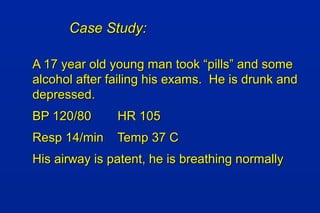
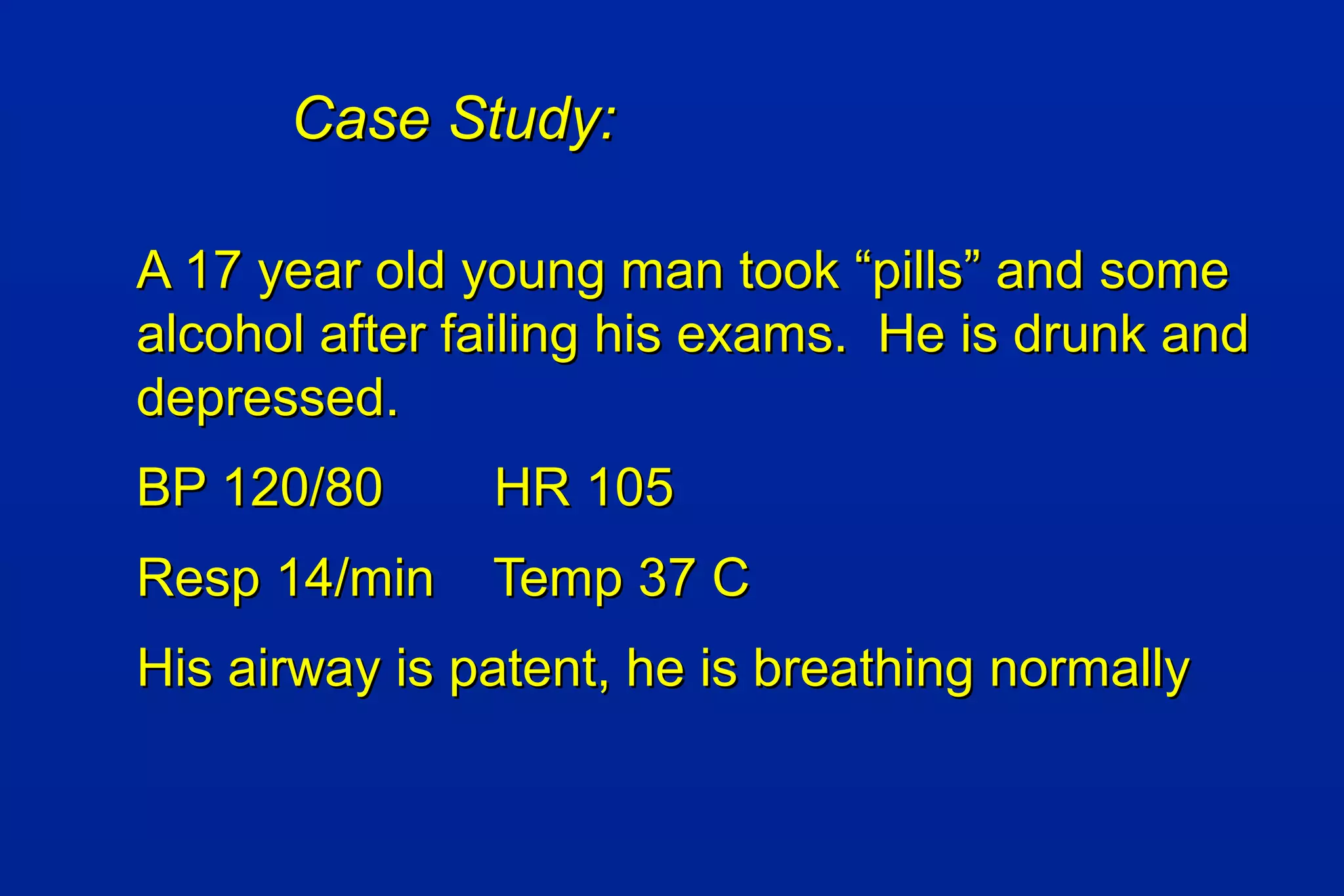
A 17 year old young man took “pills” and someA 17 year old young man took “pills” and some
alcohol after failing his exams. He is drunk andalcohol after failing his exams. He is drunk and
depressed.depressed.
BP 120/80BP 120/80 HR 105HR 105
Resp 14/minResp 14/min Temp 37 CTemp 37 C
His airway is patent, he is breathing normallyHis airway is patent, he is breathing normally
Case, continued:Case, continued:
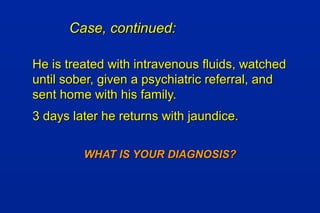
He is treated with intravenous fluids, watchedHe is treated with intravenous fluids, watched
until sober, given a psychiatric referral, anduntil sober, given a psychiatric referral, and
sent home with his family.sent home with his family.
3 days later he returns with jaundice.3 days later he returns with jaundice.
WHAT IS YOUR DIAGNOSIS?WHAT IS YOUR DIAGNOSIS?
Paracetamol PoisoningParacetamol Poisoning
Paracetamol poisoningParacetamol poisoning
Diagnosis easily missedDiagnosis easily missed
– often overlooked in historyoften overlooked in history
– no characteristic early symptoms or signsno characteristic early symptoms or signs
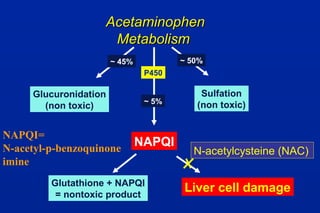
AcetaminophenAcetaminophen
MetabolismMetabolism
Glucuronidation
(non toxic)
Sulfation
(non toxic)
NAPQI
P450
~ 5%
Glutathione + NAPQI
= nontoxic product
Liver cell damage
N-acetylcysteine (NAC)
~ 45% ~ 50%
NAPQI=
N-acetyl-p-benzoquinone
imine
Paracetamol Toxicity:Paracetamol Toxicity:
Overdose:Overdose:
– sulfation and glucuronidation saturatedsulfation and glucuronidation saturated
– increased production of p-450 metaboliteincreased production of p-450 metabolite
• glutathione eventually depletedglutathione eventually depleted
• reactive intermediate NAPQI injures cellsreactive intermediate NAPQI injures cells
PCM toxicity, cont.PCM toxicity, cont.
High-risk groups:High-risk groups: enhanced p-450 activityenhanced p-450 activity
– chronic alcoholicschronic alcoholics
– chronic use of isoniazid (INH)chronic use of isoniazid (INH)
PharmacokineticsPharmacokinetics
Tablets dissolve rapidlyTablets dissolve rapidly
Peak level 3-4 hours after ingestionPeak level 3-4 hours after ingestion
Clinical Manifestations of Toxicity:Clinical Manifestations of Toxicity:
Early:Early: non-specificnon-specific
– anorexia, vomitinganorexia, vomiting
24-48 hrs:24-48 hrs:
– onset of liver injuryonset of liver injury
• AST, ALT may exceed 10,000 IUAST, ALT may exceed 10,000 IU
– renal injury may also occurrenal injury may also occur
Paracetamol Toxicity, continued:Paracetamol Toxicity, continued:
2-5 days:2-5 days:
– liver & kidney injury resolve in most patientsliver & kidney injury resolve in most patients
– some patients may developsome patients may develop fulminant liver failurefulminant liver failure
• progressive rise in PT/INR, bilirubinprogressive rise in PT/INR, bilirubin
• metabolic acidosis, hypoglycemiametabolic acidosis, hypoglycemia
• encephalopathyencephalopathy
• DEATHDEATH
Prediction of Paracetamol Toxicity:Prediction of Paracetamol Toxicity:
History:History:
– acuteacute ingestion of >200 mg/kg or >10 gmingestion of >200 mg/kg or >10 gm
• 20 tablets in average-sized person20 tablets in average-sized person
– chronicchronic use of >4-6 gm/day in a high-risk groupuse of >4-6 gm/day in a high-risk group
• Chronic alcohol abuse, isoniazid useChronic alcohol abuse, isoniazid use
Prediction of PCM toxicity, cont.Prediction of PCM toxicity, cont.
Clinical evaluation:Clinical evaluation:
– serum PCM level is best predictor, if availableserum PCM level is best predictor, if available
– levels associated with “probable toxicity”:levels associated with “probable toxicity”:
• 200 mg/L at 4 hrs after acute ingestion200 mg/L at 4 hrs after acute ingestion
• 100 at 8 hrs100 at 8 hrs
• 50 at 12 hrs50 at 12 hrs
Very early and transient increase in the PT/INRVery early and transient increase in the PT/INR
may predict later LFT risemay predict later LFT rise
– Normal PT/INR at 24 hrs may have good negativeNormal PT/INR at 24 hrs may have good negative
predictive valuepredictive value
Gut decontamination for PCMGut decontamination for PCM
Activated charcoalActivated charcoal
Gastric lavageGastric lavage
Treatment, continuedTreatment, continued
Antidote:Antidote: N-acetylcysteine (NAC)N-acetylcysteine (NAC)
– provides SH group - binds to NAPQIprovides SH group - binds to NAPQI
• most effective if started within 8-10 hrs after ingestionmost effective if started within 8-10 hrs after ingestion
– can be given PO or IVcan be given PO or IV
– if vomiting, use IV routeif vomiting, use IV route
Alternate medication: oralAlternate medication: oral methioninemethionine
Antidote:Antidote: N-acetylcysteine (NAC)N-acetylcysteine (NAC)
N-acetylcysteine (NAC): effective if startedN-acetylcysteine (NAC): effective if started
within 8-10 hrs after ingestionwithin 8-10 hrs after ingestion
FDA recommendation:FDA recommendation:
Loading dose: 150mg/kg IV over 60 mins 4Loading dose: 150mg/kg IV over 60 mins 4
hr infusion of 50 mg/kg 16 hr infusion ofhr infusion of 50 mg/kg 16 hr infusion of
100 mg/kg.100 mg/kg.
Check renal/liver fnc testCheck renal/liver fnc test
PT/INRPT/INR
If fulminant hepatic failure,final trt:If fulminant hepatic failure,final trt: liver transplantliver transplant
SummarySummary
Ingestion < 200 mg/kg probably not toxicIngestion < 200 mg/kg probably not toxic
If no serum level available treat based on doseIf no serum level available treat based on dose
IV acetylcysteine or oral methionineIV acetylcysteine or oral methionine
Start antidote within 8 hoursStart antidote within 8 hours
Liver or kidney damage is usually delayed to 24-Liver or kidney damage is usually delayed to 24-
48 hrs after ingestion of paracetamol48 hrs after ingestion of paracetamol
Case HistoryCase History
A 17yr old nursing student was brought toA 17yr old nursing student was brought to
hospital deeply unconscious.hospital deeply unconscious.
On probing it was discovered she took a heavyOn probing it was discovered she took a heavy
dose of sleeping pills.dose of sleeping pills.
Patient was hemodynamically stable but herPatient was hemodynamically stable but her
respiration was slightly shallow.respiration was slightly shallow.
Her pupils were slightly constricted.Her pupils were slightly constricted.
Patient was put on forced alkaline diuresis.Patient was put on forced alkaline diuresis.
However, patient refused to improve even afterHowever, patient refused to improve even after
4 days of treatment.4 days of treatment.
Patient developed some bullae over the legs.Patient developed some bullae over the legs.
Patient remained in deep coma, but otherwisePatient remained in deep coma, but otherwise
was stable.was stable.
Day 5:Day 5:
Some response to deep stimuli was observedSome response to deep stimuli was observed
Day 6:Day 6:
Patient significantly regained consciousness butPatient significantly regained consciousness but
was delirious. However, it lasted for short period.was delirious. However, it lasted for short period.
Day 10: DischargedDay 10: Discharged
Diagnosis?Diagnosis?
Acute Barbiturate PoisoningAcute Barbiturate Poisoning
BARBITURATESBARBITURATES
Non-selectiveNon-selective CNS depressants.CNS depressants.
Derivatives of barbituric acid (2,4,6- trioxo hexa hydroDerivatives of barbituric acid (2,4,6- trioxo hexa hydro
pyrimidine).pyrimidine).
Popular sedative & hypnotics up to 1960’s.Popular sedative & hypnotics up to 1960’s.
Can produce effects ranging fromCan produce effects ranging from sedationsedation && reductionreduction
of anxietyof anxiety toto unconsciousnessunconsciousness && deathdeath from respiratoryfrom respiratory
& cardio vascular failure.& cardio vascular failure.
USES:USES:
 Sedative & hypnotic.Sedative & hypnotic.
 Pre operative sedation.Pre operative sedation.
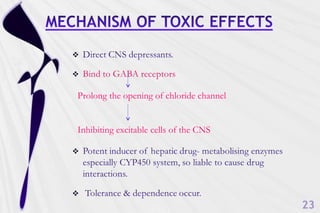
Prolong the opening of chloride channel
Inhibiting excitable cells of the CNS
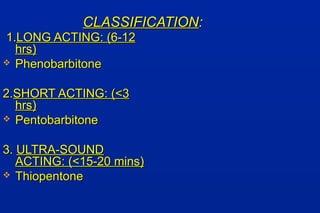
1.1.LONG ACTING: (6-12LONG ACTING: (6-12
hrs)hrs)
 PhenobarbitonePhenobarbitone
2.2.SHORT ACTING: (<3SHORT ACTING: (<3
hrs)hrs)
 PentobarbitonePentobarbitone
3.3. ULTRA-SOUNDULTRA-SOUND
ACTING: (<15-20 mins)ACTING: (<15-20 mins)
 ThiopentoneThiopentone
CLASSIFICATIONCLASSIFICATION::
ACUTE BARBITURATE POISONINGACUTE BARBITURATE POISONING
 Leading cause of poisoning due to their readyLeading cause of poisoning due to their ready
availability.availability.
 Most of the cases are suicidal but some are due toMost of the cases are suicidal but some are due to
error or ungraded exploration in children.error or ungraded exploration in children.
 Short acting barbiturates are more dangerous thanShort acting barbiturates are more dangerous than
long acting.long acting.
 Shock & anorexia occur quickly.Shock & anorexia occur quickly.
 Coma is more severe with short actingComa is more severe with short acting
barbiturates.barbiturates.
SYMPTOMS:SYMPTOMS:
 Stupor or coma, areflexiaStupor or coma, areflexia
 Peripheral circulatory collapse.Peripheral circulatory collapse.
 Weak & rapid pulse.Weak & rapid pulse.
 Cold clammy skin.Cold clammy skin.
 Slow & shallow breathing.Slow & shallow breathing.
 HypothermiaHypothermia
 Cutaneous bullae (blisters)Cutaneous bullae (blisters)
 Pupils – usually constrictedPupils – usually constricted
 Mild renal failure may occurMild renal failure may occur
 Death due to respiratory arrest or cardio vascularDeath due to respiratory arrest or cardio vascular
collapsecollapse
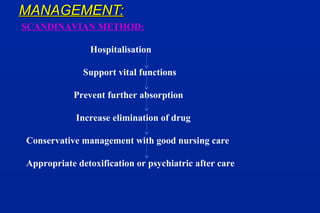
MANAGEMENT:MANAGEMENT:
SCANDINAVIAN METHOD:
Hospitalisation
Support vital functions
Prevent further absorption
Increase elimination of drug
Conservative management with good nursing care
Appropriate detoxification or psychiatric after care
HOSPITALIZATION:HOSPITALIZATION:
 Admitted to the hospital.Admitted to the hospital.
SUPPORT VITAL FUNCTIONS:SUPPORT VITAL FUNCTIONS:
 Consciousness.Consciousness.
 Airway , breathing , circulation.Airway , breathing , circulation.
 Blood pressure.Blood pressure.
PREVENT FURTHER ABSORPTION:PREVENT FURTHER ABSORPTION:
 Emesis.Emesis.
 Gastric lavage.Gastric lavage.
 Activated charcoal & catharsis.Activated charcoal & catharsis.
INCREASE ELIMINATION OF DRUG:INCREASE ELIMINATION OF DRUG:
 Forced alkaline diuresisForced alkaline diuresis
 Peritoneal dialysis.Peritoneal dialysis.
 Hemodialysis.Hemodialysis.
 HemoperfusionHemoperfusion
OTHER MEASURES:OTHER MEASURES:
 Psychiatric after care.Psychiatric after care.
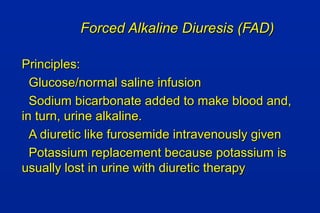
Forced Alkaline Diuresis (FAD)Forced Alkaline Diuresis (FAD)
Principles:Principles:
Glucose/normal saline infusionGlucose/normal saline infusion
Sodium bicarbonate added to make blood and,Sodium bicarbonate added to make blood and,
in turn, urine alkaline.in turn, urine alkaline.
A diuretic like furosemide intravenously givenA diuretic like furosemide intravenously given
Potassium replacement because potassium isPotassium replacement because potassium is
usually lost in urine with diuretic therapyusually lost in urine with diuretic therapy
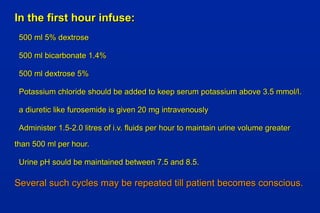
In the first hour infuse:In the first hour infuse:
500 ml 5% dextrose500 ml 5% dextrose
500 ml bicarbonate 1.4%500 ml bicarbonate 1.4%
500 ml dextrose 5%500 ml dextrose 5%
Potassium chloride should be added to keep serum potassium above 3.5 mmol/l.Potassium chloride should be added to keep serum potassium above 3.5 mmol/l.
a diuretic like furosemide is given 20 mg intravenouslya diuretic like furosemide is given 20 mg intravenously
Administer 1.5-2.0 litres of i.v. fluids per hour to maintain urine volume greaterAdminister 1.5-2.0 litres of i.v. fluids per hour to maintain urine volume greater
than 500 ml per hour.than 500 ml per hour.
Urine pH sould be maintained between 7.5 and 8.5.Urine pH sould be maintained between 7.5 and 8.5.
Several such cycles may be repeated till patient becomes conscious.Several such cycles may be repeated till patient becomes conscious.
BENZODIAZEPINESBENZODIAZEPINES
Anxiolytic & hypnotic agents.Anxiolytic & hypnotic agents.
Safest of all sedative drugs.Safest of all sedative drugs.
USES:USES:
Management ofManagement of
 Anxiety disordersAnxiety disorders
 Seizure disordersSeizure disorders
 InsomniaInsomnia
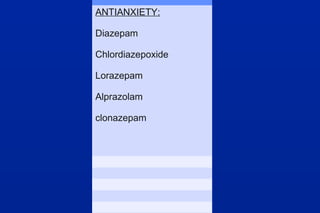
ANTIANXIETY:
Diazepam
Chlordiazepoxide
Lorazepam
Alprazolam
clonazepam
 Toxic symptoms-sedative action on the CNS.
 Large doses-neuromuscular blockade .
 Intravenous injection-peripheral vasodilation -fall in BP, shock.
 ↓se alveolar ventilation (↓se PO2 , ↑se PCO2 ).
 Induce CO2 narcosis in persons with COPD.
 Respiratory depressant effect with sedative drugs-concomitantly
taken.
 Death occurred in persons who concurrently injected ethanol / CNS
depressant.
 IV dosing-hypotension & respiratory depression-death.
Overdose:Overdose:
Toxic symptoms-sedative action on the CNS.Toxic symptoms-sedative action on the CNS.
Intravenous injection-peripheral vasodilation -fallIntravenous injection-peripheral vasodilation -fall
in BP, shock.in BP, shock.
↓↓se alveolar ventilation (↓se PO2 , ↑se PCO2 ).se alveolar ventilation (↓se PO2 , ↑se PCO2 ).
Induce CO2 narcosis in persons with COPD.Induce CO2 narcosis in persons with COPD.
Respiratory depressant effectRespiratory depressant effect
ComaComa
o COMA 1 (Stage 1): Responsive to painful stimuli but not to verbal or tactileCOMA 1 (Stage 1): Responsive to painful stimuli but not to verbal or tactile
stimuli, no disturbance in respiration or BP.stimuli, no disturbance in respiration or BP.
o COMA 2 (Stage 2):Unconscious, not responsive to painful stimuli, noCOMA 2 (Stage 2):Unconscious, not responsive to painful stimuli, no
disturbance in respiration or BP.disturbance in respiration or BP.
o IV dosing-hypotension & respiratory depression-death.IV dosing-hypotension & respiratory depression-death.
MANAGEMENT:MANAGEMENT:
 DECONTAMINATION:DECONTAMINATION:
Stomach wash within 6-12 hrsStomach wash within 6-12 hrs
Activated charcoalActivated charcoal
 LIFE SUPPORTIVE PROCEDURES &LIFE SUPPORTIVE PROCEDURES &
SYMPTOMATIC TREATMENT:SYMPTOMATIC TREATMENT:
Airway , breathing & circulationAirway , breathing & circulation
Intravenous fluid administrationIntravenous fluid administration
Endotracheal intubationEndotracheal intubation
Assisted ventilationAssisted ventilation
Supplemental oxygenSupplemental oxygen
CORRECTION OF HYPOTENSION WITHCORRECTION OF HYPOTENSION WITH
DOPAMINEDOPAMINE
ANTIDOTE TREATMENT: FLUMAZENILANTIDOTE TREATMENT: FLUMAZENIL
Flumazenil –reversing the coma induced byFlumazenil –reversing the coma induced by
benzodiazepines.benzodiazepines.
Mode of action – competitive antagonism specifically atMode of action – competitive antagonism specifically at
bezodizepine receptor sitebezodizepine receptor site
Has no effect on barbiturate, ethanol or other sedativeHas no effect on barbiturate, ethanol or other sedative
toxicitytoxicity
Complete reversal of benzodiazepine effect usually with aComplete reversal of benzodiazepine effect usually with a
total slow iv dose of 1mg.total slow iv dose of 1mg.
Administered in a series of smaller doses beginning with 0.2Administered in a series of smaller doses beginning with 0.2
mg & progressively increasing by 0.1- 0.2 mg every minutemg & progressively increasing by 0.1- 0.2 mg every minute
until a cumulative total dose of 3.5 mg is reached.until a cumulative total dose of 3.5 mg is reached.
Duration of action only 2-3 hrs, thus resedation occurs withinDuration of action only 2-3 hrs, thus resedation occurs within
½ hr – 2 hrs.½ hr – 2 hrs.
Thus repeat doses are required.Thus repeat doses are required.
Thank YouThank You

Drug overdose

  • 1.
    Case Study:Case Study: A17 year old young man took “pills” and someA 17 year old young man took “pills” and some alcohol after failing his exams. He is drunk andalcohol after failing his exams. He is drunk and depressed.depressed. BP 120/80BP 120/80 HR 105HR 105 Resp 14/minResp 14/min Temp 37 CTemp 37 C His airway is patent, he is breathing normallyHis airway is patent, he is breathing normally
  • 2.
    Case, continued:Case, continued: Heis treated with intravenous fluids, watchedHe is treated with intravenous fluids, watched until sober, given a psychiatric referral, anduntil sober, given a psychiatric referral, and sent home with his family.sent home with his family. 3 days later he returns with jaundice.3 days later he returns with jaundice. WHAT IS YOUR DIAGNOSIS?WHAT IS YOUR DIAGNOSIS?
  • 3.
  • 4.
    Paracetamol poisoningParacetamol poisoning Diagnosiseasily missedDiagnosis easily missed – often overlooked in historyoften overlooked in history – no characteristic early symptoms or signsno characteristic early symptoms or signs
  • 5.
    AcetaminophenAcetaminophen MetabolismMetabolism Glucuronidation (non toxic) Sulfation (non toxic) NAPQI P450 ~5% Glutathione + NAPQI = nontoxic product Liver cell damage N-acetylcysteine (NAC) ~ 45% ~ 50% NAPQI= N-acetyl-p-benzoquinone imine
  • 6.
    Paracetamol Toxicity:Paracetamol Toxicity: Overdose:Overdose: –sulfation and glucuronidation saturatedsulfation and glucuronidation saturated – increased production of p-450 metaboliteincreased production of p-450 metabolite • glutathione eventually depletedglutathione eventually depleted • reactive intermediate NAPQI injures cellsreactive intermediate NAPQI injures cells
  • 7.
    PCM toxicity, cont.PCMtoxicity, cont. High-risk groups:High-risk groups: enhanced p-450 activityenhanced p-450 activity – chronic alcoholicschronic alcoholics – chronic use of isoniazid (INH)chronic use of isoniazid (INH)
  • 8.
    PharmacokineticsPharmacokinetics Tablets dissolve rapidlyTabletsdissolve rapidly Peak level 3-4 hours after ingestionPeak level 3-4 hours after ingestion
  • 9.
    Clinical Manifestations ofToxicity:Clinical Manifestations of Toxicity: Early:Early: non-specificnon-specific – anorexia, vomitinganorexia, vomiting 24-48 hrs:24-48 hrs: – onset of liver injuryonset of liver injury • AST, ALT may exceed 10,000 IUAST, ALT may exceed 10,000 IU – renal injury may also occurrenal injury may also occur
  • 10.
    Paracetamol Toxicity, continued:ParacetamolToxicity, continued: 2-5 days:2-5 days: – liver & kidney injury resolve in most patientsliver & kidney injury resolve in most patients – some patients may developsome patients may develop fulminant liver failurefulminant liver failure • progressive rise in PT/INR, bilirubinprogressive rise in PT/INR, bilirubin • metabolic acidosis, hypoglycemiametabolic acidosis, hypoglycemia • encephalopathyencephalopathy • DEATHDEATH
  • 11.
    Prediction of ParacetamolToxicity:Prediction of Paracetamol Toxicity: History:History: – acuteacute ingestion of >200 mg/kg or >10 gmingestion of >200 mg/kg or >10 gm • 20 tablets in average-sized person20 tablets in average-sized person – chronicchronic use of >4-6 gm/day in a high-risk groupuse of >4-6 gm/day in a high-risk group • Chronic alcohol abuse, isoniazid useChronic alcohol abuse, isoniazid use
  • 12.
    Prediction of PCMtoxicity, cont.Prediction of PCM toxicity, cont. Clinical evaluation:Clinical evaluation: – serum PCM level is best predictor, if availableserum PCM level is best predictor, if available – levels associated with “probable toxicity”:levels associated with “probable toxicity”: • 200 mg/L at 4 hrs after acute ingestion200 mg/L at 4 hrs after acute ingestion • 100 at 8 hrs100 at 8 hrs • 50 at 12 hrs50 at 12 hrs
  • 13.
    Very early andtransient increase in the PT/INRVery early and transient increase in the PT/INR may predict later LFT risemay predict later LFT rise – Normal PT/INR at 24 hrs may have good negativeNormal PT/INR at 24 hrs may have good negative predictive valuepredictive value
  • 14.
    Gut decontamination forPCMGut decontamination for PCM Activated charcoalActivated charcoal Gastric lavageGastric lavage
  • 15.
    Treatment, continuedTreatment, continued Antidote:Antidote:N-acetylcysteine (NAC)N-acetylcysteine (NAC) – provides SH group - binds to NAPQIprovides SH group - binds to NAPQI • most effective if started within 8-10 hrs after ingestionmost effective if started within 8-10 hrs after ingestion – can be given PO or IVcan be given PO or IV – if vomiting, use IV routeif vomiting, use IV route Alternate medication: oralAlternate medication: oral methioninemethionine
  • 16.
    Antidote:Antidote: N-acetylcysteine (NAC)N-acetylcysteine(NAC) N-acetylcysteine (NAC): effective if startedN-acetylcysteine (NAC): effective if started within 8-10 hrs after ingestionwithin 8-10 hrs after ingestion FDA recommendation:FDA recommendation: Loading dose: 150mg/kg IV over 60 mins 4Loading dose: 150mg/kg IV over 60 mins 4 hr infusion of 50 mg/kg 16 hr infusion ofhr infusion of 50 mg/kg 16 hr infusion of 100 mg/kg.100 mg/kg. Check renal/liver fnc testCheck renal/liver fnc test PT/INRPT/INR If fulminant hepatic failure,final trt:If fulminant hepatic failure,final trt: liver transplantliver transplant
  • 17.
    SummarySummary Ingestion < 200mg/kg probably not toxicIngestion < 200 mg/kg probably not toxic If no serum level available treat based on doseIf no serum level available treat based on dose IV acetylcysteine or oral methionineIV acetylcysteine or oral methionine Start antidote within 8 hoursStart antidote within 8 hours Liver or kidney damage is usually delayed to 24-Liver or kidney damage is usually delayed to 24- 48 hrs after ingestion of paracetamol48 hrs after ingestion of paracetamol
  • 19.
    Case HistoryCase History A17yr old nursing student was brought toA 17yr old nursing student was brought to hospital deeply unconscious.hospital deeply unconscious. On probing it was discovered she took a heavyOn probing it was discovered she took a heavy dose of sleeping pills.dose of sleeping pills. Patient was hemodynamically stable but herPatient was hemodynamically stable but her respiration was slightly shallow.respiration was slightly shallow. Her pupils were slightly constricted.Her pupils were slightly constricted. Patient was put on forced alkaline diuresis.Patient was put on forced alkaline diuresis. However, patient refused to improve even afterHowever, patient refused to improve even after 4 days of treatment.4 days of treatment.
  • 20.
    Patient developed somebullae over the legs.Patient developed some bullae over the legs. Patient remained in deep coma, but otherwisePatient remained in deep coma, but otherwise was stable.was stable. Day 5:Day 5: Some response to deep stimuli was observedSome response to deep stimuli was observed Day 6:Day 6: Patient significantly regained consciousness butPatient significantly regained consciousness but was delirious. However, it lasted for short period.was delirious. However, it lasted for short period. Day 10: DischargedDay 10: Discharged Diagnosis?Diagnosis?
  • 21.
    Acute Barbiturate PoisoningAcuteBarbiturate Poisoning
  • 22.
    BARBITURATESBARBITURATES Non-selectiveNon-selective CNS depressants.CNSdepressants. Derivatives of barbituric acid (2,4,6- trioxo hexa hydroDerivatives of barbituric acid (2,4,6- trioxo hexa hydro pyrimidine).pyrimidine). Popular sedative & hypnotics up to 1960’s.Popular sedative & hypnotics up to 1960’s. Can produce effects ranging fromCan produce effects ranging from sedationsedation && reductionreduction of anxietyof anxiety toto unconsciousnessunconsciousness && deathdeath from respiratoryfrom respiratory & cardio vascular failure.& cardio vascular failure. USES:USES:  Sedative & hypnotic.Sedative & hypnotic.  Pre operative sedation.Pre operative sedation.
  • 23.
    Prolong the openingof chloride channel Inhibiting excitable cells of the CNS
  • 24.
    1.1.LONG ACTING: (6-12LONGACTING: (6-12 hrs)hrs)  PhenobarbitonePhenobarbitone 2.2.SHORT ACTING: (<3SHORT ACTING: (<3 hrs)hrs)  PentobarbitonePentobarbitone 3.3. ULTRA-SOUNDULTRA-SOUND ACTING: (<15-20 mins)ACTING: (<15-20 mins)  ThiopentoneThiopentone CLASSIFICATIONCLASSIFICATION::
  • 25.
    ACUTE BARBITURATE POISONINGACUTEBARBITURATE POISONING  Leading cause of poisoning due to their readyLeading cause of poisoning due to their ready availability.availability.  Most of the cases are suicidal but some are due toMost of the cases are suicidal but some are due to error or ungraded exploration in children.error or ungraded exploration in children.  Short acting barbiturates are more dangerous thanShort acting barbiturates are more dangerous than long acting.long acting.  Shock & anorexia occur quickly.Shock & anorexia occur quickly.  Coma is more severe with short actingComa is more severe with short acting barbiturates.barbiturates.
  • 26.
    SYMPTOMS:SYMPTOMS:  Stupor orcoma, areflexiaStupor or coma, areflexia  Peripheral circulatory collapse.Peripheral circulatory collapse.  Weak & rapid pulse.Weak & rapid pulse.  Cold clammy skin.Cold clammy skin.  Slow & shallow breathing.Slow & shallow breathing.  HypothermiaHypothermia  Cutaneous bullae (blisters)Cutaneous bullae (blisters)  Pupils – usually constrictedPupils – usually constricted  Mild renal failure may occurMild renal failure may occur  Death due to respiratory arrest or cardio vascularDeath due to respiratory arrest or cardio vascular collapsecollapse
  • 27.
    MANAGEMENT:MANAGEMENT: SCANDINAVIAN METHOD: Hospitalisation Support vitalfunctions Prevent further absorption Increase elimination of drug Conservative management with good nursing care Appropriate detoxification or psychiatric after care
  • 28.
    HOSPITALIZATION:HOSPITALIZATION:  Admitted tothe hospital.Admitted to the hospital. SUPPORT VITAL FUNCTIONS:SUPPORT VITAL FUNCTIONS:  Consciousness.Consciousness.  Airway , breathing , circulation.Airway , breathing , circulation.  Blood pressure.Blood pressure. PREVENT FURTHER ABSORPTION:PREVENT FURTHER ABSORPTION:  Emesis.Emesis.  Gastric lavage.Gastric lavage.  Activated charcoal & catharsis.Activated charcoal & catharsis.
  • 29.
    INCREASE ELIMINATION OFDRUG:INCREASE ELIMINATION OF DRUG:  Forced alkaline diuresisForced alkaline diuresis  Peritoneal dialysis.Peritoneal dialysis.  Hemodialysis.Hemodialysis.  HemoperfusionHemoperfusion OTHER MEASURES:OTHER MEASURES:  Psychiatric after care.Psychiatric after care.
  • 30.
    Forced Alkaline Diuresis(FAD)Forced Alkaline Diuresis (FAD) Principles:Principles: Glucose/normal saline infusionGlucose/normal saline infusion Sodium bicarbonate added to make blood and,Sodium bicarbonate added to make blood and, in turn, urine alkaline.in turn, urine alkaline. A diuretic like furosemide intravenously givenA diuretic like furosemide intravenously given Potassium replacement because potassium isPotassium replacement because potassium is usually lost in urine with diuretic therapyusually lost in urine with diuretic therapy
  • 31.
    In the firsthour infuse:In the first hour infuse: 500 ml 5% dextrose500 ml 5% dextrose 500 ml bicarbonate 1.4%500 ml bicarbonate 1.4% 500 ml dextrose 5%500 ml dextrose 5% Potassium chloride should be added to keep serum potassium above 3.5 mmol/l.Potassium chloride should be added to keep serum potassium above 3.5 mmol/l. a diuretic like furosemide is given 20 mg intravenouslya diuretic like furosemide is given 20 mg intravenously Administer 1.5-2.0 litres of i.v. fluids per hour to maintain urine volume greaterAdminister 1.5-2.0 litres of i.v. fluids per hour to maintain urine volume greater than 500 ml per hour.than 500 ml per hour. Urine pH sould be maintained between 7.5 and 8.5.Urine pH sould be maintained between 7.5 and 8.5. Several such cycles may be repeated till patient becomes conscious.Several such cycles may be repeated till patient becomes conscious.
  • 33.
    BENZODIAZEPINESBENZODIAZEPINES Anxiolytic & hypnoticagents.Anxiolytic & hypnotic agents. Safest of all sedative drugs.Safest of all sedative drugs. USES:USES: Management ofManagement of  Anxiety disordersAnxiety disorders  Seizure disordersSeizure disorders  InsomniaInsomnia
  • 34.
  • 35.
     Toxic symptoms-sedativeaction on the CNS.  Large doses-neuromuscular blockade .  Intravenous injection-peripheral vasodilation -fall in BP, shock.  ↓se alveolar ventilation (↓se PO2 , ↑se PCO2 ).  Induce CO2 narcosis in persons with COPD.  Respiratory depressant effect with sedative drugs-concomitantly taken.  Death occurred in persons who concurrently injected ethanol / CNS depressant.  IV dosing-hypotension & respiratory depression-death.
  • 36.
    Overdose:Overdose: Toxic symptoms-sedative actionon the CNS.Toxic symptoms-sedative action on the CNS. Intravenous injection-peripheral vasodilation -fallIntravenous injection-peripheral vasodilation -fall in BP, shock.in BP, shock. ↓↓se alveolar ventilation (↓se PO2 , ↑se PCO2 ).se alveolar ventilation (↓se PO2 , ↑se PCO2 ). Induce CO2 narcosis in persons with COPD.Induce CO2 narcosis in persons with COPD. Respiratory depressant effectRespiratory depressant effect ComaComa o COMA 1 (Stage 1): Responsive to painful stimuli but not to verbal or tactileCOMA 1 (Stage 1): Responsive to painful stimuli but not to verbal or tactile stimuli, no disturbance in respiration or BP.stimuli, no disturbance in respiration or BP. o COMA 2 (Stage 2):Unconscious, not responsive to painful stimuli, noCOMA 2 (Stage 2):Unconscious, not responsive to painful stimuli, no disturbance in respiration or BP.disturbance in respiration or BP. o IV dosing-hypotension & respiratory depression-death.IV dosing-hypotension & respiratory depression-death.
  • 37.
    MANAGEMENT:MANAGEMENT:  DECONTAMINATION:DECONTAMINATION: Stomach washwithin 6-12 hrsStomach wash within 6-12 hrs Activated charcoalActivated charcoal  LIFE SUPPORTIVE PROCEDURES &LIFE SUPPORTIVE PROCEDURES & SYMPTOMATIC TREATMENT:SYMPTOMATIC TREATMENT: Airway , breathing & circulationAirway , breathing & circulation Intravenous fluid administrationIntravenous fluid administration Endotracheal intubationEndotracheal intubation Assisted ventilationAssisted ventilation Supplemental oxygenSupplemental oxygen CORRECTION OF HYPOTENSION WITHCORRECTION OF HYPOTENSION WITH DOPAMINEDOPAMINE
  • 38.
    ANTIDOTE TREATMENT: FLUMAZENILANTIDOTETREATMENT: FLUMAZENIL Flumazenil –reversing the coma induced byFlumazenil –reversing the coma induced by benzodiazepines.benzodiazepines. Mode of action – competitive antagonism specifically atMode of action – competitive antagonism specifically at bezodizepine receptor sitebezodizepine receptor site Has no effect on barbiturate, ethanol or other sedativeHas no effect on barbiturate, ethanol or other sedative toxicitytoxicity Complete reversal of benzodiazepine effect usually with aComplete reversal of benzodiazepine effect usually with a total slow iv dose of 1mg.total slow iv dose of 1mg. Administered in a series of smaller doses beginning with 0.2Administered in a series of smaller doses beginning with 0.2 mg & progressively increasing by 0.1- 0.2 mg every minutemg & progressively increasing by 0.1- 0.2 mg every minute until a cumulative total dose of 3.5 mg is reached.until a cumulative total dose of 3.5 mg is reached. Duration of action only 2-3 hrs, thus resedation occurs withinDuration of action only 2-3 hrs, thus resedation occurs within ½ hr – 2 hrs.½ hr – 2 hrs. Thus repeat doses are required.Thus repeat doses are required.
  • 39.