
DRUG BIO-TRASFORMATION
BY:
MD. MYNUL HASAN
SOUTHEAST UNIVERSITY
Biotransformation
The conversion of molecules from one form to another
within an organism, often associated with change
(increase, decrease, or little change) in pharmacologic
activity; refers especially to drugs and other xenobiotics.
The metabolism of a drug or toxin in a body is an
example of a biotransformation. The body typically
deals with a foreign compound by making it more water-
soluble, to increase the rate of its excretion through the
urine.
History
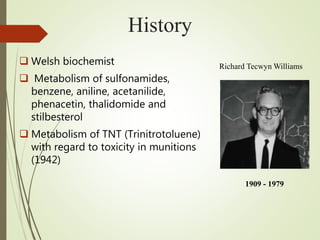
 Welsh biochemist
 Metabolism of sulfonamides,
benzene, aniline, acetanilide,
phenacetin, thalidomide and
stilbesterol
 Metabolism of TNT (Trinitrotoluene)
with regard to toxicity in munitions
(1942)
1909 - 1979
Richard Tecwyn Williams
The role of biotransformation
Alteration or termination of drug activity
Converts pro-drug to active compound
Coverts less active drug to more active drug
Produces toxic compound
Terminates drug actions
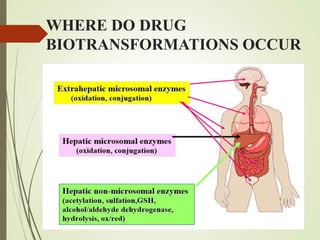
WHERE DO DRUG
BIOTRANSFORMATIONS OCCUR
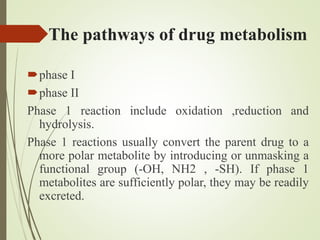
The pathways of drug metabolism
phase І
phase II
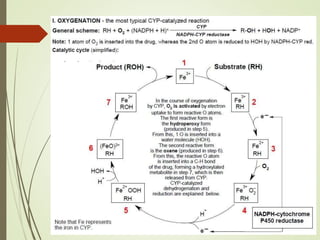
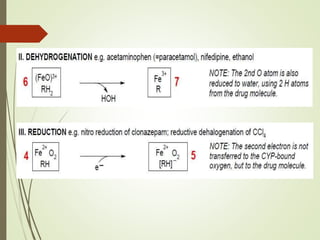
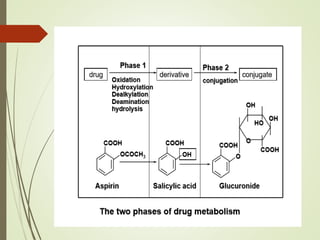
Phase 1 reaction include oxidation ,reduction and
hydrolysis.
Phase 1 reactions usually convert the parent drug to a
more polar metabolite by introducing or unmasking a
functional group (-OH, NH2 , -SH). If phase 1
metabolites are sufficiently polar, they may be readily
excreted.
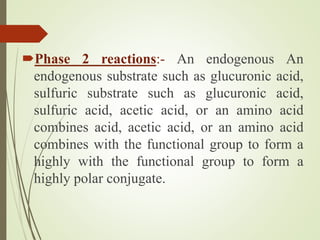
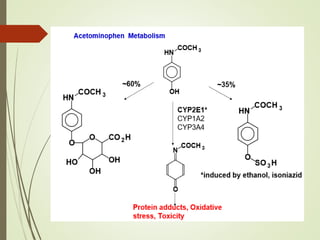
Phase 2 reactions:- An endogenous An
endogenous substrate such as glucuronic acid,
sulfuric substrate such as glucuronic acid,
sulfuric acid, acetic acid, or an amino acid
combines acid, acetic acid, or an amino acid
combines with the functional group to form a
highly with the functional group to form a
highly polar conjugate.
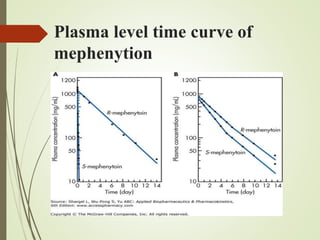
Plasma level time curve of
mephenytion
Factors affecting Drug Metabolism
Genetic factors
Diet & environmental factors
Age & sex
Drug-drug interactions during
metabolism
Interactions between drugs &
endogenous compounds
Disease affecting drug metabolism
drug metabolism plays a major role and determines the
fate of the prospective drugs.
Drug metabolism must take place only after the drugs
reach their specific target site and produce the desired
effects.
Drug metabolism has an important role in the
determination of the pharmacokinetic (PK) parameters
like- Oral Biioavailability
Clearane and Half life.
 Drug metabolism is very essential in the toxicity studies
too.
 The persistence of the compounds in the systemic
circulation for long period causes toxicity.
Importance of Biotransformation
THANK YOU

Drug biotransformation

  • 1.
    DRUG BIO-TRASFORMATION BY: MD. MYNULHASAN SOUTHEAST UNIVERSITY
  • 2.
    Biotransformation The conversion ofmolecules from one form to another within an organism, often associated with change (increase, decrease, or little change) in pharmacologic activity; refers especially to drugs and other xenobiotics. The metabolism of a drug or toxin in a body is an example of a biotransformation. The body typically deals with a foreign compound by making it more water- soluble, to increase the rate of its excretion through the urine.
  • 3.
    History  Welsh biochemist Metabolism of sulfonamides, benzene, aniline, acetanilide, phenacetin, thalidomide and stilbesterol  Metabolism of TNT (Trinitrotoluene) with regard to toxicity in munitions (1942) 1909 - 1979 Richard Tecwyn Williams
  • 4.
    The role ofbiotransformation Alteration or termination of drug activity Converts pro-drug to active compound Coverts less active drug to more active drug Produces toxic compound Terminates drug actions
  • 5.
  • 6.
    The pathways ofdrug metabolism phase І phase II Phase 1 reaction include oxidation ,reduction and hydrolysis. Phase 1 reactions usually convert the parent drug to a more polar metabolite by introducing or unmasking a functional group (-OH, NH2 , -SH). If phase 1 metabolites are sufficiently polar, they may be readily excreted.
  • 9.
    Phase 2 reactions:-An endogenous An endogenous substrate such as glucuronic acid, sulfuric substrate such as glucuronic acid, sulfuric acid, acetic acid, or an amino acid combines acid, acetic acid, or an amino acid combines with the functional group to form a highly with the functional group to form a highly polar conjugate.
  • 12.
    Plasma level timecurve of mephenytion
  • 13.
    Factors affecting DrugMetabolism Genetic factors Diet & environmental factors Age & sex Drug-drug interactions during metabolism Interactions between drugs & endogenous compounds Disease affecting drug metabolism
  • 14.
    drug metabolism playsa major role and determines the fate of the prospective drugs. Drug metabolism must take place only after the drugs reach their specific target site and produce the desired effects. Drug metabolism has an important role in the determination of the pharmacokinetic (PK) parameters like- Oral Biioavailability Clearane and Half life.  Drug metabolism is very essential in the toxicity studies too.  The persistence of the compounds in the systemic circulation for long period causes toxicity. Importance of Biotransformation
  • 15.