Author: Carlo Andrea Gonano
Co-author: Prof. Riccardo Enrico Zich
Politecnico di Milano, Italy
EUCAP 2014,
6-11 April, The Hague,The Netherlands
Drude-Lorentz model
in circuit form
Contents
1. Introduction
2. The Drude-Lorentz Model
7. Limits of the models
8. Conclusions
9. Questions and Extras
4. Request for a circuit model
5. Extending KCL
6. Circuit dipoles
7. Multi-resonance model
8. Anisotropic materials
2C.A. Gonano, R.E. Zich
Introduction
ESTIMATING PERMITTIVITY
• The Drude-Lorentz model (DLM) is a method for
estimate the permittivity e of a bulk material
• Atomic, simple and linearized model, but
quite effective and widespread
• Calculating e is a common problem in the
project of metamaterials
• Need to design the structure at a microscopic
level and in a simple way
3C.A. Gonano, R.E. Zich
CIRCUITS ARE A POWERFUL
TOOL FOR THIS PURPOSE
• Problem: the DLM is not a circuit model
Material micro-macro structure
– image by Pendry &Smith
The Drude-Lorentz model (I)
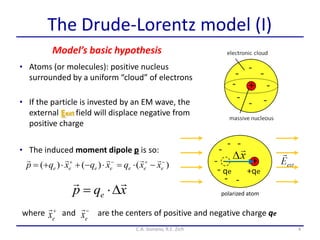
• Atoms (or molecules): positive nucleus
surrounded by a uniform “cloud” of electrons
• If the particle is invested by an EM wave, the
external Eext field will displace negative from
positive charge
• The induced moment dipole p is so:
4C.A. Gonano, R.E. Zich
Model’s basic hypothesis
polarized atom
)()()( 
 eeeeeee xxqxqxqp

xqp e


where and
ex
 
ex
 are the centers of positive and negative charge qe
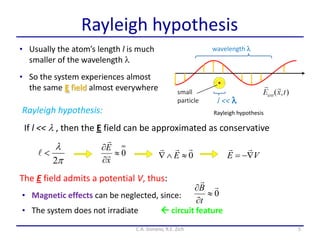
Rayleigh hypothesis
• Usually the atom’s length l is much
smaller of the wavelength l
5C.A. Gonano, R.E. Zich
Rayleigh hypothesis
• So the system experiences almost
the same E field almost everywhere
If l << l , then the E field can be approximated as conservative
The E field admits a potential V, thus:
• Magnetic effects can be neglected, since:
Rayleigh hypothesis:
0





t
B
• The system does not irradiate

l
2
 0

 E0


x
E


VE 

 circuit feature
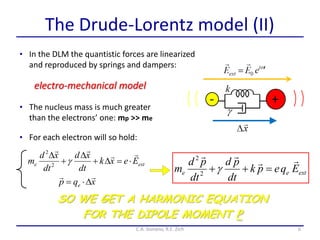
The Drude-Lorentz model (II)
• In the DLM the quantistic forces are linearized
and reproduced by springs and dampers:
• For each electron will so hold:
6C.A. Gonano, R.E. Zich
xqp e


exte Eexk
dt
xd
dt
xd
m






2
2
• The nucleus mass is much greater
than the electrons’ one: mp >> me
extee Eqepk
dt
pd
dt
pd
m


2
2
SO WE GET A HARMONIC EQUATION
FOR THE DIPOLE MOMENT P
electro-mechanical model
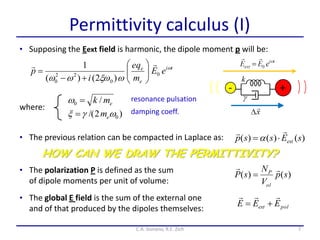
Permittivity calculus (I)
• Supposing the Eext field is harmonic, the dipole moment p will be:
• The previous relation can be compacted in Laplace as:
7C.A. Gonano, R.E. Zich
where:
ti
e
e
eE
m
qe
i
p 

0
0
22
0 )2()(
1 








emk /0  resonance pulsation
)2/( 0 em damping coeff.
)()()( sEssp ext


• The polarization P is defined as the sum
of dipole moments per unit of volume:
)()( sp
V
N
sP
ol
P 

HOW CAN WE DRAW THE PERMITTIVITY?
• The global E field is the sum of the external one
and of that produced by the dipoles themselves: polext EEE


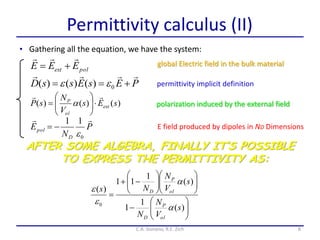
Permittivity calculus (II)
• Gathering all the equation, we have the system:
8C.A. Gonano, R.E. Zich
P
N
E
D
pol

0
11
e

AFTER SOME ALGEBRA, FINALLY IT’S POSSIBLE
TO EXPRESS THE PERMITTIVITY AS:
polext EEE


PEsEssD

 0)()()( ee
)()()( sEs
V
N
sP ext
ol
P







 
global Electric field in the bulk material
permittivity implicit definition
polarization induced by the external field
E field produced by dipoles in ND Dimensions





















)(
1
1
)(
1
11
)(
0
s
V
N
N
s
V
N
Ns
ol
P
D
ol
P
D


e
e
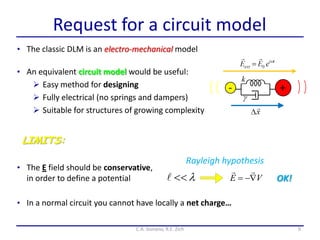
Request for a circuit model
• An equivalent circuit model would be useful:
 Easy method for designing
 Fully electrical (no springs and dampers)
 Suitable for structures of growing complexity
9
LIMITS:
• The E field should be conservative,
in order to define a potential
C.A. Gonano, R.E. Zich
• The classic DLM is an electro-mechanical model
l VE 

OK!
Rayleigh hypothesis
• In a normal circuit you cannot have locally a net charge…
10
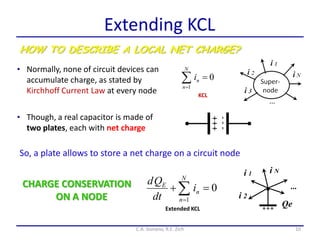
Extending KCL
• Normally, none of circuit devices can
accumulate charge, as stated by
Kirchhoff Current Law at every node
HOW TO DESCRIBE A LOCAL NET CHARGE?
• Though, a real capacitor is made of
two plates, each with net charge
0
1
 
N
n
n
E
i
dt
Qd
Extended KCL
0
1

N
n
ni
KCL
C.A. Gonano, R.E. Zich
i 1
i 2
...
i N
Qe
So, a plate allows to store a net charge on a circuit node
CHARGE CONSERVATION
ON A NODE
11
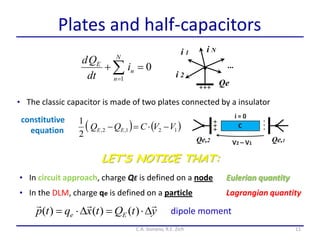
Plates and half-capacitors
• The classic capacitor is made of two plates connected by a insulator
   121,2,
2
1
VVCQQ EE 
C.A. Gonano, R.E. Zich
constitutive
equation
LET’S NOTICE THAT:
• In circuit approach, charge QE is defined on a node Eulerian quantity
ytQtxqtp Ee

 )()()(
• In the DLM, charge qe is defined on a particle
dipole moment
Lagrangian quantity
0
1
 
N
n
n
E
i
dt
Qd
i 1
i 2
...
i N
Qe
12
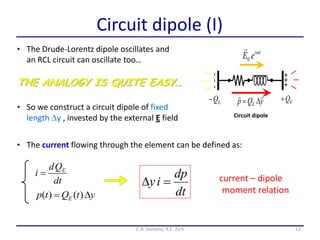
Circuit dipole (I)
THE ANALOGY IS QUITE EASY…
• The Drude-Lorentz dipole oscillates and
an RCL circuit can oscillate too…
C.A. Gonano, R.E. Zich
• So we construct a circuit dipole of fixed
length y , invested by the external E field
• The current flowing through the element can be defined as:
dt
Qd
i E

ytQtp E  )()( dt
dp
iy 
yQp E

 EQEQ
ti
eE 
0

Circuit dipole
current – dipole
moment relation
13
Circuit dipole (II)
C.A. Gonano, R.E. Zich
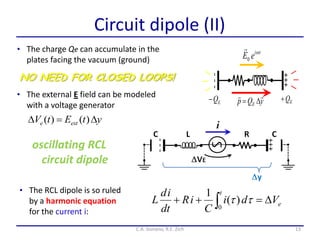
• The external E field can be modeled
with a voltage generator
ytEtV exte  )()(
yQp E

 EQEQ
ti
eE 
0
• The charge Qe can accumulate in the
plates facing the vacuum (ground)
NO NEED FOR CLOSED LOOPS!
• The RCL dipole is so ruled
by a harmonic equation
for the current i:
e
t
Vdi
C
iR
dt
id
L  0
)(
1

oscillating RCL
circuit dipole
14
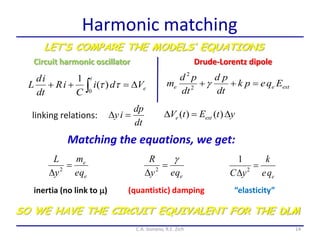
LET’S COMPARE THE MODELS’ EQUATIONS
Harmonic matching
Drude-Lorentz dipole
e
e
qe
m
y
L

 2
eqey
R 

 2
eqe
k
yC

 2
1
inertia (no link to m) (quantistic) damping “elasticity”
C.A. Gonano, R.E. Zich
extee Eqepk
dt
pd
dt
pd
m 2
2
dt
dp
iy  ytEtV exte  )()(
Circuit harmonic oscillator
e
t
Vdi
C
iR
dt
id
L  0
)(
1

Matching the equations, we get:
linking relations:
SO WE HAVE THE CIRCUIT EQUIVALENT FOR THE DLM
15
Multi-resonance model (I)
C.A. Gonano, R.E. Zich
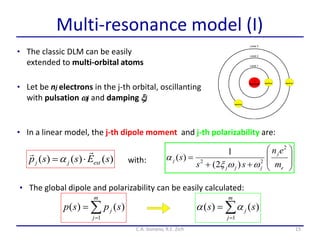
• The classic DLM can be easily
extended to multi-orbital atoms
with: 









e
j
jjj
j
m
en
ss
s
2
22
)2(
1
)(

)()()( sEssp extjj


• In a linear model, the j-th dipole moment and j-th polarizability are:
• The global dipole and polarizability can be easily calculated:


m
j
j spsp
1
)()( 

m
j
j ss
1
)()( 
• Let be nj electrons in the j-th orbital, oscillanting
with pulsation j and damping j
16
Multi-resonance model (II)
C.A. Gonano, R.E. Zich
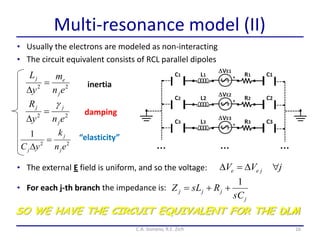
SO WE HAVE THE CIRCUIT EQUIVALENT FOR THE DLM
• Usually the electrons are modeled as non-interacting
• The circuit equivalent consists of RCL parallel dipoles
22
en
m
y
L
j
ej


22
eny
R
j
jj 


22
1
en
k
yC j
j
j


inertia
damping
“elasticity”
• The external E field is uniform, and so the voltage: jVV jee 
• For each j-th branch the impedance is:
j
jjj
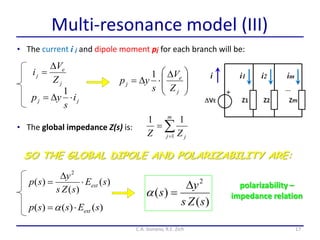
sC
RsLZ
1

17
Multi-resonance model (III)
C.A. Gonano, R.E. Zich
SO THE GLOBAL DIPOLE AND POLARIZABILITY ARE:
• The current i j and dipole moment pj for each branch will be:
)(
)(
2
sZs
y
s




m
j jZZ 1
11
jj i
s
yp 
1
• The global impedance Z(s) is:
)(
)(
)(
2
sE
sZs
y
sp ext


)()()( sEssp ext
j
e
j
Z
V
i









 

j
e
j
Z
V
s
yp
1
polarizability –
impedance relation
18
Anisotropic materials
C.A. Gonano, R.E. Zich
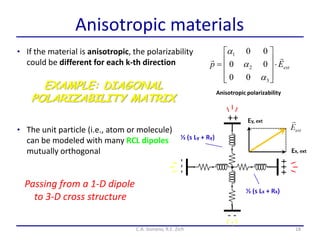
• If the material is anisotropic, the polarizability
could be different for each k-th direction
EXAMPLE: DIAGONAL
POLARIZABILITY MATRIX
• The unit particle (i.e., atom or molecule)
can be modeled with many RCL dipoles
mutually orthogonal
extEp













3
2
1
00
00
00



Anisotropic polarizability
Passing from a 1-D dipole
to 3-D cross structure
19
Orthogonal dipoles
C.A. Gonano, R.E. Zich
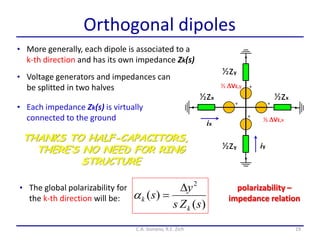
• More generally, each dipole is associated to a
k-th direction and has its own impedance Zk(s)
• Each impedance Zk(s) is virtually
connected to the ground
THANKS TO HALF-CAPACITORS,
THERE’S NO NEED FOR RING
STRUCTURE
• Voltage generators and impedances can
be splitted in two halves
• The global polarizability for
the k-th direction will be:
)(
)(
2
sZs
y
s
k
k


polarizability –
impedance relation
Limits of the models
20C.A. Gonano, R.E. Zich
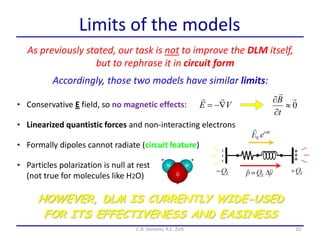
• Conservative E field, so no magnetic effects:
As previously stated, our task is not to improve the DLM itself,
but to rephrase it in circuit form
Accordingly, those two models have similar limits:
• Linearized quantistic forces and non-interacting electrons
• Formally dipoles cannot radiate (circuit feature)
VE 

0





t
B
• Particles polarization is null at rest
(not true for molecules like H2O)
HOWEVER, DLM IS CURRENTLY WIDE-USED
FOR ITS EFFECTIVENESS AND EASINESS
Conclusions and future tasks
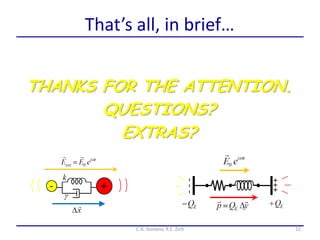
• We did it with simple RCL circuits , introducing the concept of half-capacitor
21C.A. Gonano, R.E. Zich
• The DLM is electro-mechanic, but it can be rephrased in circuit form
• The circuit model could be a powerful design
tool for metamaterial’s unit elements
MAIN FEATURES
• We showed that the circuit concept is suitable also
for multi-resonance and anisotropic materials
• Differently from other models, the circuit
structure is defined for every frequency
That’s all, in brief…
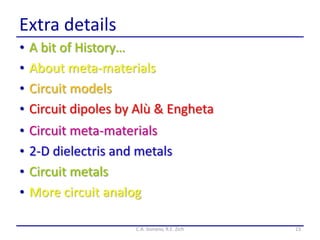
THANKS FOR THE ATTENTION.
QUESTIONS?
EXTRAS?
22C.A. Gonano, R.E. Zich
Extra details
• A bit of History…
• About meta-materials
• Circuit models
• Circuit dipoles by Alù & Engheta
23C.A. Gonano, R.E. Zich
• Circuit meta-materials
• 2-D dielectris and metals
• Circuit metals
• More circuit analog
A bit of History…
24C.A. Gonano, R.E. Zich
Paul Karl Ludwig Drude
• In 1900 paper “Zur Elektronentheorie der Metalle”, Paul
Drude applied the kinetic theory to describe the electrical
conduction in metals
• Gas of free electrons bouncing on massive positive ions,
damping due to collision
• Ohm’s law and conductivity s well explained
Electron gas;
image in free domain
E
m
en
J
e








2
Permittivity can be calculated too:
)(
1
)(
2
2
0 e
p
mi 

e
e


A bit of History…
• In 1905 paper “Le movement des electrons dans les
metaux”, H. A. Lorentz tried to describe the interaction
between matter and EM waves
25C.A. Gonano, R.E. Zich
Hendrik Antoon Lorentz
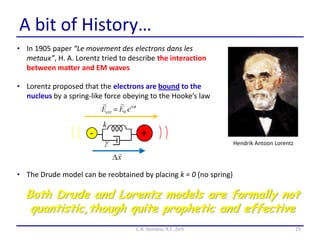
• Lorentz proposed that the electrons are bound to the
nucleus by a spring-like force obeying to the Hooke’s law
Both Drude and Lorentz models are formally not
quantistic,though quite prophetic and effective
• The Drude model can be reobtained by placing k = 0 (no spring)
Designing metamaterials
26C.A. Gonano, R.E. Zich
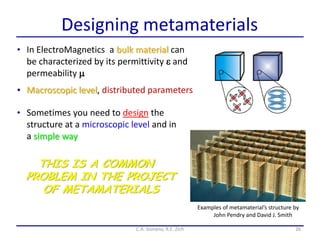
• In ElectroMagnetics a bulk material can
be characterized by its permittivity e and
permeability m
• Macroscopic level, distributed parameters
Examples of metamaterial’s structure by
John Pendry and David J. Smith
• Sometimes you need to design the
structure at a microscopic level and in
a simple way
THIS IS A COMMON
PROBLEM IN THE PROJECT
OF METAMATERIALS
S k
Negative refraction
Metamaterials
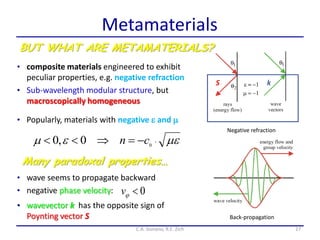
• composite materials engineered to exhibit
peculiar properties, e.g. negative refraction
• Sub-wavelength modular structure, but
macroscopically homogeneous
27C.A. Gonano, R.E. Zich
BUT WHAT ARE METAMATERIALS?
Back-propagation
• Popularly, materials with negative e and m
meem  0
0,0 cn
Many paradoxal properties…
• wave seems to propagate backward
• negative phase velocity: 0v
• wavevector k has the opposite sign of
Poynting vector S
Metamaterials: applications
28C.A. Gonano, R.E. Zich
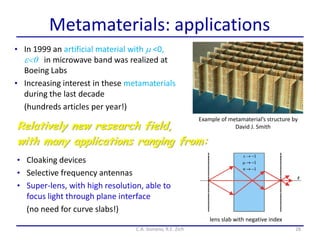
• In 1999 an artificial material with m <0,
e0 in microwave band was realized at
Boeing Labs
• Increasing interest in these metamaterials
during the last decade
(hundreds articles per year!)
Relatively new research field,
with many applications ranging from:
Example of metamaterial’s structure by
David J. Smith
• Cloaking devices
• Selective frequency antennas
• Super-lens, with high resolution, able to
focus light through plane interface
(no need for curve slabs!)
lens slab with negative index
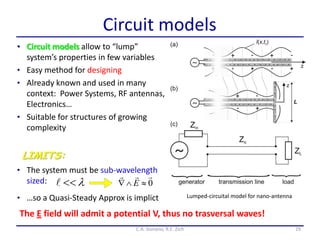
Circuit models
• Circuit models allow to “lump”
system’s properties in few variables
• Easy method for designing
• Already known and used in many
context: Power Systems, RF antennas,
Electronics…
• Suitable for structures of growing
complexity
29
LIMITS:
Lumped-circuital model for nano-antenna
• The system must be sub-wavelength
sized: l 0

 E
The E field will admit a potential V, thus no trasversal waves!
• …so a Quasi-Steady Approx is implict
C.A. Gonano, R.E. Zich
30
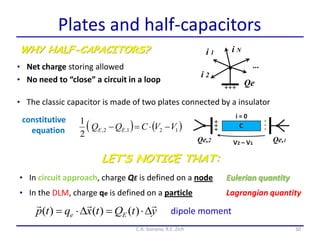
Plates and half-capacitors
WHY HALF-CAPACITORS?
• The classic capacitor is made of two plates connected by a insulator
   121,2,
2
1
VVCQQ EE 
C.A. Gonano, R.E. Zich
i 1
i 2
...
i N
Qe
• Net charge storing allowed
• No need to “close” a circuit in a loop
constitutive
equation
LET’S NOTICE THAT:
• In circuit approach, charge QE is defined on a node Eulerian quantity
ytQtxqtp Ee

 )()()(
• In the DLM, charge qe is defined on a particle
dipole moment
Lagrangian quantity
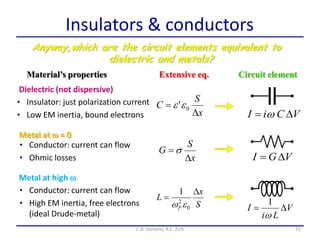
Insulators & conductors
• Insulator: just polarization current
• Low EM inertia, bound electrons
31
Dielectric (not dispersive)
Anyway,which are the circuit elements equivalent to
dielectric and metals?
VCiI  x
S
C

 0'ee
• Conductor: current can flow
• Ohmic losses
Metal at  = 0
VGI x
S
G

s
• Conductor: current can flow
• High EM inertia, free electrons
(ideal Drude-metal)
Metal at high 
S
x
L
P


0
2
1
e V
Li
I 

1
Material’s properties Extensive eq. Circuit element
C.A. Gonano, R.E. Zich
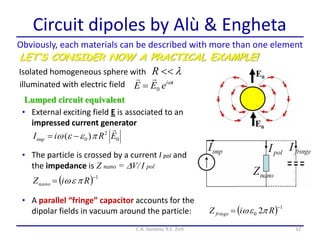
Circuit dipoles by Alù & Engheta
32
LET’S CONSIDER NOW A PRACTICAL EXAMPLE!
Obviously, each materials can be described with more than one element
• External exciting field E is associated to an
impressed current generator
Isolated homogeneous sphere with
ti
eEE 
0


lR
illuminated with electric field
Lumped circuit equivalent
• The particle is crossed by a current I pol and
the impedance is Z nano = V/ I pol
0
2
0 )( ERiIimp

ee 
  1
 RiZnano e
• A parallel “fringe” capacitor accounts for the
dipolar fields in vacuum around the particle:   1
0 2

 RiZ fringe e
C.A. Gonano, R.E. Zich
33
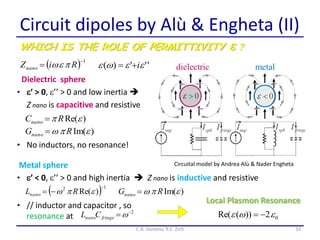
Circuital model by Andrea Alù & Nader Engheta
dielectric metal
WHICH IS THE ROLE OF PERMITTIVITY e ?
Circuit dipoles by Alù & Engheta (II)
• e’ > 0, e’’ > 0 and low inertia 
Z nano is capacitive and resistive
Dielectric sphere
• e’ < 0, e’’ > 0 and high inertia  Z nano is inductive and resistive
Metal sphere
''')( eee i
)Re(e RCnano 
• No inductors, no resonance!
)Im(e RGnano 
  1
 RiZnano e
 12
)Re(

 e RLnano )Im(e RGnano 
• // inductor and capacitor , so
resonance at
2
fringenanoCL 02))(Re( ee 
Local Plasmon Resonance
C.A. Gonano, R.E. Zich
34
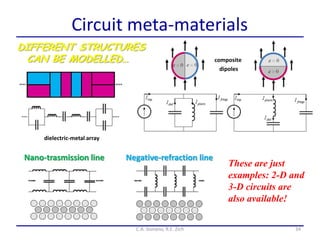
DIFFERENT STRUCTURES
CAN BE MODELLED…
Circuit meta-materials
composite
dipoles
dielectric-metal array
Nano-trasmission line Negative-refraction line
These are just
examples: 2-D and
3-D circuits are
also available!
C.A. Gonano, R.E. Zich
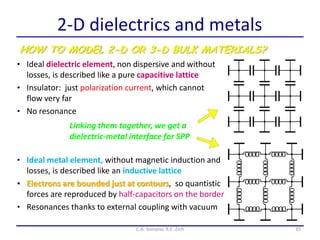
2-D dielectrics and metals
35
• Ideal dielectric element, non dispersive and without
losses, is described like a pure capacitive lattice
• Insulator: just polarization current, which cannot
flow very far
• No resonance
• Ideal metal element, without magnetic induction and
losses, is described like an inductive lattice
• Electrons are bounded just at contours, so quantistic
forces are reproduced by half-capacitors on the border
• Resonances thanks to external coupling with vacuum
HOW TO MODEL 2-D OR 3-D BULK MATERIALS?
Linking them together, we get a
dielectric-metal interface for SPP
C.A. Gonano, R.E. Zich
36
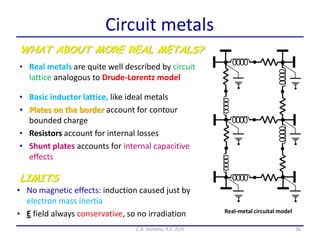
Circuit metals
• Real metals are quite well described by circuit
lattice analogous to Drude-Lorentz model
WHAT ABOUT MORE REAL METALS?
• No magnetic effects: induction caused just by
electron mass inertia
• E field always conservative, so no irradiation
LIMITS
• Basic inductor lattice, like ideal metals
• Plates on the border account for contour
bounded charge
• Resistors account for internal losses
• Shunt plates accounts for internal capacitive
effects
Real-metal circuital model
C.A. Gonano, R.E. Zich
37
More circuit analogs
Site by Gerard Westendorp, ecleptic engineer
http://westy31.home.xs4all.nl/Electric.html
C.A. Gonano, R.E. Zich
38
This is the last slide
C.A. Gonano, R.E. Zich
THAT’S ALL FOR NOW

Drude Lorentz circuit Gonano Zich

  • 1.
    Author: Carlo AndreaGonano Co-author: Prof. Riccardo Enrico Zich Politecnico di Milano, Italy EUCAP 2014, 6-11 April, The Hague,The Netherlands Drude-Lorentz model in circuit form
  • 2.
    Contents 1. Introduction 2. TheDrude-Lorentz Model 7. Limits of the models 8. Conclusions 9. Questions and Extras 4. Request for a circuit model 5. Extending KCL 6. Circuit dipoles 7. Multi-resonance model 8. Anisotropic materials 2C.A. Gonano, R.E. Zich
  • 3.
    Introduction ESTIMATING PERMITTIVITY • TheDrude-Lorentz model (DLM) is a method for estimate the permittivity e of a bulk material • Atomic, simple and linearized model, but quite effective and widespread • Calculating e is a common problem in the project of metamaterials • Need to design the structure at a microscopic level and in a simple way 3C.A. Gonano, R.E. Zich CIRCUITS ARE A POWERFUL TOOL FOR THIS PURPOSE • Problem: the DLM is not a circuit model Material micro-macro structure – image by Pendry &Smith
  • 4.
    The Drude-Lorentz model(I) • Atoms (or molecules): positive nucleus surrounded by a uniform “cloud” of electrons • If the particle is invested by an EM wave, the external Eext field will displace negative from positive charge • The induced moment dipole p is so: 4C.A. Gonano, R.E. Zich Model’s basic hypothesis polarized atom )()()(   eeeeeee xxqxqxqp  xqp e   where and ex   ex  are the centers of positive and negative charge qe
  • 5.
    Rayleigh hypothesis • Usuallythe atom’s length l is much smaller of the wavelength l 5C.A. Gonano, R.E. Zich Rayleigh hypothesis • So the system experiences almost the same E field almost everywhere If l << l , then the E field can be approximated as conservative The E field admits a potential V, thus: • Magnetic effects can be neglected, since: Rayleigh hypothesis: 0      t B • The system does not irradiate  l 2  0   E0   x E   VE    circuit feature
  • 6.
    The Drude-Lorentz model(II) • In the DLM the quantistic forces are linearized and reproduced by springs and dampers: • For each electron will so hold: 6C.A. Gonano, R.E. Zich xqp e   exte Eexk dt xd dt xd m       2 2 • The nucleus mass is much greater than the electrons’ one: mp >> me extee Eqepk dt pd dt pd m   2 2 SO WE GET A HARMONIC EQUATION FOR THE DIPOLE MOMENT P electro-mechanical model
  • 7.
    Permittivity calculus (I) •Supposing the Eext field is harmonic, the dipole moment p will be: • The previous relation can be compacted in Laplace as: 7C.A. Gonano, R.E. Zich where: ti e e eE m qe i p   0 0 22 0 )2()( 1          emk /0  resonance pulsation )2/( 0 em damping coeff. )()()( sEssp ext   • The polarization P is defined as the sum of dipole moments per unit of volume: )()( sp V N sP ol P   HOW CAN WE DRAW THE PERMITTIVITY? • The global E field is the sum of the external one and of that produced by the dipoles themselves: polext EEE  
  • 8.
    Permittivity calculus (II) •Gathering all the equation, we have the system: 8C.A. Gonano, R.E. Zich P N E D pol  0 11 e  AFTER SOME ALGEBRA, FINALLY IT’S POSSIBLE TO EXPRESS THE PERMITTIVITY AS: polext EEE   PEsEssD   0)()()( ee )()()( sEs V N sP ext ol P          global Electric field in the bulk material permittivity implicit definition polarization induced by the external field E field produced by dipoles in ND Dimensions                      )( 1 1 )( 1 11 )( 0 s V N N s V N Ns ol P D ol P D   e e
  • 9.
    Request for acircuit model • An equivalent circuit model would be useful:  Easy method for designing  Fully electrical (no springs and dampers)  Suitable for structures of growing complexity 9 LIMITS: • The E field should be conservative, in order to define a potential C.A. Gonano, R.E. Zich • The classic DLM is an electro-mechanical model l VE   OK! Rayleigh hypothesis • In a normal circuit you cannot have locally a net charge…
  • 10.
    10 Extending KCL • Normally,none of circuit devices can accumulate charge, as stated by Kirchhoff Current Law at every node HOW TO DESCRIBE A LOCAL NET CHARGE? • Though, a real capacitor is made of two plates, each with net charge 0 1   N n n E i dt Qd Extended KCL 0 1  N n ni KCL C.A. Gonano, R.E. Zich i 1 i 2 ... i N Qe So, a plate allows to store a net charge on a circuit node CHARGE CONSERVATION ON A NODE
  • 11.
    11 Plates and half-capacitors •The classic capacitor is made of two plates connected by a insulator    121,2, 2 1 VVCQQ EE  C.A. Gonano, R.E. Zich constitutive equation LET’S NOTICE THAT: • In circuit approach, charge QE is defined on a node Eulerian quantity ytQtxqtp Ee   )()()( • In the DLM, charge qe is defined on a particle dipole moment Lagrangian quantity 0 1   N n n E i dt Qd i 1 i 2 ... i N Qe
  • 12.
    12 Circuit dipole (I) THEANALOGY IS QUITE EASY… • The Drude-Lorentz dipole oscillates and an RCL circuit can oscillate too… C.A. Gonano, R.E. Zich • So we construct a circuit dipole of fixed length y , invested by the external E field • The current flowing through the element can be defined as: dt Qd i E  ytQtp E  )()( dt dp iy  yQp E   EQEQ ti eE  0  Circuit dipole current – dipole moment relation
  • 13.
    13 Circuit dipole (II) C.A.Gonano, R.E. Zich • The external E field can be modeled with a voltage generator ytEtV exte  )()( yQp E   EQEQ ti eE  0 • The charge Qe can accumulate in the plates facing the vacuum (ground) NO NEED FOR CLOSED LOOPS! • The RCL dipole is so ruled by a harmonic equation for the current i: e t Vdi C iR dt id L  0 )( 1  oscillating RCL circuit dipole
  • 14.
    14 LET’S COMPARE THEMODELS’ EQUATIONS Harmonic matching Drude-Lorentz dipole e e qe m y L   2 eqey R    2 eqe k yC   2 1 inertia (no link to m) (quantistic) damping “elasticity” C.A. Gonano, R.E. Zich extee Eqepk dt pd dt pd m 2 2 dt dp iy  ytEtV exte  )()( Circuit harmonic oscillator e t Vdi C iR dt id L  0 )( 1  Matching the equations, we get: linking relations: SO WE HAVE THE CIRCUIT EQUIVALENT FOR THE DLM
  • 15.
    15 Multi-resonance model (I) C.A.Gonano, R.E. Zich • The classic DLM can be easily extended to multi-orbital atoms with:           e j jjj j m en ss s 2 22 )2( 1 )(  )()()( sEssp extjj   • In a linear model, the j-th dipole moment and j-th polarizability are: • The global dipole and polarizability can be easily calculated:   m j j spsp 1 )()(   m j j ss 1 )()(  • Let be nj electrons in the j-th orbital, oscillanting with pulsation j and damping j
  • 16.
    16 Multi-resonance model (II) C.A.Gonano, R.E. Zich SO WE HAVE THE CIRCUIT EQUIVALENT FOR THE DLM • Usually the electrons are modeled as non-interacting • The circuit equivalent consists of RCL parallel dipoles 22 en m y L j ej   22 eny R j jj    22 1 en k yC j j j   inertia damping “elasticity” • The external E field is uniform, and so the voltage: jVV jee  • For each j-th branch the impedance is: j jjj sC RsLZ 1 
  • 17.
    17 Multi-resonance model (III) C.A.Gonano, R.E. Zich SO THE GLOBAL DIPOLE AND POLARIZABILITY ARE: • The current i j and dipole moment pj for each branch will be: )( )( 2 sZs y s     m j jZZ 1 11 jj i s yp  1 • The global impedance Z(s) is: )( )( )( 2 sE sZs y sp ext   )()()( sEssp ext j e j Z V i             j e j Z V s yp 1 polarizability – impedance relation
  • 18.
    18 Anisotropic materials C.A. Gonano,R.E. Zich • If the material is anisotropic, the polarizability could be different for each k-th direction EXAMPLE: DIAGONAL POLARIZABILITY MATRIX • The unit particle (i.e., atom or molecule) can be modeled with many RCL dipoles mutually orthogonal extEp              3 2 1 00 00 00    Anisotropic polarizability Passing from a 1-D dipole to 3-D cross structure
  • 19.
    19 Orthogonal dipoles C.A. Gonano,R.E. Zich • More generally, each dipole is associated to a k-th direction and has its own impedance Zk(s) • Each impedance Zk(s) is virtually connected to the ground THANKS TO HALF-CAPACITORS, THERE’S NO NEED FOR RING STRUCTURE • Voltage generators and impedances can be splitted in two halves • The global polarizability for the k-th direction will be: )( )( 2 sZs y s k k   polarizability – impedance relation
  • 20.
    Limits of themodels 20C.A. Gonano, R.E. Zich • Conservative E field, so no magnetic effects: As previously stated, our task is not to improve the DLM itself, but to rephrase it in circuit form Accordingly, those two models have similar limits: • Linearized quantistic forces and non-interacting electrons • Formally dipoles cannot radiate (circuit feature) VE   0      t B • Particles polarization is null at rest (not true for molecules like H2O) HOWEVER, DLM IS CURRENTLY WIDE-USED FOR ITS EFFECTIVENESS AND EASINESS
  • 21.
    Conclusions and futuretasks • We did it with simple RCL circuits , introducing the concept of half-capacitor 21C.A. Gonano, R.E. Zich • The DLM is electro-mechanic, but it can be rephrased in circuit form • The circuit model could be a powerful design tool for metamaterial’s unit elements MAIN FEATURES • We showed that the circuit concept is suitable also for multi-resonance and anisotropic materials • Differently from other models, the circuit structure is defined for every frequency
  • 22.
    That’s all, inbrief… THANKS FOR THE ATTENTION. QUESTIONS? EXTRAS? 22C.A. Gonano, R.E. Zich
  • 23.
    Extra details • Abit of History… • About meta-materials • Circuit models • Circuit dipoles by Alù & Engheta 23C.A. Gonano, R.E. Zich • Circuit meta-materials • 2-D dielectris and metals • Circuit metals • More circuit analog
  • 24.
    A bit ofHistory… 24C.A. Gonano, R.E. Zich Paul Karl Ludwig Drude • In 1900 paper “Zur Elektronentheorie der Metalle”, Paul Drude applied the kinetic theory to describe the electrical conduction in metals • Gas of free electrons bouncing on massive positive ions, damping due to collision • Ohm’s law and conductivity s well explained Electron gas; image in free domain E m en J e         2 Permittivity can be calculated too: )( 1 )( 2 2 0 e p mi   e e  
  • 25.
    A bit ofHistory… • In 1905 paper “Le movement des electrons dans les metaux”, H. A. Lorentz tried to describe the interaction between matter and EM waves 25C.A. Gonano, R.E. Zich Hendrik Antoon Lorentz • Lorentz proposed that the electrons are bound to the nucleus by a spring-like force obeying to the Hooke’s law Both Drude and Lorentz models are formally not quantistic,though quite prophetic and effective • The Drude model can be reobtained by placing k = 0 (no spring)
  • 26.
    Designing metamaterials 26C.A. Gonano,R.E. Zich • In ElectroMagnetics a bulk material can be characterized by its permittivity e and permeability m • Macroscopic level, distributed parameters Examples of metamaterial’s structure by John Pendry and David J. Smith • Sometimes you need to design the structure at a microscopic level and in a simple way THIS IS A COMMON PROBLEM IN THE PROJECT OF METAMATERIALS
  • 27.
    S k Negative refraction Metamaterials •composite materials engineered to exhibit peculiar properties, e.g. negative refraction • Sub-wavelength modular structure, but macroscopically homogeneous 27C.A. Gonano, R.E. Zich BUT WHAT ARE METAMATERIALS? Back-propagation • Popularly, materials with negative e and m meem  0 0,0 cn Many paradoxal properties… • wave seems to propagate backward • negative phase velocity: 0v • wavevector k has the opposite sign of Poynting vector S
  • 28.
    Metamaterials: applications 28C.A. Gonano,R.E. Zich • In 1999 an artificial material with m <0, e0 in microwave band was realized at Boeing Labs • Increasing interest in these metamaterials during the last decade (hundreds articles per year!) Relatively new research field, with many applications ranging from: Example of metamaterial’s structure by David J. Smith • Cloaking devices • Selective frequency antennas • Super-lens, with high resolution, able to focus light through plane interface (no need for curve slabs!) lens slab with negative index
  • 29.
    Circuit models • Circuitmodels allow to “lump” system’s properties in few variables • Easy method for designing • Already known and used in many context: Power Systems, RF antennas, Electronics… • Suitable for structures of growing complexity 29 LIMITS: Lumped-circuital model for nano-antenna • The system must be sub-wavelength sized: l 0   E The E field will admit a potential V, thus no trasversal waves! • …so a Quasi-Steady Approx is implict C.A. Gonano, R.E. Zich
  • 30.
    30 Plates and half-capacitors WHYHALF-CAPACITORS? • The classic capacitor is made of two plates connected by a insulator    121,2, 2 1 VVCQQ EE  C.A. Gonano, R.E. Zich i 1 i 2 ... i N Qe • Net charge storing allowed • No need to “close” a circuit in a loop constitutive equation LET’S NOTICE THAT: • In circuit approach, charge QE is defined on a node Eulerian quantity ytQtxqtp Ee   )()()( • In the DLM, charge qe is defined on a particle dipole moment Lagrangian quantity
  • 31.
    Insulators & conductors •Insulator: just polarization current • Low EM inertia, bound electrons 31 Dielectric (not dispersive) Anyway,which are the circuit elements equivalent to dielectric and metals? VCiI  x S C   0'ee • Conductor: current can flow • Ohmic losses Metal at  = 0 VGI x S G  s • Conductor: current can flow • High EM inertia, free electrons (ideal Drude-metal) Metal at high  S x L P   0 2 1 e V Li I   1 Material’s properties Extensive eq. Circuit element C.A. Gonano, R.E. Zich
  • 32.
    Circuit dipoles byAlù & Engheta 32 LET’S CONSIDER NOW A PRACTICAL EXAMPLE! Obviously, each materials can be described with more than one element • External exciting field E is associated to an impressed current generator Isolated homogeneous sphere with ti eEE  0   lR illuminated with electric field Lumped circuit equivalent • The particle is crossed by a current I pol and the impedance is Z nano = V/ I pol 0 2 0 )( ERiIimp  ee    1  RiZnano e • A parallel “fringe” capacitor accounts for the dipolar fields in vacuum around the particle:   1 0 2   RiZ fringe e C.A. Gonano, R.E. Zich
  • 33.
    33 Circuital model byAndrea Alù & Nader Engheta dielectric metal WHICH IS THE ROLE OF PERMITTIVITY e ? Circuit dipoles by Alù & Engheta (II) • e’ > 0, e’’ > 0 and low inertia  Z nano is capacitive and resistive Dielectric sphere • e’ < 0, e’’ > 0 and high inertia  Z nano is inductive and resistive Metal sphere ''')( eee i )Re(e RCnano  • No inductors, no resonance! )Im(e RGnano    1  RiZnano e  12 )Re(   e RLnano )Im(e RGnano  • // inductor and capacitor , so resonance at 2 fringenanoCL 02))(Re( ee  Local Plasmon Resonance C.A. Gonano, R.E. Zich
  • 34.
    34 DIFFERENT STRUCTURES CAN BEMODELLED… Circuit meta-materials composite dipoles dielectric-metal array Nano-trasmission line Negative-refraction line These are just examples: 2-D and 3-D circuits are also available! C.A. Gonano, R.E. Zich
  • 35.
    2-D dielectrics andmetals 35 • Ideal dielectric element, non dispersive and without losses, is described like a pure capacitive lattice • Insulator: just polarization current, which cannot flow very far • No resonance • Ideal metal element, without magnetic induction and losses, is described like an inductive lattice • Electrons are bounded just at contours, so quantistic forces are reproduced by half-capacitors on the border • Resonances thanks to external coupling with vacuum HOW TO MODEL 2-D OR 3-D BULK MATERIALS? Linking them together, we get a dielectric-metal interface for SPP C.A. Gonano, R.E. Zich
  • 36.
    36 Circuit metals • Realmetals are quite well described by circuit lattice analogous to Drude-Lorentz model WHAT ABOUT MORE REAL METALS? • No magnetic effects: induction caused just by electron mass inertia • E field always conservative, so no irradiation LIMITS • Basic inductor lattice, like ideal metals • Plates on the border account for contour bounded charge • Resistors account for internal losses • Shunt plates accounts for internal capacitive effects Real-metal circuital model C.A. Gonano, R.E. Zich
  • 37.
    37 More circuit analogs Siteby Gerard Westendorp, ecleptic engineer http://westy31.home.xs4all.nl/Electric.html C.A. Gonano, R.E. Zich
  • 38.
    38 This is thelast slide C.A. Gonano, R.E. Zich THAT’S ALL FOR NOW