INTRODUCTION
• Even though, in the early 19th
century, there
was absence of any awareness about the
etiology and spread of the diseases, yet
minimum effective safety measures such as
quarantine and isolation were followed.
• During outbreak of bubonic plague and
cholera pandemic isolation practices were
used as a standard safety precaution.
Definition
• Standard precaution:
• Standard precautions are meant to reduce the
risk of transmission of bloodborne and other
pathogens from both recognized and
unrecognized sources. They are the basic level
of infection control precautions which are to
be used, as a minimum, in the care of all
patients.- World heath organization.
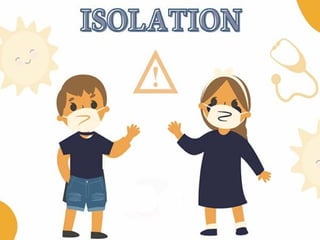
ISOLATION
• In the context of health care settings, the
isolation is defined as any of the various
interventions usually termed as “isolation
precautions” adopted within a HCF (health
care facility) for the control of infection and
for the prevention of communicable diseases
from a patient to other patients, health care
personnel or visitors.
Types of isolation system
• As early as the 20th
century, there have been
evidences of segregating the contagiously
infected patients from others by restricting
them in separate wards. In the current times,
the isolation practices along with the other
preventive strategies are adopted to reduce
the transmission of communicable diseases.
Cont..
• The isolation system can be of following two
types:
1. Barrier isolation
- Contact isolation
- Droplet isolation
- Airborne isolation
2. Reverse barrier isolation
Cont..
• Barrier isolation:
• the barrier isolation is required when the surrounings
and the people around health care facility need
protection from the infection spread by the patients.
• There types of isolation systems:
• Contact isolation:
• This type of isolation is implemented when the mode of
transmission of infection is by contact only in the form
of the contact precautions.
• The use of PPE is most.
Cont..
• Droplet isolation:
• This type of isolation is implemented when the
mode of transmission of the prevailing infection is
the droplet infection that requires the usage of the
droplet precautions to be followed by the healthcare
personnel while handling the patients like:
• Surgical masks
• Surgical googles
• Face sheilds
Cont..
• Airborne isolation:
• This type of isolation is implemented when the mode of
transmission of infection is airborne that requires the
isolation of the patient itself in order to ensure the
safety of the healthcare personnel as well as the
surrounding environment. This kind of isolation
includes the following:
- Isolation rooms or negative air pressure rooms
- Respiratory masks while dealing with the patients.
- Breathing apparatus
Cont..
• Reverse Barrier isolation:
• In this case the patient who is
immunocompromised requires protection
from the infection prevailing in the
environment. This can be done using the
standard/ transmission based precautions by
the patient itself. So, the isolation adopted is
as per the patient concerned i.e., either
contact, droplet or airborne isolation.
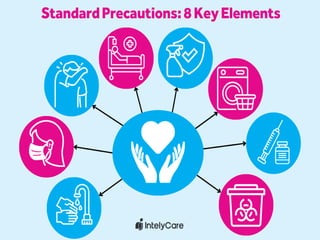
Standard precautions
• They are a set of guidelines that helps reduce
the risk of transmission HAI in hospitals and
microorganisms from both recognized and
unrecognized sources of infection in hospitals.
Guidelines in standard precautions
• Handwashing
• Gloves
• Personal protective equipments
• Patient care equipment
• Environmental control
Handwashing
• Hands of health care workers are often
colonized with pathogens from patients and
environmental surfaces.
• Bacteria that cause hospital-associated
infections (HAI) are most frequently spread
from one patient to another on the hands of
HCW.
Cont..
• Some reasons why HCW do not wash their
hands often as they should:
• Heavy workloads
• Sinks are not available or are poorly located
• Skin irritation caused by frequent exposure to
soap and water
• Hands don’t look dirty
• Handwashing takes too long.
Indications for handwashing
Cont..
• Before touching the patient
• Before clean/aseptic procedure
• After touching the patient
• After body fluid exposure
• After touching patient’s surroundings
Handwashing techniques
• Nails must be clean and short
• All jewellery should be removed prior to
handwashing.
• Wet hands under running water
• Apply soap covering all surfaces of the hands.
• Vigorously rub all surfaces of lathered hands
for 10-15 seconds.
Handwashing Agents
• Soap
- Liquid soap is better than bar soap.
- If only bar soap is available, use which should
be just adequate
• 2%-4% chlorhexidine gluconate
• 7.5% povidone iodine.
Alcohol hand rubs
• Used as an alternative to handwashing with soap and
water or disinfectants.
• Do not use for visibly soiled hands
• Has a good immediate activity.
• Does not require drying with a towel
• Does not require a designated area for hand washing.
• Less time consuming and does not cause drying of skin
• Can be prepared in house
• (97ml of 70% alcohol + 3ml of glycerol)
Surgical hand scrub
• Remove all jewellery before scrubbing
• Nail brush should be used only for the first hand
wash of the day to remove debris from
underneath nails.
• Apply 3-5 ml of antiseptic detergent (eg: 4%
chlorhexidine or 7.5% povidone iodine) to
moistened hand and forearms.
• Vigorously rub all surfaces of hands and forearms
for 3-5 minutes.
Personal protective equipment (PPE)
• HCW should assess the risk of exposure to
blood, body fluids, excretions or secretions
and should choose their items of PPE
according to the risk.
• Discard used PPE appropriately and wash
hands after attending to patients.
Patient care equipment
• Handling of used patient care equipment
soiled with blood, body fluids, secretions and
excretions to prevent.
- Skin and mucous membrane exposures
- Contamination of clothing
- Transfer of microorganisms to other patients
and environment.
Cont..
• Single-used items
- Are discarded properly and never re-used.
- However, if such items have to be reused
cleaning and high level disinfection is
recommended.
• Reusable equipment
- Should be cleaned and disinfected or sterilized
appropriately.
Cleaning of instruments
• Carried out before disinfection and sterilization.
• Thorough cleaning with detergent and water will
remove most microorganisms.
• Wear Personal protective equipments.
• The sink should be deep enough to completely
immerse the equipment.
• Remove any gross soiling on the instrument by
rinsing in tap water.
Cont..
• Immerse all parts in water with detergent.
• Rinse in hot water (45 degree celsius) unless
contraindicated.
• Dry the instrument
Environmental Control
• Keep the environment dry, clean, well ventilated
and exposed to sunlight.
• Do not use disinfectants unless indicated eg:
spills, isolation rooms.
• Keep mops and buckets clean, dry and inverted.
• Use different cleaning equipments for clinical
areas and washrooms.
• Routine culture of environment and air should be
done.
Management of spills
Blood and body fluid spills
• Wear heavy duty gloves.
• Soak up fluid using absorbent material
• Pour 1% hypochlorite solution till it is well soaked. Leave
for at least 10 minutes.
• Remove the absorbent material and discard as clinical
waste.
• Clean area with detergent and water and dry.
• Discard waste as per BMW protocols.
• Wash hands
Linen
• Handle, transport and process soiled linen so as to
prevent skin and mucous membrane exposures and
contamination of clothing.
• Ideally blood and body fluid stained linen and linen
from patients in contact isolation should be washed
in:
- Washing machine with a hot cycle using bleach
- Or should be soaked in 0.5-1% hypochlorite solution for
30 minutes in the wards/ operation theatre before
sending to the laundry.
Handling of Sharps
• Sharps such as scalpels, lancets, needles and
syringes should be single use only.
• Take care to prevent injuries when using,
handling after procedures, cleaning and
disposing of sharps.
• Avoid recapping used needles
• Do not remove used needles from disposable
syringes by hand.
Cont..
• Discard sharps immediately into the sharps
bin.
• Use clean gloves during procedures like
phlebotomy.
isolation precautions, infection control

isolation precautions, infection control

  • 2.
    INTRODUCTION • Even though,in the early 19th century, there was absence of any awareness about the etiology and spread of the diseases, yet minimum effective safety measures such as quarantine and isolation were followed. • During outbreak of bubonic plague and cholera pandemic isolation practices were used as a standard safety precaution.
  • 3.
    Definition • Standard precaution: •Standard precautions are meant to reduce the risk of transmission of bloodborne and other pathogens from both recognized and unrecognized sources. They are the basic level of infection control precautions which are to be used, as a minimum, in the care of all patients.- World heath organization.
  • 4.
    ISOLATION • In thecontext of health care settings, the isolation is defined as any of the various interventions usually termed as “isolation precautions” adopted within a HCF (health care facility) for the control of infection and for the prevention of communicable diseases from a patient to other patients, health care personnel or visitors.
  • 5.
    Types of isolationsystem • As early as the 20th century, there have been evidences of segregating the contagiously infected patients from others by restricting them in separate wards. In the current times, the isolation practices along with the other preventive strategies are adopted to reduce the transmission of communicable diseases.
  • 6.
    Cont.. • The isolationsystem can be of following two types: 1. Barrier isolation - Contact isolation - Droplet isolation - Airborne isolation 2. Reverse barrier isolation
  • 7.
    Cont.. • Barrier isolation: •the barrier isolation is required when the surrounings and the people around health care facility need protection from the infection spread by the patients. • There types of isolation systems: • Contact isolation: • This type of isolation is implemented when the mode of transmission of infection is by contact only in the form of the contact precautions. • The use of PPE is most.
  • 8.
    Cont.. • Droplet isolation: •This type of isolation is implemented when the mode of transmission of the prevailing infection is the droplet infection that requires the usage of the droplet precautions to be followed by the healthcare personnel while handling the patients like: • Surgical masks • Surgical googles • Face sheilds
  • 9.
    Cont.. • Airborne isolation: •This type of isolation is implemented when the mode of transmission of infection is airborne that requires the isolation of the patient itself in order to ensure the safety of the healthcare personnel as well as the surrounding environment. This kind of isolation includes the following: - Isolation rooms or negative air pressure rooms - Respiratory masks while dealing with the patients. - Breathing apparatus
  • 10.
    Cont.. • Reverse Barrierisolation: • In this case the patient who is immunocompromised requires protection from the infection prevailing in the environment. This can be done using the standard/ transmission based precautions by the patient itself. So, the isolation adopted is as per the patient concerned i.e., either contact, droplet or airborne isolation.
  • 12.
    Standard precautions • Theyare a set of guidelines that helps reduce the risk of transmission HAI in hospitals and microorganisms from both recognized and unrecognized sources of infection in hospitals.
  • 13.
    Guidelines in standardprecautions • Handwashing • Gloves • Personal protective equipments • Patient care equipment • Environmental control
  • 14.
    Handwashing • Hands ofhealth care workers are often colonized with pathogens from patients and environmental surfaces. • Bacteria that cause hospital-associated infections (HAI) are most frequently spread from one patient to another on the hands of HCW.
  • 15.
    Cont.. • Some reasonswhy HCW do not wash their hands often as they should: • Heavy workloads • Sinks are not available or are poorly located • Skin irritation caused by frequent exposure to soap and water • Hands don’t look dirty • Handwashing takes too long.
  • 16.
  • 17.
    Cont.. • Before touchingthe patient • Before clean/aseptic procedure • After touching the patient • After body fluid exposure • After touching patient’s surroundings
  • 18.
    Handwashing techniques • Nailsmust be clean and short • All jewellery should be removed prior to handwashing. • Wet hands under running water • Apply soap covering all surfaces of the hands. • Vigorously rub all surfaces of lathered hands for 10-15 seconds.
  • 20.
    Handwashing Agents • Soap -Liquid soap is better than bar soap. - If only bar soap is available, use which should be just adequate • 2%-4% chlorhexidine gluconate • 7.5% povidone iodine.
  • 21.
    Alcohol hand rubs •Used as an alternative to handwashing with soap and water or disinfectants. • Do not use for visibly soiled hands • Has a good immediate activity. • Does not require drying with a towel • Does not require a designated area for hand washing. • Less time consuming and does not cause drying of skin • Can be prepared in house • (97ml of 70% alcohol + 3ml of glycerol)
  • 22.
    Surgical hand scrub •Remove all jewellery before scrubbing • Nail brush should be used only for the first hand wash of the day to remove debris from underneath nails. • Apply 3-5 ml of antiseptic detergent (eg: 4% chlorhexidine or 7.5% povidone iodine) to moistened hand and forearms. • Vigorously rub all surfaces of hands and forearms for 3-5 minutes.
  • 23.
    Personal protective equipment(PPE) • HCW should assess the risk of exposure to blood, body fluids, excretions or secretions and should choose their items of PPE according to the risk. • Discard used PPE appropriately and wash hands after attending to patients.
  • 24.
    Patient care equipment •Handling of used patient care equipment soiled with blood, body fluids, secretions and excretions to prevent. - Skin and mucous membrane exposures - Contamination of clothing - Transfer of microorganisms to other patients and environment.
  • 25.
    Cont.. • Single-used items -Are discarded properly and never re-used. - However, if such items have to be reused cleaning and high level disinfection is recommended. • Reusable equipment - Should be cleaned and disinfected or sterilized appropriately.
  • 26.
    Cleaning of instruments •Carried out before disinfection and sterilization. • Thorough cleaning with detergent and water will remove most microorganisms. • Wear Personal protective equipments. • The sink should be deep enough to completely immerse the equipment. • Remove any gross soiling on the instrument by rinsing in tap water.
  • 27.
    Cont.. • Immerse allparts in water with detergent. • Rinse in hot water (45 degree celsius) unless contraindicated. • Dry the instrument
  • 28.
    Environmental Control • Keepthe environment dry, clean, well ventilated and exposed to sunlight. • Do not use disinfectants unless indicated eg: spills, isolation rooms. • Keep mops and buckets clean, dry and inverted. • Use different cleaning equipments for clinical areas and washrooms. • Routine culture of environment and air should be done.
  • 29.
    Management of spills Bloodand body fluid spills • Wear heavy duty gloves. • Soak up fluid using absorbent material • Pour 1% hypochlorite solution till it is well soaked. Leave for at least 10 minutes. • Remove the absorbent material and discard as clinical waste. • Clean area with detergent and water and dry. • Discard waste as per BMW protocols. • Wash hands
  • 30.
    Linen • Handle, transportand process soiled linen so as to prevent skin and mucous membrane exposures and contamination of clothing. • Ideally blood and body fluid stained linen and linen from patients in contact isolation should be washed in: - Washing machine with a hot cycle using bleach - Or should be soaked in 0.5-1% hypochlorite solution for 30 minutes in the wards/ operation theatre before sending to the laundry.
  • 31.
    Handling of Sharps •Sharps such as scalpels, lancets, needles and syringes should be single use only. • Take care to prevent injuries when using, handling after procedures, cleaning and disposing of sharps. • Avoid recapping used needles • Do not remove used needles from disposable syringes by hand.
  • 32.
    Cont.. • Discard sharpsimmediately into the sharps bin. • Use clean gloves during procedures like phlebotomy.