Chapter 9
Land Ice, Climate, and Modeling
Yonggang Liu
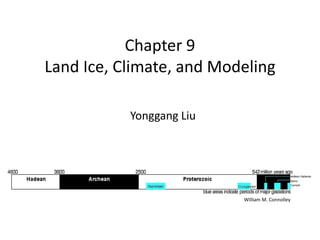
William M. Connolley
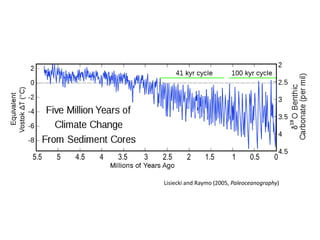
Lisiecki and Raymo (2005, Paleoceanography)
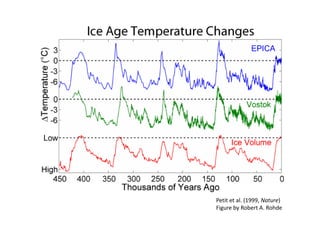
Petit et al. (1999, Nature)
Figure by Robert A. Rohde
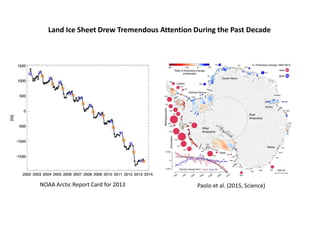
Land Ice Sheet Drew Tremendous Attention During the Past Decade
Paolo et al. (2015, Science)NOAA Arctic Report Card for 2013
How Does Ice Sheet Affect the Climate?
Answer: mainly through albedo feedback
But sea level rise has a substantial impact on the human society
What Property of the Ice Sheet Do We Care
About the Most?
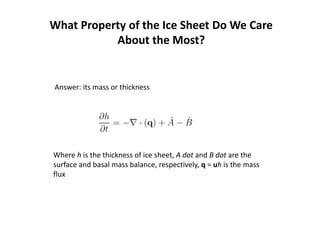
Answer: its mass or thickness
Where h is the thickness of ice sheet, A dot and B dot are the
surface and basal mass balance, respectively, q = uh is the mass
flux
Surface and Basal Mass Balance
Winkelmann et al. (2012, Nature)
Dynamics (to get mass flux q)
Deviatoric stress
Strain rate
Pressure
Constitutional relationship
where
Stokes’ Equations
What’s the difference from the
momentum equation for the
atmosphere and ocean
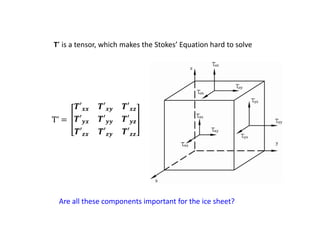
T’ is a tensor, which makes the Stokes’ Equation hard to solve
Are all these components important for the ice sheet?
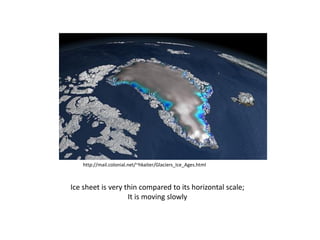
http://mail.colonial.net/~hkaiter/Glaciers_Ice_Ages.html
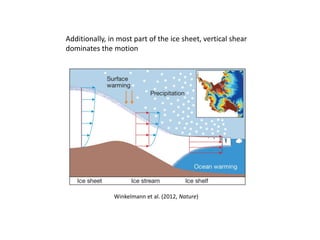
Ice sheet is very thin compared to its horizontal scale;
It is moving slowly
Winkelmann et al. (2012, Nature)
Additionally, in most part of the ice sheet, vertical shear
dominates the motion
Shallow-Ice Approximation
Where s and b are surface and bottom elevation, respectively. C(T) is the basal
sliding constant and B dot is the basal melting rate.
Then we get decoupled equations of u, v and w (Greve, 1995)
, andAssume
Note the temperature dependence
Alpine Glacier
(http://mail.colonial.net/~hkaiter/Glaciers_Ice_Age
s.html)
Lateral friction is large, obviously cannot ignored
Other examples: fast flowing ice streams
Full Stokes’ Equation needs to be solved!
Shallow-Shelf Approximation
Assume vertical shear is 0
Winkelmann et al. (2012, Nature)
The following equations result
Thermal dynamics
What assumption has been made?
Boundary conditions
T = Ta
Q = Qb At the bottom
At the surface
The viscosity of ice is dependent on temperature, and frictional heating and
geothermal heating at the bottom of the ice sheet may cause melting there.
These require that the temperature evolution of the ice sheet need to be
solved.
Where
is the frictional heating
MacAyeal (1997)
Summary

[CM2015] Chapter 9 - Land Ice Modeling

  • 1.
    Chapter 9 Land Ice,Climate, and Modeling Yonggang Liu William M. Connolley
  • 2.
    Lisiecki and Raymo(2005, Paleoceanography)
  • 3.
    Petit et al.(1999, Nature) Figure by Robert A. Rohde
  • 5.
    Land Ice SheetDrew Tremendous Attention During the Past Decade Paolo et al. (2015, Science)NOAA Arctic Report Card for 2013
  • 6.
    How Does IceSheet Affect the Climate? Answer: mainly through albedo feedback But sea level rise has a substantial impact on the human society
  • 7.
    What Property ofthe Ice Sheet Do We Care About the Most? Answer: its mass or thickness Where h is the thickness of ice sheet, A dot and B dot are the surface and basal mass balance, respectively, q = uh is the mass flux
  • 8.
    Surface and BasalMass Balance Winkelmann et al. (2012, Nature)
  • 9.
    Dynamics (to getmass flux q) Deviatoric stress Strain rate Pressure Constitutional relationship where Stokes’ Equations What’s the difference from the momentum equation for the atmosphere and ocean
  • 10.
    T’ is atensor, which makes the Stokes’ Equation hard to solve Are all these components important for the ice sheet?
  • 11.
    http://mail.colonial.net/~hkaiter/Glaciers_Ice_Ages.html Ice sheet isvery thin compared to its horizontal scale; It is moving slowly
  • 12.
    Winkelmann et al.(2012, Nature) Additionally, in most part of the ice sheet, vertical shear dominates the motion
  • 13.
    Shallow-Ice Approximation Where sand b are surface and bottom elevation, respectively. C(T) is the basal sliding constant and B dot is the basal melting rate. Then we get decoupled equations of u, v and w (Greve, 1995) , andAssume Note the temperature dependence
  • 14.
    Alpine Glacier (http://mail.colonial.net/~hkaiter/Glaciers_Ice_Age s.html) Lateral frictionis large, obviously cannot ignored Other examples: fast flowing ice streams Full Stokes’ Equation needs to be solved!
  • 15.
    Shallow-Shelf Approximation Assume verticalshear is 0 Winkelmann et al. (2012, Nature) The following equations result
  • 16.
    Thermal dynamics What assumptionhas been made? Boundary conditions T = Ta Q = Qb At the bottom At the surface The viscosity of ice is dependent on temperature, and frictional heating and geothermal heating at the bottom of the ice sheet may cause melting there. These require that the temperature evolution of the ice sheet need to be solved. Where is the frictional heating
  • 17.
  • 18.