Drinking Water Treatment
Environmental Engineering
Introduction
• It is the process of improving the quality of water to make
it appropriate for use.
• The water after treatment can be used for for drinking ,
industrial water supply, river flow maintenance, etc.
• Water treatment removes the contaminant and undesired
component or reducing the concentration so that the
water becomes fit to use.
Process:
• Chemical
• Physical
• Physio-chemical
• Bio-chemical
Chemical
• Pre-chlorination for algae control
• Aeration along with pre-
chlorination for removal of
dissolved iron when present with
small amounts relatively of
manganese.
• Disinfection for killing pathogens,
using chlorine, ozone and ultra-
violet light.
• Sedminantaion process
• Filtration process
• Dissolve air flotation
• Coagulation for
flocculation.
• Coagulant aids to improve
coagulation and for more
robust floc formation.
Physio-chemicalPhysical
Biological
• Slow sand filtration using a
biofilm to metabolize
organic matter.
Water treatment
Chemical Addition
• chemical /coagulant are used inorder to make the
suspended particle that are floating in the water clump
together to form a heavier and larger gelantinous particle
• In this process, a chemical is added that reacts with the
natural alkalinity in solution to form an insoluble
precipitate.
• some of the chemical used are: aluminum sulfate, ferrous
sulfate, ferric chloride, sodium aluminate, activated silica
STEP/METHOD USED
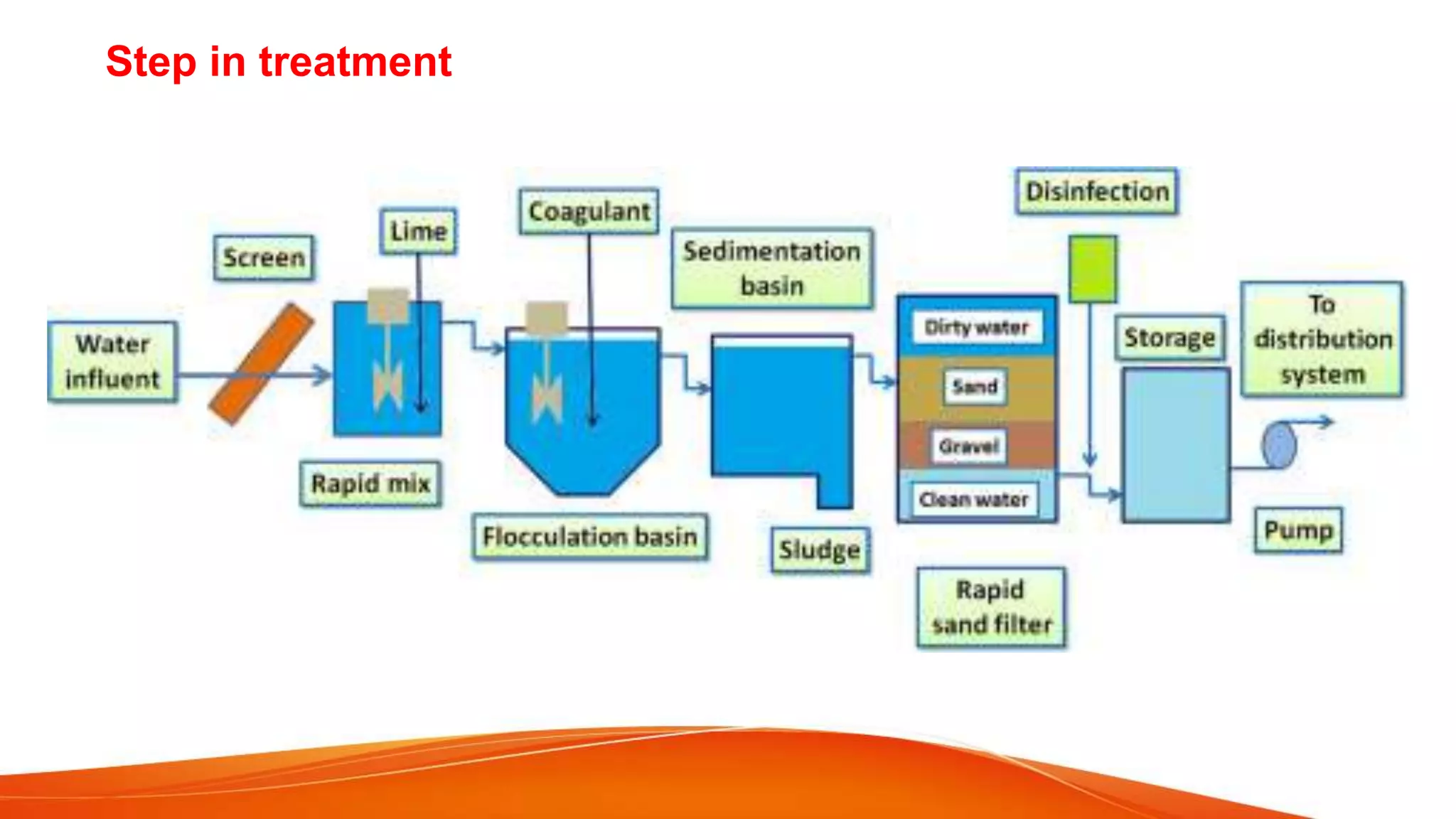
Step in treatment
Screening
• first unit operation carried out
inorder to retain solid found in
water mostly by using the large
metal screen or bar screen
which is place in intake.
• Large items are trapped on the
screen as the
• water passes through it. These
screens must routinely be raked
or cleaned off.
Coagulation and Flocculation
• Coagulation and flocculation are
used to separate the suspended
solids portion from the water.
• Suspended particles vary in source,
charge, particle size, shape, and
density.
• The process of adding a chemical to
cause the suspended material to
“clump” into larger particles is called
flocculation or coagulation.
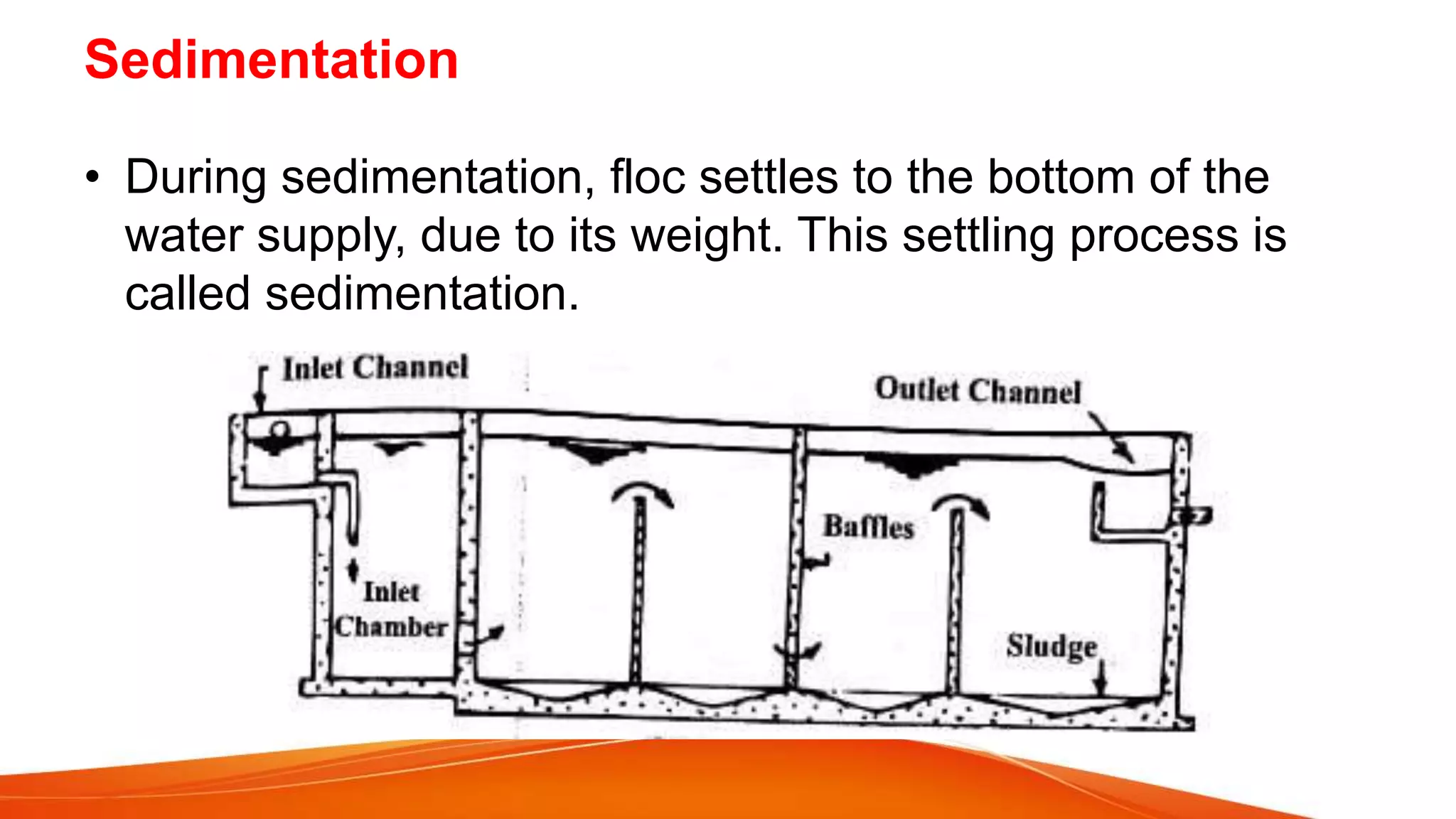
• During sedimentation, floc settles to the bottom of the
water supply, due to its weight. This settling process is
called sedimentation.
Sedimentation
Filtration
• After floc settlement on bottom
of W/s, clear water on top pass
through filters of varying
compositions (sand, gravel,
and charcoal) and pore sizes,
inorder to remove dissolved
particles such as dust,
parasites, bacteria, viruses &
chemicals.
Type of filter
• Slow sand filter
 1 to 2 metres deep
loading rate of 200 to 400
litres per hour per square
metre
Slow sand filters use
biological processes to
clean the water, and are
non-pressurized systems
• Rapid sand filter
 multi-stage treatment
systems
 complex and expensive to
operate and maintain
use of flocculation
chemicals—typically alum
rate of filtration 80 to 120
Lpm/ m2 of filter bed area or
4.8 to 7.2 m/ h.
• Pressure Filtration
It consists of a round container
with filter materials.
 On top there is a cover with hose
connections and the operation.
 Water is pressed through the
filters under pressure of the pond
pump.
With the help of bacteria the filter
removes the dirt particles from the
water.
Disinfection
• it involves the addition of
chemicals in order to kill or
reduce the number of
pathogenic organisms
 Drinking Water treatment

Drinking Water treatment

  • 1.
  • 2.
    Introduction • It isthe process of improving the quality of water to make it appropriate for use. • The water after treatment can be used for for drinking , industrial water supply, river flow maintenance, etc. • Water treatment removes the contaminant and undesired component or reducing the concentration so that the water becomes fit to use.
  • 3.
    Process: • Chemical • Physical •Physio-chemical • Bio-chemical
  • 4.
    Chemical • Pre-chlorination foralgae control • Aeration along with pre- chlorination for removal of dissolved iron when present with small amounts relatively of manganese. • Disinfection for killing pathogens, using chlorine, ozone and ultra- violet light.
  • 5.
    • Sedminantaion process •Filtration process • Dissolve air flotation • Coagulation for flocculation. • Coagulant aids to improve coagulation and for more robust floc formation. Physio-chemicalPhysical
  • 6.
    Biological • Slow sandfiltration using a biofilm to metabolize organic matter. Water treatment
  • 7.
    Chemical Addition • chemical/coagulant are used inorder to make the suspended particle that are floating in the water clump together to form a heavier and larger gelantinous particle • In this process, a chemical is added that reacts with the natural alkalinity in solution to form an insoluble precipitate. • some of the chemical used are: aluminum sulfate, ferrous sulfate, ferric chloride, sodium aluminate, activated silica
  • 8.
  • 9.
  • 10.
    Screening • first unitoperation carried out inorder to retain solid found in water mostly by using the large metal screen or bar screen which is place in intake. • Large items are trapped on the screen as the • water passes through it. These screens must routinely be raked or cleaned off.
  • 11.
    Coagulation and Flocculation •Coagulation and flocculation are used to separate the suspended solids portion from the water. • Suspended particles vary in source, charge, particle size, shape, and density. • The process of adding a chemical to cause the suspended material to “clump” into larger particles is called flocculation or coagulation.
  • 13.
    • During sedimentation,floc settles to the bottom of the water supply, due to its weight. This settling process is called sedimentation. Sedimentation
  • 14.
    Filtration • After flocsettlement on bottom of W/s, clear water on top pass through filters of varying compositions (sand, gravel, and charcoal) and pore sizes, inorder to remove dissolved particles such as dust, parasites, bacteria, viruses & chemicals.
  • 15.
    Type of filter •Slow sand filter  1 to 2 metres deep loading rate of 200 to 400 litres per hour per square metre Slow sand filters use biological processes to clean the water, and are non-pressurized systems
  • 16.
    • Rapid sandfilter  multi-stage treatment systems  complex and expensive to operate and maintain use of flocculation chemicals—typically alum rate of filtration 80 to 120 Lpm/ m2 of filter bed area or 4.8 to 7.2 m/ h.
  • 17.
    • Pressure Filtration Itconsists of a round container with filter materials.  On top there is a cover with hose connections and the operation.  Water is pressed through the filters under pressure of the pond pump. With the help of bacteria the filter removes the dirt particles from the water.
  • 18.
    Disinfection • it involvesthe addition of chemicals in order to kill or reduce the number of pathogenic organisms