DR B.R. AMBEDKAR
CONTENTS
INTRODUCTION
EARLY LIFE
POLITICAL CAREER
PROTESTS
OPPOSITION TO UNTOUCHABILITY
EDUCATION
SECOND MARRIAGE
DRAFTING
CONVERSION TO BUDHISM
DEATH
MESSAGE
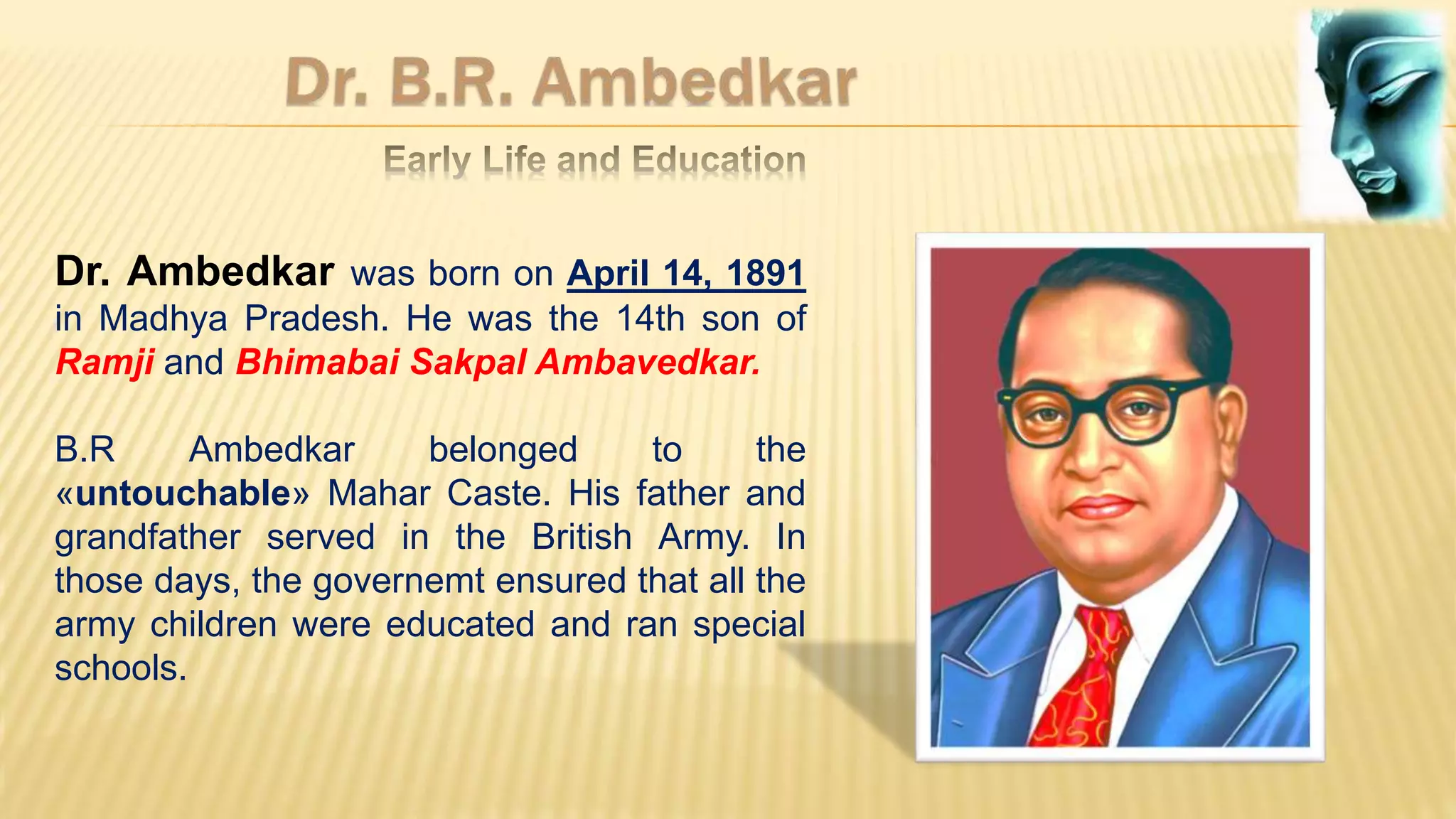
Dr. Ambedkar was born on April 14, 1891
in Madhya Pradesh. He was the 14th son of
Ramji and Bhimabai Sakpal Ambavedkar.
B.R Ambedkar belonged to the
«untouchable» Mahar Caste. His father and
grandfather served in the British Army. In
those days, the governemt ensured that all the
army children were educated and ran special
schools.
Ambedkar was a brilliant child. His teacher at school, was
impressed and added a surname to him. It is also said
that his earlier name was Bhimrao Ambedkar and it was
his teacher who made it Ambedkar
and gave him full name as Bhimrao Ramji Ambedkar.
Ambedkar and other untouchable children were
segregated and given little attention or assistance by the
teachers. They were not allowed to sit inside the
class.In1894,ambedkar’s mother died.
In 1897, Ambedkar became the only untouchable enrolled
at Elphinstone High School. In 1906, his marrige was
arranged to a 9 year old girl, Ramabai.
In 1912, Dr Ambedkar obtained degree in economics and
political science from Bombay University.
In 1913, he moved to United States. Where he had been
awarded a Baroda State Scholarship 11.50 $ per month
for three years.
Dr Ambedkar recieved the oppourtuniry for postgraduate
education at Columbia University in New York City.
In 1915, Dr Ambedkar passed M.A. exam « Majoring in
Economics » with
Sociology, History, Philosophy and Anthropology.
 First thesis – (Ancient Indian Commerce).
 In 1916 - Second thesis – (National Dividend of India).
 Finally received PhD in Economics in 1917 for his third
thesis. Dr Ambedkar as a student
Dr Ambedkar was obliged to go back to India as
the term of his scholarship from Baroda ended.
Ambedkar came back to London at the first
opportunity and completed his studies.
In 1921, he took Master’s degree and in 1923, he
took his D.Sc in Economics (Doctor of Science)
In 1952, completed his third PhD in Law Ll.D and
fourth in 1952 in Columbia.
Dr Ambedkar worked as a private tutor, as an accountant,
but it failed when his clients learned that he was an
untouchable.
In 1918, Baba Saheb became Professor of Political
Economy in the Sydenham College of Commerce and
Economics in Mumbai.
He was successful with the students, however other
profeesors objected to his sharing the same drinking-water
jug that they all used.
Ambedkar as a barrister
in 1922
Dr Ambedkar while practicing law in Bombay
High Court, he tried to uplift the untouchbles in
order to educate them.
He first organized attempt to promote
education and socio-economic imporvement
and Dalit rights.
By 1927 Ambedkar decided to launch active
movements against untouchability.
In 1927, public movements to open up and share
public drinking water resources.
He also struggle for the right to enter Hindu
temples.
Ambedkar condemned the classic Hindu Text
(Laws of Manu). Burned copies of the ancient text.
After that, thousands of people burnt copies of
Manusmriti under leadership of Ambedkar.
Dr. B.R. Ambedkar
In 1935, Ambedkar became the principal
of the
Government Law College, Mumbai.
Ambedkar in Mumbai, constructed a
house, and stocked his personal library
with more than 50.000 books.
His wife Ramabai died, after a long
illness in the same year.
Dr. B.R. Ambedkar
In 1952, Baba Saheb contested in the Indian
General Election but lost to the Congress
candidates.
Ambedkar became the member of Rajya
Sabha, an appointed member. He tried to enter
Lok sabha again in 1954, but was placed third
by Congress.
By the time the second general election was
held in 1957, Ambedkar had already passed
away.
Dr. B.R. Ambedkar
After 15 August 1947, invited by the Congress
government to serv as the first Law Minister.
On 29 August, he was appointed Chairman of
the Constitution Drafting Committee, charged
to write India’s new Constitution.
The new Consitution drafted by Ambedkar was
described as «first and foremost document».
Dr. B.R. Ambedkar
The text prepared guaranteed protections for a wide
range of civil liberties, including:
 Freedom of religion, the abolition of untouchability
and outlawing of all forms of discrimination.
 Economic and Social rights for women.
 Jobs for members of scheduled castes and other
backward class.
The constituion was adopted on 26 November 1949 by
the Contituent Assembly.
Dr. B.R. Ambedkar
Ambedkar’s first wife Ramabai died in 1935
following long illness.
After drafting India’s Constituion in late 1940’s
Ambedkar went to Bombay for treatment. He
was suffering from lack of sleep and
diabetes.
There he met Dr. Sharada Kabir, whom he
married on 15 April 1948 and she too care of
him for the rest of his life.
Dr. B.R. Ambedkar
Dr Ambedkar had considered converting to
Sikhism. He rejected the idea after meeting
with leaders of the Sikh community and
concluding that his conversion might result in
him having as a «second rate-status» among
Sikhs.
Dr Ambedkar studied Buddhism all his life,
and around 1950, he turned his attention
fully to Buddhism and travelled to Sri Lanka
to attend meeting of the World Fellowship of
Buddhists.
Dr. B.R. Ambedkar
Ambedkar announced that he was writing a
Book on Buddhism, and as soon as it was finished,
he planned to make a formal conversion o
Buddhism.
In 1955, he founded the Buddhist Society of India.
He completed his final work, «The Buddha and His
Dhamma»,
in 1956 it was published.
Dr. B.R. Ambedkar
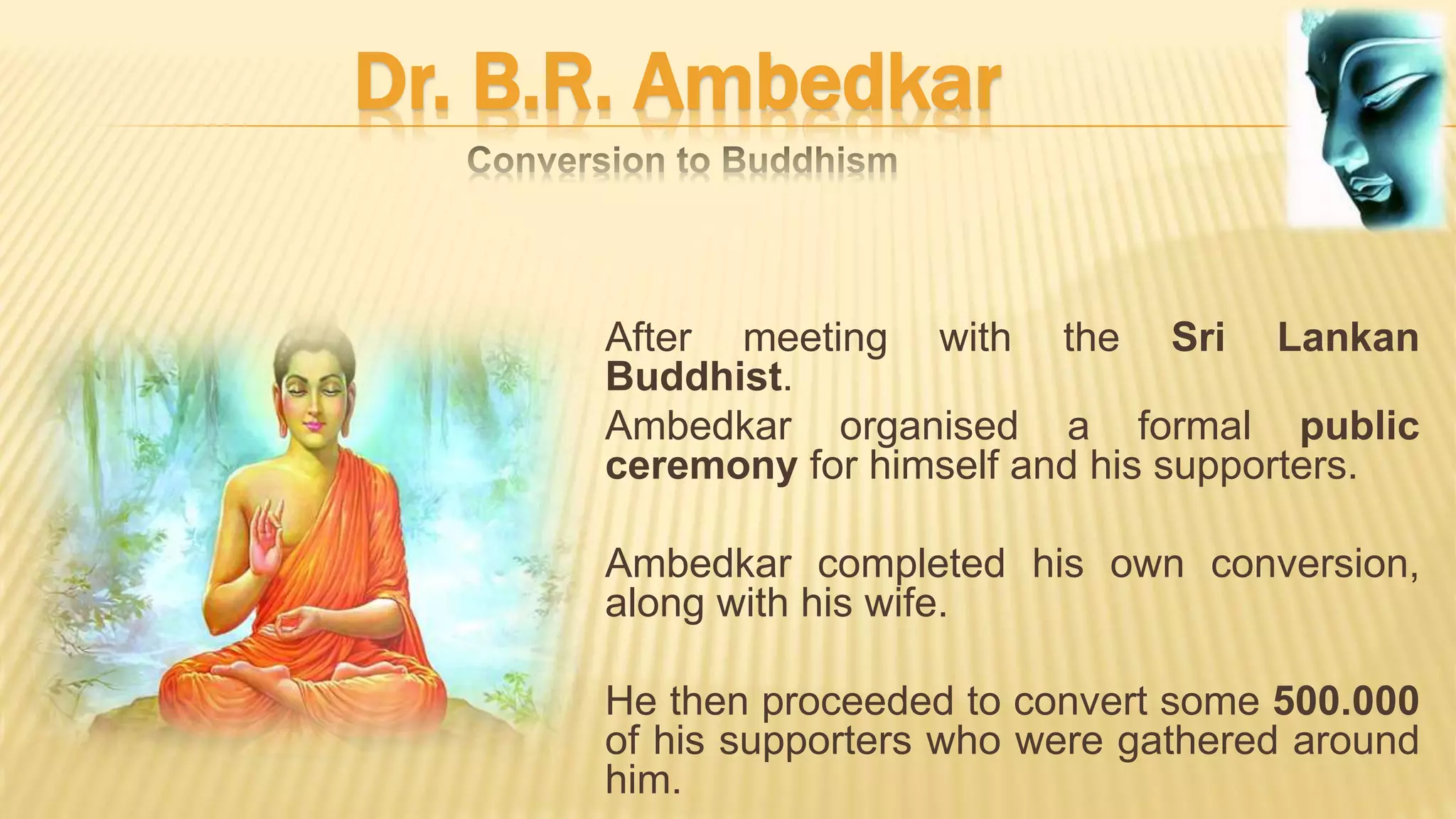
After meeting with the Sri Lankan
Buddhist.
Ambedkar organised a formal public
ceremony for himself and his supporters.
Ambedkar completed his own conversion,
along with his wife.
He then proceeded to convert some 500.000
of his supporters who were gathered around
him.
Dr. B.R. Ambedkar
Since 1948, Ambedkar had been suffering
from diabetes.
Three days after completing his final
manuscript The Buddha and his Dhamma,
Ambedkar passed away in his sleep on 6
December 1956 at his home in delhi.
A Buddhist cremation was organised for him
on 7 December, attended by half a million
sorrowing people.
Dr. B.R. Ambedkar
 “ My Final Words of Advice To You Are
Educate, Agitate And Organize.
Have Faith In Yourself And Learn To Live In
This
World With Self Respect.”
 “ I Like The Religion That Teaches:
LIBERTY, EQUALITY & FRATERNITY.”
 “ It is The Education Which Is The Right Weapon
To Cut Slavery.”
• “I measure the progress of a
community by the degree of
progress which women have
achieved.”
• Men are mortal. So are ideas. An
idea needs propagation as much
as a plant needs watering.
Otherwise both will wither and die.
Dr. B.R Ambedkar
Dr.br ambedker

Dr.br ambedker

  • 1.
  • 2.
    CONTENTS INTRODUCTION EARLY LIFE POLITICAL CAREER PROTESTS OPPOSITIONTO UNTOUCHABILITY EDUCATION SECOND MARRIAGE DRAFTING CONVERSION TO BUDHISM DEATH MESSAGE
  • 3.
    Dr. Ambedkar wasborn on April 14, 1891 in Madhya Pradesh. He was the 14th son of Ramji and Bhimabai Sakpal Ambavedkar. B.R Ambedkar belonged to the «untouchable» Mahar Caste. His father and grandfather served in the British Army. In those days, the governemt ensured that all the army children were educated and ran special schools.
  • 4.
    Ambedkar was abrilliant child. His teacher at school, was impressed and added a surname to him. It is also said that his earlier name was Bhimrao Ambedkar and it was his teacher who made it Ambedkar and gave him full name as Bhimrao Ramji Ambedkar. Ambedkar and other untouchable children were segregated and given little attention or assistance by the teachers. They were not allowed to sit inside the class.In1894,ambedkar’s mother died.
  • 5.
    In 1897, Ambedkarbecame the only untouchable enrolled at Elphinstone High School. In 1906, his marrige was arranged to a 9 year old girl, Ramabai. In 1912, Dr Ambedkar obtained degree in economics and political science from Bombay University. In 1913, he moved to United States. Where he had been awarded a Baroda State Scholarship 11.50 $ per month for three years. Dr Ambedkar recieved the oppourtuniry for postgraduate education at Columbia University in New York City.
  • 6.
    In 1915, DrAmbedkar passed M.A. exam « Majoring in Economics » with Sociology, History, Philosophy and Anthropology.  First thesis – (Ancient Indian Commerce).  In 1916 - Second thesis – (National Dividend of India).  Finally received PhD in Economics in 1917 for his third thesis. Dr Ambedkar as a student
  • 7.
    Dr Ambedkar wasobliged to go back to India as the term of his scholarship from Baroda ended. Ambedkar came back to London at the first opportunity and completed his studies. In 1921, he took Master’s degree and in 1923, he took his D.Sc in Economics (Doctor of Science) In 1952, completed his third PhD in Law Ll.D and fourth in 1952 in Columbia.
  • 8.
    Dr Ambedkar workedas a private tutor, as an accountant, but it failed when his clients learned that he was an untouchable. In 1918, Baba Saheb became Professor of Political Economy in the Sydenham College of Commerce and Economics in Mumbai. He was successful with the students, however other profeesors objected to his sharing the same drinking-water jug that they all used. Ambedkar as a barrister in 1922
  • 9.
    Dr Ambedkar whilepracticing law in Bombay High Court, he tried to uplift the untouchbles in order to educate them. He first organized attempt to promote education and socio-economic imporvement and Dalit rights. By 1927 Ambedkar decided to launch active movements against untouchability.
  • 10.
    In 1927, publicmovements to open up and share public drinking water resources. He also struggle for the right to enter Hindu temples. Ambedkar condemned the classic Hindu Text (Laws of Manu). Burned copies of the ancient text. After that, thousands of people burnt copies of Manusmriti under leadership of Ambedkar.
  • 11.
    Dr. B.R. Ambedkar In1935, Ambedkar became the principal of the Government Law College, Mumbai. Ambedkar in Mumbai, constructed a house, and stocked his personal library with more than 50.000 books. His wife Ramabai died, after a long illness in the same year.
  • 12.
    Dr. B.R. Ambedkar In1952, Baba Saheb contested in the Indian General Election but lost to the Congress candidates. Ambedkar became the member of Rajya Sabha, an appointed member. He tried to enter Lok sabha again in 1954, but was placed third by Congress. By the time the second general election was held in 1957, Ambedkar had already passed away.
  • 13.
    Dr. B.R. Ambedkar After15 August 1947, invited by the Congress government to serv as the first Law Minister. On 29 August, he was appointed Chairman of the Constitution Drafting Committee, charged to write India’s new Constitution. The new Consitution drafted by Ambedkar was described as «first and foremost document».
  • 14.
    Dr. B.R. Ambedkar Thetext prepared guaranteed protections for a wide range of civil liberties, including:  Freedom of religion, the abolition of untouchability and outlawing of all forms of discrimination.  Economic and Social rights for women.  Jobs for members of scheduled castes and other backward class. The constituion was adopted on 26 November 1949 by the Contituent Assembly.
  • 15.
    Dr. B.R. Ambedkar Ambedkar’sfirst wife Ramabai died in 1935 following long illness. After drafting India’s Constituion in late 1940’s Ambedkar went to Bombay for treatment. He was suffering from lack of sleep and diabetes. There he met Dr. Sharada Kabir, whom he married on 15 April 1948 and she too care of him for the rest of his life.
  • 16.
    Dr. B.R. Ambedkar DrAmbedkar had considered converting to Sikhism. He rejected the idea after meeting with leaders of the Sikh community and concluding that his conversion might result in him having as a «second rate-status» among Sikhs. Dr Ambedkar studied Buddhism all his life, and around 1950, he turned his attention fully to Buddhism and travelled to Sri Lanka to attend meeting of the World Fellowship of Buddhists.
  • 17.
    Dr. B.R. Ambedkar Ambedkarannounced that he was writing a Book on Buddhism, and as soon as it was finished, he planned to make a formal conversion o Buddhism. In 1955, he founded the Buddhist Society of India. He completed his final work, «The Buddha and His Dhamma», in 1956 it was published.
  • 18.
    Dr. B.R. Ambedkar Aftermeeting with the Sri Lankan Buddhist. Ambedkar organised a formal public ceremony for himself and his supporters. Ambedkar completed his own conversion, along with his wife. He then proceeded to convert some 500.000 of his supporters who were gathered around him.
  • 19.
    Dr. B.R. Ambedkar Since1948, Ambedkar had been suffering from diabetes. Three days after completing his final manuscript The Buddha and his Dhamma, Ambedkar passed away in his sleep on 6 December 1956 at his home in delhi. A Buddhist cremation was organised for him on 7 December, attended by half a million sorrowing people.
  • 20.
    Dr. B.R. Ambedkar “ My Final Words of Advice To You Are Educate, Agitate And Organize. Have Faith In Yourself And Learn To Live In This World With Self Respect.”  “ I Like The Religion That Teaches: LIBERTY, EQUALITY & FRATERNITY.”  “ It is The Education Which Is The Right Weapon To Cut Slavery.” • “I measure the progress of a community by the degree of progress which women have achieved.” • Men are mortal. So are ideas. An idea needs propagation as much as a plant needs watering. Otherwise both will wither and die. Dr. B.R Ambedkar